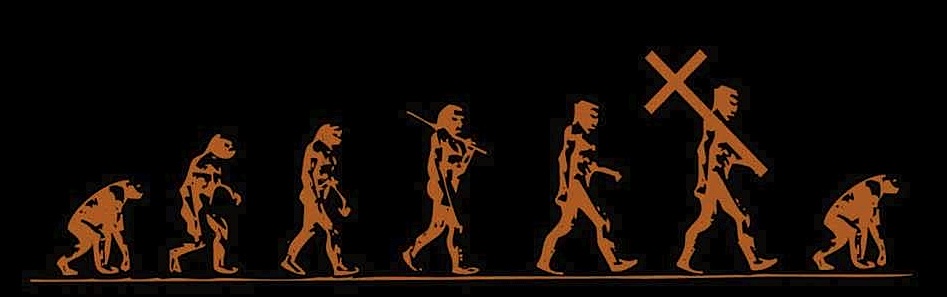
Advent, Evolution, & Absolution [RE-POST]


Today, I’m re-posting a piece I wrote exactly a year ago for last year‘s Advent series. During this year‘s, we’re seeing how the Advent event affects parts of our lives that we usually don’t associate with it. Today, it’s Advent and Evolution. You can follow the series here.

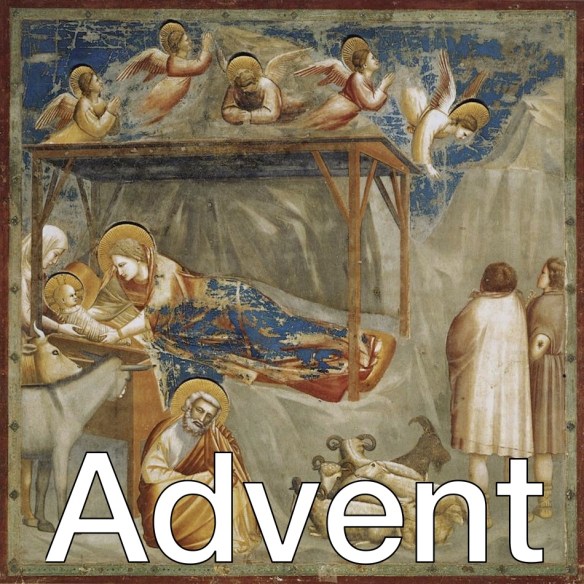
It’s Advent. A time where we especially orient ourselves towards rejoicing and celebrating the fact that God did not remain far off and merely create a “legal” or “dogmatic” satisfaction for the plight of his creation and creatures. Rather, he broke into it and came into his creation and among his creatures. In this year’s Advent series, we’re exploring how, in this Coming, Jesus took on our creaturely formcare-taking functioncomprehensive fallenness, and communal formation.

First, God took physical, human, creaturely form. In the study I did–and subsequent lecture I gave–on Beauty a couple of years ago, I defined “Beauty” as the attribute of something that expressed complexity simply. Is not this God-in-human-flesh (theologically referred to as the Incarnation) the most beautiful of all miracles to take place? The Infinitely Complex God inhabits the simplest of human forms: a child.

Continue Reading –>

Advent & Mary: Ordained as Prophetess, Priestess, & Queen


Tanner-the-anunciation-mary

This Advent, we’re seeing how this season affects parts of our lives we usually don’t associate with it. Follow the series here. This post is also filed in the series “Catholics Aren’t Crazy” and “Women Leading Stuff in Churches“.

If a woman is revered by the church for giving the faithful their savior, then surely women are good enough for leadership roles in the church to save it. –Vishwanath Ayengar

I ran across that quote in some letters to the editor of Newsweek a couple of years back in response to a cover story arguing that if women were ordained as priests in the Catholic Church, there wouldn’t have been any sex abuse scandal. I don’t know if that’s true, but the quote is insightful and (hopefully) thought-provoking.

I can hear conservatives now: Well, God used a donkey to speak! He used Caiaphas the high priest to unknowingly prophesy about Jesus before sentencing him to death! He used Judas to bring about Christ’s crucifixion and therefore our salvation! It doesn’t mean that they were fit to be ordained pastors!

Yeah, yeah, I get it. This post isn’t necessarily meant as a “proof” or “defense” of women’s place in ministry (though it’s a part of my on-going series on the topic). I just want to revel a bit in some divine mystery. Can we all just put our swords down and marvel?
Continue reading

Advent & Politics: The Government is on His Shoulders


laureti-triumph-christianity-pagan-statue

This Advent season, we’re seeing how the Advent event affects parts of our lives that we usually don’t associate with this time. You can follow the series here.

The book of Isaiah is a minefield for biblical studies, mainly because of the development it seems its contents went through to get to its final form. It appears to be a strange stitching together of many writings, perhaps by many people, for several different purposes. But in all of its complexity and mystery, there is one theme that it consistently holds throughout its contents: politics. The political movements of the nation of Israel and the nations around it–and God’s movement in and through all of it–occupy most every chapter of the book.

Interestingly, this is also where many of the most dramatic and explicit messianic prophecies are found–specifically Advent prophecies. When telling the Christmas story, the gospels quote Isaiah (I believe) more than any other Old Testament book. Images of virgins, Emmanuel, Davidic lineage, “roots of Jesse”, and John’s “voice crying in the wilderness” all find their source here.

There seems to be an intimate connection between politics and Advent.
Continue reading

I’m going on a Bloggers Trip to Guatemala with Lemonade Int’l. (happy 8th blog-versary)


lemonade-guatemala-1 BloggersDate

Eight years ago, today, I began this blog as a cathartic response to my frustration at a girl in my dorm. It was a very strange post full of rambling, weird logic, bad grammar, and typos. Not much has changed since then in those respects, but I do want to let you all know about an amazing opportunity that this 8-year endeavor has offered me.

Recently, some old friends of mine (that I happen to have hooked up) got me connected to this amazing non-profit, Lemonade International. LI does great development work in the La Limonada neighborhood of Guatemala, the largest urban slum community in Central America.

LI shares my own convictions that international development work should utilize local resources (instead of bringing in outside talent for everything), empower communities (instead of simply giving them aid), and build long-term relationships (instead of “short-term” “missions” programs) in order to reverse injustice. Here’s a trailer for a documentary about their community and their work:
Continue reading

Herman Bavinck on the Advent Incarnation


The doctrine of Christ is not the starting point, but it certainly is the central point of the whole system of dogmatics. All other dogmas either prepare for it or are inferred from it. In it, as the heart of dogmatics, pulses the whole of the religious-ethical life of Christianity. It is ‘the mystery of godliness’ (1 Tim. 3:16). From this mystery all Christology has to proceed. If, however, Christ is the incarnate Word, then the incarnation is the central fact of the entire history of the world; then, too, it must have been prepared from before the ages and have its effects throughout eternity…the incarnation is not an incidental decree that emerged later: it was decided and determined from eternity. There was not time when the Son did not exist; there was also no time when the Son did not know he would assume and when he was not prepared to assume the human nature from the fallen race of Adam. The incarnation was prepared from eternity; it does not rest in the essence of God but in the person. It is not a necessity as in pantheism, but neither is it arbitrary or accidental as in Pelagianism.

Reformed Dogmatics, Vol. 3, pp. 274; 276-277 (found this by way of friend-of-the-blog Austin Ricketts)

Free Advent Mixtape Available Now!


Advent-Mixtape-Cover

Update: I got some inspiration and updated the Mixtape, changing the song selection/order a little bit from when this was originally posted. Sorry for the inconvenience.

A new church season, a new mixtape. You can find this year’s Advent Mixtape above, in the appropriately-named tab, or just click here. It’s free, and you can stream, download, or share it.

It’s very similar to last year’s except with some songs removed, added, and re-ordered. I definitely think this one is better. (Let me know what you think!) Be sure to read my post introducing Advent this year, including ways than you can more intentionally participate in this season. I hope this Mixtape can play some role in your time as well.

Here’s some more info, from the “Advent Mixtape” page:
Continue reading