What the Supreme Court on Gay Marriage can tell us about ISIS


isis-flag-iraq

U.S. foreign policy as it pertains to ISIS should reflect the reality of what ISIS is: a social movement for which the best course for absolute defeat is a “bottom-up” approach, rather than just “top-down”.

On Monday, the Supreme Court gave a shocking decision to not rule on gay marriage decisions in five states. Some could see this as a defeat for gay marriage, prolonging the costs and time it takes to move the process forward state-by-state.

On the other hand, though, most commentators and gay marriage proponents saw this as giving tacit approval to gay marriage by the Court. And in fact, this does seem to be the case. Unlike most other Supreme Court decisions, it doesn’t take a majority for the Court to agree to hear a case–it only takes four votes. This means that at least a super-majority of the justices did not feel the need to provide oversight to the decisions.

And this is important to remember. The Supreme Court is not intended to be a court in the usual sense. It is an appeals court. It oversees the federal appeals courts’ decisions and only acts when they think the appeals courts are either contradicting one another or are going in an extremely wrong direction. In other words, they are there to clarify when there’s ambiguity, not create out of thin air.
Continue reading

On #Ferguson: Why Police & Military Should Be Different [QUOTE]


ferguson-military-policeEver since the police in Ferguson, Missouri brought out their military gear in response to peaceful protests after the fatal shooting of an unarmed black teenager, there has been a new conversation about the increasingly blurred lines between the police and the military. I have very good friends that cannot seem to understand why there needs to be any distinction. Force is force, right? Well, in my reading recently, I came across this relevant quote I thought I’d share:

The distinction made here between police and war is not simply a matter of the degree to which the appeal to force, goes, the number of persons killed or killing. It is a structural and profound difference in the sociological meaning of the appeal to force.
In the police function, the violence or threat thereof is applied only to the offending party. The use of violence by the agent of the police is subject to review by higher authorities. The police officer applies power within the limits of a state whose legislation even the criminal knows to be applicable to him. In any orderly police system there are serious safeguards to keep the violence of the police from being applied in a wholesale way against the innocent. The police power generally is great enough to overwhelm that of the individual offender so that any resistance on the offender’s part is pointless.

In all of these respects, war is structurally different. The doctrine of the “just war” is an effort to extend into the realm of war the logic of the limited violence of police authority–but not a very successful one. There is some logic to the “just war” pattern of thought but very little realism.

–John Howard Yoder, The Politics of Jesus

In short, you shouldn’t appeal to policing tactics to justify military force, and you shouldn’t use military tactics in policing.

[photo credit: Whitney Curtis for the New York Times]

The Refuge of the Embattled Soul


paul-dano-12-03
I’m currently reading through Ruth Haley Barton’s Strengthening the Soul of Your Leadership. Occasionally, I’ll post reflections on my reading.

“Reach the campus, reach the world.”

That’s how they got me. With those words, I began an amazing three years in the campus ministry I was a part of throughout college. I was coming out of a fundamentalist evangelical fog, and was desperate for deep, impactful community. I found it in those incredible people.

They had pointed out that our college had students from almost every “closed nation” in the world (countries where missionaries aren’t allowed to go). The campus was a place of such diversity and nationalities; the thought was that this was the most strategic place to have the most global Christian impact. Playing a part in this excited me and stirred me to serve in this mission.

Compared to the few-hundred strong InterVarsity, our little band of 12 or so students were the definite underdogs of campus ministry. We were just starting out and decided to go legitimate and become an official student organization. This would give us access to room and equipment rentals, money, and advertising resources. But we needed “officers” and a board of leaders to do this.

I thus became the President of our campus ministry.
Continue reading

Cultivating Your Soul to Lead


paul-art-wingI’m currently reading through Ruth Haley Barton’s Strengthening the Soul of Your Leadership. Occasionally, I’ll post reflections on my reading.

In my seminary program, there’s a lot of talk about one’s “True Self”. We live so much of our existence living from the place of masks, coping mechanisms, fears, anxieties, etc.–our “False Selves”. Articulating it like this is so helpful in some ways, but in others can be frustrating.

At least for me, this “True Self” seems so deeply inside of me, so elusive, that I’ve very much resigned myself to never actually knowing this self. Like a celebrity or historical figure, I’ve had to learn to live with the reality that I’ll never actually meet this person, no matter how much I may want to. I’ve come to terms with a reality in which I just need to be gracious with myself (just as God is) that most all of my life and existence will be more “False” than “True”, and I just need to make the best out of that.
Continue reading

My first Sunday Morning Sermon. I’d like to share it with you.


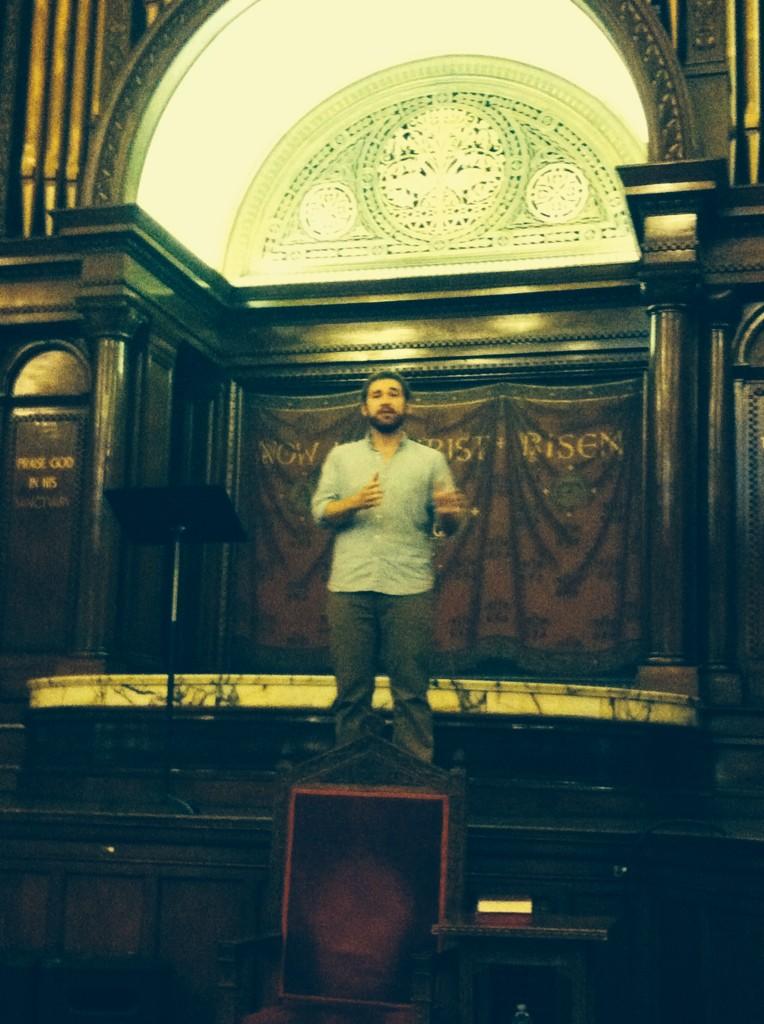
paul-liberti-sermon-preachingSure, I’ve done some lectures, taught some classes, led a home group, and preached a sermon in a seminary class, but I’ve long believed that there was something truly sacred and “other” about preaching to a church family in a gathered worship service. And it’s something I had never done.

I’ve always been an over-zealous guy, and very wise leaders have pulled the leash on me, telling me to just sit and watch for a while, until the time was right to put me in front. This has continued through my life at my church in Philly, as they’ve slowly discipled me and loosened the leash bit by bit in service to our people.

Well this past week I had the honor of preaching my first Sunday morning sermon to my church family. It felt good and I myself experienced such a grace and blessing in preparing for it and offering it to my brothers and sisters. And so, I’d like to share it with all of you as well.

It’s the final sermon in our series “Finding Freedom” that went through the Ten Commandments. The text is Matthew 7:13-29, the very end of the Sermon on the Mount. Here’s the audio:

You can also download it here, or subscribe to our podcast here.
Continue reading

A Baby Step Against My Latent Racism (And Maybe Yours?)


client-coffee-hands-bwI know, I know. One of the worst types of writing there is in the world is a white person writing about their discovery that they are privileged and this is deeply engrained. I know. This post isn’t that, I promise. Just stay with me for a little bit.

Having worked in social work for a little over five years now, I’ve grown in my understanding that racism is about a whole lot more than individuals feeling an active, conscious dislike of someone just because of their race. It’s structural, cultural, political, economic, and systemic.

(Still, I’ve really missed this at times, and old habits and ways of thinking die hard. I’m really, really sorry for that.)

Recently, I had the honor to speak at one of my church’s ministries for those in homelessness. Afterward, I walked around saying hello to the almost-exclusively black crowd there. As I made eye contact with different people, I would offer a smile to them and give them as warm of a look as I could. I did really feel a genuine warmth and love for this group.

And yet, I started feeling this…thing…within me. As I gave my smiles away to the crowd, I realized that this was a problem. I was giving my smiles to them. Something in me felt as if I, as a privileged white male, was “serving” these people by “granting” or “bestowing” upon them affection. Does this make sense? Do you see the problem?
Continue reading

Hey Church Planters! A Quick Question for you.


As part of my seminary program, I’m currently in an Urban Church Planting class. As an assignment, I’m supposed to ask you all:

What are some things you wish you had known before planting, or things you wish you had done differently?

A penny for your thoughts? Please also include your church’s name and your position there.

A Sermon I Got to Preach on Isaiah 61 [VIDEO]


Believe it or not, I don’t really have much experience at all in preaching. Yeah, I’ve spoken and “preached” at some things, but I’ve still never offered the preached proclamation at a Sunday worship service. It’s an area I’ve wanted to grow in for a while.

To that end, I took a preaching class last semester for my seminary program. It was a powerful course that changed my whole relationship to both the Bible and the act of preaching. Each of us wrote and presented a sermon on an assigned text. The sermons were recorded, and I’m offering mine here today. It opens with some brief words on the context I had in mind when preparing this.

I hope it meets you and speaks to you, wherever you are. The video is above, the text and my manuscript are below. You can also download files for both the audio or the manuscript.

Special thanks also to an old friend, J. Chord Barnes of ASERWorks Media, for fixing some audio issues in the original recording and remastering it for me. Check him out at the link above. Continue reading

Spiritual maturity has little to do with doctrine | 1 Corinthians 3.1-3


And so, brothers and sisters, I could not speak to you as spiritual people, but rather as people of the flesh, as infants in Christ. I fed you with milk, not solid food, for you were not ready for solid food. Even now you are still not ready, for you are still of the flesh. For as long as there is jealousy and quarreling among you, are you not of the flesh, and behaving according to human inclinations?
1 Corinthians 3.1-3

Firstly: Oh. Snap. Knowing the issues this church deals with, that’s got to be so insulting to them in the highest degree. “You are not spiritually mature.” But notice what makes them immature: not doctrine. Paul says time and time again throughout this letter: they’ve got wisdom and doctrine. And yet they are “infants”. Why? Jealousy. Wow.

Think: Do we think that we are “spiritually immature” when we’re “simply” jealous? What of other emotional, heart things? Do we use those things to judge our “spiritual maturity”? Or do we look more to doctrinal knowledge, what podcasts we listen to, what books we read, or how good our “quiet times” are?

See other Marginalia here. Read more about the series here.

Tender words for a terrified father | Mark 5.35-36


While he was still speaking, some people came from the leader’s house to say, “Your daughter is dead. Why trouble the teacher any further?” But overhearing what they said, Jesus said to the leader of the synagogue, “Do not fear, only believe.”
Mark 5:35-36

Jesus first offers comforting words to this father. He doesn’t put down his lack of faith, as he does with the disciples on the boat in the previous chapter, nor does he brag of his own authority to raise the dead. Instead, Jesus simply gives him a call not to fear, only to trust. What sensitive, heartfelt, loving words these are.

See other Marginalia here. Read more about the series here.

Congrats to the Women of the Church of England!


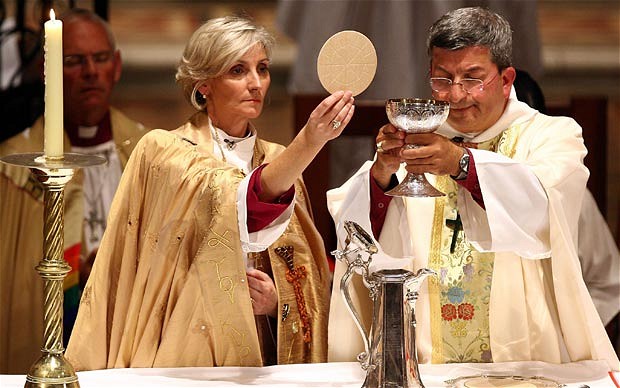
female-woman-bishop-anglican-communionI thought it would make more headlines this week in the U.S, but it didn’t, so I thought I’d put it here. Two days ago, the Church of England voted overwhelmingly to allow for female bishops in their ranks. They had for twenty years now allowed for female priests but–as is the odd logic that accompanies church hierarchies such as this–they thought it a step too far to allow women to be bishops. I don’t know. But either way, let us rejoice their is one more place in the world where women can fully and freely exercise the gifts God has given them.

Click here for more posts in my occasional series on Women in the Church.

Faith & Grace Alone: Job & the New Perspective on Paul| Job 9


job-silohetteHow then can I answer him,
choosing my words with him?
Though I am innocent, I cannot answer him;
I must appeal for mercy to my accuser.
Job 9.14-15

Job says he is innocent, but he says he still needs mercy. What does this mean? Perhaps he does see not people in the simplistic way that we often do–or at least as simplistic as we see the ancient Israelites.

Just like in the Christian scheme, I’m starting to think that the ancient Israelites also thought that people were considered righteous only on account of graciously being in covenant with God. All the sacrifices, festivals, laws, etc. were more as signs that they were the people of God; they were not how people became part of that group in the first place. In other words, the sacrifices and laws were outward displays that they were fully righteous before God’s eyes; they weren’t the ways that they “earned” righteousness or forgiveness.
Continue reading

#Marginalia Weekly Round-Up #6


Marginalia is a section of this blog dedicated to (mostly) short reflections, meditations, questions, and difficulties I have while going through my Bible reading plan. I’m still trying to figure out the best pace at which to post these, so be patient with me. To aid in helping people engage with these posts, every weekend I post a round-up of all of Marginalia posts that appeared during that week. This list is in biblical canonical order.

Job

Job, God, & Satan (Can I get some help from the scholar’s out there?)| Job 1.6-7
God, Social Justice, & Social Welfare | Job 5.15-16
Fragments from a speech by Job| Selections of Job 6 & 7
Job’s Friends are Right! Job’s Friends are Wrong.| Job 8.5-7,20-22
In a sense, God CAN’T favor the righteous| Job 9.1-4

Continue reading

The Trinity building the Church! | Acts 20.28


Keep watch over yourselves and over all the flock, of which the Holy Spirit has made you overseers, to shepherd the church of God that he obtained with the blood of his own Son.
Acts 20.28

Wow, here’s the whole Trinity at work in leading God’s church! Would that we give more attention to this Trinitarian nature to the sustaining of our churches. Also, notice how Jesus’ blood “obtained” the Church. He didn’t merely create the space of possibility. He went out and got it. It is is his.

See other Marginalia here. Read more about the series here.

The Sermon’s Essence & Power | 1 Corinthians 2.1-5


When I came to you, brothers and sisters, I did not come proclaiming the mystery of God to you in lofty words or wisdom. For I decided to know nothing among you except Jesus Christ, and him crucified. And I came to you in weakness and in fear and in much trembling. My speech and my proclamation were not with plausible words of wisdom, but with a demonstration of the Spirit and of power, so that your faith might rest not on human wisdom but on the power of God.
1 Corinthians 2.1-5

This encourages me so much in preaching. No matter the exegesis, eloquence, or whatever, we preach Christ and him crucified, and that makes a good sermon. We also live a life in accordance with that outside of the sermon and it supports our preaching as well. Just as in the nature of God Himself, our words and our deeds cannot be separated from one another.

See other Marginalia here. Read more about the series here.