Logos Bible Software & Evangelical Insecurity


devil-jesus-arm-wrestle

I use and love Logos Bible Software for my Bible study and seminary work. It really is an amazing piece of software. You can amass such a huge library of books and resources that all connect and sync up to one another.

The one problem is that they can only put the time and resources into putting out books that people will actually buy. This means that their library selection has long been skewed towards a certain demographic: American Conservative Evangelicals, usually of the “Neo-Reformed” variety.

I don’t tend to like the books that are geared for this market. Their theological assumptions seem to come first, and the text seems to often come second. I love reading robust, scholarly commentaries and books that help grow and stretch me; books that focus on the messiness of Scripture and how it is historically and culturally conditioned. Yes, this means I end up preferring writings from “liberal” (God, I hate that term) perspectives and institutions, even if my actual theological conclusions are fairly conservative.

So it’s been frustrating to me that Logos was lacking in this scholarship and thinking for some time. But in the past year, I’ve noticed this changing. More and more commentary series and scholarship book bundles are coming out by Logos that I am loving (though my bank account hasn’t). Maybe I just never noticed them before, I don’t know. But either way, I’m noticing it now, and I’m really happy.

Or rather, I was.
Continue reading

The Privilege of Holiness; The Holiness of Privilege


laureti-triumph-christianity-pagan-statue

I was at a coffee shop this past weekend doing some schoolwork when this beautiful lesbian couple came in, got some coffee, and left. I don’t know what it was about them, but they were stuck in my mind for quite a while after this. I wondered how the America church would be relating to gays at this point had sweet, loving relationships like that been the primary display Evangelicals had seen all these years.

I remembered that, as I was growing up, one of the primary Evangelical apologetics against gay rights was the whole litany of emotional, psychological, and societal detriments that come with homosexuality. I can’t tell you how many times I was told about the higher rates of depression, suicide, relationship abuse, physical health problems, STDs, and rampant unsafe sexual practices among the majority of gay population. The implicit (and sometimes explicit) suggestion was that, when someone moves so radically against “the way God designed things”, great problems are sure to follow.

Continue reading

Seminary & Ministry in the Post-Everything World


Grace-words-mouth-poetry-psalms

All last week I was in Holland, MI attending another one of our in-person sessions for my seminary program. It was another week with amazing people, at an amazing place, learning and discussing amazing things.

One of that classes I had was my preaching class. Over the course of five days, every one of us in the class got up and preached a 15-20 minute sermon. Every person–again, every. single. person.–did amazingly well. There were many surprises. People delivered messages that we could not have anticipated, in both skill and content.

Imagine listening to 14 full-on sermons in the course of a few days. It’s emotionally draining; it’s intense; it’s life-giving. It’s trying to drink from a fire hose of God’s Word and Spirit.

One benefit of this is that I got to get a glimpse into the future of the Church’s preaching ministry, and I am happy to say that I am really encouraged.

Continue reading

Wolterstorff: the liturgy & worship of lament [quote]


job-silohetteLast week, I was in Michigan again for my seminary program. Tomorrow I will post some reflections on my time there. Today, I want to offer you this amazing post-length excerpt by Nicholas Wolterstorff from an amazing piece of his called, “Trumpets, Ashes, & Tears” (pdf):

I suggest that there is yet one more thing which the believer experiences in his life of dispersion and which he brings with him to the liturgy….

As we human beings travel through life we experience pain and suffering–in part our own, in part that of others. Some of this pain and suffering is non-innocent suffering; it is punishment for, or the consequence of, moral evil. But not all of it is that.

The suffering of the Israelites in the brickyards of Egypt was not the consequence of their sin, nor was the suffering of the Jews in the camps of Auschwitz. Some of the suffering of our world even resists our seeing it as the counterpart of anyone’s sin–the accidental death of a child, for example.

Continue reading

Relentless Mercy (I’m never looking at Jonah the same way again) [QUOTE]


The forceful rejection of the doctrine of mercy is voiced by a man who was willing to die rather than cause others to die, and who was willing to leave his native land and pay with his life rather than serve the compassionate God. His vigorous and sincere opposition to divine mercy is striking evidence that it is desperately needed. Just as the flight is unqualified, so is the pursuit relentless…

Jonah must bow his head before the absolute sovereignty of the divine will…before he can hear and understand the explanation given by God, who forgives without being lenient. The gates of escape are shut in the prophet’s face; precisely this provides the opening of the gates of repentance to the transgressors with its full significance, since both are direct outcomes of the Lord’s love for His creatures.

The paradoxical tension between the Lord’s inordinate severity with Jonah and His extraordinary leniency with Nineveh teaches us about the absolute sovereignty of the divine will; it is resolved only when Jonah comes to realize that the will of the Lord is not arbitrary, but compassionate, for those who are near and for those who are far from Him. 

–from the JPS Bible Commentary on Jonah, by Dr. Uriel Simon

As Jesus said: the Bible is NOT “the Word” | Mark 4:33


With many such parables he spoke the word to them, as they were able to hear it…
Mark 4.33

Those that are not Christians can still do righteousness. But Take note: it is within the parable that the “word” is found. It is not the parables themselves. It is a vehicle for “the word” even as it is not that word itself. The “word of God” is not as simplistic as one ancient text or book. It must be discerned, sought after, and found. The Word is within the Bible’s words–“behind them”, in a sense–it is not the words themselves. We can’t confuse this.

See other Marginalia here. Read more about the series here.

Fragments from a speech by Job| Selections of Job 6 & 7


For the arrows of the Almighty are in me;
my spirit drinks their poison;
the terrors of God are arrayed against me.
Job 6.4

What a beautiful, yet tragic series of lines.

“Teach me, and I will be silent;
make me understand how I have gone wrong.
How forceful are honest words!
But your reproof, what does it reprove?
Job 6.24-25

It must not be easy to spend this time of sadness and pain, and also ask for teaching. Yes, he is asking for answers to the wrong questions. But it seems he’s still willing and wanting to listen.

“Remember that my life is a breath;
my eye will never again see good.
The eye that beholds me will see me no more;
while your eyes are upon me, I shall be gone.
As the cloud fades and vanishes,
so those who go down to Sheol do not come up;
they return no more to their houses,
nor do their places know them any more.
Job 7.7-10

Oh, if only he could know about Jesus. On another note, I wonder how this connects to his “my redeemer lives” section later on.

What are human beings, that you make so much of them,
that you set your mind on them,
visit them every morning,
test them every moment?
Job 7.7-17-18

Well that’s interesting. Almost the same lines appear in Psalm 8, except there they are words of praise and worship of God. but here, they seem more like words of accusation, complaint and lament against God.

Why do you not pardon my transgression
and take away my iniquity?
For now I shall lie in the earth;
you will seek me, but I shall not be.”
Job 7.7-17-18

But resurrection!

See other Marginalia here. Read more about the series here.

Jonah: a Children’s Story of Verbs


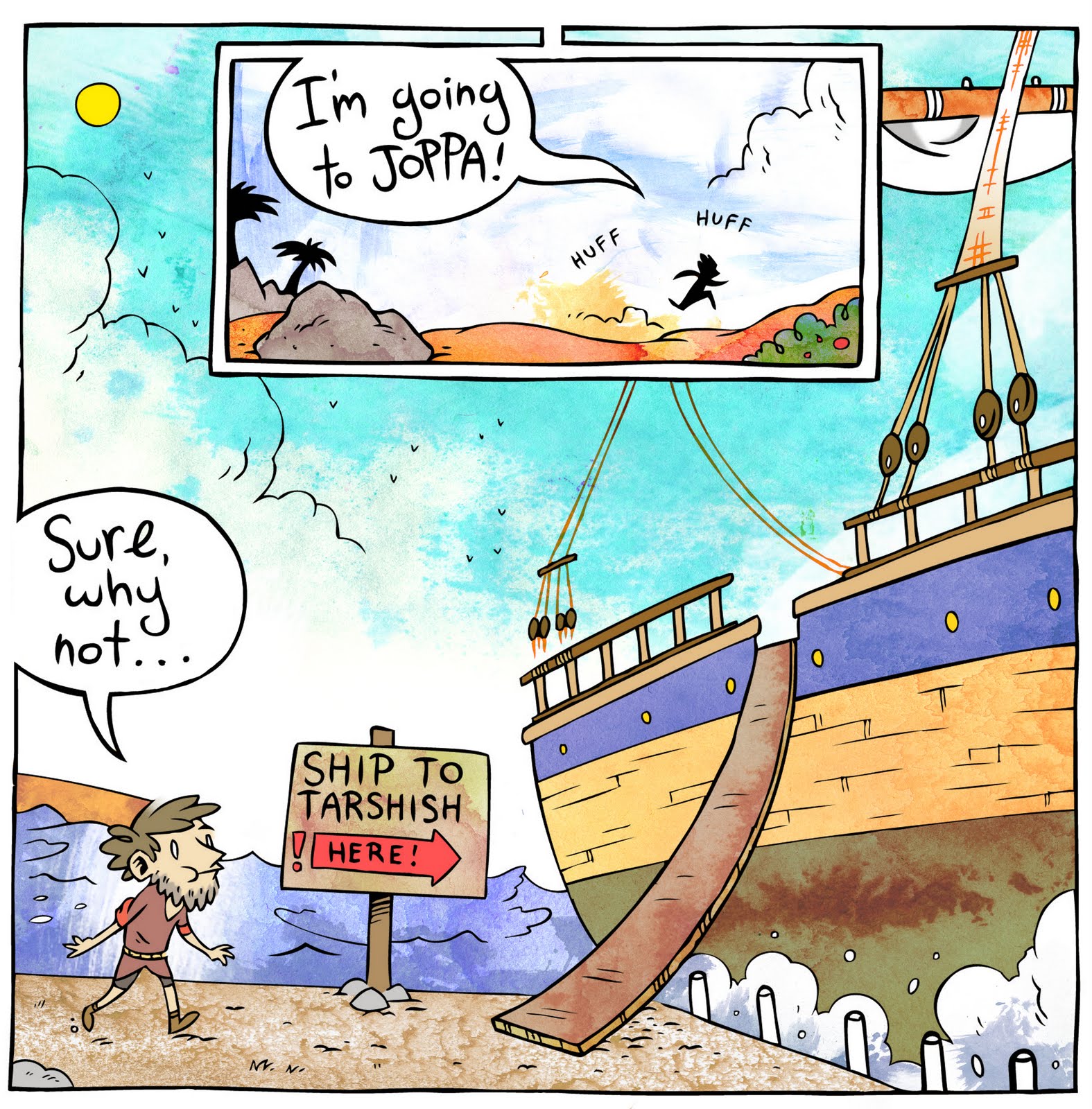
Jonah-boat-comicMy Hebrew class has moved from learning grammar to the actual process of translation and interpretation. To do this, we’re going through the book of Jonah. Our first interpretive assignment was to look at all the Jonah-related verbs in the first six verses and draw some theological conclusions. Here was my contribution.

But first, my incredibly literal and somewhat stilted translation of the opening verses [Jonah 1.1-6], including all the odd word order and idioms of Hebrew:

(1) And the word of the LORD was to Jonah son of Amittai, in order to say, (2) “Rise, go to Ninevah, the large city, and cry out against her because their evil arose to my face.” (3)And Jonah rose in order to flee in the direction of Tarshish from the toward-facing faces [Hebrew idiom for “Presence”] of the LORD and went down to Joppa and he reached a ship going to Tarshish and he gave its fare and went down in it in order to enter with them to Tarshish away from the toward-facing faces of the Lord. (4) And the LORD hurled a large wind upon the sea and it manifested as a large storm among the sea and the ship thought to shatter towards itself. (5) And the sailors were afraid and they cried out, man to his God, and they were made to throw the receptacles which were in the ship into the sea away from them towards making themselves small and Jonah had gone down into the rear of the vessel and had laid down and slept heavily. (6) And the chief sailor came to him and said to him, “Why are you sleeping? Arise! Cry out towards your gods! Perhaps the god of you will bear us in mind and we will not perish.”

And now for some lessons we can draw…
Continue reading

A method for humility, according to St. Paul | 1 Corinthians 3:18-19


Do not deceive yourselves. If you think that you are wise in this age, you should become fools so that you may become wise. For the wisdom of this world is foolishness to God. For it is written: “He catches the wise in their craftiness”
1 Corinthians 3.18-19

What a method for humility. Whenever we feel wise or smart, the best thing we can do is put ourselves in a situation where this is not valued. We must be “simplified” and lose the wisdom, else lose Christ in the process. Here I think of Lesslie Newbigin, who left his lucrative writing and tenured prestige and teaching to work with those who would never know or appreciate his brilliance. This can be a discipline that we do.

For example: Perhaps I should consider ways to stop blogging or cutting it out of my routine in those moments or seasons that I feel it is building me up too much.

See other Marginalia here. Read more about the series here.

Must-Read: The meteoric, costly & unprecedented rise of incarceration in America [LINK]


I promise, this is the most important thing you’ll read today. One of the many stunning facts: in this report:

“As a result of these trends, black men younger than 35 without a high school degree are now more likely in America to be imprisoned than employed in the labor market”

http://www.washingtonpost.com/blogs/wonkblog/wp/2014/04/30/the-meteoric-costly-and-unprecedented-rise-of-incarceration-in-america/

My Gospel Terror, Acts, & Letters [photo sermon]


Acts-bible-lomo

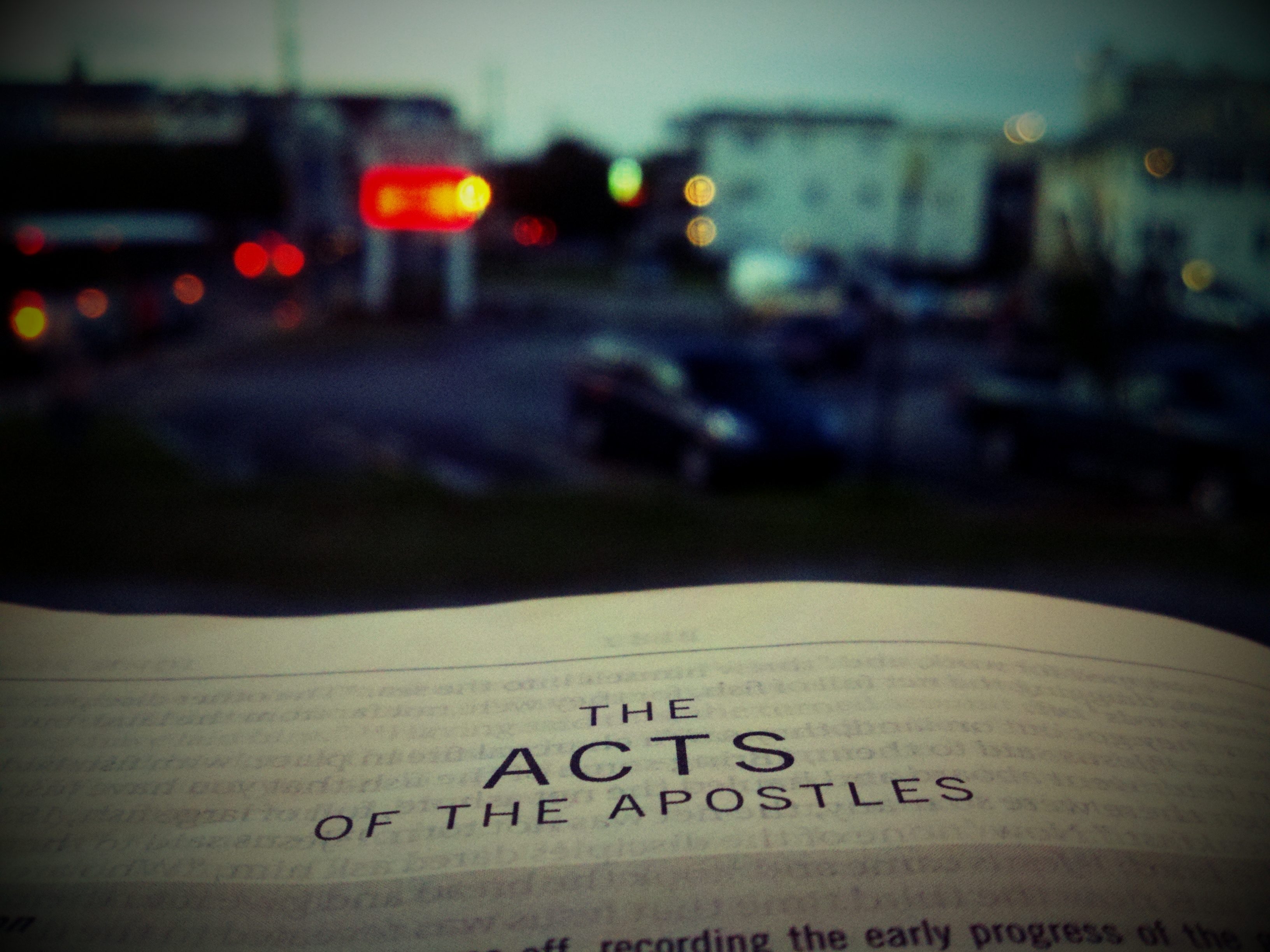
Each week, WordPress has a Weekly Photo Challenge, where they give a theme and invite people to highlight photography representing that theme, accompanied by a few meditations on it. OccasionallyI try and write a “photo sermon” or meditation based on those themes, accompanied by a photo of mine . This week’s theme is “Letters“.

* * * * *

I grew up in church and grew up loving the Bible. I did devotionals and sat in Sunday School classes for the vast majority of my life. And yet, it wasn’t until I got to my junior year of college and took a class on the Gospels that I read any of the Gospels all the way through. Sure, I had probably heard most of the Gospels preached on or excerpted in devotionals and books, but I had never read a Gospel from beginning to end.

At the time, I thought it was because they seemed too holy. It felt like too much for my young soul to handle to read the very words of Jesus on my own. It was too weighty for me and scared me. Maybe I just wanted to wait until I could drink whiskey or wine while reading them.
Continue reading

Corinthian Fragments on Church Leadership & Growth | 1 Corinthians 3 & 4


What then is Apollos? What is Paul? Servants through whom you came to believe, as the Lord assigned to each. I planted, Apollos watered, but God gave the growth. So neither the one who plants nor the one who waters is anything, but only God who gives the growth.
1 Corinthians 3.5-7

There is no such thing as “church growth” methods or strategies. Just a “church growing God”. This should correct our hubris and encourage us: when a church “fails”, it need not be because of a failure of method, leadership, vision, strategy, preaching, planning, or obedience. A lot of times, it’s just that God did not give the growth, and we should move on.

For no one can lay any foundation other than the one that has been laid; that foundation is Jesus Christ.
1 Corinthians 3.11

Would that we embraced this as our ultimate Church “growth” philosophy!

So let no one boast about human leaders. For all things are yours, whether Paul or Apollos or Cephas or the world or life or death or the present or the future—all belong to you, and you belong to Christ, and Christ belongs to God.
1 Corinthians 3:21-23

Is it just me or is this an incredibly Protestant view of Church leadership?

Think of us in this way, as servants of Christ and stewards of God’s mysteries.
1 Corinthians 4:1

Oh what a beautiful picture of what Church leadership is! “Stewards of the mysteries of God”. I love that.

I am not writing this to make you ashamed, but to admonish you as my beloved children.
1 Corinthians 4:14

What a model for leader-congregant relationships.

See other Marginalia here. Read more about the series here.

Fundamentalist vs. Pentecostals vs. the Cross | 1 Corinthians 1.27-31


For the message about the cross is foolishness to those who are perishing, but to us who are being saved it is the power of God. For it is written,

“I will destroy the wisdom of the wise,
    and the discernment of the discerning I will thwart.”

Where is the one who is wise? Where is the scribe? Where is the debater of this age? Has not God made foolish the wisdom of the world? For since, in the wisdom of God, the world did not know God through wisdom, God decided, through the foolishness of our proclamation, to save those who believe. For Jews demand signs and Greeks desire wisdom, but we proclaim Christ crucified, a stumbling block to Jews and foolishness to Gentiles, but to those who are the called, both Jews and Greeks, Christ the power of God and the wisdom of God. For God’s foolishness is wiser than human wisdom, and God’s weakness is stronger than human strength.
1 Corinthians 1.27-31

So good. And also really appropriate for this age. The fundamentalists want knowledge and certainty, and the Pentecostals want experience and signs. But we preach Christ crucified.

See other Marginalia here. Read more about the series here.

You don’t own your Baptism. Jesus does. | Romans 6.3-4


Do you not know that all of us who have been baptized into Christ Jesus were baptized into his death? Therefore we have been buried with him by baptism into death, so that, just as Christ was raised from the dead by the glory of the Father, so we too might walk in newness of life.
Romans 6.3-4

Technically, there is only one baptism that has ever taken place. Christ’s. All other baptisms are baptisms in his own. He is the one that walked in newness of life. He is the one who was baptized. He is the forerunner for all of Christian life–even it’s Covenantal participation by baptism. How beautiful is that?

See other Marginalia here. Read more about the series here.