The Echoes of History & Abraham| Genesis 24.22-23


When the camels had finished drinking, the man took a gold nose-ring weighing a half shekel, and two bracelets for her arms weighing ten gold shekels, and said, “Tell me whose daughter you are. Is there room in your father’s house for us to spend the night?”
Genesis 24.22-23

On a random historical note, though it is clear that these stories come from older narratives and traditions written down much later, it is interesting that these stories still have features that would have been accurate for the time at which the story took place, millennia before the story was written down. You can see an example here. At the Pennsylvania Museum of Archaeology, you can see artifacts from this area and supposed time (where I have seen with my own eyes the type of jewelry that this would be referring to). From doing that, it really looks like things such as these bracelets and gold rings were used for currency a lot more at this particular time in history. Later on, in a story such as this you would have more references to gold, money, cattle, or more established forms of bartering.
See other Marginalia here. Read more about the series here.

Moses the Levite? | Exodus 2:1


Now a man from the house of Levi went and married a Levite woman.
Exodus 2.1

These are Moses’ unnamed parents. It’s interesting that the text makes a point to say they are both Levites, the priesthood branch of the family. Notice that both Aaron and Miriam, Moses is siblings, would have also come from the priesthood side of the family. I wonder if this gives Miriam a certain Priestley role in the community as well? Either way, I never noticed that Moses and Aaron are both Levites. This gives Moses a much more priestly, rather than prophetic, role in what he does, and the function he serves in the story and the community.

See other Marginalia here. Read more about the series here.

Phillip the Baptizing Magician?| Acts 8.39-40


When they came up out of the water, the Spirit of the Lord snatched Philip away; the eunuch saw him no more, and went on his way rejoicing. But Philip found himself at Azotus, and as he was passing through the region, he proclaimed the good news to all the towns until he came to Caesarea.
Acts 8.39-40

What the heck? This happens and the eunuch just goes on his merry way? This is unlike most things in the book of Acts.

See other Marginalia here. Read more about the series here.

The Storied Propaganda of Acts | Acts 6.7,15


The word of God continued to spread; the number of the disciples increased greatly in Jerusalem, and a great many of the priests became obedient to the faith.
Acts 6.7

That’s odd phrasing. This is telling a certain version of history. Surely this fact would be denied by the Jews at the time. And yet, Luke is trying to paint a picture of the Gospel spreading, to the Jews first (in this section, the focus is on Jerusalem and Peter) and then to the ends of the earth (the big Paul section).

And all who sat in the council looked intently at him [Stephen], and they saw that his face was like the face of an angel.
–Acts 6:15

Here we see one of the inklings and beginning of the long Christian tradition of saint veneration and myth-making (St. George and the Dragon, anyone?)

See other Marginalia here. Read more about the series here.

Matthew & the Jews | Matthew 27.20-23


Now the chief priests and the elders persuaded the crowds to ask for Barabbas and to have Jesus killed. The governor again said to them, “Which of the two do you want me to release for you?” And they said, “Barabbas.” Pilate said to them, “Then what should I do with Jesus who is called the Messiah?” All of them said, “Let him be crucified!” Then he asked, “Why, what evil has he done?” But they shouted all the more, “Let him be crucified!”
Matthew 27.20-23

Man, Matthew really does go out of his way to show that the Jews were at fault for Jesus’ death.

See other Marginalia here. Read more about the series here.

St. Stephen & the History of Israel | Acts 7.48-53


Yet the Most High does not dwell in houses made with human hands; as the prophet says,

‘Heaven is my throne,
and the earth is my footstool.
What kind of house will you build for me, says the Lord,
or what is the place of my rest?
Did not my hand make all these things?’

“You stiff-necked people, uncircumcised in heart and ears, you are forever opposing the Holy Spirit, just as your ancestors used to do. Which of the prophets did your ancestors not persecute? They killed those who foretold the coming of the Righteous One, and now you have become his betrayers and murderers. You are the ones that received the law as ordained by angels, and yet you have not kept it.”
Acts 7.48-53

1. He skips the history of Israel that includes the Divided Monarchy, Exile, Return, Intertestamental Victories and and Sorrows, and the establishment of the Jewish state under Roman Rule.

2. He jumps straight from the temple to their Rejection of Jesus. This could be Jesus’ connection as a New Temple among us, it could highlight Israel’s inordinate obsession with the temple, even unto the rejection of their Messiah, or it could be a reference to the charges they brought against Jesus to get him crucified: blasphemy against the temple.

See other Marginalia here. Read more about the series here.

Some random Beatitude snippets | Matthew 5.6,11-12


“Blessed are those who hunger and thirst for righteousness, for they will be filled.”
Matthew 5:6

So encouraging. This gives me hope.

“Blessed are you when people revile you and persecute you and utter all kinds of evil against you falsely on my account. Rejoice and be glad, for your reward is great in heaven, for in the same way they persecuted the prophets who were before you.”
Matthew 5:6

That’s interesting. He hasn’t mentioned any other Jewish or biblical things. Why root this encouragement in a random reference to the prophets?

See other Marginalia here. Read more about the series here.

In Acts, Paul = Jesus | Acts 27.35-36


After he had said this, he took bread; and giving thanks to God in the presence of all, he broke it and began to eat. Then all of them were encouraged and took food for themselves.
Acts 27.35-36

Here is an obvious parallel between Jesus and Paul. I don’t know if these features are meant to hearken to the feeding of the 5,000, or the Last Supper. Actually, it’s probably not a parallel of the 5,000, because there is no multiplication or anything miraculous about this meal. But, Paul does the same thing with the bread that Jesus does elsewhere, and others are similarly encouraged by what he does. If I had to vote, I would say that this is a parallel of the Last Supper. Or, it is like the road to Emmaus passage, where Jesus is seen in the breaking of the bread.

See other Marginalia here.Read more about the series here.

And the story moves from Abraham to Isaac… | selections from Genesis 26


Now there was a famine in the land, besides the former famine that had occurred in the days of Abraham. And Isaac went to Gerar, to King Abimelech of the Philistines.
Genesis 26:1

This reads like a later interpolation because of confusion between the two drought accounts.

The Lord appeared to Isaac and said, “Do not go down to Egypt; settle in the land that I shall show you.
Genesis 26:2

God’s first word to Abraham: “Go”. God’s first word to his son: “Do not go”. I love that. Not sure why, but I do.

Abimelech said, “What is this you have done to us? One of the people might easily have lain with your wife, and you would have brought guilt upon us.” So Abimelech warned all the people, saying, “Whoever touches this man or his wife shall be put to death.”
Genesis 26:10-11

Oh the mercy of God, and how he protects the vulnerable here. But how do we understand when he doesn’t act in protection like this?

See other Marginalia here.Read more about the series here.

Luke on the New Perspective on Paul | Acts 15:1,8-11


Then certain individuals came down from Judea and were teaching the brothers, “Unless you are circumcised according to the custom of Moses, you cannot be saved.”…
Acts 15.1

This is a great summary of the argument for the New Perspective on Paul. The key is the line about Moses. It’s not about works righteousness, but ethnic identity.

And God, who knows the human heart, testified to them by giving them the Holy Spirit, just as he did to us; and in cleansing their hearts by faith he has made no distinction between them and us. Now therefore why are you putting God to the test by placing on the neck of the disciples a yoke that neither our ancestors nor we have been able to bear? On the contrary, we believe that we will be saved through the grace of the Lord Jesus, just as they will.”
Acts 15:8-11

Another quick NPP note. Notice here that Peter is not contrasting salvation by yoke versus salvation by grace, but that grace will also save them just as the Jews believed it saved them.

See other Marginalia here.Read more about the series here.

The Liturgy of Cain & the Tears of the Earth


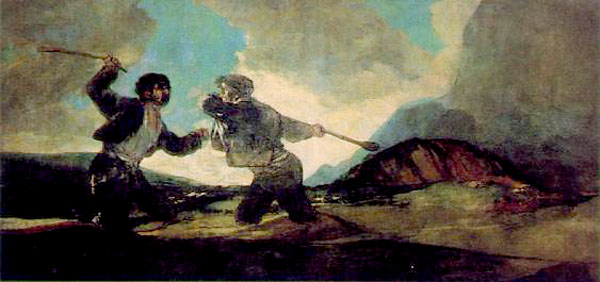
de Goya-fight with cudgels"Our Lent series this year is “The Weeping Word“, where we’re meditating on key places in the Scriptures where Lament, crying, tears, and weeping happen. Today, we look at the first instance of this in the Bible.

There is a particular rhythm that God’s people have always used in their liturgy. If you pay attention, you’ll see this rhythm pop up in lots of different places throughout the Christian Scriptures. My favorite unexpected place where this shows up is in the story of Cain and Abel.

Worship

The story opens with these two brothers coming to worship, answering an implied Call to Worship that issues from God. This is where the liturgical rhythm begins. God calls us to worship him, and we respond by offering him this worship to him.

But everyone comes to worship from different places, and not everyone’s heart and offering is pure.

And the Lord had regard for Abel and his offering, but for Cain and his offering he had no regard. So Cain was very angry, and his countenance fell. The Lord said to Cain, “Why are you angry, and why has your countenance fallen? If you do well, will you not be accepted? And if you do not do well, sin is lurking at the door; its desire is for you, but you must master it.”

Our worship gets twisted and directed towards the wrong things, and this is what we call sin. Offering worship wrongly and to the wrong things. Wrong worship produces wickedness within us.

“Cain said to his brother Abel, “Let us go out to the field.” And when they were in the field, Cain rose up against his brother Abel, and killed him.

Continue reading