Advent & Humor: stop taking yourself so seriously [casual fri]


santa-baby-jesusIn one of the posts in last year’s Advent series, I posed this question:

“Why [did Mary, Joseph, and Jesus] flee to Egypt? If they stayed and Herod killed the child Jesus, would that not still be Jesus, the Son of God–the Incarnate God–dying unjustly at the hands of a Roman provincial governor attempting to cement the reign of the powers and principalities of the world? Why go to all that effort to wait 30 years later for the same thing to happen on a cross?”

The answer we discussed was that Christ’s purpose for coming was much bigger than the cross. He did not come just so he could die. As St. Paul said, “For if while we were enemies we were reconciled to God by the death of this Son, much more, now that we are reconciled, shall we be saved by his life.”

Jesus couldn’t die when he was so young, because the benefits we receive from his Advent are not limited to his death, but also his life. We receive his life of lived-out righteousness as our own when we come to know him.

I thought about this yesterday when pondering stand-up comedy.
Continue reading

Herman Bavinck on the Advent Election of Mary [QUOTE]


In a comment on yesterday’s post on Mary, occasional blog contributor Austin Ricketts posted this quote, another gem by Dutch Reformed theologian Herman Bavinck:

[the] entire preparation of the incarnation in the preceding centuries is concentrated, as it were, and completed in the election and favoring of Mary as mother of Jesus. Mary is the blessed one among women. She received an honor bestowed to no other creature. In the undeserved favor granted her, she far exceeds all other people and all other angels. Rome was right in maintaining this; those who deny it are not taking the incarnation of God seriously…Among all Protestants who confess the incarnation of the Word, Mary is held in high esteem. She was chosen and prepared by God to be the mother of his Son. She was the favored one among women. Christ himself desired her to be his mother, who conceived him by the Holy Spirit, who carried him beneath her heart, who nursed him at her breast, who instructed him in the Scriptures, in whom, in a word, the preparation of the incarnation was completed.

Reformed Dogmatics, Vol. 3, pp. 274; 281-282

Advent, Evolution, & Absolution [RE-POST]


Today, I’m re-posting a piece I wrote exactly a year ago for last year‘s Advent series. During this year‘s, we’re seeing how the Advent event affects parts of our lives that we usually don’t associate with it. Today, it’s Advent and Evolution. You can follow the series here.

It’s Advent. A time where we especially orient ourselves towards rejoicing and celebrating the fact that God did not remain far off and merely create a “legal” or “dogmatic” satisfaction for the plight of his creation and creatures. Rather, he broke into it and came into his creation and among his creatures. In this year’s Advent series, we’re exploring how, in this Coming, Jesus took on our creaturely formcare-taking functioncomprehensive fallenness, and communal formation.

First, God took physical, human, creaturely form. In the study I did–and subsequent lecture I gave–on Beauty a couple of years ago, I defined “Beauty” as the attribute of something that expressed complexity simply. Is not this God-in-human-flesh (theologically referred to as the Incarnation) the most beautiful of all miracles to take place? The Infinitely Complex God inhabits the simplest of human forms: a child.

Continue Reading –>

Advent & Mary: Ordained as Prophetess, Priestess, & Queen


Tanner-the-anunciation-mary

This Advent, we’re seeing how this season affects parts of our lives we usually don’t associate with it. Follow the series here. This post is also filed in the series “Catholics Aren’t Crazy” and “Women Leading Stuff in Churches“.

If a woman is revered by the church for giving the faithful their savior, then surely women are good enough for leadership roles in the church to save it. –Vishwanath Ayengar

I ran across that quote in some letters to the editor of Newsweek a couple of years back in response to a cover story arguing that if women were ordained as priests in the Catholic Church, there wouldn’t have been any sex abuse scandal. I don’t know if that’s true, but the quote is insightful and (hopefully) thought-provoking.

I can hear conservatives now: Well, God used a donkey to speak! He used Caiaphas the high priest to unknowingly prophesy about Jesus before sentencing him to death! He used Judas to bring about Christ’s crucifixion and therefore our salvation! It doesn’t mean that they were fit to be ordained pastors!

Yeah, yeah, I get it. This post isn’t necessarily meant as a “proof” or “defense” of women’s place in ministry (though it’s a part of my on-going series on the topic). I just want to revel a bit in some divine mystery. Can we all just put our swords down and marvel?
Continue reading

Advent & Politics: The Government is on His Shoulders


laureti-triumph-christianity-pagan-statue

This Advent season, we’re seeing how the Advent event affects parts of our lives that we usually don’t associate with this time. You can follow the series here.

The book of Isaiah is a minefield for biblical studies, mainly because of the development it seems its contents went through to get to its final form. It appears to be a strange stitching together of many writings, perhaps by many people, for several different purposes. But in all of its complexity and mystery, there is one theme that it consistently holds throughout its contents: politics. The political movements of the nation of Israel and the nations around it–and God’s movement in and through all of it–occupy most every chapter of the book.

Interestingly, this is also where many of the most dramatic and explicit messianic prophecies are found–specifically Advent prophecies. When telling the Christmas story, the gospels quote Isaiah (I believe) more than any other Old Testament book. Images of virgins, Emmanuel, Davidic lineage, “roots of Jesse”, and John’s “voice crying in the wilderness” all find their source here.

There seems to be an intimate connection between politics and Advent.
Continue reading

I’m going on a Bloggers Trip to Guatemala with Lemonade Int’l. (happy 8th blog-versary)


lemonade-guatemala-1 BloggersDate

Eight years ago, today, I began this blog as a cathartic response to my frustration at a girl in my dorm. It was a very strange post full of rambling, weird logic, bad grammar, and typos. Not much has changed since then in those respects, but I do want to let you all know about an amazing opportunity that this 8-year endeavor has offered me.

Recently, some old friends of mine (that I happen to have hooked up) got me connected to this amazing non-profit, Lemonade International. LI does great development work in the La Limonada neighborhood of Guatemala, the largest urban slum community in Central America.

LI shares my own convictions that international development work should utilize local resources (instead of bringing in outside talent for everything), empower communities (instead of simply giving them aid), and build long-term relationships (instead of “short-term” “missions” programs) in order to reverse injustice. Here’s a trailer for a documentary about their community and their work:
Continue reading

Herman Bavinck on the Advent Incarnation


The doctrine of Christ is not the starting point, but it certainly is the central point of the whole system of dogmatics. All other dogmas either prepare for it or are inferred from it. In it, as the heart of dogmatics, pulses the whole of the religious-ethical life of Christianity. It is ‘the mystery of godliness’ (1 Tim. 3:16). From this mystery all Christology has to proceed. If, however, Christ is the incarnate Word, then the incarnation is the central fact of the entire history of the world; then, too, it must have been prepared from before the ages and have its effects throughout eternity…the incarnation is not an incidental decree that emerged later: it was decided and determined from eternity. There was not time when the Son did not exist; there was also no time when the Son did not know he would assume and when he was not prepared to assume the human nature from the fallen race of Adam. The incarnation was prepared from eternity; it does not rest in the essence of God but in the person. It is not a necessity as in pantheism, but neither is it arbitrary or accidental as in Pelagianism.

Reformed Dogmatics, Vol. 3, pp. 274; 276-277 (found this by way of friend-of-the-blog Austin Ricketts)

Free Advent Mixtape Available Now!


Advent-Mixtape-Cover

Update: I got some inspiration and updated the Mixtape, changing the song selection/order a little bit from when this was originally posted. Sorry for the inconvenience.

A new church season, a new mixtape. You can find this year’s Advent Mixtape above, in the appropriately-named tab, or just click here. It’s free, and you can stream, download, or share it.

It’s very similar to last year’s except with some songs removed, added, and re-ordered. I definitely think this one is better. (Let me know what you think!) Be sure to read my post introducing Advent this year, including ways than you can more intentionally participate in this season. I hope this Mixtape can play some role in your time as well.

Here’s some more info, from the “Advent Mixtape” page:
Continue reading

Welcome to Advent, 2012.


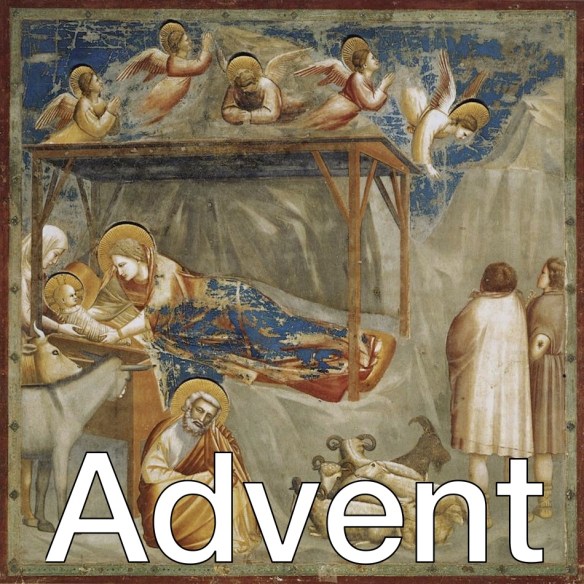
This Sunday marks the first Sunday of Advent. This is the New Year’s Day of the Christian Church Calendar. It’s the season in which we celebrate and meditate upon the “Advent” (latin for “Coming”) of Jesus into the world in the Incarnation. This season begins this Sunday and lasts until Christmas.

In this time, we stare deeply into the reality that the Creator God of the universe came into human form by way of human birth.

The season is marked (as with every Church season) with a profound tension. We meditate on the darkness into which Christ entered the world, as well as the light he brought in his Coming. Advent is a time that we sit in the tension of past, present, and future, and see how this most-differentiating belief of Christianity has profound implications on these places in time, and indeed, the whole of human life and experience.

This is why, for this year’s Advent, I’ll be doing a series meditating on how Advent affects seemingly unrelated parts of human life: art, politics, sexuality, singlenesswomen’s ordination, social justice, Evolution, suffering, humor, the city, and more.

There are several other ways you can engage in this season:
Continue reading

Weekly Photo Challenge: Thankful (humor edition) [casual fri]


Earlier this week I posted a response to this week’s WordPress Weekly Photo Challenge, which is on the theme of “Thankful“. I wrote what I hope was a beautiful expression of thankfulness that I ran across in my job; I wrote about a client of mine and the slow process of healing that brings us healing in the smallest things.

With that encouragement in mind, I’d like to offer you one of the things I’m most thankful for. What is it? I’m very, very thankful I no longer have the hair pictured below, circa 2006 (for comparison, here’s a current one):

See my past Weekly Photo Challenges here.

___________________________

Continue reading

N.T. Wright: Egalitarianism isn’t “progressive”; it’s biblical. Others object.


The Rt Revd N T (Tom) Wright delivering the Ja...Alas, due to my obsessive commitment to not let blogging get in the way of the relationships in my life, my promised post on the historical context of 1 Timothy will not be coming today (and may have to wait until next week). Instead, as part of this ongoing series, today I’d like to offer to all of you an excellent Op-ed that biblical scholar N.T. Wright posted in The Times of London (copublished here).

Last week, the Church of England voted not to allow any female bishops (though they have, for some time, allowed female priests). Prime Minister David Cameron bemoaned this, telling the Church they needed to “get with the programme” and ordain women bishops because that’s just where the world is right now, apparently. (This issue is also causing other political problems for the Church.)

Wright, who supports female bishops wrote the Op-Ed blasting Cameron for encouraging the Church to “get with the times”, saying that that is never a reason why the Church should do anything. He continues, blasting the idea of naive “progressivism” that has dominated monder thought.

Instead, he says, the Church should ordain female bishops because it’s biblical, not because it’s “cool” or “progressive”. He goes on to say that appealing to the culture does damage to the truth that it is biblical, and reinforces the patently false idea that those that oppose female ordination are the ones reading Scripture “literally” and “faithfully” while egalitarians are only listening to “culture”.

The Op-ed is brief, snarky, and powerful. Needless to say, it garned some thoughts from conservatives on this side of the pond. Doug Wilson did not just one, but two posts on it, and Denny Burke also wrote against it. The Internet Monk then brilliantly deconstructed their responses.

And so, I give you these men (why is it always men!) to read and discuss in the space below. Have fun.

On Women Leading Stuff in the Church: 1 Timothy 2:8-12


In this series on women in the church I haven’t taken the usual approach of jumping right to Bible verses. I feel there are far deeper things that affect how we interpret before we even opened the Bible. I thought we should talk about that.

This has also been a really hard post to write. For much of my readership (especially those whose minds I am most interested in changing–male church leaders who disagree with me), I don’t know what I can say that’s different than what they’ve heard before. I don’t like feeling like I’m contributing to the noise.

So here’s what we’re going to do. I’m just going to try and deconstruct the more conservative view of these verses (this post), and then offer a reconstruction of how I view the verses now (the next post). If people need me to cite sources and such, then I can do that in the comments. I won’t bog down this post with that stuff, because the people that care are generally the people that both know where to find the information and/or already know it and have incorporated it into their view. So here we go.

the text

Here’s the text in question. This is the single most “problematic” text for those that see a valid place for women in the ordained leadership offices of the Church. The text is 1 Timothy 2:8-14 (ESV):
Continue reading

Could you maybe help me win some Bible stuff? One click is all that’s needed.


Hello, blog readers. I just ran across this sweepstakes on the site of my favorite Bible Study software, Logos. To celebrate the release of Logos 5, they are giving away a Microsoft Surface Pro tablet with Logos 5 on it. With my seminary and graduate school studies starting anew, both of these items would be of great, great value to me, my thinking, my studies, and my writing. Which means, if you all help me win this, I promise you’ll reap the benefits here on the blog as well.

With that being said, could I humbly ask you to click the this link? For each person that clicks, I get 5 more entries into the drawing: http://ptab.it/iGGA

Thanks again.

Weekend Photo Challenge: Healing Thankfulness


This week’s WordPress Weekly Photo Challenge theme is “Thankful“. As soon I read the prompt, I thought of this picture.

It’s a client of mine. As a social worker, I have to deal in lots of tough stories (as I’ve written about before). This particular client is an interesting one, though. She doesn’t have too much “traditional” major trauma in her life, but that which she has, mostly, is of her own doing–or the doing of her illness, rather.

You see, she has what we call a “Personality Disorder“, meaning that she’s not really psychotic, doesn’t suffer the highs of mania, nor the lows of depression, nor is she suicidal. Rather, what she struggles with the most is a psychological disease that affects her very personality. She has a child-like demeanor that can be annoying, off-putting, attention-seeking, soul-sucking, and always full of emotional drama.

Continue reading