Dostoevsky on the Tensions of the Christian Life


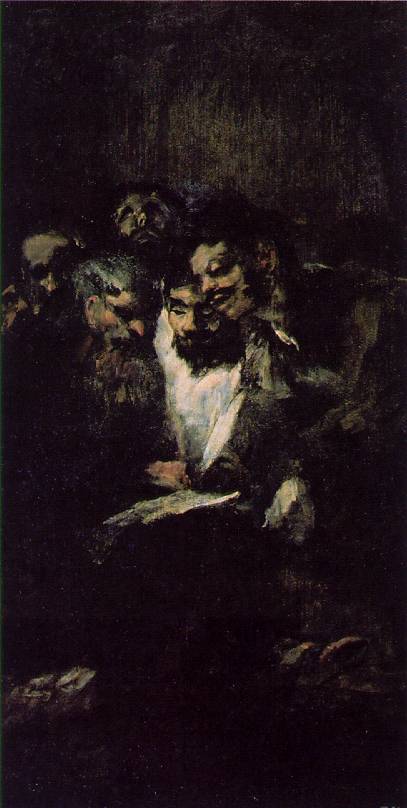
I’m currently reading through The Brothers Karamazov by Fyodor Dostoevsky. Early in the book, there is a scene where the entire Karamzov clan goes to meet with this elder priest to solve some disputes amongst themselves. Of course, being a Russian novel, before they can get to the actual disputes they engage in various forms of political and theological philosophizing for a few chapters. One of the brothers, Ivan, has one of his ideas brought up concerning moral differences between Christians and Non-christians. The elder hears this and immediately identifies it for what it is: an over-intellectualization to help explain away tensions and mysteries existing in Ivan’s heart that he can’t stop wrestling.

As any reader of my writings knows, in the past year or so I have been absolutely taken captive by the truth that Christianity, and therefore the Christian life itself, is fundamentally an exercise in holding tensions and living within mysteries that have no real answer in this life. As Peter Rollins says in the amazing book The Fidelity of Betrayal: “doubt is intimately tied up with faith, because the deep truth of faith gives birth to doubt.” In other words, only the true believer has experienced something in their heart that they can doubt in the first place. Unbelievers don’t doubt, they just don’t believe. But we Christians follow our forefather Jacob whose blessing was to wrestle with God and receive the very name Israel, which means “He wrestles with God”.

Continue reading

Writing in Hope & Angst (a Lament, a Praise)


Okay, now for a personal post. I usually don’t do these, but some encouragement/wisdom from others might help. I don’t know what exactly has been the cause, but the past few weeks have seen my desire to write and effect change rise to a level I’ve previously never known, only to be brought low by information on every side.

If I had to guess, I think my increase in desire and confidence to write has been inflamed by several fronts. First, intellectually, I’ve been experiencing a clarity and creativity of thought concerning books I’ve been wanting to write. Books that have been rolling around in my mind for about a year finally have some shape, structure, and direction. Also, I’ve been feeling more confident in my ability to think and subsequently express those thoughts in writing. This little slavery and atheism series I’ve been doing has been giving me a chance to flex some muscles I didn’t know were there. This has led to lots of affirmation and encouragement from others concerning my writing prospects. This has put writing in the front and center of my mind.

But, anxieties and insecurities ensue, both from within and without . . .

Continue reading

Consider Sponsoring a Child with Compassion


[This is also posted at the Come and See blog]

This is what a friend at another Liberti campus recently sent this out.  She’s been asked by a ministry called Compassion to look for a sponsor for a 9-year old Ethiopian named Dinku Dejene.  His birthday is August 21; he lives with his stepfather, mother, and sibling; and his favorite activities are soccer, running, and hide-and-seek.  (Click here for his full-size Compassion card.)

Meredith writes:

“The goal is to find a person to sponsor him on a committed, monthly basis for $38 per month by December 31. The children Compassion serves receive (among other things): the opportunity to hear the gospel and learn about Jesus; regular Christian training; educational opportunities and help; health care, hygiene training and supplementary food if necessary; a caring and safe Christian environment to grow in self-confidence and social skills; and personal attention, guidance and love.

Continue reading

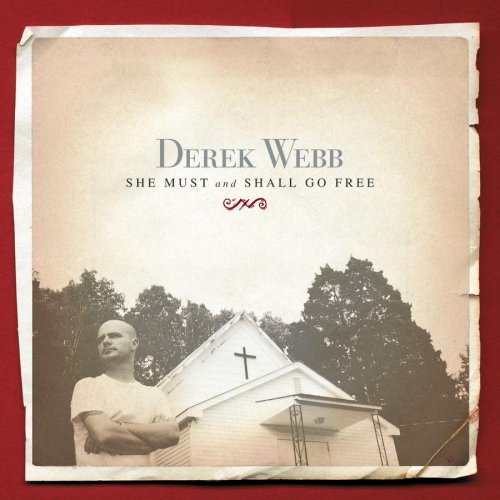
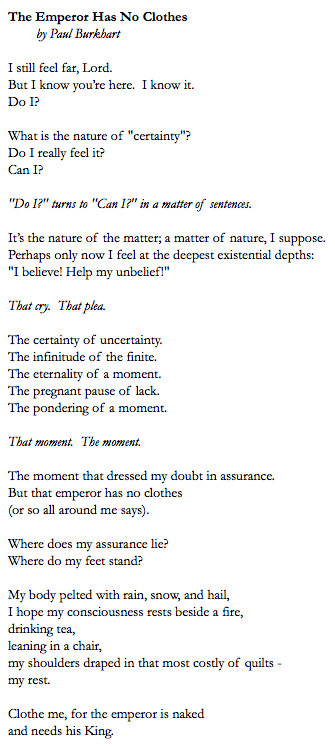
What an Ex-Seminarian gets for Christmas


In order from left-to-right:

“O Sovereign, Come” (an original Advent hymn)


On this beautiful White Christmas (at least where I’m at), for those precious few of you that will make it online today, I wanted to put up a hymn I wrote a about a year ago.  I pray this encourages you and creates anticipation for the Advent that is to come. Merry Christmas.

O Sovereign, Come

Our chains behind us, our sin before us
showing all our crippling need.
Your Grace within us, Your Spirit upon us
transforming our every deed.

After our freedom and we pass through the Red Sea,
let us not forget the desert comes.

Refrain:
Rip through the clouds, tear through the skies;
Let us see that you’re God on High.
O Sovereign, Come.  Seize our hearts.
Show yourself as Beautiful.

Your triumph of Glory, You crimson Cross
heralding Your Sovereign Way
of life through our death, enduring our thorns,
completing Your sufferings in ourselves.

Let us embrace your cross that’s set there before us
and know that it precedes the crown.

Refrain

On that day, when freed from sinning,
how I’ll see Thy lovely Face.
Clothed then in blood-washed linen,
how I’ll sing Thy Sovereign Grace.

Refrain

The Bible, Slavery, & Atheists{2b}: Theology & Ethics | Reform & Revive


By the time I finished the next article in the series, it was substantive enough and socially-oriented enough to warrant being posted on my webzine Reform & Revive.  The previous post was on on how secular Philosophy can inform our view of ethics and contribute to the discussion of Slavery, Atheism, and the Bible.  This one is about how Christian theological ethics can uniquely inform our ethics in modern times.  The article covers a LOT of ground and is the longest one I’ve written yet in this series.  Hopefully that’s not a turn off.  This article has more of my thought concerning truth and Biblical interpretation than perhaps any one article I’ve ever written contains.  Here’s the link:

http://reformandrevive.com/2009/12/22/a-theology-of-ethics-contemporary-applications/

It seems in light of my earlier post I’ve decided to pour more of myself into this series, rather than just quickly finishing it off.  Hopefully it’s helpful.

Lastly, I keep getting private emails, texts, and messages from Christians talking about how much they’re enjoying this series, and how helpful it is to them, but hardly any Christians are publicly commenting.  I’m getting tons of comments from my atheist friends, though.  Discrepancy?  I think so.  If you have a thought, please leave it.  It could be really helpful to get more input on this and diversity of thought on this.

Thank you all for your support and encouragement.  It means a lot.

Joel Rakes & Turning Violet, Violet @ World Cafe Live TONIGHT!


Yes, this is late notice.  Yes, probably no one will get this in time to come out if they weren’t already planning on coming, but nevertheless:

Joel Rakes and Turning Violet, Violet are playing tonight at World Cafe Live at 8pm.  The show is going to be amazing.  If you can come out, you should.  Get tickets here.  Also, be sure to grab 14 free Christmas songs by Joel Rakes at his site.  Here’s a taste:

weekend update


I wanted to write a quick note to anyone that’s been confused about the lack of writing on all of my sites.

For one reason or another, I’ve decided to do more research on the Slavery, Bible, and Atheism series.  Here’s why: It’s a six part series and so far each part has required two separate posts.  I am mostly done with the second post of Part 2, and for the whole series so far, I have almost 20 pages of content written.  With the stuff I want to say, and the content I wish to cover, I’ve realized that by the end of the series, if I stay on pace, I could have anywhere between 60 and 75 pages worth of material written.  And this doesn’t even include the pages worth of comments I’ve written on comments on Facebook and here on the blog.  So far, all I’ve written has been very “bloggy” in style and language; in other words — completely unworthy of even considering trying to see published.  It’s been very polemical and directly addresses other people and conversations not directly involved in this blog.

Continue reading

The Bible, Slavery, & Atheists{2a}: Philosophy & Ethics


As I’ve looked at and read the various articulations about this issue put forward by my atheist friends, I’ve noticed a few philosophical assumptions about ethics that are driving many people’s perspective on how the Bible does/should talk about these things. In this post, I’d like to highlight those things and show how they are neither philosophically or theologically correct. By the time I finished writing, it was really long, so, using one of the few benefits of blogging as a medium of discourse, I will put up the second part (concerning the more theological side of this) tomorrow or the next day.

The Philosophy of Ethics

Principles vs. Applications

Even the most cursory look shows that the study of ethics is the study of transcendent principles that govern our morality and behavior. There is an important distinction though made between those transcendent principles and their applications. One can hold to the exact same set of principles, but apply them differently at different times/cultures. It is simplistic and reductionistic to think that anyone’s “ethics” will be applied in the exact same way every time. No ethicist secular or otherwise treats ethics in this fashion. I believe that Scripture is consistent throughout in its transcendent principles, though not in their comprehensive applications (below). To navigate applications takes another pair of things the Bible talks at length about: faith and wisdom (more in the next post). Further, I don’t think this principle/application distinction provides any serious ethical challenge to biblical authority. The Bible itself never claims to treat ethics in this reductionistic manner, so to force it upon Scripture is dishonest.

One of my atheist friends mentioned the converts in isolated African tribes where nudity is prevalent, saying that if Christians were consistent, they must insist that they all cover up in order to be Church members in good standing. Except there’s a problem with that: there is no Christian ethic of “non-nudity”. There is a Christian ethic of “modesty” that says that we have the responsibility to adorn God’s beautiful creation of the human body in such a way that it maintains the respect and dignity it deserves. Now, how respect and dignity is shown changes culture to culture, so it takes wisdom to see where the human form is being abused in that culture — and that is not a compromise of Christian ethics. The consistent biblical principle has still been preached, upheld, and lived. If ethics (secular or Christian) were as naively structured as is necessary for some of these atheist criticisms to make sense, then the entire field of ethics would be unnecessary and non existent, because we could have a computer program that could make all the black-and-white moral decisions for us.

Continue reading

The Bible, Slavery, & Atheism: Part 1b


this is real (I did it myself)

The next post is pretty much done, but I wanted to send out this quick note before moving on. The previous post revealed a lot of things that I neglected to make clear. My fault. Sorry.

First and foremost, the last post was not meant to settle the question on slavery and the Bible. I just wanted to get out what the Bible actually says about it. The most I wanted to accomplish toward addressing the issue was to let people see a clear trajectory within Scripture wherein no part is inherently contradictory to the parts before or after it, no more than a seed is contradictory in nature or form to a fully blossomed flower. I also wanted to give a sense of the complexity of the issue. In every passage that lies out even the most comprehensive sets of morality and ethics for the Israelite people, you never see slavery there. It was never an action that was consistently seen as something moral. It’s not a freedom that the Israelites are free to use whenever they desire; it’s used sporadically, meaning that there must be something else going on beyond some explicit commentary by God on the moral nature of slavery. The New Testament is clear that the crucifixion of Christ was something that was foreordained and ultimately brought about by God, but this neither expunges the moral responsibility of the people that actually did it, nor says that God is all about crucifixion and thinks it is “morally neutral” or “ethically okay”. He clearly thinks it is wrong and evil, and yet He clearly ordained it, allowed it, and used it to bring about his promised redemption to the world.

Continue reading

“The Beauty of Theology (an Advent Call)”-GoingToSeminary.com


I just wanted to let all of you know about a new article I recently put up on GoingToSeminary.com.  In light of this advent season, I retooled some of the things I wrote in my Beauty series to encourage those of us getting bogged down in holiday busyness and school finals. I hope the article is used to stir many of you towards the great God that dwelt among us. Read the full thing:

The Beauty of Theology (an Advent Call)

Also, for those interested, my church, Liberti (I go to the South Philly campus) has put together a prayer guide for Advent.  I hope this further helps you in the weeks to come.

Check out the rest of my Going To Seminary posts.

An Open Response to Some Atheist Friends Regarding Slavery & Biblical Ethics (pt. 1)


[First off, this is a long one, and only part 1 of 6, so beware before you start reading.]

On Facebook, there appeared a status by an old atheist friend of mine from undergrad named Larry (supported by another friend Christopher). Here was the thesis of the post:

Regarding moral relativism the christians are hypocritical. They say they believe in a moral objectivity given by god…but how is it then, that they believed slavery was a product of the old days, as it was applicable to the time it was practiced (and sanctioned by the bible) but now condemn it? The bible, last I checked did not change. I think this is a PRIMARY example of moral relativism exhibited by the church and christians. So how can they sit here and tell us that a proof for god is moral objectivity?

In other words, how could the ethics of Christians change over time if the book they supposedly base their ethics upon has not changed? Either the God that inspired the Bible was completely incompetent in his revelation or there was no God revealing anything at all. The note caused a discussion that resulted in almost 90 comments, and I quickly realized that if I were going to respond, it would need to be in a more lengthy manner than a Facebook comment (which is not the most helpful of mediums of debate). So here it is. I’d like to respond to the ideas that came out in the discussions. I want to disagree with them on the basis of five ideas:

Continue reading

My Favorite New Comedies This Season [VIDEOS]


As many of us twentysomethings have been bemoaning this entire Fall Season, our generation’s across-the-board favorite comedy, The Office, is declining rapidly.  Jim and Pam’s wedding episode was one of the funniest episodes the show has ever seen, but it’s perhaps the only episode all season that had me consistently laughing out loud.  Don’t get me wrong, it’s not completely dead.  I still sit through (most, not all) episodes with a pleasant smile on my face, but few times will I actually laugh out loud.

It takes a lot to make me laugh out loud.  So when a show is able to make me do it consistently almost through an entire episode, I find myself shocked and awed.  Friends and (admittedly) Everybody Loves Raymond had been the closest I had experienced to this, until The Office came along and blew my every expectation possible for a comedy.  The first handful of seasons of that show are, I feel, among the funniest TV has ever seen.  But The Office of today is a mere shadow of The Office of yester-season.  But not one but two shows have more than made up for this lack of laugh-out-loud-ness this season.

Continue reading

Some Help for the Journey & the Fall (Matt Chandler, Patrol Mag, & the iMonk)


Melograna - fallingArt by Julia Meolgrana

If you have about an hour or so, I wanted to plug several articles and a sermon.  The sermon is from Matt Chandler.  It is a message he gave during a chapel service at Southern Baptist Theological Seminary.  There is both audio and video available.  The message is walking through Hebrews Chapter 11 and into 12 to show what the Christian life is meant to consist of.  This message blew me away.  It’s about 40 minutes long, and I was almost crying at work by the end.  It is a call to see the Fallenness of this world, the Beauty of its Savior, and our need to repent.

The main article I want to push now is an editorial from Patrol Magazine, a frequent subject and inspiration for posts on this blog.  These weekly editorials are becoming a highlight of my week.  They are always scathing critiques on Christian culture, but are written so intelligently, thoughtfully, and comprehensively, one cannot help but notice the dearth of such quality writing elsewhere in the Christian world.  This particular editorial is about how Evangelicalism is dead — not only as a term, but as a movement altogether.  Here’s a taste:

Continue reading

A New Church Home . . .


liberti south philly coverepiphany fellowshipAs of a couple of weeks ago, I am an in-covenant member at Liberti Church: South Philly. One of the reasons I am writing this is to inform those at Epiphany that don’t know this yet. I thought a good number of people knew, but I’m getting more and more texts and messages from people that obviously don’t know this. Sorry for not communicating this to more people.

As many people know, ever since I first got to Philadelphia, I was an avid member of Epiphany Fellowship. In fact, it was a message by Eric Mason delivered at the Village Church in Dallas, Texas that sealed my decision to come to Philly in the first place. When every other seminarian was spending their first few months at school in that awkward period of looking for a church home, I already had mine. The apartment-hunting visits I had made prior to moving let me visit Epiphany months before I actually moved here and I was made to feel the warmth and hospitality of a community that lived in line with the amazing teaching they receive in and out of Sunday mornings.

Continue reading