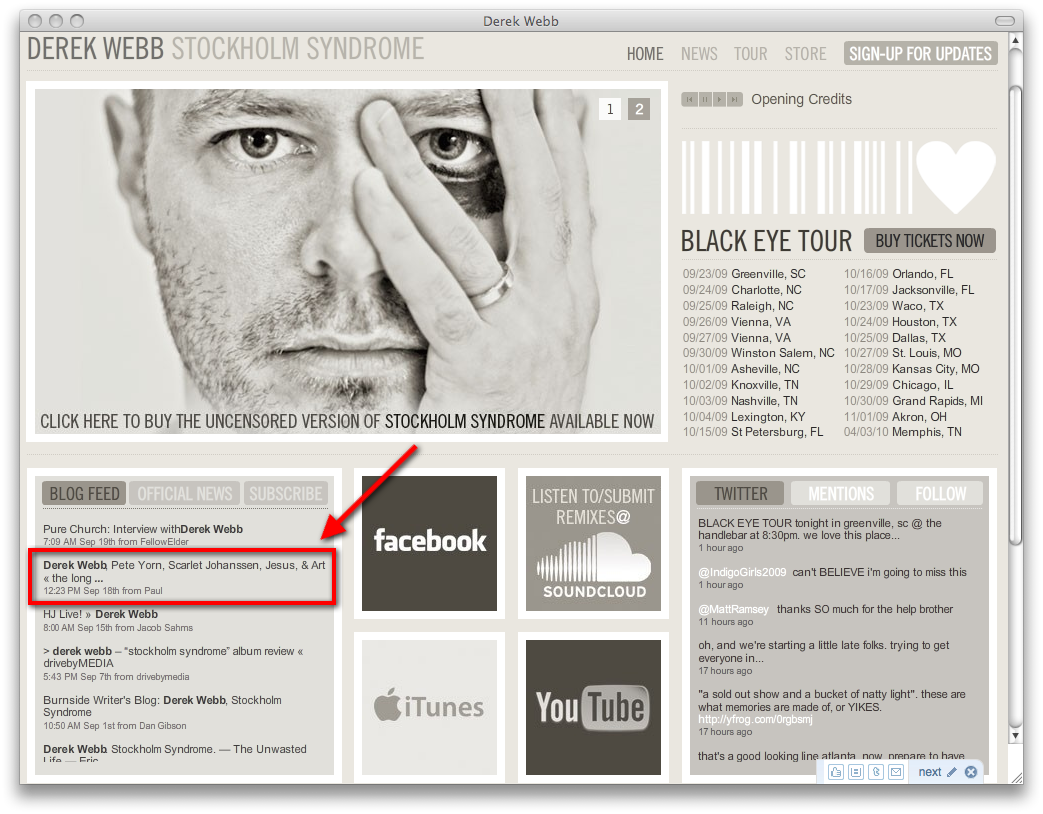
i made it on Derek Webb’s homepage!


webb shot

Well, that was exciting.  I noticed a huge jump in visits to my site and saw that I was getting traffic from Derek’s main page.  So, I jumped over there and saw that he has a blog feed going.  It linked to the article I wrote last week on his thoughts on art in a recent interview.  No doubt the feed just crawls the web for keywords and puts up links to any ol’ page that finds his name in the title.  I doubt he has actually read any of my stuff.  So far I only know of one “celebrity” that’s commented here.

But still, I thought it was cool.  My little 15 minutes . . .

btw- “Beauty” part 9?  On the way in a few minutes.

Derek Webb, Pete Yorn, Scarlet Johanssen, Jesus, & Art


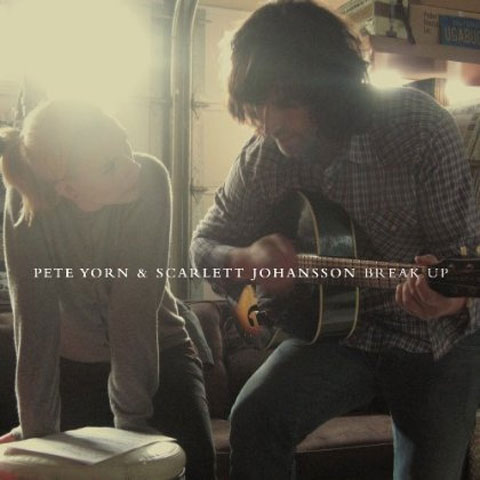
Break UpThe Mockingbird blog did a great interview with Derek Webb that was published today.  It seems like every interview he’s been doing has consisted of the same content, but this seems to have a few original questions in it.  It’s really enjoyable.

This was my favorite quote from the whole thing.  It’s a very biblical view of “Christian art” and it resonates well with my recent article on the Beauty of Art, so I thought I’d share it with all of you.

As an artist, my job is to look at the world and tell you what I see. Every artist, regardless of their beliefs, has some way that they look at the world that helps them make sense of what they see. A grid through which they look at the world which makes order out of it. For me that’s following Jesus, for other artists it’s other things. It could be anything, but every artist has that grid. Most Christian art unfortunately is more focused on making art/writing songs about the grid itself. As opposed to writing songs about what you see when you look through the grid. I’m more interested in looking through the grid and telling you what I see.

In other art news, I can stop listening to the new Pete Yorn/Scarlet Johanssen duet/compilation album Break Up.  It’s pretty phenomenal.  Expect a review here in the coming days. You can listen to the entire thing online here.  I know Scarlet’s received a lot of crap about her voice and singing ability, especially after her solo album of Tom Waits covers called Anywhere I Lay My Head.  Personally, I love her voice.  I think it’s amazing, refreshing, and seductive.  Here, try this random single she did called “Last goodbye” (I have no idea where it’s originally from.  Sorry.):

Enjoy the quote, links, and audio and let me know what you think.

“Letting Seminary Doctrinally Change You” & Controversy – GoingToSeminary.com


Remember “that” article I was talking about last week?  The one that may begin some “controversy” at GoingToSeminary.com?

Well, it’s up now.

It’s part one of two on a little series I’m writing on doctrinal changes while in seminary.  As I said then, I’m more concerned about this next article than this one.  If it even comes out.  In an hour and a half I have been called upon by the “Vice President of Advancement” and “Associate Professor of Systematic Theology” of Westminster Theological Seminary, David Garner to grab some lunch.  I have no idea what the topic of conversation is (and the one time I’ve asked, he never answered), but I’m optimistic.  He has always been one of my favorite professors I ever had and has one of the most pastoral, worshipful, Christ-centered hearts I’ve ever seen in a man.  I look up to him greatly as a pastor, preacher, teacher, husband, and father.

But, he is very much on the side of the issues at Westminster that I am not.  So I’m wondering what this is about.  I haven’t been that vocal against WTS have I?  I feel like whenever I have I’ve always made it clear that this is my opinion and I that I know I’m still young, arrogant, and don’t know anything.  I don’t know.  We’ll see.  I may let you all know.  But, in the meantime, read and enjoy the article “Letting Seminary Doctrinally Change You” at GoingToSeminary.com.  Here it is:

Letting Seminary Doctrinally Change You

Check out the rest of my Going To Seminary posts.

NPR, News, & the Politics of Change


npr search

I encountered one of the most fascinating things the other day. In the picture above (click for a larger version), you will see a search I recently did on Twitter for “npr”. I was trying to find their various Twitter accounts so I could follow, get news updates, and the like. I was shocked to see that with 1,448,766 followers, NPR’s Politics account is by far the most popular. NPR News is a distant second with only 123,086 followers.

Why is that?

This has been giving more pause than it should. Why are there more than ten times as many people wanting to follow NPR Politics than NPR anything else? Of course, there are many factors I don’t know that could contribute to these results. The Politics account could be the oldest account, and the News one being a relatively new one. They all could have been started around the time of the election. The Politics account could have been advertised more. I don’t know, but still: would those variables fully account for the inequality?

Are Americans really that much more interested in Political news as opposed to general News? Actually, maybe. I know that prior to this election, I only got obsessed with politics for the five or so months leading up to voting night, and then dropped it like a bad habit the next morning. But not this time. For some reason unbeknownst to me, I have kept up with my political engagement – perhaps increased it, in fact. My personal addiction to NPR, The Economist, the Politics section of the New York Times and Slate magazine, various editorials and opinion columns, and all things Social Justice-y has only increased since November.

Could this be a reflection of the amount of hope and anticipation a completely new guard promised to bring? That Americans freely ascribed to? That all of us knew was needed? Perhaps. Personally, I think that the academy is moving past postmodernity into what I’m currently calling “neo-pragmatism” (some good friends would rather call it “critical realism”, and they have some good points). But either way, I feel like modernity preached to us the mind, postmodernity the heart, and now “neo-pragmatism” the legs. In short, I think people are seeking a “whatever works” approach. The great fulfillment promised by the previous two major philosophical epochs never happened, so now people are willing to do whatever it takes – throw off any convention, question so many presuppositions, and change ideologies – in the hopes that something might actually effect change and lasting growth in our lives.

Perhaps this simple Twitter search is a reflection of this? Maybe there really is a much greater interest in the mechanisms of change in the world because people know we need it, they want it, and want to know how their leaders are trying to help them accomplish it. Need I mention more than Obama’s campaign-winning slogan? It wasn’t Ideology you can believe in or even Truth you can believe in. It was Change. And politics is much more likely to accomplish change than news (for better or worse).

I think we’re right in looking for change. I think we’re right in looking for that which will actually be readily applicable in our everyday lives. I think we’re right in looking for what works.

I just fear we’re looking in the wrong place.

The Contemplation of Beauty{8}


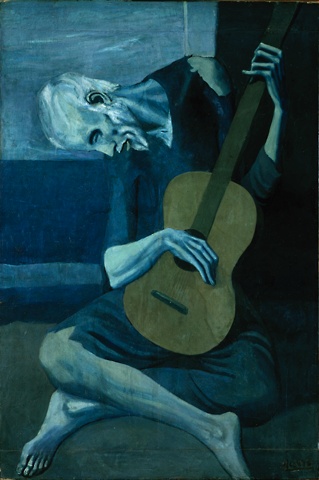
Picasso - The Old GuitaristSorry for the brief hiatus.  I don’t quite know what happened.  Probably just getting used to work and a new schedule and everything.  I have a few “lighter” articles in the works for the next couple of days, plus I’m working on more substantial things for other sites.  I’ll let you all know.  But now, back to beauty.

Last we left the Beauty series, we were discussing the proper way in which to respond to it.  Though there’s no absolute “most proper” way to respond, I used our main Biblical text that we’ve been looking at, and an idea developed by C.S. Lewis to break down our response into two useful categories: contemplation and enjoyment.  Before we enjoy, we contemplate.  This is not to say we can’t enjoy anything apart from comprehensively knowing it, but it does say that a contemplation and exploration of things helps us enjoy them more fully; and to be enjoyed to the fullest is the ultimate desire of Beauty itself.  But what does this contemplation look like in real life?

Let’s recall our defintion of Beauty as the attribute of something that expresses complexity, simply.  It’s what takes the complex unwoven strands out there in reality and weaves them into a tapestry that we can perceive with our spiritual and physical sense.  The more strands are woven more simply, the more beautiful that tapestry is. So in its most basic form, the contemplation of Beauty is thinking through what “strands” or what “complexity” is being represented in the thing in front of you.  So what does it look like? Well, formally, in philosophy, this endeavor is called “Aesthetics” or “Metaphysics”. It’s the philosophical study of Beauty and Beautiful things.

In the real world, for the rest of us, I thought of two ways this could look. First, when presented with something that your senses find beautiful, ask yourself, “What is it that’s actually being stirred in me?” Is it romance? Sorrow? Reminders of childhood joys? That stirring is your soul resonating with the strands that are in the tapestry in front of you. This is what art critics are really good at doing: teasing apart the strands that make up any given piece of art. The second way I could see this look is when you are encountered with something or someone that everyone seems to think is so beautiful but you just don’t get it. Maybe it’s the Mona Lisa. You may think: “Yeah, it’s a good painting, but what’s the big deal?” Maybe it’s some piece of abstract art that everyone else is swooning over but you. Maybe it’s a book, poem, or song you just don’t understand. In this case, I would encourage you to do research, read criticism, and try and understand the complexity behind the tapestry that others are noticing, but not you. It seems like people that know Music theory really well seem to like Jazz and Classical more than others. It seems like trained poets like weird abnormal poetry. The better you can understand the complexity in something, the easier it is for you to appreciate and ultimately enjoy the fullness of its beauty. This is why I would encourage all of you to be very curious about as many topics as possible. It’s not for the sake of more knowledge, but so that you can better enjoy the world around you and see it’s Beauty in everything.

Now, what I just went through is more for our everyday use and understanding of subjective, created Beauty. But more importantly, we must learn what it means to contemplate the Beauty of God. In Christianity this endeavor is called “Theology”. If Theology is (as most people know) “the study of God”, then it by definition is the study of Beauty Itself. This is what Theology was meant to be. It’s the kind of theology God calls us to do. Theology is the contemplation of the various complexities and revealed “strands” of God in order to better enjoy Him. John Calvin talks about this in his Institutes of the Christian Religion. He says that if your quote-on-quote “theological study” isn’t leading you to greater praise and enjoyment in God, then you’re not really studying theology! At that point it’s just studying literature – getting a better idea of this “character” named God in this “novel” called “The Bible”. This is why I had to leave seminary. I was in the midst of such beauty and I was numb to it! I was too immature. I didn’t have the spiritual infrastructure to see it for how beautiful it was! This infinite complexity being placed in front of me day in and day out was not leading me to enjoy Him. How many of us live day in and day out surrounded by the objective beauty of Christ and it does nothing to us? This contemplation of the Beauty of God can help us. Just yesterday our brother Marc Savage sent that group text (I have no idea how many of you got it) with this quote from Charles Spurgeon: “There is something exceedingly improving to the mind in a contemplation of the Divinity. It is a subject so vast, that all our thoughts are lost in its immensity; so deep, that our pride is drowned in its infinity. No subject of contemplation will tend to more humble the mind, than thoughts of God.”

May I challenge all of us to press in and seek the complexities of Who this God is and how He has revealed Himself? Understanding the beauty of God is of the utmost importance to the Christian, because His beauty is completely pointless. It can’t be manipulated, used, or abused. It can only be enjoyed. Something I’ve learned over time: whenever spirituality of any kind goes awry and goes off track, the Beauty of God is one of the first things to go. The inability to accept the mysterious complexities of God is the beginning of all heresy. You can’t have a right enjoyment of the Beauty of God and be a legalist, libertine (someone who abuses grace), or a hypocrite. Seeking to enjoy the Beauty of God is a guard against all these things. In my reading, one of my favorite things I came across was from a Catholic theologian named John Navone. He says in his book Toward a Theology of Beauty that Christian theologians (which I would argue should be all of us) are people given the task of articulating and putting into words how everything in life is given to us by God. Navone calls this the “givenness” of life and selfhood. This means that all of life is grace – unmerited favor; and that even things that are usually seen as secular (types of visual art, media, culture, jobs, and types of “non-Christian” music) are actually things that “mediate the mystery of the dawn of Christ’s Kingdom, as epiphanies or manifestations of grace. We as theologians [(and I would argue as artists and beholders of beautiful things)] are charged with the task of ushering in and articulating the mysteries of beauty which we will rest in forever.” That’s amazing. He goes on to say that “Theologians [(and I’d say even Christian artists)] are engaged in a dialogue, not only with their public, but with the object of their contemplation.” This should be one of the distinguishing factors between artists that are Christians, compared to those that are not: non-Christian artists can only use their art to dialogue with other people (speaking horizontally) and other art (speaking down). Only the Christian can make art with the confidence and hope that it also speaks and dialogues upwards to a God pleased to see, hear, or watch it.

Now what if you’re hearing all this, but you wouldn’t say you’re a Christian. First, if your interest has been piqued, but you just don’t get it, I’d give you the same encouragement I gave to those earlier that don’t understand the Beauty of things that others find beautiful. Learn about this God. Stick around. Ask questions. Seek answers. Try to see the infinite complexity of this God and how simply he has revealed Himself. Look into how He has revealed Himself and start to pick apart the strands of the incredible tapestry he has revealed Himself as. Secondly, let me encourage you: there is objective Beauty. You heart yearns for it and longs for it, and it is out there. Objective beauty is when the fullest possible complexity is expressed to us. So God – infinite complexity – is that objective Beauty Itself. But people don’t know full objective beauty before they know God. This complexity cannot be comprehended until God changes someone to comprehend it. If you’re not there yet, that’s fine. Pray. Ask God to change you as He has changed many of us. Contemplate this God. Contemplate His world. Contemplate all Beauty.

Why?  So we can enjoy Beauty.  I’ll see you next time.

Here are the manuscript and lecture that this series is based off of.

Click for Manuscript Pdf

Manucscript

Click here for sermon audio

Audio

How Do We Respond to Beauty{7}?


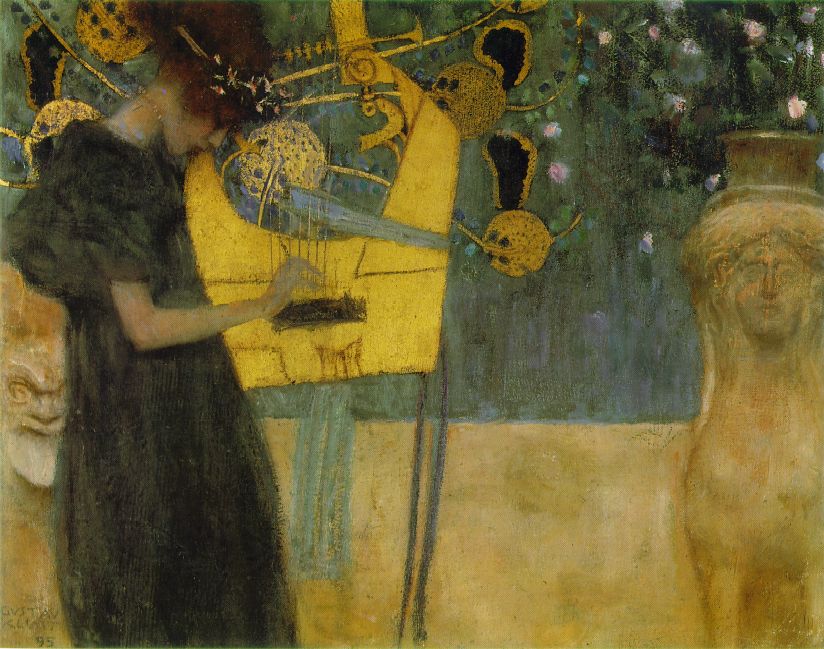
Klimt - Music 1

_______________

Wow. We have covered a lot of ground so far. We’ve discussed what beauty is, what things are actually beautiful (God, Nature, Humans, Art), and why they are beautiful. But there’s one more very important thing left to discuss (that will take a while to unpack): how are we meant to respond to Beauty? We used our text (Ecclesiastes 3:11-15) to give us a context to figure out a definition of Beauty, and then we applied that definition to different things, so let’s go back to it and see how we are supposed to respond to this beauty.

“He has made everything beautiful in its time. Also, he has put eternity into man’s heart, yet so that he cannot find out what God has done from the beginning to the end. I perceived that there is nothing better for them than to be joyful and to do good as long as they live; also that everyone should eat and drink and take pleasure in all his toil—this is God’s gift to man. I perceived that whatever God does endures forever; nothing can be added to it, nor anything taken from it. God has done it, so that people fear before him. That which is, already has been; that which is to be, already has been; and God seeks what has been driven away.”[Ecclesiastes 3:12-15]

The ultimate response, the final goal, of seeing all the Beauty God has put in our hearts, put in the world, and is doing in and around us, is joy and doing good. But the writer did something before he could declare this: he thought about it and “perceived” this to be the case. You see this in the final verses of this section as well. After declaring the joy that should come from seeing Beauty, he then steps back and sees the bigger picture. He tells us what first must be true about God if we are going to ultimately respond to beauty the way we should.

Reading this reminded me of something C.S. Lewis once said. In one of his philosophical works (I honestly don’t remember which one) he says that humans interact with things by contemplating and enjoying. He says that they cannot do these things at the same time though they can rapidly move back and forth between the two. I think this is a great way of saying what the author in Ecclesiastes is saying. We first must “perceive” (or contemplate) Beauty and then we enjoy the Beauty that God is making all things into and that he has placed into our hearts and world. Often, this distinction between contemplating and enjoying happens so rapidly that it seems like it is happening at the same time, so don’t worry, I’m not necessarily saying that you can’t enjoy beauty before sitting down and thinking about it, researching it, and writing out some paper something. Even before contemplating something and learning its complexities you can enjoy the Beauty of something. But this is the same way that a husband can enjoy his wife on the first day they’re married, but he must spend time and effort after that contemplating and getting to know his wife, so he can enjoy her more fully and more comprehensively. Contemplation is not necessary to enjoy at first, but it is necessary to enjoy fully.

I know this was a brief post. It’s just because the next several sections are substantial enough to deserve their own posts. So, mull on this for a while, read some other new posts of mine at Reform & Revive and GoingToSeminary.com, and Monday we’ll go really in depth into the contemplation of Beauty and beautiful things.

Click for Manuscript Pdf

Manucscript

Click here for sermon audio

Audio

uh…about that article I talked about yesterday…


Some may have read my post yesterday about my upcoming article on GoingToSeminary.com.  Well, I also mentioned that the site was changing servers all day yesterday, and in the process they lost a few articles . . . including mine.

They’re still down with posting it, I just need to send it to them, which I am about to do right now (here’s a lesson for all you bloggers out there: always do your writing in some other program and save a copy on your hard drive).  But, this being the case, I have no idea when it will actually go up.  Hopefully in the next couple of days.

But not today.  I’ll let you all know when it does.  And . . . I am currently working on the next Beauty post to put up in the next hour or so.  See you then!

–paul

Controversy, Controversy, Controversy at GoingToSeminary.com


old lady

Update: The two posts mentioned in this article are now up. “Letting Seminary Doctrinally Change You” and “Seminaries & the Nature of Truth“.

Yep, it’s a double-post sort of day.  (let’s just say I’m making up for Labor Day.)  But this is a personal one.  I’m asking for some prayer.

At publication time for this post, the site GoingToSeminary.com is currently changing servers, so it’s down.  It was just bought by the somewhat Lutheran and fully online Rockbridge Seminary, sold by my good friend (and former campus minister) Ryan Burns of Design Simple.

As some of you know, I am a Contributor for the site, and my articles have tended to be pretty weighty.  I don’t know why.  It hasn’t been purposeful.  I suppose when I think of seminary it tugs at my urgent pastoral heart more than the light, fun, twentysomething heart; and this has been evident in the posts.  From what I can tell, my last article “Realizing Seminary’s Not For You” has received more comments than any other single article that I can find on the site, and those comments were fiery.  I got blasted from every side (and defended by many – thank you all, by the way).  A couple of people even compared me to an unfaithful Israelite who saw the giants in the Promised Land and got scared.  Another, in light of my severe disappointment in Westminster Theological Seminary as an institution, said that apparently I don’t know good doctrine when I see it.  In short, it caused some controversy.  I really try not to seek such controversy, and I never thought that post would spurn such heated discussion.

But –

Tomorrow’s another story.  Tomorrow my new article is going live on the site and I’m fairly sure this one will ruffle some feathers.  In fact, I’m shocked Rockbridge went ahead and decided to post it.  Kudos to them.  It will be very easy for this article to be misunderstood on both sides: those that think I go too far, and those that think I don’t go as far as I am in fact trying to go.

The article is a discussion of how to let seminary doctrinally change you.  To do this, I very consciously employ postmodern thought into my own thinking and advocate others do so as well.  It’s very touchy and I am not wholly confident that I phrased myself as articulately as a more experienced writer may have been able to.  I guess we’ll see over the next couple of days.

But, I’m actually not as concerned with this article as I am with the follow-up article I am about half-way through writing.  In the first article I lay out the responsibilities for the seminarian in this respect; in this second one, I talk about the responsibilities of the healthy seminary institution.  And in doing so I am directly taking Westminster to task for how they have abandoned the principles I lay out in this first article.  I’m sort of doubting Rockbridge would run it on the site, but who knows?  Westminster’s a competing institution and Rockbridge is marketing themselves as a seminary for the 21st century, so we’ll see.

All that to say, look for my article tomorrow at GoingToSeminary.com, and please pray for me if you could.  I’m still young and arrogant, and I need the spiritual support.  I’ll also link to the article tomorrow.  Until then . . .

My Official Review of “Fearless” by Max Lucado at Reform & Revive


Look at that face.  That’s Max Lucado.  And I just reviewed his new book Fearless.  You can find the review here at Reform & Revive.  Some of you may have read my “Review Preview” and now are wondering why on earth I’m putting up this little post, just to send people somewhere else for the review.

Well, that “Review Preview” got a lot of hits due to search engine traffic.  That means that this site will appear sooner in a search for the book than will Reform & Revive.  But, seeing as reviews of this sort are much more in line with the mission and purpose of R&R, rather than that of this bog, I thought it was more appropriately posted there, and not on this blog.  So, I’m putting up this post on the off chance someone meanders here due to a search engine.  So, if you have fallen victim to such an off-chance, you can find the review at my webzine, Reform & Revive, found at the link below:

http://reformandrevive.com/2009/09/08/review-fearless-by-max-lucado/

By the way, for those that have stopped by for the next part of my Beauty series, you will find the next installment here tomorrow.  Probably.  Well, technically, my review of John Navone’s book Toward a Theology of Beauty counted as the “next installment”, but I’ll write another tomorrow.

Review: John Navone’s “Toward a Theology of Beauty”


In my attempt at writing shorter and more frequent posts (rather than feeling the burden to produce daily meaty posts), I thought I’d put up this little review of a little book (91 pages) I just finished called Toward a Theology of Beauty by John Navone (1996, The Liturgical Press).  I had originally started reading it for the Beauty message I gave, but I never finished it.  As time went by, though, the things I had read in this book began creeping back into my thoughts, so I decided to finish it, and let me tell you, that was a good call.

This is an incredible book. I’m still in awe of it. It seizes your soul and takes it to the highest realms of the mind and heart of the Beautiful Triune God. I have almost an entire journal filled with notes I have taken form this book.  I will look over these notes often for years to come, to let myself get swept away by the ideas present here.  Navone doesn’t have progressive outline, so it’s difficult to lay out exactly everything he talks about.  The best thing one could do is shoot over to the Amazon.com page for the book and “Look inside” to peer at the Table of Contents for his topics.  Suffice it to say, the book is theologically comprehensive.  It doesn’t answer many of the more practical questions we may have about art, human beauty, and such, but it does help in a much greater understanding of the more ethereal and abstract realities of Beauty, especially as it originates in and delights God Himself.

I guess my only critique is a common one I had with most things I read during my preparation.  It assumes the validity, and authority of ancient Greek philosophy, especially the distinction between the True, the Good, and the Beautiful.  He uses this Hellenistic concept throughout.  Many things I read used this “trinitarian” framework to shape and organize their thoughts.  I don’t know how valid this is and I would argue this limits us in many ways.  but this is minor, and doesn’t really take away from the wonder and awe of this book.

Navone is a Catholic theologian, and if I learned one thing from reading this book, it’s that Catholics understand Beauty in a way that only 2,000 years of thought and reflection can provide. We Protestants can learn a lot from our Catholic brothers and sisters. Heck, after reading this, I’m practically Catholic now myself.

Navone’s writing is beautiful, his thoughts profound, and theology rich. I highly recommend this book to anyone looking to increase their worship of a Beautiful Transcendent God.

Ah, the Beauty{6} of Art


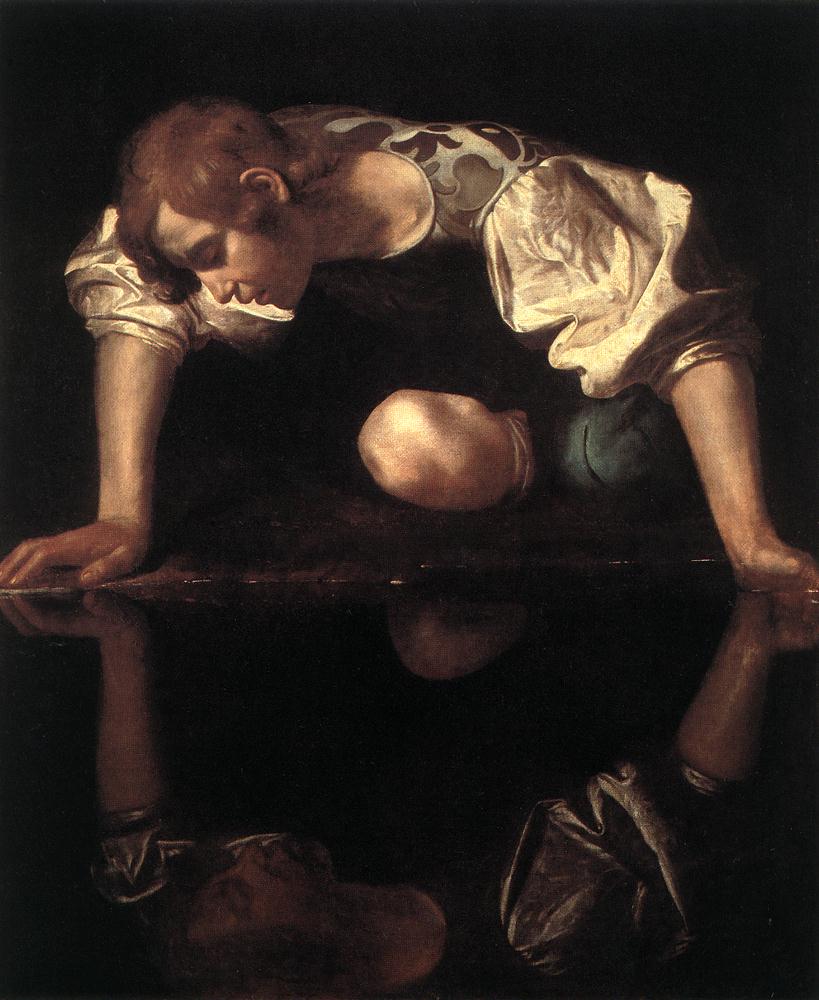
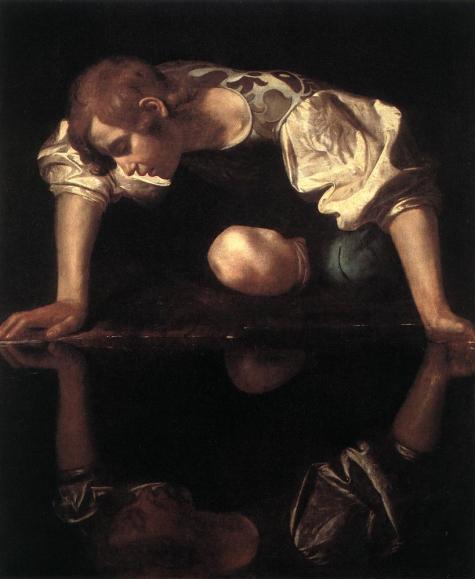
Caravaggio - NarcissusThis is the next installment in the Beauty series (for the complete series, click here).  This is based on the manuscript I wrote for a message I gave at Epiphany Fellowship in Philadelphia (links to both the manuscript and the audio are at the bottom).  We’ve gone through a lot so far, including a discussion of why we long for Beauty, a definition of Beauty, and how science and nature are beautiful.  This series has received great feedback from people (and it’s only about half done!).  So feel free to jump in and comment and keep the discussion going.  Today’s post is on the beauty of Art.

_______________

Humanity’s creations are beautiful.This is where we get to talk about art.

For some reason (I have no idea why) this was actually the very last section I worked on.Whether that means it’s a lot better or a lot worse, I don’t know.Anyway, art is a really tough thing to talk about.Its a huge topic that everyone has an opinion on, and as time has gone on, the conventions of art and what it is have broken down and definitions have broadened almost to the point of not really being definitions at all.Not only this, but you also seem to have people forgetting some very important things that we all must be reminded of.

First off, we are too quick to call God the “Supreme Artist”.That’s taking a description of humans and describing God with it.We’re right in starting with him in trying to understand art, but seeing Him as the “Supreme Artist” generally makes us picture in our minds the type of artistry we like best, and then begin thinking that God values that kind the most.This ends up being a bottom-up kind of description of art rather than top-down.Before God is Artist, He is a Creator, so we must start thinking of art creative-ly.This means that the way God is an artist is by making things that are not him and weren’t around before.So when I refer to God as Artist, that’s what I have in mind.

Secondly, we must keep in mind that God Himself was the first abstract artist.I kept reading all these books and articles written by Christians about art and so many of them seemed to not have room in their “theologies of art” for the abstract.The opposite of “abstract” art is “representational” art – art that “re-presents” something we know exists.When God did His artistry, it was all abstract.There was nothing to “re-present”So that being the case, I can’t think that God isn’t glorified in even the most abstract of art.There may even be an argument that abstract art is closer to the heart of God than representational.I’m not making that argument, but someone could.

Thirdly, as most Christians recognize, we create things because God does.In the first passage in the Bible that talks about people being made in the “Image of God” in Genesis 1:27, the logical question that follows is: what exactly does that mean?Now, theologians and philosophers have argued about this for thousands of years, and I’m not going to try and finish that fight right now, but I will say that it’s interesting that at this particular time in Scripture that this verse shows up, there’s only one thing we know about this God that humans are apparently in the “image of”: that He has the desire and ability to make things.I imagine that’s where we get our desire and ability.As G.K. Chesterton points out in his book “The Everlasting Man”, whatever role evolution may have played in the development of this world, it can’t by itself explain art.You don’t see monkeys in caves making bad art and humans now making good art.There’s something about art that reflects what makes us unique among all created things.

So when we do create and we do make, what does this have to do with beauty?Everything.I really do believe that art, like science, is a necessary endeavor in furthering God’s plan in History.God’s creation merely points to God’s Beauty.It doesn’t make beauty itself.Humans, on the other hand, actually make beauty and play an integral part in God “making all things beautiful in their time“.Let’s go back to our definition of “Beauty”:Complexity expressed simply – many complex strands woven into a sensually perceived simple tapestry.  The more complexity of “strands” that are represented in a piece of art, the more beautiful it is.And remember- different people, due to many factors, will find and feel different “strands” running through different pieces of art, leading to different personal aesthetic standards for each of us.

So imagine every strand in the universe is there before an artist preparing to do a piece.You have suffering over here, hope here, joy here, God, evil, life, humanity, death, birth, redemption, pain – all there before the artist.In art, the artist grabs as many of those strands as they can and crams and weaves them into the piece.And the more there are, the more beautiful it is.That’s why many people don’t like Postmodern art.There’s no complexity.It’s too simple and says nothing.There are not enough strands in it to strike the heart of a person so they can actually call it beautiful.A complexity of ideas makes art beautiful.In the Preface to The Picture of Dorian Gray, Oscar Wilde writes out his thoughts on Beauty and art.He writes: “It is the spectator, and not life, that art really mirrors.Diversity of opinion about a work of art shows that the work is new, complex, and vital.When critics disagree, the artist is in accord with himself.”Though I disagree with Wilde on some of what he’s saying, nevertheless he is noticing that different strands in any piece should resonate with different people.Some people will be offended.Others will praise it.It’s just the way beautiful things are. After all, it’s how God and the Gospel are.

I’ll end this oh-too-brief section on art with a few comments on the distinction between “Christian” art and “secular” art.As Phil Ryken, just down the street at Tenth Pres writes in his book Art for God’s Sake: Bad Christian art “ultimately dishonors God because it is not in keeping with the truth and beauty of His character.It also undermines the church’s gospel message of salvation in Christ.”How? Well, the kind of modern art that most Christians scoff at is art that is completely void of goodness, light, and truth.But Christian art tends to do the same thing by being void of other very real things in this world: depravity, pain, and sin.When our art shies away from these things, in effect, we’re avoiding showing the world what they need salvation from.Jesus didn’t come to save some cute coffee mug or bumper sticker kind of world.He came and suffered, bled, and died an ugly death that we celebrate as the most beautiful event in all of history.We must make room in our art to explore the darkness and pain of this world so we can show them that Christ can and does engage and enter into brokenness to see it redeemed.

To conclude, recall what I said a couple of posts ago on the structure and nature of history and time?  History is not the story of the present hurtling through time towards some future endpoint we call “heaven”.  Rather, it is the beauty of that future world invading the present, even as we sit and read this.  If “Beauty” is the end goal for which God is making all things in their time (Ecclesiastes 3:11), then whatever floods the world with Beauty is actually furthering this process of redemption.  Artists, both saved and secular, are actually missionaries of sorts, as they help reweave the fabric of the universe with the beauty of their creations.

Are you all starting to see why we need artists?Good artists doing good and beautiful work; and not trite, kitschy, cute things that keep us away from the real world out of fear that we might “catch it” or something?A creation always reveals something about its creator.If you are a Christian reading this right now, may I urge you to show the world through your creations that you have been saved by a Gospel that makes you care about excellence engaging darkness, beauty engaging filth, order engaging chaos, and redemption conquering sin?Let our art, our creations, speak of a beautiful work that a beautiful God has done in us, whether or not it is an explicitly “religious” piece.

Art is beautiful, and necessary for the redemption of this world.

Resources for this series:

Max Lucado’s “Fearless” and my heart (a review preview)


I’m a book reviewer for Thomas Nelson Publishers.  A few weeks ago I received a pre-publication copy of Max Lucado‘s upcoming book “Fearless“.  I hate so much about Christian “culture”, especially its commercialism, cheesy cliches, seemingly naive treatment of the fallenness of the world, and an inability to know and apply a deep understanding of the Gospel.  For years, admittedly, Lucado has stood in my mind as a representative of much of this.  I have, with little engagement with his material (other than his children’s books), tagged him as such a man; and in a certain way, he is the cheesy, cliche-ridden, mass appealing writer I have assumed (as is evidenced by this official site for the book), and the official trailer found below:

Let’s just say it’s been a big change going from Francis Turretin, John Calvin, and Herman Bavinck to Max Lucado in a matter of months.  Anyone that knows me knows that it has been a long journey through many frustrations with mainline evangelical culture to teach me how to love the Bride of Christ.  And I’m still learning.  I have belittled her, talked her down, mocked her, and ridiculed her in the most shameful of ways.

And this book has been a healing process for me.  Not giving away too much of my upcoming review when the book’s released, I just want to say that this book is amazing.  Save for the first few chapters, I have been shown that even amidst bad jokes, inadequate metaphors, “simple” writing, and an over-commercialized release (including shirts, calendars, mugs, study guides, DVDs, children’s books, teaching curricula), there can be poetry, depth, a real exploration of the human condition, and beautiful articulations and applications of the deepest, most precious truths of the Gospel.  Lucado has shocked me.  And taught me.  And helped me.  And stirred me for this God, His Gospel, and all that it supplies us.  Though I may be going against the fine print in my publisher’s agreement in doing so, I want to share with you all my favorite few paragraphs from the book so far:

A calmer death would have sufficed.  A single drop of blood could have redeemed humankind.  Shed his blood, silence his breath, still his pulse, but be quick about it.  Plunge a sword into his heart.  Take a dagger to his neck.  Did the atonement for sin demand six hours of violence?

No, but his triumph over sadism did.  Jesus once and for all displayed his authority over savagery.  Evil may have her moments, but they will be brief.  Satan unleashed his meanest demons on God’s Son.  He tortured every nerve ending and inflicted every misery.  Yet the master of death could not destroy the Lord of life.  Heaven’s best took hell’s worst and turned it into hope.

I pray God spares you such evil.  May he grant [you] long life and peaceful passage . . .. But if he doesn’t, if you “have been given not only the privilege of trusting in Christ but also the privilege if suffering for him” (Phil. 1:29 NLT), remember, God wastes no pain.

Amazing.  Look for my review September 8.  In the meantime, you can order the book here, and read some of the ebook here.

Facebook Friends, sorry for the inconvenience


screen-captureMost of my friends on Facebook probably think I just write a lot of Facebook notes.  This isn’t actually the case.  As many know, I have a personal blog, “the long way home“, that I write everything on.  Facebook has a great little feature where it will import the RSS feed from this blog into Facebook as a note.  So, long story short, I write a post on the blog, it shows up in Facebook as a note.  I never actually touch the Notes feature.  But there’s a problem with this.

When the feature first came out, there was a prominent “View Original Post” button attached to the facebook note.  Clicking this would take you to the blog itself.  Alas, as time has gone by, this button has grown smaller and more obscure (you can find it now on the very bottom of this Note next to the “Like” and “Comment” links.  This has caused fewer and fewer people to go to the actual site, because they can just stay on Facebook and read.  This causes many problems on my end.  So, after today, I will no longer be importing my blog posts to Facebook.  Read on if you care to know why.

First, formatting.  I format all my posts based on how they look on the blog, not on Facebook.  This means that embedded images, videos, and audio either get all jacked up, appear merely as links, or don’t show up at all.

Second, there are many resources and links that I provide on the blog in the sidebar and in the various pages.  Of course, these do not import to Facebook, meaning that there’s a whole dimension of engaging with the content that’s lost to the casual Facebook reader.

Third, it’s tough maintaining two separate audiences.  I get far more people leaving comments on the Facebook version of posts, and these comments only stay within our little particular corner of the Facebook community.  Having these same discussions on the blog let the rest of the world engage and broaden the conversation.  Also, there have been several occasions where blog visitors have left similar comments as people did on Facebook, so I’ve had practically the same conversation running in two separate places at once.

Lastly, and most importantly, tracking who reads what on the site.  This is not about needing the praise that comes with knowing people have read something of yours.  Anyone that has a site knows that knowing where the traffic comes from and what it’s reading is so important to knowing in what direction you should take the site.  I really have no idea how many people actually read what I write and this is frustrating.  I may go for weeks or years putting a lot of thought and energy into a particular series of writings, not knowing that nobody is actually reading them.  That’s a lot of wasted time that could be spent writing about things that will actually help people.  Also, I have a couple of sites I write for, and it would be great to know how much traffic each one gets so I can post appropriate writings in the appropriate places.  With more people visiting and linking to my actual site instead of just Facebook notes, this will also increase my exposure on search engines thereby driving more people to the site and to possible helpful resources.

Those are all the reasons I have decided to stop importing my posts to Facebook (after this post).  I will still put up a note each time I write, but it will only have a brief summary of the content and a link to the blog.

We’ll see how this goes.  If the number of people actually reading things on the site doesn’t jump up significantly, or if people make a big stink over it on Facebook, I may put it back, but in the meantime, I just want to see how this goes.  Links to the posts will still appear via the Facebook App “Networked Blogs” as well.

Sorry, if this isn’t as convenient.  Feel free to leave me your input.

Human Beauty{5} | (Anthropological Aesthetics)


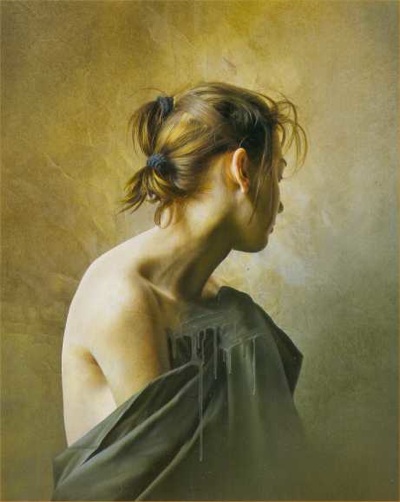
Sandorfi - Ange-smallerOkay, I’ve realized that I’m only about half-way done with this series on Beauty, so after this week, I’m going to make this into a once-a-week series for the rest of its duration. After Wednesday, after we talk about art, the theoretical foundation will be laid and the rest of the series is merely application. So every Monday, I’ll post the next part. I want to do this so people don’t get tired of it, so I can talk about the many other things rolling around in my head, and lastly, I want to do this so that people will actually engage the material and have time to digest it.

With that being said, this is the next section in the series on the Beauty of humanity. You will not find the usual bold/regular font distinction I’ve had to make in the other parts of this series because pretty much all of this is new material I didn’t get to cover in the message. I know this is all very inadequate. If I ever turn this message into a book or something, I’ll be fleshing this out a whole lot more. A few nights after I gave the message this whole manuscript was based on, I ended up talking to my roommate for about an hour further unpacking these ideas about physical beauty to him. He pretty much received an hour long lecture full of material that was in neither the message nor the manuscript. All that to say: there’s far more application of our working definition of beauty that could be made concerning human beauty, and far more questions that can be answered. Maybe someday I’ll engage some of those, but for now, I’ll just put this up and answer any specific questions as they come. I hope this is helpful. You can find the whole series here. Once more, links to the full manuscript and audio of the message are below.

Humans are Beautiful.

Humans are the crown of God’s creation. In the opening chapters of Genesis you see that with each day of creation, what God creates grows increasingly complex and nearer to the heart of God, until you reach that final creative act, where God intimately makes humans in his very own image. We can’t lose this. All humans have dignity, worth, and beauty, no matter where they end up eternally. God loves all humanity, and so should we. Being image-bearers gives us all innate worth and innate objective beauty. But, as we are all very aware of, humans also have a very subjective sense of beauty as well. This is where we get to talk about physical beauty briefly. Though I can’t do full justice to this topic here, I’ll try to give you some tools to better think through these things on your own. I know there’s a lot of brokenness over this issue in this room. Lots of pain and baggage that I wish I could deal with more. People who’s beauty has been abused or insulted. People who have used their own beauty to fill that eternity in our hearts, but to know avail.

Though I can’t hit every issue involved in this, I do want to say two main things that I hope are helpful. First, remember our definition of Beauty? Beauty is complexity expressed simply. Everything about us is always expressing the almost infinite complexity that comes from being human. Physical unattractiveness, it seems to me then, is when this human complexity is not physically expressed very simply, orderly, or harmoniously. Does this make sense? Is it not true that the ideas of “ugliness”, “grotesqueness”, and similar descriptors carry with them a sense of “busyness”, “disarray”, and “too much going on”- the opposite of simplicity and order? I say this not only to give an understanding of physical unattractiveness, but to to remind us that our physicality expresses parts of our humanity. In the tapestry of being human, our physicality – how we carry, dress, make-up, and build-up ourselves – emphasizes and expresses different strands within that tapestry. What parts of the beautiful artwork you are are you trying to accentuate and emphasize with your physical beauty? Your own strength? Your ability to draw eyes to yourself? Or do you use your beauty to point others away from yourself to the one of whom your beauty is but a shadow of? There’s a difference between True Beauty and Seductive Beauty. True Beauty is whatever attracts us towards our ultimate fulfillment and happiness. It draws us towards higher, more complex joys, excellencies, and goods. Seductive Beauty on the other had is beauty that tries and draw us away from our highest good and draws us towards lower things- baser pleasures, compromises, and harms that will eventually be our ultimate unhappiness and destruction. If you are not trying to draw people to their greatest good, then you’re drawing them to destruction.

Secondly, remember earlier, where I said that some people, because of culture, experiences, and such value different “strands” of that tapestry of the world differently? This is a complex way of saying that different people find different things beautiful, and that’s okay. That’s good. Humans were made to make value judgments. This is so that we who have been changed by God can look at him and rightfully and freely declare him as all Beauty. We were made this way so that we could assign true value to true things. But this good purpose of assigning value to things has become distorted because of sin and we often give the wrong value to wrong things. We long for Beauty, so we often (especially when we are not joined with God who is Beauty Itself) try to fill things with more meaning, more complexity, more “strands” in order to make them seem more beautiful, but it’s a false beauty that will never really deliver. It’s imposed on things and not recognized from within things. So, I think physical beauty is an outward reminder of the original goodness, order, and “complexity-expressed-simply” that people were made for, just like deformities are outward reminders of the fallenness of this world. We are supposed to be drawn to physical beauty. That’s okay. But sin takes that one strand of the tapestry of what makes someone completely beautiful as simply a human, and makes it more valuable than all the other strands. The problem is not when we recognize and enjoy physical beauty, it’s when we prioritize it above other things. So, feel free to pursue romance with someone you are physically attracted to (amen) and feel free to acknowledge when you see physical beauty. But, the encouragement I’ll give you is this: as you do so, make sure you are spending plenty of time enjoying and rightfully calling “beautiful” the God Who’s Beauty overshadows all others. Practicing right value judgments with the One of highest value helps us see ourselves and the rest of the world more properly.

Humanity is beautiful.

Art by Istvan Sandorfi.

Here are the links to the audio of the message, and the full manuscript.

Click for Manuscript Pdf

Manucscript

Click here for sermon audio

Audio