Nature, Science, and the Structure of Time |Beauty{4}


Van Gogh - Wheat Field with Cloud-smallerWe’ve been doing a little series here at the blog on Beauty. I recently gave a talk on it and I’m taking excerpts of the full manuscript, the fruit of several months of labor, and posting them online for all to enjoy and engage with. In this post, I break some of the order in the original manuscript to talk about both space and time. My point is simple: nature and history are beautiful. I’m applying a definition of beauty I discuss here, that says that Beauty is the attribute of something that expresses complexity, simply. To help explain that, I’ve been using the imagery of complexity represented as the strands that make up everything in the universe. Beauty is when these strands are woven together into a tapestry we can perceive with our senses (physical or spiritual). We’ve already discussed how God Himself is beautiful. Next week we’ll talk about the beauty of humans and then art. Should be good. The links to the full manuscript and the message audio are at the bottom. [Bold: things I had time to say in the talk// Regular: things I didn’t have time for]

God’s creation is beautiful.

The Bible clearly tells us in several places that nature proclaims God’s Glory, and that many of God’s invisible attributes are made plain to us by Creation. Thomas Aquinas, in his book Divine Names, in the section on God being called “Beauty” says that divine beauty is the motive for God creating all of this. God loves his own divine beauty so much that he wants to share it as much as possible. So, he creates creatures and mysteriously communicates this likeness of Beauty to them. God intends everything in creation to become beautiful in the fullness of His divine Beauty so, just like he has placed a deposit of eternity into our hearts, He has placed a deposit of that beauty in creation. Modern science was birthed out of an awe for this beauty. People looked out on the earth and saw that it worked on ordered processes, and these people determined to find out what those laws and processes were. Science and medicine is humanity accomplishing what theologians call the “Dominion Mandate” – when God commands the first humans to “subdue the earth”. Science is the process of looking deeply into the tapestry of the created world and seeing what strands comprise it. They get to stare into the inner workings of the beauty of God in this world. It’s sad that the Church has so divorced itself from this endeavor of worship. The comedian Steve Martin is also a novelist and playwright. He wrote one of my favorite plays called “Picasso at the Lapin Agile“. The premise is pretty simple: what would happen if Pablo Picasso, five years before he painted his definitive painting Les Desmoiselles d’Avignon met a young scientist named Albert Einstein in a small cafe a year before he published a little book called “The Theory of Relativity”? It’s one of the smartest and funniest plays I’ve ever seen. There’s a scene about halfway through where Picasso lays out his creative process and then looks at Einstein and says, “But what do you know about it anyway? You’re just a scientist. You just want theories”. Einstein replies with, “Yes, but like you, the theories must be beautiful. Do you know why the sun doesn’t revolve around the earth? Because the idea is not beautiful!” He further explains this and then Picasso says, “So you bring a beautiful idea into being.” God’s creation, and the laws that run it, are beautiful.

History is beautiful.

As our text says, History is the context in which all things are being made beautiful. This is where the Beauty of God, His creation, humans, and their creations all collide and interact in order to bring about this beauty and peace in the world. It is the ultimate tapestry in which all these strands are being woven together. One of the best understandings of history I’ve ever heard came from Harold Best, dean of Wheaton College’s Conservatory of Music and author of the incredible book that everyone should read before they die “Unceasing Worship” in a message he gave called “Continuous Worship: Is “Worship” the Only Word for Worship?” In it, he points out that the Eastern mind sees time as circular. Life repeats itself and moves in consistent cycles. The Western mind, on the other hand, sees time as linear, with a definite beginning and a definite ending. Now most of us have heard this before and then were told the various reasons why the Western idea was right.

Best, in the message, and our text tonight, both point out how our modern Western bias is misguided. Our text tells us some of the ingredients God uses to make all things beautiful in their time. And God employs these same list of things over and over and over again through time. In fact, one of the consistent themes of the book of Ecclesiastes is the vain repetitions and cycles that seem to make up life. In Best’s message, he points out that time is in fact neither linear nor circular. It’s helical – in the shape of helix. That shape, so essential to the creation and sustenance of life is actually woven into time. Life moves in circularly as it linearly moves through time. Assuming that’s true, let’s apply our definition of Beauty and see what happens. History is the story of God liberating all of creation from its bondage to decay and ugliness into participation in the glory and Beauty of God. If this is true, then every moment that goes by means the further Beautifying of the world. Imagine, then, time as moving in this circular fashion towards the glory and Beauty of God, the earlier parts being made of less woven strands and slowly, over the years, through time, God employs people, situations, art, Jesus, and the Cross to weave these strands ever and ever more securely together into the Image of Heaven.

What this means then is that time isn’t merely moving forward toward some point in the future we call “Heaven” or “the end of time”, Heaven is actually invading the present as we speak, as we sit here, as art is made, as people are seen as beautiful – we are actually ushering in heaven on earth as those strands are pulled tighter and tighter together to form this epic tapestry of history. In Marilynne Robinson’s book Gilead, she writes from the perspective of an old Congregationalist preacher about to die. This man, reflecting on life and heaven says this as he thinks about this very topic we’re talking about: “I feel sometimes as if I were a child who opens its eyes on the world once and sees amazing things it will never know names for and then has to close his eyes again. I know this is all mere apparition compared to what awaits us, but it is only lovelier for that. There is human beauty in it. And I can’t believe that, when we have all been changed and put on incorruptibility, we will forget our fantastic condition of mortality and impermanence, the great bright dream of procreating and perishing that meant the whole world to us. In eternity this world will be Troy, I believe, and all that passed here will be the epic of the universe, the ballad they sing in the streets. Because I don’t imagine any reality putting this one in the shade entirely, and I think piety {and a love for God has done on this earth] forbids me to try.” Jonathan Edwards described history flowing into the Beauty and Glory of Heaven like this: As time moves forward now and on through eternity, God’s people are ever steadily rising higher and higher into the Glory of God, perhaps with an increasing velocity towards a height to which they will never attain. This history is beautiful. Don’t waste it on trivial, lower, ugly things.

Click for Manuscript Pdf

Manucscript

Click here for sermon audio

Audio

Derek Webb Discusses “Stockholm Syndrome” in Patrol Magazine


screen-capture

Here you can read a really informative interview with Derek Webb concerning the Church, culture, his creative process, and of course, his new album “Stockholm Syndrome”.

Patrol Magazine is perhaps my favorite site I read, and this interview furthers secures its place in my affections. A favorite and very enlightening paragraph in the interview reads:

Stockholm Syndrome is the sound of me using the resources I have to create a barricade between my own community and the people I love more than anybody else in my life, who don’t understand (nor do I) the major disconnect between the way that Jesus loved people, and the way that Jesus’ followers love people. People have no problem with Jesus, this man who loved others so radically that he was killed for it. But many who now follow Jesus love others so poorly, and they seem more like those in the Biblical account who Jesus reserved the harshest language for. I’m as confused about that as my friends are. But it was time for me, personally, to draw a line and try to absorb for them, to join them on the line, absorbing this hatred that seems directed at them. I just couldn’t go another year in my personal life and not make some of these statements, simply because some of my best friends have been on the receiving end of that hatred.

A commenter on a previous post I wrote on this album let me know from a personal conversation he had with Webb that he does not in fact see himself as a prophet.  Just an artist making art about what the world looks like to him.  Derek says:

Ultimately, my job is to look at the world and tell people what I see—and I literally see it as part of my job, to agitate people. I’m good at it . . . Controversy—it’s not something that I’ve intentionally manufactured. I don’t look for opportunities to make it happen. As a communicator, though, I would be stupid to not take advantage of every opportunity.

I must say, after this interview, I really do have a much more understanding picture of Derek Webb in my head.  I see more of his heart, and as I’ve really worn out the album, I’m starting to “get it” more.

So, read the interview, buy the album, and begin to see the world through the eyes of Derek Webb.  Let me know what you think.

The Triune God is Beauty{3}


Caravaggio - The Conversion of Saint Paul 3bThis is the third part in what will end up being a fairly long and comprehensive series on Beauty. It’s based on a recent message I gave on the topic. You can find the full audio and full manuscript below. [Bold: things I had time to say // Regular: things I didn’t have time for] So far, we’ve seen why we long for Beauty, we’ve discussed what it is, now let’s apply this definition.

What is beautiful?

First and foremost, the Triune God is beautiful.

He is Three Persons (complexity) existing in One Deity (simplicity). Just think of that word God. That is the human term that he has chosen to be acceptable for us to call him. Those three letters contain the simplest expression of the Sovereign Creator God of the Universe. Most old school systematic theologies are structured the same basic way: the first actual section of theology is reserved for “the Doctrine of God”, and the first thing you learn about God is his “unknowability”. This is the fact that God is infinite, inexhaustible, holy, and completely separate from all things we could ever conceive or understand. We cannot know him. Any pursuit we go on to know him will always be futile. Just the fact that the Infinite God has revealed anything to us in a way that we can actually understand is beauty itself. He is the perfect and complete tapestry within which all things are woven together in the first place. He is peace. He is shalom. He is Beauty. But let’s look at His distinct persons as well.

God the Father is beautiful.

In Exodus 3, Moses is talking to this God who is showing Himself through a burning bush and he asks this God “Who are you?” The huge transcendent God simply says “I am that I am”. So, in the Bible and in the creation, God the Father reveals Himself clearly enough that we can know who we should worship. Think about it. The infinite God who is outside of time and space uses finite things within time and space to communicate himself. This Infinite Head of the Godhead reveals the Infinite strands of who He is in one of the simplest of tapestries: “I AM”. This is beautiful.

God the Holy Spirit is beautiful.

1 Corinthians 2 says, “As it is written, ‘what no eye has seen, nor ear heard, nor the heart of man imagined, what God has prepared for those who love him’” We often stop there. We talk about all those infinite promises God has made that no one has seen and no one can know. But this isn’t the case. Read on. Paul writes that all these things that no one has seen, all these infinite and glorious promises that would blow our minds “God has revealed to us through the Spirit. For the Spirit searches everything, even the depths of God. For who knows a person’s thoughts except the spirit of that person, which is in him? So also no one comprehends the thoughts of God except the Spirit of God. Now we have received not the spirit of the world, but the Spirit who is from God, that we might understand the things freely given us by God.” The Infinite complex Spirit of the Infinite complex God dwells within finite simple believers and what’s more, he communicates the previously unspoken thoughts of God Himself. So through the mediator of the Holy Spirit, God weaves his thoughts into the tapestry of our souls.

God the Son is beautiful.

Of course, we go to John 1 for this: “In the beginning was the Word and the Word was with God and the Word was God. He was in the beginning with God. All things were made through him, and without him was not any thing made that was made. . . And the Word became flesh and dwelt among us, and we have seen his glory, glory as of the only Son from the Father, full of grace and truth. . . For the law was given through Moses; grace and truth came through Jesus Christ. No one has ever seen God; the only God, who is at the Father’s side, he has made him known.” He is the ultimate earthly reflection of beauty. He is the living word of God. He is God of God in the flesh of man. The ultimate, infinite, precious, all-consuming, King of Kings and Lord of Lords takes on the form of a child born in a manger. Oh the humility. Oh the beauty in this act we call the Incarnation, where the infinite God takes on finite humanity.

Though much more could be said (and maybe should be) I feel I’ll stop there. This is an all too-brief picture of why/how God is beautiful, but this is because most people acknowledge that if there is a God, He is in fact what we would think of as beautiful. Otherwise He wouldn’t be worthy to worship. Most would agree with what I’ve written if in fact this was the God that existed. We’ll discuss that more next week. On Wednesday, though, we’ll talk about worship, nature, science and how all those things connect. It’s one of my favorite sections. Here are the links I mentioned earlier:

Click for Manuscript Pdf

Manucscript

Click here for sermon audio

Audio

May I Offer a Definition of | Beauty{2} ?


Caravaggio - Saint Jerome2This is Part 2 of an ongoing series based on the paper I wrote on Beauty and the subsequent sermon I gave on it. [Bold: things I had time to say // Regular: things I didn’t have time for]

__________

Whenever you go to study a particular topic in the Bible, the first place you go is the concordance. You go online, or you look in a book, and you search for every time that word is used. If you’re lucky, you’ll find some place in the Bible where the the writer gives you a direct definition for that topic. You look for statements like “This is love” or “Faith is” or “This is the will of God”. The Bible never gives a definition of Beauty. It calls God, creation, and people all beautiful. It says some people are beautiful. It says some people do beautiful things. It calls both good things and evil things beautiful. It calls for us to seek after certain beautiful things. It tells to avoid certain other beautiful things. So, just simply looking at the whenever the Bible uses the word “beautiful” doesn’t help us tremendously, but it’s a start. We can start to see that beauty is a bit more complex than we’re sometimes told. We start to see how a lot of common definitions we hear some times aren’t true Biblically. We see that:

  • it’s not perfection.
  • it’s not just when something reflects God.
  • it’s not just order or symmetry. We all know there can be beauty in chaos sometimes.
  • it’s not just in the eye of the beholder. There is some objective sense of beauty.
  • it’s not just an attribute of things or people.

The next step in studying something topically is to look at the original language to see what the English translation “beauty” meant in the Greek and Hebrew. When you do this, things get nuts. In the ESV alone, there are over 20 very different Hebrew and Greek words all translated as “beauty” or “beautiful”, but we can still learn a few things. First off, we see that the Hebrew mindset is a lot richer than the Greek one. The Hebrew words range in literal meanings such as pleasant, dignified, adorned, sweet, delightful, precious, boastful, arrogant, glorious, vigorous – one word used only once even means “scraped of all impurity”. The Greek words mean simply good and beautiful. But there is some depth here. The most common NT word used for “beautiful”, but most often translated as “good”, originally comes from a verb which means “to call”, speaking to the attractive nature of beauty. The other word used comes from the word for “hour” which describes beauty as being “within one’s hour”. By the way, in the attached manuscript, you can find a full breakdown of every instance these words appear in the Bible, their form, their frequency, and what each of those Greek or Hebrew words most literally mean.

So now we have a fuller idea of beauty, but still no working definition. At this point you just have to pray, read, and think a lot while looking at the broader context of theology. We use the things we clearly know about the nature of God, humankind, and reality to shed light on the ambiguous things and help us get closer to a definition. When you do that, some things come up that we need to keep in mind.

First, our definition needs to make God the most beautiful Person in the universe, it needs to make the cross the most beautiful event in history, it needs to make Jesus the most beautiful man who lived the most beautiful life this world has ever known, and lastly, it needs to make the Gospel (or the message of Christianity) the most beautiful thing anyone could ever hear or believe.

Secondly, we see that there is a tension that has to be held when it comes to talking about Beauty. It seems like Christians throughout history have fallen into one of two errors when thinking about it: either a pantheistic view or deistic view of beauty. The pantheistic view would say that God is beauty so only things that join him in His beauty can be beautiful. Nothing can have beauty in and of itself. It’s only beautiful as much as God shines through it. This definition would say that bad music made by Christians will always be more beautiful than really good music made by non-Christians. Now we all know that’s not true, because we’ve all heard really bad Christian music. This is the over-objective view of of beauty. The other view, the deistic view would say that God is beautiful, so He put beauty on earth that’s completely separate from Him so we can have a beauty that’s all our own, and it doesn’t relate to God in any way. God is beautiful. Humans are beautiful. There’s no connection. We don’t share in God’s beauty. This view would say that there is absolutely nothing more beautiful about one song that talks about the depths of who God is as opposed to another that doesn’t. They’re just songs. This view is an over-subjective view of beauty.

The Biblical view is different from both of these. The Bible teaches that God is separate from His creation, but He’s still present. God is not in created things, but those things can and do preach about who God is. Man is not God, but God has become a man so that He might communicate Himself to us and accomplish for us what we could not do for ourselves. So God is completely other, but He’s near. So, our definition of beauty has to reflect this. It has to be something that is connected to the nature of God but is still something humans can possess, but not in the same way. It has to objective for God, but subjective for us.

After doing all that, are you ready for an actual definition? The best definition that my arrogant, immature, and prideful 23-year old mind has been able to come up with for beauty is this:

Beauty is the attribute of something that expresses complexity, simply.

That’s it. Beauty is what makes infinity, finite; it makes transcendent things seem near. So the more “stuff” that is represented more “simply”, the more beautiful something is. The best image I’ve been able to think of to explain beauty is the Hebrew word shalom. Many people know that this word is usually translated as “peace” but it has a much richer meaning than this. The Old Testament uses this word to describe the ultimate goal and end of history and all that God is doing–peace. Now, when we think of peace, we usually define it negatively- no fighting, no war, no hunger, no pain. But this word in the Hebrew carries with it the connotation of reknitting the very fabric of the universe. It paints a picture of a world that is made up of an infinite number of “strands” of sorts, and shalom is when these strands are re-woven together into a sort of tapestry. Beauty, therefore, is when some or many of these complex strands are woven together into a tapestry that we can perceive with our senses, both physical and spiritual. The more complex strands contained in one simple “tapestry”, the more beautiful that thing is.

This is the objective idea of beauty. But, this definition also has the benefit of having an appropriate subjective component as well. You see, we as individuals over time become more sensitive to certain ones of those strands of the universe and less sensitive to to others. Our culture, experiences, natural make-up, and ultimately our spiritual state all cause us to sense and value various strands differently, making us value different “tapestries” differently.

Next time, we’ll begin applying this definition to other things to (a) better explain it, (b) see if it works, (c) explain why we find somethings beautiful. The first thing we’ll talk about being beautiful? God. Until then . . .

Click for Manuscript Pdf

Manucscript

Click here for sermon audio

Audio


CashTag

Enjoy the Post? Leave a tip with Square Cash!

Why We Long (Setting the Stage) [Eccl.2+3] |Beauty{1}


Scotland-Summer 2006-Edinburgh-Calton Hill-040This is the first part in my series going through the different ideas in the manuscript I wrote for a recent message I gave at Epiphany Fellowship’s monthly ministry “First Friday Fundamentals”. Upcoming topics include what Beauty is, how science reveals Beauty, why we find some things/people unattractive, and the nature of physical beauty. This first part lays out a theological and psychological understanding for why we long for beauty in the first place and how even that longing can get derailed because of our fallenness, finitude, and sinfulness. Also, I made a Web Album of pictures I took from Calton Hill.  They can never do it justice, and they look really anticlimactic, I know, but just trust me, God met me there.  I also linked relevant references in the manuscript to their appropriate pictures.

[Bold: things I had time to say // Regular: things I didn’t have time for]

___________________

In the Summer of 2006 I spent some time studying Creative Writing abroad at the Glasgow School of Art in Glasgow, Scotland. It was amazing in many ways. It was the first time I’d ever been out of the country. I saw things, met people, and went places I only could have dreamt of seeing, meeting, or going. One particularly memorable highlight: I had my first beer ever in a Scottish pub, July 4th, during the World Cup. The third week or so into the program, we had a free weekend so I decided to spend the weekend in Scotland’s capitol, Edinburgh. On Sunday I found a church and attended this amazing service. Afterwards, I just started walking around the city. I ended up following my map to this place called “Calton Hill. I walked in the shade of the tress around the base of the hill and found these little stairs to my right. I followed those stairs and as I reached the top, the trees broke just right, and the light fell so precisely, and I turned at just the right angle that I suddenly found myself standing above the entire city of Edinburgh looking out for miles. As I turned around 360 degrees, I could see the ocean on one side, the city on the other, and the giant hill to my left a mile or so away called Arthur’s seat that they say figures into the King Arthur legend.  [Click Here for the Web Album]

I began to cry almost immediately. One thing you’ll realize about me over time: I’m either the most rational romantic or the most romantic rational. To the charismatics in an old church of mine in Richmond I was the cold, dead theologian. To the seminarians up here I was the feely, emotional charismatic. They’re probably both right. But regardless, I broke down on top of this hill because I was staring at the most beauty I’ve ever seen. I felt small, I felt sinful, I felt worshipful, and I felt the presence of God more tangibly in those few hours I spent on top of that hill than at any other moment of my life. At the very same time I felt the most complexity and simplicity of emotions. I was so at peace, yet I wanted to scream.

So why is it that beauty draws those sorts of things from us? What is it anyway? How do we know what is beautiful and how to respond to it? We live in a world of such paradox. Pain and ugliness are the primary soundtrack of our lives, it seems, and yet most of us don’t live in a constant state of despair. We seem to live off those little oases of beauty in life. So how do we understand what beauty is and how it works in the midst of the seeming vanity of all life? Well, there was another man in history that pondered these things and recorded them in the book of the Bible we know as “Ecclesiastes”. He looked out on his own existence and the nature of life and saw it for what it was: full of useless strivings and the vain repetitions of repeated history as all reality just keeps turning, turning, turning. We know him today by the Hebrew word for “Speaker” or “Preacher” and that is what he does. In the text we’ll be in he tells us about life and beauty and how these things relate.

The Text (Ecclesiastes 2:22-3:15)

Read 2:22-24 | verse 24, as the Hebrew literally says it, and how it can legitimately be translated, reads: Nothing is better unto mankind than that he should eat and drink and see his soul as beautiful in the midst of his toil.

Read 2:25-26 | The “toil and striving of the heart” the writer talks about here is the work that we do in light of our deepest desires. It’s the pursuits to fulfill all we want and all we long for. It is those pursuits that can never be accomplished, those longings that can never be fulfilled. It’s the deepest drives within us that motivate everything we do. The writer says that these desires, these strivings can never be satisfied. We can try all we want, but no matter what, that pain and vanity will always be the constant state of our lives. But why? Why is it so vain to work so hard at this?

Read 3:1-8 | You see, it’s vain because all things already have their proper predetermined season. Everything you work to accomplish will only come in it’s appointed season for you, and everything you work to avoid will always come in its appointed season for you. That is why our toil is all in vain. But yet we strive anyway. So why do we still strive in this life? The Preacher asks this very same question: What gain has the worker from his toil? He then tells us that he thinks that God has given him a special perspective to give us some insight on why we do (and should do) the strivings that we do. He says: I have seen the business that God has given to the children of man to be busy with. He says that he thinks he sees it. He has looked out over history and life and he thinks he sees why it is we strive. Though it’s in vain, God still births something in us to toil. The Preacher has seen the proper striving that God has given humans to do. So what is it? Well, his answer to that is our main text tonight.

Read 3:9-15 | The writer says I have seen the business that God has given to the children of man to be busy with. He has made everything beautiful in its time. Also, he has put eternity into man’s heart, yet so that he cannot find out what God has done from beginning to end. Does anyone else see how weird this sounds? The writer says this is the business of man and then goes on to talk about God doing things and what we can’t do. So what’s going on? This is what I think the writer is saying: God has a picture of what a good and beautiful world looks like and He is forming this world into that picture as he is making all things beautiful. This beautiful world is an Infinite, eternal one. So, He has put eternity into our hearts, or in other words, put a deposit of this eternal beautiful world in our hearts, causing us to long for it. This seems to be so we can recognize the beauty that God is making while not seeing the exact mechanisms that God is using to do it. It forces us to enjoy what God is doing while still having to trust Him rather than trying to predict Him. Apparently the business of man, then, is to see, recognize, and enjoy the beauty God is doing. But, in our sinfulness, we don’t like not being able to find out what God is doing from the beginning to the end, so we like to form our own pictures in our heads of what a good and beautiful world looks like. So every action of every human being is to make the world out there match the world in their head. The task of the Christian, then, is to make the world they want in their head match the world the God has placed a longing for in their heart. The rest of our text describes what this looks like, so we’ll get to that later when we talk about how we respond to beauty. But let’s first get down a definition of Beauty.

And that, my friends, is for next time . . . Here are the audio and manuscript links, as promised:

Click for Manuscript Pdf

Manucscript

Click here for sermon audio

Audio

Eternity in Our Hearts: The God of Beauty, the Beauty of God


Sargent - Madame Errazuriz-smallThis message was seven months in the making, and this past Friday I finally delivered it.  So, as promised, I’m posting both the audio and the manuscript here.  You can also find a general outline on my Sermon site, and you can also find it at my Podcast.

Click here for sermon audio

Click for Audio

Click for Manuscript Pdf

Click for FULL Manuscript

This is the message I gave at Epiphany Fellowship. The topic was Beauty. The attached manuscript is the full manuscript. It is 43 pages long and contains far more information than I was able to give in a 40 minute message. It includes an appendix where every form of every word in the Greek and Hebrew translated as “Beauty” or “Beautiful” in the English Standard Version of the Bible is ordered by frequency and includes the literal meanings and lexical range of each word.

I really cannot stress how much more is in the manuscript than was preached.  Every section has huge amounts of thought and prayer in it that was not able to be included in the final message.  That’s why throughout the next week or more, I’ll be blogging about every section of this manuscript.  Each post will focus and discuss the fuller version of each section.  If it gets to be too much I’ll spread it out as need be, but we’ll see.  This is where your thoughts and insights will be so helpful and needed, but if you have a question now, don’t feel like you have to wait for that blog post to come to ask.  Engage with any and everything now.

I hope this blesses all of you as much as it did me.  The feedback that evening was more than I knew how to handle and perhaps I’m still processing it.  Thank you all for your grace and affirmation.  For those that came out, I thank you. I very much enjoyed both preparing and delivering this message, and I look forward to further chances to do so.  If you’re interested in giving me such a chance, feel free to use the contact email on the sidebar to the right (or just click here).

Enjoy, and feel free to let me know what you think, and please at least look through some of the manuscript.  Until next time . . .

One small final note: on most every site and post I’ve used to discuss this message I’ve used the attached piece of art.  It is a piece called “Madame Erraruriz” and it is by my favorite American painter John Singer Sargent.  I got to see this painting in an exhibit of his at the Virginia Museum of Fine Arts and ever since seeing the brushstrokes in this simple painting and seeing the nuances and the subtleties that don’t quite come across from this digital shot, I have long found it to be one of the most beautiful paintings I’ve ever seen.  It is for that reason I have chosen it as the picture that has constantly been up for all these posts.  A few years back I even wrote a poem based on the piece called “Extended Engagement”.  I ended up writing two versions, one less structured than the other to better mirror the feel of the piece, but on this blog you can read both Version 1 and Version 2.  Let me know which you prefer.

I’m preaching in Philadelphia.


As the title clearly says, I will be giving the message tomorrow at Epiphany Fellowship‘s monthly event called “First Friday Fundamentals“.  Each month we take a topic and see how the culture, media, and world at large views this topic.  We look at various forms of media, art, film clips, and music to observe the predominant worldviews.  Then someone gives a message on a Biblical perspective on that topic.

This month’s topic is Beauty.

If you can make it, should be a great evening.  The info is below.  If you can’t make it, please pray for me (I’m not very experienced at this stuff).  And also know that I’ll be posting the audio, full manuscript (almost 40 pages long!) and other resources on the topic on this very blog you’re reading, my sermon site, and my podcast.  I’ll also be blogging about it all next week to let people discuss it further.  Here’s the info for the night:

First Friday Fundamentals @ Epiphany Fellowship

Friday, August 6, 2009

17th & Diamond, Philadelphia, PA

8-10:30pm, Free

I hope to see many of you there.  Below is the trailer for the evening:

{3John11} | Of Translations, Repentance, and Worship


bible-greek-manuscript

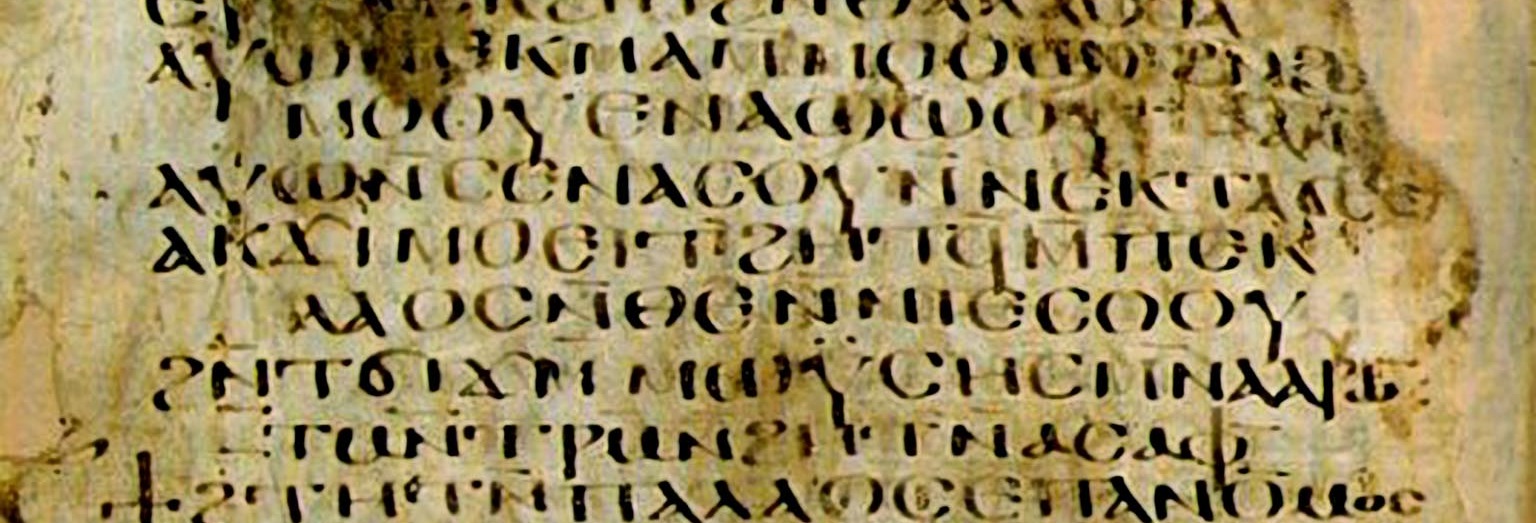
ὁἀγαθοποιῶνἐκτοῦθεοῦἐστιν· ὁκακοποιῶνοὐχἑώρακεντὸνθεόν.

[ho agathopoion ek tou theou estin; ho kakopoion ouk heoraken ton theon.]

The one who does good is

[of/from/because of/in the manner of/apart from/part of/controlled by]

God.

The one who does evil has not seen God.

{3John11}

Forgive these fragmented and perhaps poorly-written or elementary thoughts. I write this post not to “show off my Greek” (today was the first I had opened it up in the past couple of months) nor to confuse people by talking very technically. I (hopefully) write this as worship.

I finished translating 3 John today. I’m starting with the shortest New Testament book and just continually trying to translate up to the longest. It’ll probably never be done, but it’s some sort of system, so it works for me. I always know what’s next so that’s helpful.

Anyway, like I said earlier, this was the first day I had gone back to 3 John in a couple of months. I only had a few more verses left so I quickly finished it and then started the first couple of verses of 2 John. I then began to shut my books and move on to the next item on my reading list when I realized something: I couldn’t even remember vaguely what I had translated in 3 John. I had been so concerned with just translating and “getting it done” that I forgot to even meditate or think on it.

I turned to my translation and looked over what I had written and the above verse popped out at me. So, I’m writing this as my act of both repentance for having this gift of the ability to translate and not using it to know God more, and as my act of worship, that I might explore some nuances in this text.

The problem with this verse is a problem common in any language: the preposition. That word εκ [ek] means any of the bracketed things above. Most simply, it’s translated as “of”, but the question always turns to “what does ‘of’ mean here? “Which of the myriad of possible translations does this mean? Well, you look at the context.

What I noticed is that whatever it means, it’s supposed to be a contrast to “The one who does evil has not seen God”. So whatever this “of God” means, it is in contrast with “not seeing God”. It also means that being “of” or “from” God is a matter of seeing him. To see Him is to be joined to Him, to be of Him, or to be from Him. I don’t know enough about Greek to make a definitive call about precisely which translation is correct, but this idea is enough for me: walking obediently so as to please God is a matter of seeing God, and those that continue in disobedience show that they have not.

The way this is phrased let’s us know that whoever is walking obediently can take no credit for this, because their obedience is of/from God. But at the same time, those that are still walking in disobedience bear the full weight of responsibility for their disobedience because they have not seen Him. It is a mystery that leads to God’s greatest Glory and our greatest joy.

So for those saints weary under the weight of their sin and disobedience, be encouraged: obedience and doing good is not a matter of striving and fighting your own will. It is a matter of seeing Him and therefore being joined with Him so that all our being, living, and moving is from/of/in the manner of God. Seeing and therefore being joined to Him through Christ allows us to move according to His nature and will. All disobedience, sin, and evil results from not seeing God. He is our hope. He is our salvation.

Let us therefore fix our eyes on Him, and run.

For those wondering how my job is going . . .


unemployment. . . well, it’s not.

In May, I wrote about my journey in looking for a job.A month and half later(ish) I wrote of having found a job.My start date was July 1st.

But July 1st was the appointed day for another reason: it was the official first day of a new fiscal year for many companies, churches, and governments (federal, state, and local), therefore, of course, it was the day that new 2009 budgets went into effect all across the country.

Well, at least, when those budgets were supposed to go into effect.

The State of Pennsylvania is embroiled in an ever-increasingly heated battle over its State Budget that was supposed to be done and go in effect July 1st.The company I got my job with gets most of its money from the State Health Department, so this poses a problem for them, seeing as the State Health Department has no 2009 money allocated to them by an effective budget to give to my company any money to hire me – so they’re under a hiring freeze.Did that all make sense?

So, in short, I’ve been waiting for over a month for Pennsylvania to pass its own budget, after which I can start my job.Assuming of course that my usual luck doesn’t come into play and my job decides to drop me for some reason.I don’t know.Pray this doesn’t happen.It seems the budget problem is this: there’s a huge gap in the budget between income and expenses.So they either need to get more money or make more cuts.The Governor has suggested a very small increase to the income tax to cover this, but Republicans have cried foul.Democrats have said they’re not “wedded” to the idea of a tax increase and are open to any ideas, but Republicans have been both unable to suggest any new ideas and unwilling to make any cuts in their various localities, insisting further cuts happen at the State level.So, tax increases are being forbidden, no new ideas being brought forth, no new cuts being suggested, and no one willing to budge.Therefore, I have a job, but don’t – all at the same time.

It’s an excellent object lesson in the angst and tension in the Biblical idea of things “already being accomplished, but not yet fully realized”. By the way, last Friday was the last day State employees were actually getting paid.now they’re getting I.O.U.’s. Ugh.

I am trying to find odd jobs to hold me over, but may be looking for a more stable job here shortly, and eventually if I need to, I may look somewhere else entirely for a “real” job (any ideas or possible work is more than appreciated).I hope I don’t have to move on, for as I have said, this job is my dream position, but if I need to, I need to.

God certainly deals with us strangely, confusingly, and mercifully. So much opportunity in this time of “unemployment” to draw near to my God and serve are currently being wasted day to day due to my inherent lack of discipline. He really desires more of me in this time, and I fear I haven’t taken advantage of these moments to learn my neediness and His presence.Pray I learn these lessons well in the “already but not yet”.

And pray that Pennsylvania passes a flippin’ budget already (and that I still have a job waiting for me when they do)!

Pogue vs. Cell Industry, pt. 2: “Take Back the Beep” Campaign (and some thoughts on Capitalism)


photo by user Kyle !!!11!!one!! on Flickr

photo by user Kyle !!!11!!one!! on Flickr

On Tuesday I wrote up an article on an exchange between New York Time’s Tech columnist David Pogue and Lowell McAdam, CEO of Verizon.  An article which Pogue himself commented on, by the way (I’m still waiting for McAdam to take notice of little ol’ me, even though I am a Verizon customer.  Hmm…)

Well, as is mentioned in Pogue’s comment on that article, he has started a new campaign on his blog to make our cell phone lives slightly easier (at least for three hours out of the year).

What is the object upon which he has called his followers to descend?  Those annoying 15-second long instructions at the beginning of either leaving or checking a voicemail on your phone.  Apparently, Pogue has been told point-blank by various phone company reps that these instructions really are to make us use our minutes.  And it works.  According to Pogue’s calculations, we spend three hours a year listening to those messages and the cell companies rake in about $670 million a year (and that’s just Verizon! By the way, those calculations are based on leaving and checking voicemails twice a day, every weekday, for a year).

To accomplish this, Pogue has contacted the cell companies and has received from them info on where we, their customers, can complain about this.  Pogue writes:

“Let’s push back, and hard. We want those time-wasting, money-leaking messages eliminated, or at least made optional. . . We’re going to descend, en masse, on our carriers. Send them a complaint, politely but firmly. Together, we’ll send them a LOT of complaints.  If enough of us make our unhappiness known, I’ll bet they’ll change.”

Of course, the companies just gave their general web complaint areas (though the AT&T guy gave his own email address.  Impressive.), and of course they’re probably a pain to navigate.  For example, I tried to do it on the Verizon site, but being on a family plan with my parents, I don’t have all the very specific information they demand of you from your monthly statement before you can even leave a comment.

I don’t know about the other sites, but I hope this actually works.  Honestly, not so much because this specific complaint ruins my life so much.  Rather (if I may wax philosophical for a moment), I think Western Capitalism is coming of an age where power players have emerged such that they have become disconnected from the consumers that strengthen them.  I have just recently become hyper-aware of the fact that we as Americans have lost control of the very institutions we are supposedly responsible for.  CEO’s are supposed to rely on the customers.  Food companies are supposed to be dependent upon their consumers.  Politicians are technically our employees and should be terrified of not producing the results we want.

But no, we sheep of the “American dream” have relinquished the control of these institutions preferring ignorance, entertainment, and comfort as our opiates.  I would love this campaign to work so I might still have hope that people, policies, and institutions can really change- that the status quo is not fixed.  I pray that the steep terrain of the proverbial slippery slope might tip.

So won’t you help us show CEO’s that they are finite- dependent upon us, the customers, for all that they enjoy in their posts of power and influence?  Might we find some bright light still left in a somewhat Capitalistic managed economy?

Or maybe we should all just become Distributists and all our problems will be solved.

Here’s the contact info provided by Pogue in his blog post today:

I’ve told each of the four major carriers that they’ll be hearing from us. They’ve told us where to send the messages:

* Verizon: Post a complaint here: http://bit.ly/FJncH.

* AT&T: Send e-mail to Mark Siegel, executive director of media relations: MS8460@att.com.

* Sprint: Post a complaint here: http://bit.ly/9CmrZ

* T-Mobile: Post a complaint here: http://bit.ly/2rKy0u

P.S. – as is mentioned in Pogue’s post, apparently Apple made AT&T take these messages off of the iPhone.  One more reason why Apple is what it is and has accomplished what it has.  I feel like they (and Starbucks.  Yeah, I said it.  What?) are the only large companies out there that get it.  They care and put people before profit.  And that’s profitable.  If only cell companies felt the same way.
“WTFWJD? | (on Christian cursing)”-Reform & Revive


"Andrew Murray" by Amy Roberts

"Andrew Murray" by Amy Roberts

Just wanted to drop a quick plug for a new article I posted yesterday in the online magazine I run, Reform & Revive.  The article is on the topic of Christians that curse and explores the issues that surround it.  It’s received some really good, really helpful feedback and comments, so I wanted to post something here as well letting people know about it so they can join in on the conversation.

Remember to leave comments and retweet.

Here’s the link:

http://reformandrevive.com/2009/07/28/wtfwjd-on-christian-cursing/

Also, if you want to write for Reform & Revive, you can either get in touch with me here or use this form.  We are always looking for more content and new ideas for the site.

You can find more art from Amy Roberts here.

NYT’s David Pogue Takes on Cell Industry


Pogue_hiUPDATE: more cell phone company d-baggage.  Apparently with the advent of the potentially-amazing-but-not-quite-yet Google Voice, most major cell providers have banned the various Google Voice apps that allow it to integrate into your phone’s operating system.  Ugh…

I really hope everyone out there knows who David Pogue is by now (his personal site can be found here). He is the main New York Times Tech Columnist, and he is great. His main job at the NYT is to make technology make sense to the everyday consumer, and he is really good at it. He’s so knowledgeable and yet is so funny and comes across as such an Everyman, you have a hard time believing he’s not your next door neighbor or at least your new best friend.

I follow him on Twitter and it is definitely one of my favorite feeds. He recently finished writing a book over Twitter where every night he would have some sort of game that his followers would play along with and the best responses ended up in the book. It was great. He has a very loyal Twitter fan base. He regularly crashes websites by posting links to interesting videos or articles, just to have most of his 700,000+ followers go to these sites all at once and crashing the servers.

Anyway, Pogue has recently drawn some attention for a recent article he wrote about his “Everyman” frustrations with the cell phone industry. After a brief defense of the industry over phone exclusivity contracts (ala AT&T and the iPhone) where he explains why this is an unreasonable frustration to have with them, he outlines six legitimate frustrations to have with the cell industry. The gripes are as follows (but I still really encourage you to actually read the article. He’s a great writer.):

  1. Unreasonable text-messaging fees
  2. Double-billing (where you get billed for sending and receiving a call)
  3. Unfair Phone Subsidies Practices (you spend the first half of your contract paying off your phone, but still keep paying the same price even after your phone’s paid off)
  4. Crazy International Phone Call Rates
  5. Way Too-Long Voicemail Instructions Just To Waste Your Minutes
  6. Miscellaneous (dead spots, data caps, customer service, etc.)

(You’ll see why I wrote that outline out here soon) That was last Wednesday, July 22nd. Apparently that article put into words the frustrations of many, many Americans, awakening a small public relations disaster for cell phone companies. I know I felt really good after reading it.

So how did the industry respond? Did they rush together to serve the interests of their customers? Did they begin more research to see if in fact a huge percentage of their clients felt similarly? No. Instead, two days later, on July 24th, Lowell C. McAdam, CEO of Verizon, sent an open letter to the publisher of the New York Times (I have no idea why he didn’t just send it to Pogue) accusing the New York Times of publishing “myths” and “highly misleading charges at wireless companies”. He then goes on to carefully rebut these “myths” and “charges” leveled against his industry by Pogue’s article. Now, I would love everyone to look back up and reacquaint yourselves with Pogue’s outline of complaints.

Done? Good. Now here are McAdam’s counterpoints to Pogue, presented in Myth/Fact fashion:

  • Myth 1: American’s pay less than Europeans; Truth: they pay an average of ten cents per minute less (as long as you don’t factor in international calls, text messages, data rates, and overage charges).
  • Myth 2: The cell phone industry isn’t competitive; Fact: Al Gore at some point said they were very competitive (seriously, that’s what the letter says)
  • Myth 3: Bad customer service; Fact: 84% of customers are satisfied (really? I’m “satisfied” with a lot of things, but I’d much rather be “pleased”. We kind of have to be satisfied with what we got anyway)
  • Myth 4: Wireless companies don’t look out for the rural guy; Fact: Verizon looks out for them.

Wow. Eat it, Pogue. McAdam really took you to task. How did Pogue respond to such an “onslaught” (are you catching the sarcasm yet)? With this tweet and this brief article. Personally, I think it’s pretty bad when someone attacks you, you attack back, and that person proceeds to promote your attack as amusement for his supporters. Shortly afterward, Pogue continued to tweeting about other things, but several hours later decided he was going to start a campaign to get rid of the long voicemail instructions, so he asked his followers for potential “war-cry” slogans.

I really hope this causes some real discourse and perhaps even change in how cell companies treat their customers, but I’m not holding my breath. In the meantime, though, I’ll enjoy playing along with Pogue as he milks this exchange for all of the entertainment it’s worth. Good for him.

So, read his stuff, buy his book, follow his Twitter, watch his song and lecture below from December on 2009 cell phone trends, and enjoy the ride.

From the iMonk: Mary Consoles Eve


I found this at the site of Michael Spencer (a.k.a. The Internet Monk).  This guy is having an increasing amount of influence and inspiration on my thinking as a Christian in this world.  You find him at The Internet Monk. Anyway, I love this piece of art and the poem.

Crayon & pencil drawing by Sr. Grace Remington, OCSO. Copyright 2005, Sisters of the Mississippi Abbey

_______________

O Eve!

My mother, my daughter, life-giving Eve,

Do not be ashamed, do not grieve.

The former things have passed away,

Our God has brought us to a New Day.

See, I am with Child,

Through whom all will be reconciled.

O Eve! My sister, my friend,

We will rejoice together

Forever

Life without end.

Sr. Columba Guare copyright© 2005 Sisters of the Mississippi Abbey

_______________

This was found by Michael Spencer at Inside Catholic.

Speak your mind: What is Beauty? (A Survey)


Sargent - Madame Errazuriz-small

For those that might run across this post in the future, the message mentioned in this post was written, given, and walked through part-by-part on this blog.  You can see all these posts by clicking here.

So . . . I’m giving a talk in a few weeks on the topic of Beauty.  The first section of the talk will be a discussion attempting to answer the question “What is Beauty?”  To aid me in this I’d like to extend this question to the world at large.  So, I’m asking all of you out there: what do you think beauty is?

Feel free to take your time or just give me the first thing that pops into your head, or even give me more than one idea if you want. This is totally open.  Leave a comment.  Email me.  Facebook me.  Whatever you want.

Or, leave a joke if you want – but only if it’s a good one.  Here’s the dictionary definition for “Beauty” to get you started thinking:

the quality present in a thing or person that gives intense pleasure or deep satisfaction to the mind, whether arising from sensory manifestations (as shape, color, sound, etc.), a meaningful design or pattern, or something else (as a personality in which high spiritual qualities are manifest).

So, that’s what Dictionary.com thinks.  What do you think Beauty is?

(art: “Madame Errazuriz” by John Singer Sargent)

“For your life – Flee!” by Sean Brendan Stewart – Reform & Revive | a Plugfest


sorry, no y-axis this time

sorry, no y-axis this time

[Thank you to spectacular photographer and friend David Schrott for inspiring this post]

Okay, due to a few recent articles I’ve written, the number of people visiting my blog has increased by over 4000% in the past week.  It’s pretty nuts.  That’s why everything has seemed to be about Derek Webb and his new album, Stockholm Syndrome.  So, I just wanted to take this chance to put in a few plugs for some of my other projects.

I have web magazine called Reform & Revive.  It looks at the intersection between faith and culture, politics, art, the church, and just life in general.  These Derek Webb posts would perhaps have been more appropriate on that site, but the readership here jumped up so fast (I’m actually on the first page of most Google searches having to do with the album).

Anyway, friend, brother, and fellow impassioned writer, Sean Brendan Stewart, just put up a special article that seems to have a similar message as the new Webb album.  It’s some commentary from him, then a very brief manuscript of some audio from a Carter Conlon message.  After that, feel free to look at our more regular full articles from our Contributors.

Lastly, I have my own personal site, Prodigal Paul, that acts as a hub for organizing other blogs, Bible studies, sermons, and such that I have produced over the years.

That is all.