How do you know you’re salty? | Luke 14.34-35


“Salt is good, but if salt has lost its taste, how can its saltiness be restored? It is useful neither for the soil nor for the manure pile; they throw it away. If you have ears to hear, then hear!”
Luke 14:34-35

I fully understand that this can be taken too far, but how could salt know if it has lost its saltiness? I would contend that the salt itself cannot determine its own saltiness in any other way than seeing its effects on the world around it.

In other words, I wonder if how the world views us in regards to the effects we have in the world are a better indicator of our “saltiness” than our own perception of how faithful to a system of the doctrines we are. If you have ears to hear, then hear!

See other Marginalia here. Read more about the series here.

Proof of God? Wilderness & Return | Exodus 3.11-12


So come, I will send you to Pharaoh to bring my people, the Israelites, out of Egypt.” But Moses said to God, “Who am I that I should go to Pharaoh, and bring the Israelites out of Egypt?” He said, “I will be with you; and this shall be the sign for you that it is I who sent you: when you have brought the people out of Egypt, you shall worship God on this mountain.”
Exodus 3.10-12

So…what’s God’s proof that He is with Moses and He is the one behind all this?

Not the mystical voice from the fire.
Not the miracles nor plagues.

Moses will know that God is real and he is the one that did all this only after deliverance and wilderness, having returned to where he started, utterly transformed.

Ain’t that the truth?

See other Marginalia here. Read more about the series here.

For All Saints’ Day: Our Son’s Baptism (And Yours)


Today is All Saints’ Day–when Christians remember the saints that came before us. It’s a perfect day to celebrate our son’s entry into visible membership into God’s family through the sacrament of baptism! You can watch it in the video above.

I wasn’t raised witnessing or agreeing with infant baptism. I grew up as a Bible Belt Southern Baptist (and pretty much all my relatives continue in that tradition). As a child, infant baptism was seen as a strange Catholic thing that went against the doctrine of salvation through grace.

But over time, my perspective changed as I found myself drawn into another tradition within Christianity–one that views baptism in a different way that I’ve found incredibly meaningful and beautiful.

Continue reading

Genesis 3 | The Garden Temptation (a sermon)


I had the chance to offer the sermon this past week at my church. We started a new sermon series called “Bible Mixtape, Volume 2”, where we take otherwise familiar Bible stories and revisit them by putting them in their original culture and context. I kicked us off with Genesis 3, The Garden Temptation, and coupled that with Matthew 4:1-11, Jesus’ Wilderness Temptation. Below you’ll find the video as well as the manuscript. I hope it blesses you. Click here for the podcast audio.

(Click to here to watch the Scripture reading portion.)

Continue reading

Suffering: A Family Affair | James 1.2-3


My brothers and sisters, whenever you face various trials, consider it all joy, because you know that the testing of your faith produces endurance.
James 1.2-3

These verses are so rich, it’s going to take more than one post to mine their treasures. A flattened, cursory reading can sound very callous and insensitive to the lived experience of human suffering. However, I think there is a nuanced, sensitive perspective here that deserves sitting with a bit.

“brothers and sisters…”

James knows he is going to say tough things, so he uses this intimate term on the outset. He doesn’t say “children” holding himself above those going through trials, but uses this familial term for peers under the same authority. This shows that no one–not even an apostle, not even the brother of Jesus–is above suffering and trials.

It also reminds us that this letter is not to individuals, but a community. This is a huge key to these verses (and the whole book). The encouragement to “consider it all joy” when we face trials can seem at least insensitive, if not outright abusive, apart from this context.

Suffering should be a community effort. We ought to be close enough to others that we hurt when our spiritual family members hurt. We share the burden to live this verse out. In suffering, not everyone will have the wherewithal to follow all these encouragements, so others step in and make up for what we lack in a given moment.

Others can keep hope on our behalf when we feel hopeless. They can recognize the resilience and endurance growing within us when we have no more to give. They can maintain faith in God’s goodness while we doubt God is there at all. These words are meant to mark a community at all times, not individuals at all times.

Note here that the brother of Jesus calls us his siblings, showing the unity we have as the singular body of Christ. James knows that spiritual family is deeper and more defining than natural, biological family. Blood may be thicker than water, but spirit is thicker still.

See other Marginalia here. Read more about the series here.

Family Messiahs & Modern Dispersions | James 1.1


James, a servant of God and of the Lord Jesus Christ,
To the twelve tribes in the dispersion:
Greetings.
James 1.1

1. “servant” (or “slave”): This is surprising. Traditionally, James is one of the brothers of Jesus (I’ve tried, but I just can’t follow Catholicism in its beliefs of Mary’s perpetual virginity and these being Jesus’ “cousins”). The Gospels tell us that Jesus’ brothers denied Christ as Messiah. They thought he was crazy. What must have happened to James to change his view to be a “slave” of his brother? How easy would it be for any of us to so quickly start seeing our brother or sister as the Son of God through which all things we were created, by which all things are sustained?

2. “dispersion”: All Jews living outside Judea. We can find ourselves in this. God’s people far from where God has promised us to be, trying to figure out how to do this whole “Christianity” thing. This is what the rest of James is about. This whole earth is ours and we wait expectantly for the enemies to be cleared out so we can receive our inheritance. So what does life look like in the tension of awaiting promises for a new home, knowing it’s not yet time, but it will come? What is the first characteristic of this life that James brings up? What does life here look like? The answer is probably in verses 2-4: a life of suffering for the purposes that God has laid out for us.

See other Marginalia here. Read more about the series here.

1 Corinthians, Chapter-by-Chapter


I wrote another post applying 1 Corinthians to the divisions and differences among Christian groups. I recognize my thesis could be a little controversial, so I wanted to show my work with this survey of the letter to show Paul’s thought on these issues.

The letter is to a church divided, so it’s interesting the Paul begins by grounding them in what unifies them. They are sanctified, exist “in Christ”, are called to be saints, and call on the name of Christ as Lord. (1:1-9). But he pretty quickly gets into the divisions themselves (1:10-17).

He’ll eventually tell us what this gospel is, but first he teaches us how to think about it. Repeatedly, Paul hits hard one main idea: you can’t think about the gospel or Christianity in the same way that you think about other sets of ideas or beliefs. When you do that, Christianity is just going to look like foolishness (1:18-2:16).

But still, Paul never challenges the divisions themselves. He does not seem to think that differing views on even important issues is a challenge to Christianity or “the gospel”, which he puts in a different category than other parts of life and faith. (Ch. 3).

The problem is not what these Christians are believing, but how they are believing it and how that gets translated in their actions and worship.

Continue reading

Mary: Ordained as Prophetess, Priestess, & Queen


Tanner-the-anunciation-mary

One of the beautiful things about Catholic theology is that it sees story as one of its main interpretive filters. Protestantism, on the other hand, focuses much more on historical context and the text itself.

To modern ears, the Protestant ways sounds great, but there’s one big problem: this is not how most of the biblical writers, Jesus, the apostles, the early church, nor most of church history have ever treated the Bible. They were and have been much “freer” with the text (yes, often to a fault). Catholicism’s rootedness in ancient ways of reading invites them into new dimensions and interpretations.

Take Mary, for example. Catholics see her foretold in the Old Testament just as much as Jesus is. They see her in prophecies and allegorically represented in other women. They see parallels between her and the Ark of the Covenant, the Tabernacle, and the Temple, saying they all carried the Holy of Holies within them, and were revered for it.

There are three biblical offices of authority among God’s people: Prophet, Priest, and King. Christians see Jesus as the fulfillment and highest expression of each of these, but in the Advent event, you can see Mary serving these functions as well. So today, as a Protestant, I want to sit with this and revel in some beauty and divine mystery.

Continue reading

Ascension: Our Glory & the Bible’s Hinge


jesus-christ-ascension-icon

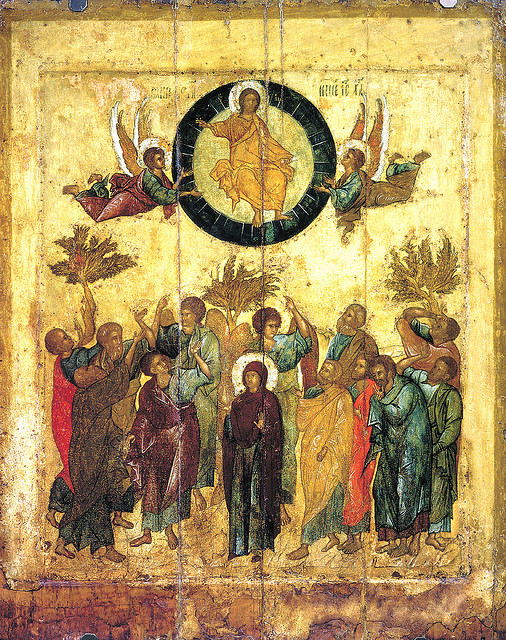
Yesterday in the Christian Church Calendar was Ascension Day, where we celebrate Christ ascending into heaven after his resurrection and now sitting at “the right hand of God the Father.”

The Useless Ascension

“Ascension” doesn’t get a lot of attention nowadays in the Church. This, in spite of the fact that it’s an essential part of all the Church’s earliest doctrinal formulations. Additionally, the New Testament sees it as the primary proof of Jesus’ divinity and “lordship” and it’s the subject of the most-quoted Old Testament verse in the New Testament: “The Lord says to my lord, ‘Sit at my right hand until I make your enemies your footstool.'”

Maybe we neglect this because the Ascension isn’t really a “doctrine”–it’s an “event” and a “declaration”; and we western Christians love our systematic “doctrines” that we can pick apart ad nauseam and/or figure out how to “apply it to our lives” so we can feel like “good Christians.”

But honestly, the Ascension isn’t “useful” to us in that way. There’s not much we can “do” with it.

Which is precisely why it’s so valuable. More than many other aspects of the Gospel and Christianity, the Ascension isn’t an “idea” to mull or unpack, but rather “news” to receive and let it act on us.

Continue reading

The Meaning of Marriage… Licenses.


A few weeks ago, my fiance Amanda and I got our wedding license. We’re getting married on October 18. Of all the surprises in that process, though, the biggest was me breaking down crying in the middle of this Chester County Courthouse office while signing papers. It took me a little bit to figure out why I was so emotional, and what was going on inside of me. But here it is. 

First and foremost, I love this woman. I’ve known this. But (especially if you know some of my story) it was so powerful and surreal to see another human being willingly and joyfully sign on the dotted line to actually spend their life with me.

Continue reading

Lent, the End of the World, & the Coming of the Son of Man | Mark 13.1-27


This meditation on Mark 13.1-27 is expanded from the Liberti Church 2020 Lent Prayerbook

__________

If you participated in Ash Wednesday a few weeks ago, you may have felt the shocking way Lent sneaks up on us. It refuses to ease us into its contours and instead hits us in the face with as much blunt force reality as it can: You are ash. You will die.

For those uncomfortable with these sorts of truths, the text  below does not let up. It is a scary and confusing one, speaking of death, torment, wars, and destruction–even among those most innocent in society. The confusion of this text led some Christian traditions (especially the 19th-century American Church) to separate these words from their original context and history and see them as terrifying images of the end of the world. Perhaps you grew up in such a tradition and read these words with that filter.

To the extent there is good news in this, it is that these words are not in fact talking about the end of the world. The bad news? Well, the truth of what it is saying is even scarier.

Jesus is not talking about an end-of-the-world Armageddon here. Instead, he is predicting the destruction of the Jewish Temple (which happened at the hands of the Romans 35 years later) and telling his people what to do when it happens. Just look at the verses immediately preceding the scary ones. Jesus says the Temple will be destroyed, his disciples ask when that’s going to happen and what will it be like, and then Jesus says all this stuff. When you start reading it that way, it’s pretty straightforward. But why does this matter?

Continue reading

Tamar: Waiting for Justice [guest post]


This Advent meditation is part of the Liberti Church 2019 Advent and Christmas Prayerbook, and it is by Liberti member Jessa Stevens.

__________

I started a company six years ago and I truly felt I was following God’s plan for my life. I saw him leading me through challenges, making connections, providing financially. I was filled with hope and motivation. I felt like what I was doing was helping people, healing friends and family. I was doing something I loved that connected me to God and his vision for my life.

If you’ve spoken to me in the last year, however, the road has been more bumpy and more challenging. And surprisingly, though at times I’ve been angry, confused, and discontent with the struggles of this company, I’ve been relying more on God daily than I had when I was praising him for all the ease and fun of this job.
Continue reading

Rahab: Waiting for Judgment [guest post]


This Advent meditation is part of the Liberti Church 2019 Advent and Christmas Prayerbook, and it is by Amanda Mahnke.

__________

Growing up, I was always intrigued by the story of Rahab. As a tween and teen, it was somewhat perplexing to me that the Bible celebrated this woman as righteous for lying to protect the Israelite spies. Given Rahab’s less-than-reputable profession —and a wealth of biblical heroes who did far worse than she — I’m not sure why the deceit was my biggest hangup. I do know, though, that ruminating on Rahab’s story was an important step in my journey toward a less black-and-white, judgmental kind of faith.

The story of Rahab begins as Joshua and his army are preparing to destroy the Canaanite city of Jericho as an offering to the Lord. In an act of treason, Rahab hides the enemy spies and lies to her own government officials regarding their whereabouts. We have no real way of knowing why she does this. What we do know is that, somehow, this Canaanite prostitute has heard about the miracles of the Israelite God, and she has believed.
Continue reading

Bathsheba: Waiting for Mercy [guest post]


This Advent meditation is part of the Liberti Church 2019 Advent and Christmas Prayerbook, and it is by Liberti member Maria Lipkin.

__________

When I read some of the episodes of David’s story I often think, “what a coward! How did God let him get away with so much?!” I feel this way especially when I read the story of David and Bathsheba. Here is a king who was supposed to be fighting with his men but is instead lounging around his palace. At the first sight of a naked woman, he makes her have sex with him even though she is married to one of his own valiant soldiers! They conceive a child and David kills her husband to cover up his act. The child dies because of David’s sin.
Continue reading

Jesus Heals the Bethesda Pool Paralytic: Misc Thoughts | John 5.1-9


Reading through the story of Jesus healing the man by the pool of Bethesda, I was struck by a series of things I wanted to share with you all today, in no particular order. (But first, read the story in John 5.1-9):

First, the man doesn’t go to Jesus or ask him anything–he doesn’t even request the healing himself! Jesus just goes to him and heals him.
Continue reading