Creation: a suffering world through a suffering Lord | Lent {4}


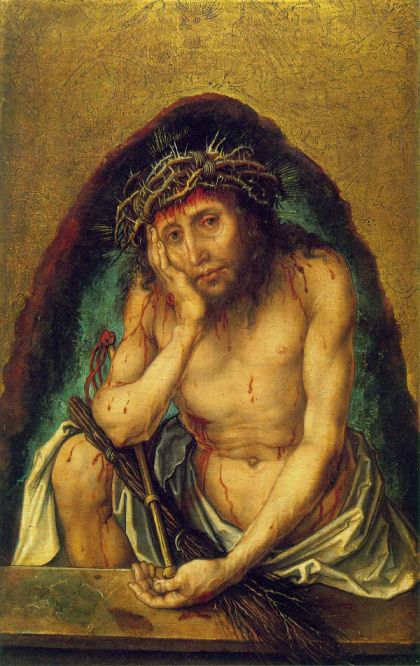
Lent is a season in which God’s people meditate on the slaying of Jesus on the Cross and all that is within them (and the world) that made that Cross necessary. To that end, we’ve been meditating on the fact that Christ is the Lamb who was “slain before the foundations of the world”. We’ve been thinking through what it might mean that Jesus, in some sense, has been suffering for all time (and some theological issues along the way).
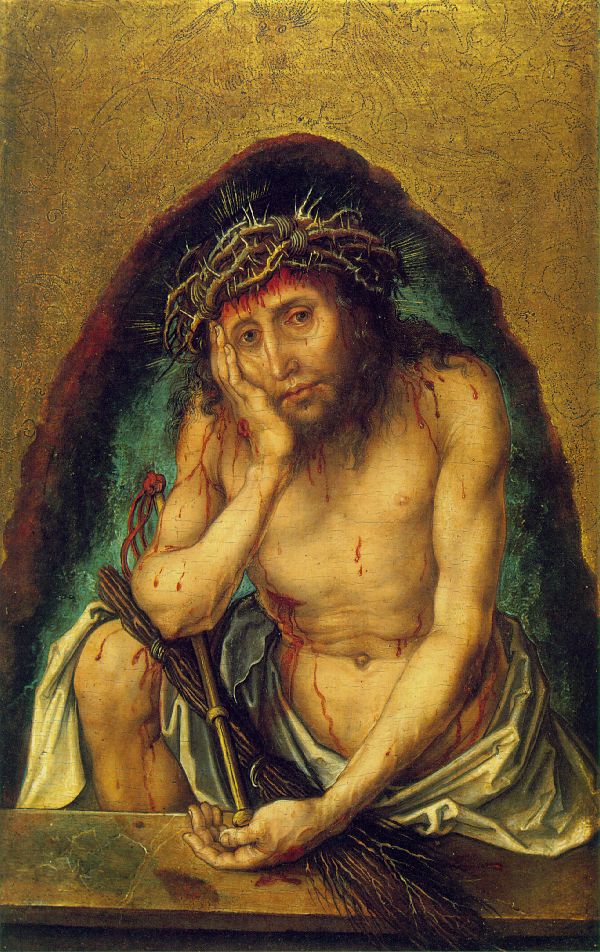


So far, we’ve talked about how this is a reflection of an eternal attribute of Jesus. There has been an aspect of suffering and death woven into the depths of his nature and character since before time began.

But at some point, time began.
Continue reading

Lent-erpretative Musings {a theological interlude} {3a}


WARNING: this post gets into some theological discussion that, for most everyone out there, will be neither helpful nor interesting. And it’s way too long (which is why I’ve broken it up into two separate posts). Forgive me and please be gracious.

_____________

Anyone that follows the blog knows that I’m currently thinking through and writing a Lent series on the theological idea that Jesus was slain “before the foundations of the world” (Part 1, Part 2). Even though no one has said anything to this effect, I have felt like somewhat of a hypocrite. As I’ve been doing this, I’ve been haunted by a little voice reminding me that it seems like I’m employing many of the same techniques of interpretation and viewing the Bible that I’ve criticized in others before. This post is my attempt at reconciling this in my own head (in front of all of you).

As J.R.D. Kirk (and others) has often talked about, many of our theological disagreements in the church boil down to a simple question “what is the Bible?”. At the end of the day, we can argue about any number of things appealing to the Bible, but if we believe fundamentally different things about what the Bible is–and how it is that–we will never get anywhere.

And here’s where I’m getting into problems with this series: there are ways of viewing the Bible that, in others, I have criticized as reductionistic, simplistic, and frankly, abusive to the text itself, and I fear that I’m employing many of those same techniques in my thinking through this series. Here are two of those ways (two more later):
Continue reading

The Cross: eternal Beauty made present | Lent {2}


Earlier this week, I kicked off this year’s Lent series with a question.

This season, we’ll be meditating on the biblical idea that Jesus, in some mysterious way, was slain in eternity past. And so, I asked what this means for the Cross of Jesus:

Was it an eternal truth breaking into the temporal realm, or was it itself such a powerful event that it echoed backwards and forwards through the past and future?

My vote? Jesus’ suffering and “slain-ness” is an eternal attribute of who he is, and the Cross was this aspect of the nature of God breaking into our reality. The Crucifixion was, in effect, God drawing the curtain back on a heavenly reality that had, until that point, only been hinted at.

I side with this for two main reasons: the essence of God, and the election of God.

Continue reading

some gospel encouragement sitting in a coffee shop…


I’m sitting in this coffee shop, and across the room there’s this college-aged girl walking one of her friends (apparently from another country) through the story of the Bible and the gospel.

She seems like a pro. She’s teaching her friend the structure of the Bible, answering her questions, and having her read the Scripture. She’s talking about who wrote the different books and each of their stories. They’re even hanging out in the Old Testament a bunch.

She’s not over-anxious or pushy; she’s just hanging out. The friend seems engaged and they keep laughing, sharing stories, and engaging the Scriptures.

I can’t help but feel I’m watching the Kingdom of God breaking all the more into this world–the future flooding the present.
Continue reading

A Shout-Out to My Mennonite Pacifists Out There…


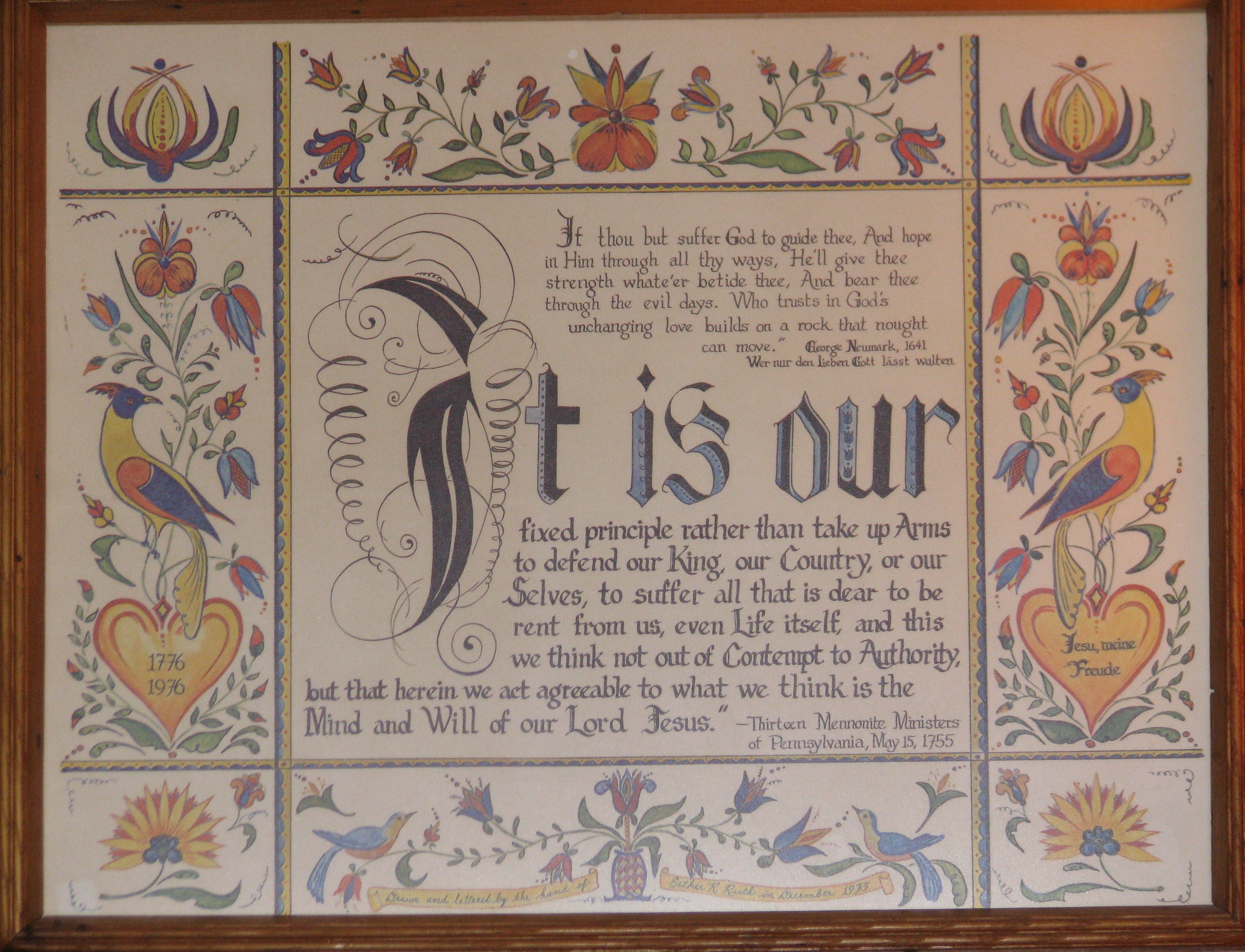
Being in Pennsylvania, I meet lots of people that either consider themselves Mennonite, or at least were raised that way. One of the most well-known aspects of Mennonite belief is their unwavering commitment to pacifism (or, as a commenter corrected me below, the Mennonite “doctrine of nonresistance”). Hanging out with one of my new raised-Mennonite friends the other evening, she showed me (with pride) the above picture that has hung in one of their family’s houses for a long time. It struck me as beautiful as well, especially the second quote. Here it is, nicely typed out for optimal readability and convenience:

“It is our fixed principle rather than take up Arms to defend our King, our Country, or our Selves, to suffer all that is dear to be rent from us, even Life itself, and this we think not out of Contempt to Authority, but that herein we act agreeable to what we think is the Mind and Will of our Lord Jesus.”

–Thirteen Mennonite Ministers of Pennsylvania, May 15, 1755

Continue reading

HAPPY ADVENT!! {10}


Well, it’s here. The day we’ve been building up to and meditating upon. This is the day we joyfully celebrate the King who broke into our reality and ushered in His Kingdom and our salvation by coming in the form of a little child.

Even though this time can be tough for some (my grandfather died a year ago tomorrow), I do hope and pray that we are all able to have at least one good laugh this year and see the smile of at least one person we love and that we know loves us. And eat good food. And drink good drink. And listen to bad, cheesy music. (On a side-note: the picture above is a picture of the wall-hanging that went up in my house every year as I grew up. And now I have it. I love it.)

Don’t worry, this isn’t really a whole other post. This Advent season has been an especially fruitful time for my writing (as my Facebook Wall obviously shows). I want to thank everyone that has been telling me how helpful these posts were–or even those that just told me they were reading them in the first place!. I can’t tell you how much it affects me, sticks with me, and encourages me. But anyway, I just wanted to write this post so I could put up all these posts in one place for you easy reading pleasure, should you so desire. Happy Advent!
Continue reading

What is the True Gospel of Advent? {9} (hint: it’s not your salvation)


As I mentioned in my previous post, my church has been doing an Advent series called “The Other Christmas Stories” where we’ve been looking at various texts (outside of the traditional Christmas narratives) that comment on the Advent event. Last week, our pastor preached from the book of Revelation, including some of these verses:

Then I heard a loud voice in heaven say: “Now have come the salvation and the power and the kingdom of our God, and the authority of his Messiah. For the accuser of our brothers and sisters, who accuses them before our God day and night, has been hurled down. They triumphed over him by the blood of the Lamb and by the word of their testimony; they did not love their lives so much as to shrink from death. Therefore rejoice, you heavens and you who dwell in them!”
–Revelation 12:11-12

Continue reading

God loves me. But does he like me? (on being “Christ-like”) | Advent {8b}


[This is Part 2. Read Part 1 here.]

My church has been doing a series called “The Other Christmas Stories” where we’ve been going through other texts in the Bible that comment on and meditate upon the event of Advent. The first message was preached on that quintessential Advent text, John 1. The preaching on these verses really struck me:

But as many as received him, to them he gave power to become the sons of God, even to them that believe on his name: Which were born, not of blood, nor of the will of the flesh, nor of the will of man, but of God.
— John 1:12-13

The sermon went on to remind us that in these verses is a promise that the Advent did not happen in order to make us into something we are not, but rather to give us the power to become who we most truly are (children of God). Now, I want to be clear. I grew up in Church hearing that phrase “be who you are” (and hearing it in music), and in certain seasons that thought has been helpful to me, but I’m not quite trying to express the same sentiment.
Continue reading

What the Gospel is not. [QUOTE]


“I believe the word gospel has been hijacked by what we believe about “personal salvation,” and the gospel itself has been reshaped to facilitate making “decisions.” The result of this hijacking is that the word gospel no longer means in our world what it originally meant to either Jesus or the apostles.”

— Scot McKnight, “The King Jesus Gospel

Amen. I’m so glad this book was written. So far, it’s pretty amazing. And on the Kindle, it’s currently only $3.99.

Posted from WordPress for Android on my Droid X

our failed function, God’s full faithfulness | Advent {3}


This week, I’m meditating on a few particular aspects of the Advent event. I’m thinking through and writing about how, in Jesus, God inhabited our creaturely form, care-taking function, comprehensive fallenness, and communal formation.

As I said in the teaching I gave over the summer about the Nature and Narrative of the Bible, the opening chapters of the Bible describe this divine act of creating in very architectural terms; the same words are later used in describing the building of the tabernacle and the temple. In this we see that God’s act of creating was, in essence, building this world as his temple in which he would rest (for more on this see John Walton’s amazing book, The Lost World of Genesis One, or just watch this short video).

In the story, he builds and establishes this Temple-World, and then creates and ordains two priests–Adam and Eve–to be his representatives in this temple to care for it and work in it faithfully. In the ancient world, temples were usually placed in the midst of large and beautiful gardens which acted as extensions of the temple itself; to care for the garden was to care for the temple, and to make the garden larger was to expand the scope and size of the temple.
Continue reading

A Death Penalty Follow-Up


Last week, I wrote a post about the recent case of Troy Davis and how this had inspired me to rethink and reconsider my position on the use of Capital Punishment by the government to punish those convicted of crimes they deemed worthy of such a response. In my attempt to be nuanced, I fear I may have given a wrong impression of where I stand now.

I think some people may have walked away from the post thinking that I believe that the government should have the right to bring the death penalty to bear upon some criminals, but Christians shouldn’t actually do it (or something like that). This isn’t quite the case.

Let me restate what I’m thinking even more clearly and simply: I don’t see a justification for Christians supporting the use of Capital Punishment by the government in any case. 

Continue reading

Troy Davis, Capital Punishment, & the Death of Conscience


This is a tough one to write. And it’s long. I broke almost all of my personal blogging rules in this, but I just need to get this out. I’ve spent the past two days with this post and it’s central ideas rolling around in my head and even now as I sit to type, I have little knowledge how it’s all going to come out.

Today, for the first time in my young life, I shed tears for a man that was executed at the hands of the State. Two nights ago, Troy Davis was finally executed in Georgia for the 1989 murder of an off-duty police officer. Questions still abound concerning his guilt and innocence, the politics at play in the various boards and courts that refused to change their minds, and the calcification of a seemingly dispassionate justice system  that renders helpless the voices of those it presumes to protect. This New York Times article perfectly captures the complexity and tension that exists right now over this topic.
Continue reading

A Theology of Sleep (i need it) | Psalms 63, 121, 127


Lately, I haven’t been able to sleep. It’s not that if I lay in my bed, I can’t fall asleep, mind you. It’s the getting to bed part that keeps getting to me. I find myself staying up way too late (usually writing up these blog posts) until I can barely function, and then falling into my bed–unconscious even before my head hits the pillow. I then struggle to wake up and don’t end up having time and energy to start my day in the way I would hope.

Continue reading

Weekend Must-Reads {09.09.11} | church leadership retreat edition


This weekend I find myself with the honor, joy, and privilege of heading to a two-day long leadership retreat for my amazing church, liberti church: center city. In honor of this, I wanted to post articles by myself and others focusing on Church philosophy, community, and such. Some of them are a bit longer than usual, so feel free to grab a cup coffee before digging in. I hope you find these helpful and encouraging no matter where you find yourself in relation to the Christian Church. Have a great weekend. And be sure to stop by next week; I’m pretty excited for the stuff I’ve got planned for the blog then.

And Thus It Begins: liberti home meetings & my heart | the long way home

liberti: center city’s home meetings start next week. I wrote this blog post last year the day before I began leading a brand new group in the Rittenhouse neighborhood of Philadelphia. It’s wonderful to look back over the past year with these people and see that God has answered every prayer I had in this post. I’m still serving these amazing people as their leader, and I can’t wait to see them on Tuesday.

On the State of Contemporary Theology | Fors Clavigera – James K.A. Smith

Here, the author of one of my favorite books I’ve ever read, Desiring the Kingdom, offers his thoughts on the current state of theology, denominations, and theological education. A quick must-read for all.

Continue reading

Mark’s Endings, the Church’s Beginnings, & History’s End


Having recently finished my own personal study on the Gospel of Mark, I just had a few thoughts on the ending of the book, what it meant for the early church, and what it means for us today. So, first, if you’ve never read the last chapter of Mark, let me encourage you to do so here.

You’ll see it’s really weird. There are reasons why most sermons on this part of Jesus’ story don’t often come from this book. It doesn’t have an actual Resurrection account. There seems to be some humor (the ladies ask “who’s gonna roll away the stone when we get there?” They look up and it’s rolled away and Mark adds, “it was very large”). The angels say “tell the disciples and Peter about all this”, but the women are scared and don’t say anything. And then it just ends (assuming the last part isn’t original, as we’re about to talk about). The ending seems to not carry with it the same reverence, awe, gravity, and seriousness of the moment that other Gospels seem to have. It’s almost playful. As far as Gospel accounts go, it’s definitely odd.
Continue reading