Some Lord’s Day Meditations on Paul’s Thorn | 2Cor 12:7-11


I’m almost done going through 2 Corinthians, and last night I came across that oh-so-familiar passage of 2 Corinthians 12:7-11:

So to keep me from becoming conceited because of the surpassing greatness of the revelations, a thorn was given me in the flesh, a messenger of Satan to harass me, to keep me from becoming conceited. Three times I pleaded with the Lord about this, that it should leave me. But he said to me, “My grace is sufficient for you, for my power is made perfect in weakness.” Therefore I will boast all the more gladly of my weaknesses, so that the power of Christ may rest upon me. For the sake of Christ, then, I am content with weaknesses, insults, hardships, persecutions, and calamities. For when I am weak, then I am strong.

I thought I’d share some of the things that really spoke to me as I meditated on it:

Continue reading

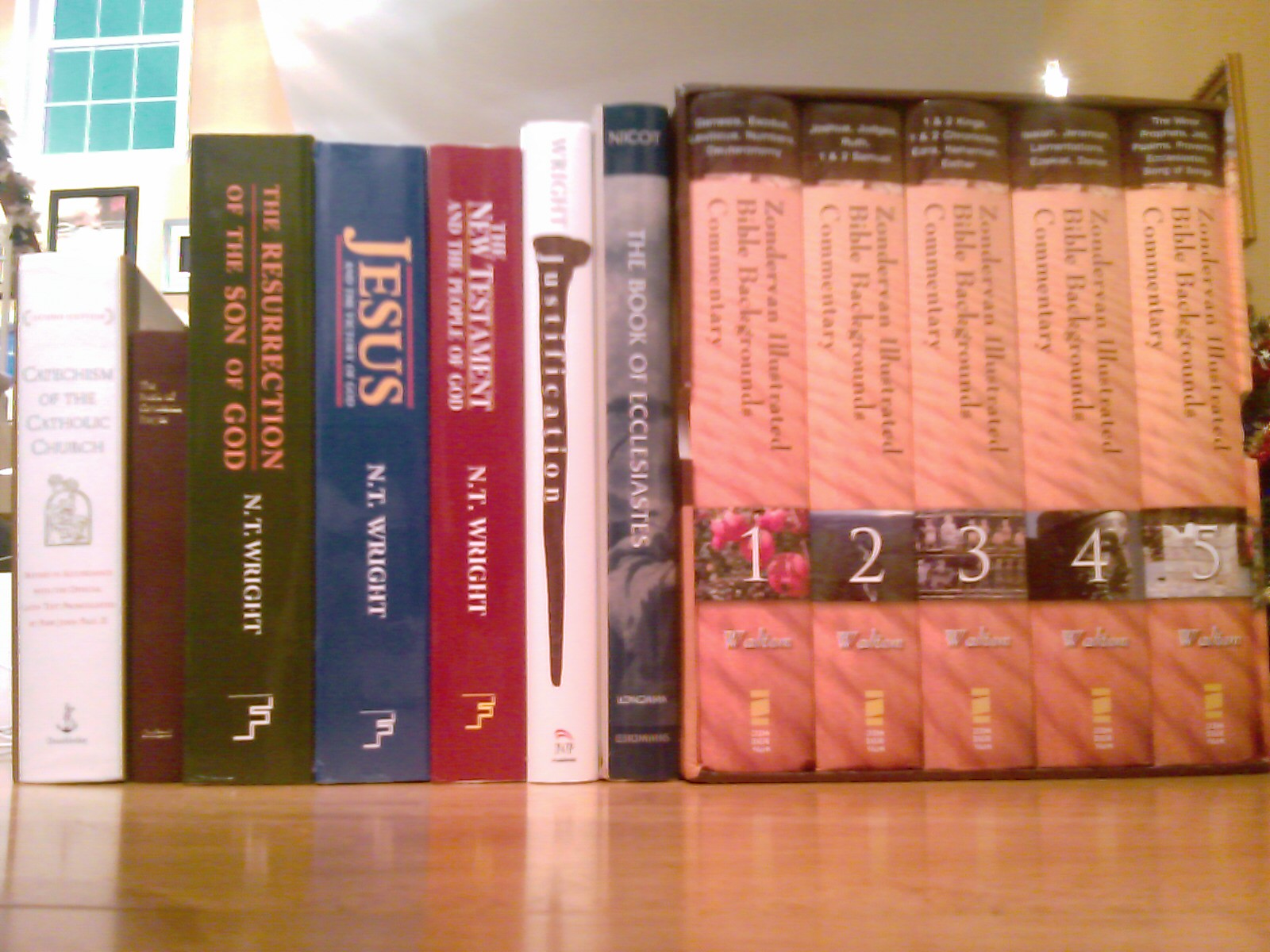
What an Ex-Seminarian gets for Christmas


In order from left-to-right:

The Bible, Slavery, & Atheists{2b}: Theology & Ethics | Reform & Revive


By the time I finished the next article in the series, it was substantive enough and socially-oriented enough to warrant being posted on my webzine Reform & Revive.  The previous post was on on how secular Philosophy can inform our view of ethics and contribute to the discussion of Slavery, Atheism, and the Bible.  This one is about how Christian theological ethics can uniquely inform our ethics in modern times.  The article covers a LOT of ground and is the longest one I’ve written yet in this series.  Hopefully that’s not a turn off.  This article has more of my thought concerning truth and Biblical interpretation than perhaps any one article I’ve ever written contains.  Here’s the link:

http://reformandrevive.com/2009/12/22/a-theology-of-ethics-contemporary-applications/

It seems in light of my earlier post I’ve decided to pour more of myself into this series, rather than just quickly finishing it off.  Hopefully it’s helpful.

Lastly, I keep getting private emails, texts, and messages from Christians talking about how much they’re enjoying this series, and how helpful it is to them, but hardly any Christians are publicly commenting.  I’m getting tons of comments from my atheist friends, though.  Discrepancy?  I think so.  If you have a thought, please leave it.  It could be really helpful to get more input on this and diversity of thought on this.

Thank you all for your support and encouragement.  It means a lot.

The Bible, Slavery, & Atheists{2a}: Philosophy & Ethics


As I’ve looked at and read the various articulations about this issue put forward by my atheist friends, I’ve noticed a few philosophical assumptions about ethics that are driving many people’s perspective on how the Bible does/should talk about these things. In this post, I’d like to highlight those things and show how they are neither philosophically or theologically correct. By the time I finished writing, it was really long, so, using one of the few benefits of blogging as a medium of discourse, I will put up the second part (concerning the more theological side of this) tomorrow or the next day.

The Philosophy of Ethics

Principles vs. Applications

Even the most cursory look shows that the study of ethics is the study of transcendent principles that govern our morality and behavior. There is an important distinction though made between those transcendent principles and their applications. One can hold to the exact same set of principles, but apply them differently at different times/cultures. It is simplistic and reductionistic to think that anyone’s “ethics” will be applied in the exact same way every time. No ethicist secular or otherwise treats ethics in this fashion. I believe that Scripture is consistent throughout in its transcendent principles, though not in their comprehensive applications (below). To navigate applications takes another pair of things the Bible talks at length about: faith and wisdom (more in the next post). Further, I don’t think this principle/application distinction provides any serious ethical challenge to biblical authority. The Bible itself never claims to treat ethics in this reductionistic manner, so to force it upon Scripture is dishonest.

One of my atheist friends mentioned the converts in isolated African tribes where nudity is prevalent, saying that if Christians were consistent, they must insist that they all cover up in order to be Church members in good standing. Except there’s a problem with that: there is no Christian ethic of “non-nudity”. There is a Christian ethic of “modesty” that says that we have the responsibility to adorn God’s beautiful creation of the human body in such a way that it maintains the respect and dignity it deserves. Now, how respect and dignity is shown changes culture to culture, so it takes wisdom to see where the human form is being abused in that culture — and that is not a compromise of Christian ethics. The consistent biblical principle has still been preached, upheld, and lived. If ethics (secular or Christian) were as naively structured as is necessary for some of these atheist criticisms to make sense, then the entire field of ethics would be unnecessary and non existent, because we could have a computer program that could make all the black-and-white moral decisions for us.

Continue reading

“The Beauty of Theology (an Advent Call)”-GoingToSeminary.com


I just wanted to let all of you know about a new article I recently put up on GoingToSeminary.com.  In light of this advent season, I retooled some of the things I wrote in my Beauty series to encourage those of us getting bogged down in holiday busyness and school finals. I hope the article is used to stir many of you towards the great God that dwelt among us. Read the full thing:

The Beauty of Theology (an Advent Call)

Also, for those interested, my church, Liberti (I go to the South Philly campus) has put together a prayer guide for Advent.  I hope this further helps you in the weeks to come.

Check out the rest of my Going To Seminary posts.

An Open Response to Some Atheist Friends Regarding Slavery & Biblical Ethics (pt. 1)


[First off, this is a long one, and only part 1 of 6, so beware before you start reading.]

On Facebook, there appeared a status by an old atheist friend of mine from undergrad named Larry (supported by another friend Christopher). Here was the thesis of the post:

Regarding moral relativism the christians are hypocritical. They say they believe in a moral objectivity given by god…but how is it then, that they believed slavery was a product of the old days, as it was applicable to the time it was practiced (and sanctioned by the bible) but now condemn it? The bible, last I checked did not change. I think this is a PRIMARY example of moral relativism exhibited by the church and christians. So how can they sit here and tell us that a proof for god is moral objectivity?

In other words, how could the ethics of Christians change over time if the book they supposedly base their ethics upon has not changed? Either the God that inspired the Bible was completely incompetent in his revelation or there was no God revealing anything at all. The note caused a discussion that resulted in almost 90 comments, and I quickly realized that if I were going to respond, it would need to be in a more lengthy manner than a Facebook comment (which is not the most helpful of mediums of debate). So here it is. I’d like to respond to the ideas that came out in the discussions. I want to disagree with them on the basis of five ideas:

Continue reading

Beauty: The Complete Series


screen-captureIn 2009 I did a seminar at my old church, Epiphany Fellowship, on the topic of Beauty. I spent about nine months doing research, reading, talking, and thinking before offering it to the community. I then separated my overall talk into the series of blog posts you’ll see below. A year later, I updated the main manuscript with some expanded thoughts. Those blog posts represent the material before the update.

On this page you’ll find the audio from the talk and the updated manuscript,, as well as a special appendix I put together offering a complete breakdown of every word in both Greek and Hebrew that the English Standard Version of the Bible translates as “beauty” or “beautiful”, broken down by frequency.  Along with those words (and all their forms), I’ve offered the most literal definition of each so you can easily see the huge range of meanings that the Biblical words for “beauty” carry. I hope it’s helpful. You don’t need any knowledge of Greek or Hebrew to understand it or get something from it.

Series Table of Contents

Resources for this series:

[photo by David Schrott]

The Outline for the Entire Series:

Resources for this series:

[photo by David Schrott]

“Seminaries & the Nature of Truth” – GoingToSeminary.com


Hey, just wanted to write a quick note letting you all know that my new article is up on GoingToSeminary.com.  This is Part 2 of a very unofficial series I’m doing on Truth and Doctrine.  The first part went up about a week and half ago, and had some great feedback on it.  This article is getting mostly positive feedback, though maybe I wasn’t as clear on this one.  I would love some more feedback.  By the way, Beauty Part 10, should be up in the next few minutes.  Here’s the link to the GtS article:

Seminaries & the Nature of Truth

Check out the rest of my Going To Seminary posts.

“Letting Seminary Doctrinally Change You” & Controversy – GoingToSeminary.com


Remember “that” article I was talking about last week?  The one that may begin some “controversy” at GoingToSeminary.com?

Well, it’s up now.

It’s part one of two on a little series I’m writing on doctrinal changes while in seminary.  As I said then, I’m more concerned about this next article than this one.  If it even comes out.  In an hour and a half I have been called upon by the “Vice President of Advancement” and “Associate Professor of Systematic Theology” of Westminster Theological Seminary, David Garner to grab some lunch.  I have no idea what the topic of conversation is (and the one time I’ve asked, he never answered), but I’m optimistic.  He has always been one of my favorite professors I ever had and has one of the most pastoral, worshipful, Christ-centered hearts I’ve ever seen in a man.  I look up to him greatly as a pastor, preacher, teacher, husband, and father.

But, he is very much on the side of the issues at Westminster that I am not.  So I’m wondering what this is about.  I haven’t been that vocal against WTS have I?  I feel like whenever I have I’ve always made it clear that this is my opinion and I that I know I’m still young, arrogant, and don’t know anything.  I don’t know.  We’ll see.  I may let you all know.  But, in the meantime, read and enjoy the article “Letting Seminary Doctrinally Change You” at GoingToSeminary.com.  Here it is:

Letting Seminary Doctrinally Change You

Check out the rest of my Going To Seminary posts.

The Contemplation of Beauty{8}


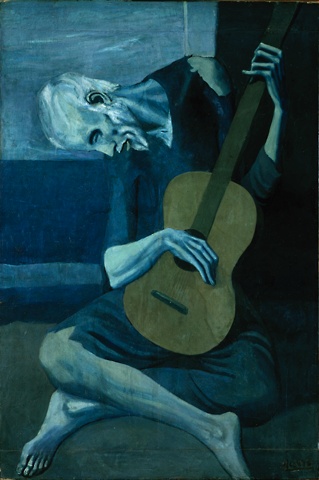
Picasso - The Old GuitaristSorry for the brief hiatus.  I don’t quite know what happened.  Probably just getting used to work and a new schedule and everything.  I have a few “lighter” articles in the works for the next couple of days, plus I’m working on more substantial things for other sites.  I’ll let you all know.  But now, back to beauty.

Last we left the Beauty series, we were discussing the proper way in which to respond to it.  Though there’s no absolute “most proper” way to respond, I used our main Biblical text that we’ve been looking at, and an idea developed by C.S. Lewis to break down our response into two useful categories: contemplation and enjoyment.  Before we enjoy, we contemplate.  This is not to say we can’t enjoy anything apart from comprehensively knowing it, but it does say that a contemplation and exploration of things helps us enjoy them more fully; and to be enjoyed to the fullest is the ultimate desire of Beauty itself.  But what does this contemplation look like in real life?

Let’s recall our defintion of Beauty as the attribute of something that expresses complexity, simply.  It’s what takes the complex unwoven strands out there in reality and weaves them into a tapestry that we can perceive with our spiritual and physical sense.  The more strands are woven more simply, the more beautiful that tapestry is. So in its most basic form, the contemplation of Beauty is thinking through what “strands” or what “complexity” is being represented in the thing in front of you.  So what does it look like? Well, formally, in philosophy, this endeavor is called “Aesthetics” or “Metaphysics”. It’s the philosophical study of Beauty and Beautiful things.

In the real world, for the rest of us, I thought of two ways this could look. First, when presented with something that your senses find beautiful, ask yourself, “What is it that’s actually being stirred in me?” Is it romance? Sorrow? Reminders of childhood joys? That stirring is your soul resonating with the strands that are in the tapestry in front of you. This is what art critics are really good at doing: teasing apart the strands that make up any given piece of art. The second way I could see this look is when you are encountered with something or someone that everyone seems to think is so beautiful but you just don’t get it. Maybe it’s the Mona Lisa. You may think: “Yeah, it’s a good painting, but what’s the big deal?” Maybe it’s some piece of abstract art that everyone else is swooning over but you. Maybe it’s a book, poem, or song you just don’t understand. In this case, I would encourage you to do research, read criticism, and try and understand the complexity behind the tapestry that others are noticing, but not you. It seems like people that know Music theory really well seem to like Jazz and Classical more than others. It seems like trained poets like weird abnormal poetry. The better you can understand the complexity in something, the easier it is for you to appreciate and ultimately enjoy the fullness of its beauty. This is why I would encourage all of you to be very curious about as many topics as possible. It’s not for the sake of more knowledge, but so that you can better enjoy the world around you and see it’s Beauty in everything.

Now, what I just went through is more for our everyday use and understanding of subjective, created Beauty. But more importantly, we must learn what it means to contemplate the Beauty of God. In Christianity this endeavor is called “Theology”. If Theology is (as most people know) “the study of God”, then it by definition is the study of Beauty Itself. This is what Theology was meant to be. It’s the kind of theology God calls us to do. Theology is the contemplation of the various complexities and revealed “strands” of God in order to better enjoy Him. John Calvin talks about this in his Institutes of the Christian Religion. He says that if your quote-on-quote “theological study” isn’t leading you to greater praise and enjoyment in God, then you’re not really studying theology! At that point it’s just studying literature – getting a better idea of this “character” named God in this “novel” called “The Bible”. This is why I had to leave seminary. I was in the midst of such beauty and I was numb to it! I was too immature. I didn’t have the spiritual infrastructure to see it for how beautiful it was! This infinite complexity being placed in front of me day in and day out was not leading me to enjoy Him. How many of us live day in and day out surrounded by the objective beauty of Christ and it does nothing to us? This contemplation of the Beauty of God can help us. Just yesterday our brother Marc Savage sent that group text (I have no idea how many of you got it) with this quote from Charles Spurgeon: “There is something exceedingly improving to the mind in a contemplation of the Divinity. It is a subject so vast, that all our thoughts are lost in its immensity; so deep, that our pride is drowned in its infinity. No subject of contemplation will tend to more humble the mind, than thoughts of God.”

May I challenge all of us to press in and seek the complexities of Who this God is and how He has revealed Himself? Understanding the beauty of God is of the utmost importance to the Christian, because His beauty is completely pointless. It can’t be manipulated, used, or abused. It can only be enjoyed. Something I’ve learned over time: whenever spirituality of any kind goes awry and goes off track, the Beauty of God is one of the first things to go. The inability to accept the mysterious complexities of God is the beginning of all heresy. You can’t have a right enjoyment of the Beauty of God and be a legalist, libertine (someone who abuses grace), or a hypocrite. Seeking to enjoy the Beauty of God is a guard against all these things. In my reading, one of my favorite things I came across was from a Catholic theologian named John Navone. He says in his book Toward a Theology of Beauty that Christian theologians (which I would argue should be all of us) are people given the task of articulating and putting into words how everything in life is given to us by God. Navone calls this the “givenness” of life and selfhood. This means that all of life is grace – unmerited favor; and that even things that are usually seen as secular (types of visual art, media, culture, jobs, and types of “non-Christian” music) are actually things that “mediate the mystery of the dawn of Christ’s Kingdom, as epiphanies or manifestations of grace. We as theologians [(and I would argue as artists and beholders of beautiful things)] are charged with the task of ushering in and articulating the mysteries of beauty which we will rest in forever.” That’s amazing. He goes on to say that “Theologians [(and I’d say even Christian artists)] are engaged in a dialogue, not only with their public, but with the object of their contemplation.” This should be one of the distinguishing factors between artists that are Christians, compared to those that are not: non-Christian artists can only use their art to dialogue with other people (speaking horizontally) and other art (speaking down). Only the Christian can make art with the confidence and hope that it also speaks and dialogues upwards to a God pleased to see, hear, or watch it.

Now what if you’re hearing all this, but you wouldn’t say you’re a Christian. First, if your interest has been piqued, but you just don’t get it, I’d give you the same encouragement I gave to those earlier that don’t understand the Beauty of things that others find beautiful. Learn about this God. Stick around. Ask questions. Seek answers. Try to see the infinite complexity of this God and how simply he has revealed Himself. Look into how He has revealed Himself and start to pick apart the strands of the incredible tapestry he has revealed Himself as. Secondly, let me encourage you: there is objective Beauty. You heart yearns for it and longs for it, and it is out there. Objective beauty is when the fullest possible complexity is expressed to us. So God – infinite complexity – is that objective Beauty Itself. But people don’t know full objective beauty before they know God. This complexity cannot be comprehended until God changes someone to comprehend it. If you’re not there yet, that’s fine. Pray. Ask God to change you as He has changed many of us. Contemplate this God. Contemplate His world. Contemplate all Beauty.

Why?  So we can enjoy Beauty.  I’ll see you next time.

Here are the manuscript and lecture that this series is based off of.

Click for Manuscript Pdf

Manucscript

Click here for sermon audio

Audio

How Do We Respond to Beauty{7}?


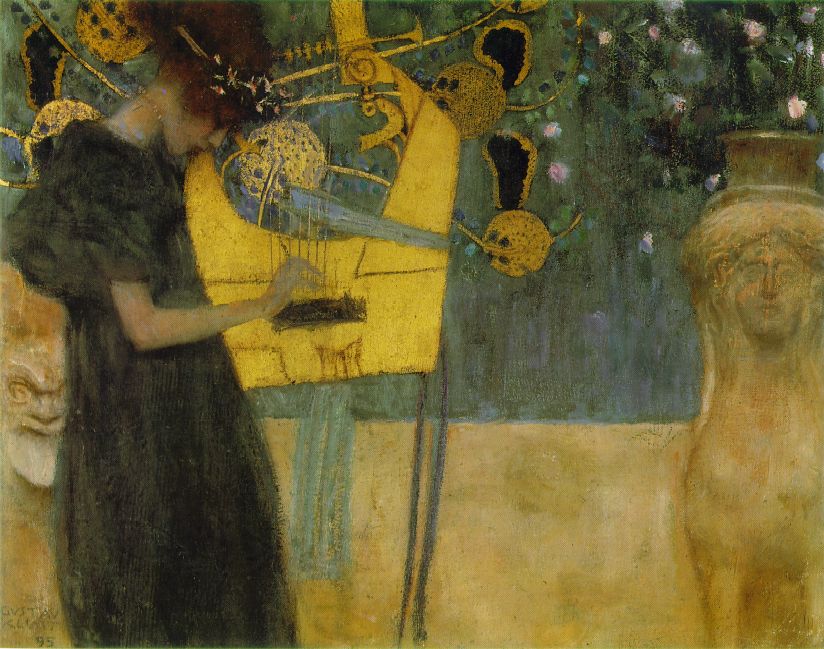
Klimt - Music 1

_______________

Wow. We have covered a lot of ground so far. We’ve discussed what beauty is, what things are actually beautiful (God, Nature, Humans, Art), and why they are beautiful. But there’s one more very important thing left to discuss (that will take a while to unpack): how are we meant to respond to Beauty? We used our text (Ecclesiastes 3:11-15) to give us a context to figure out a definition of Beauty, and then we applied that definition to different things, so let’s go back to it and see how we are supposed to respond to this beauty.

“He has made everything beautiful in its time. Also, he has put eternity into man’s heart, yet so that he cannot find out what God has done from the beginning to the end. I perceived that there is nothing better for them than to be joyful and to do good as long as they live; also that everyone should eat and drink and take pleasure in all his toil—this is God’s gift to man. I perceived that whatever God does endures forever; nothing can be added to it, nor anything taken from it. God has done it, so that people fear before him. That which is, already has been; that which is to be, already has been; and God seeks what has been driven away.”[Ecclesiastes 3:12-15]

The ultimate response, the final goal, of seeing all the Beauty God has put in our hearts, put in the world, and is doing in and around us, is joy and doing good. But the writer did something before he could declare this: he thought about it and “perceived” this to be the case. You see this in the final verses of this section as well. After declaring the joy that should come from seeing Beauty, he then steps back and sees the bigger picture. He tells us what first must be true about God if we are going to ultimately respond to beauty the way we should.

Reading this reminded me of something C.S. Lewis once said. In one of his philosophical works (I honestly don’t remember which one) he says that humans interact with things by contemplating and enjoying. He says that they cannot do these things at the same time though they can rapidly move back and forth between the two. I think this is a great way of saying what the author in Ecclesiastes is saying. We first must “perceive” (or contemplate) Beauty and then we enjoy the Beauty that God is making all things into and that he has placed into our hearts and world. Often, this distinction between contemplating and enjoying happens so rapidly that it seems like it is happening at the same time, so don’t worry, I’m not necessarily saying that you can’t enjoy beauty before sitting down and thinking about it, researching it, and writing out some paper something. Even before contemplating something and learning its complexities you can enjoy the Beauty of something. But this is the same way that a husband can enjoy his wife on the first day they’re married, but he must spend time and effort after that contemplating and getting to know his wife, so he can enjoy her more fully and more comprehensively. Contemplation is not necessary to enjoy at first, but it is necessary to enjoy fully.

I know this was a brief post. It’s just because the next several sections are substantial enough to deserve their own posts. So, mull on this for a while, read some other new posts of mine at Reform & Revive and GoingToSeminary.com, and Monday we’ll go really in depth into the contemplation of Beauty and beautiful things.

Click for Manuscript Pdf

Manucscript

Click here for sermon audio

Audio

Review: John Navone’s “Toward a Theology of Beauty”


In my attempt at writing shorter and more frequent posts (rather than feeling the burden to produce daily meaty posts), I thought I’d put up this little review of a little book (91 pages) I just finished called Toward a Theology of Beauty by John Navone (1996, The Liturgical Press).  I had originally started reading it for the Beauty message I gave, but I never finished it.  As time went by, though, the things I had read in this book began creeping back into my thoughts, so I decided to finish it, and let me tell you, that was a good call.

This is an incredible book. I’m still in awe of it. It seizes your soul and takes it to the highest realms of the mind and heart of the Beautiful Triune God. I have almost an entire journal filled with notes I have taken form this book.  I will look over these notes often for years to come, to let myself get swept away by the ideas present here.  Navone doesn’t have progressive outline, so it’s difficult to lay out exactly everything he talks about.  The best thing one could do is shoot over to the Amazon.com page for the book and “Look inside” to peer at the Table of Contents for his topics.  Suffice it to say, the book is theologically comprehensive.  It doesn’t answer many of the more practical questions we may have about art, human beauty, and such, but it does help in a much greater understanding of the more ethereal and abstract realities of Beauty, especially as it originates in and delights God Himself.

I guess my only critique is a common one I had with most things I read during my preparation.  It assumes the validity, and authority of ancient Greek philosophy, especially the distinction between the True, the Good, and the Beautiful.  He uses this Hellenistic concept throughout.  Many things I read used this “trinitarian” framework to shape and organize their thoughts.  I don’t know how valid this is and I would argue this limits us in many ways.  but this is minor, and doesn’t really take away from the wonder and awe of this book.

Navone is a Catholic theologian, and if I learned one thing from reading this book, it’s that Catholics understand Beauty in a way that only 2,000 years of thought and reflection can provide. We Protestants can learn a lot from our Catholic brothers and sisters. Heck, after reading this, I’m practically Catholic now myself.

Navone’s writing is beautiful, his thoughts profound, and theology rich. I highly recommend this book to anyone looking to increase their worship of a Beautiful Transcendent God.

May I Offer a Definition of | Beauty{2} ?


Caravaggio - Saint Jerome2This is Part 2 of an ongoing series based on the paper I wrote on Beauty and the subsequent sermon I gave on it. [Bold: things I had time to say // Regular: things I didn’t have time for]

__________

Whenever you go to study a particular topic in the Bible, the first place you go is the concordance. You go online, or you look in a book, and you search for every time that word is used. If you’re lucky, you’ll find some place in the Bible where the the writer gives you a direct definition for that topic. You look for statements like “This is love” or “Faith is” or “This is the will of God”. The Bible never gives a definition of Beauty. It calls God, creation, and people all beautiful. It says some people are beautiful. It says some people do beautiful things. It calls both good things and evil things beautiful. It calls for us to seek after certain beautiful things. It tells to avoid certain other beautiful things. So, just simply looking at the whenever the Bible uses the word “beautiful” doesn’t help us tremendously, but it’s a start. We can start to see that beauty is a bit more complex than we’re sometimes told. We start to see how a lot of common definitions we hear some times aren’t true Biblically. We see that:

  • it’s not perfection.
  • it’s not just when something reflects God.
  • it’s not just order or symmetry. We all know there can be beauty in chaos sometimes.
  • it’s not just in the eye of the beholder. There is some objective sense of beauty.
  • it’s not just an attribute of things or people.

The next step in studying something topically is to look at the original language to see what the English translation “beauty” meant in the Greek and Hebrew. When you do this, things get nuts. In the ESV alone, there are over 20 very different Hebrew and Greek words all translated as “beauty” or “beautiful”, but we can still learn a few things. First off, we see that the Hebrew mindset is a lot richer than the Greek one. The Hebrew words range in literal meanings such as pleasant, dignified, adorned, sweet, delightful, precious, boastful, arrogant, glorious, vigorous – one word used only once even means “scraped of all impurity”. The Greek words mean simply good and beautiful. But there is some depth here. The most common NT word used for “beautiful”, but most often translated as “good”, originally comes from a verb which means “to call”, speaking to the attractive nature of beauty. The other word used comes from the word for “hour” which describes beauty as being “within one’s hour”. By the way, in the attached manuscript, you can find a full breakdown of every instance these words appear in the Bible, their form, their frequency, and what each of those Greek or Hebrew words most literally mean.

So now we have a fuller idea of beauty, but still no working definition. At this point you just have to pray, read, and think a lot while looking at the broader context of theology. We use the things we clearly know about the nature of God, humankind, and reality to shed light on the ambiguous things and help us get closer to a definition. When you do that, some things come up that we need to keep in mind.

First, our definition needs to make God the most beautiful Person in the universe, it needs to make the cross the most beautiful event in history, it needs to make Jesus the most beautiful man who lived the most beautiful life this world has ever known, and lastly, it needs to make the Gospel (or the message of Christianity) the most beautiful thing anyone could ever hear or believe.

Secondly, we see that there is a tension that has to be held when it comes to talking about Beauty. It seems like Christians throughout history have fallen into one of two errors when thinking about it: either a pantheistic view or deistic view of beauty. The pantheistic view would say that God is beauty so only things that join him in His beauty can be beautiful. Nothing can have beauty in and of itself. It’s only beautiful as much as God shines through it. This definition would say that bad music made by Christians will always be more beautiful than really good music made by non-Christians. Now we all know that’s not true, because we’ve all heard really bad Christian music. This is the over-objective view of of beauty. The other view, the deistic view would say that God is beautiful, so He put beauty on earth that’s completely separate from Him so we can have a beauty that’s all our own, and it doesn’t relate to God in any way. God is beautiful. Humans are beautiful. There’s no connection. We don’t share in God’s beauty. This view would say that there is absolutely nothing more beautiful about one song that talks about the depths of who God is as opposed to another that doesn’t. They’re just songs. This view is an over-subjective view of beauty.

The Biblical view is different from both of these. The Bible teaches that God is separate from His creation, but He’s still present. God is not in created things, but those things can and do preach about who God is. Man is not God, but God has become a man so that He might communicate Himself to us and accomplish for us what we could not do for ourselves. So God is completely other, but He’s near. So, our definition of beauty has to reflect this. It has to be something that is connected to the nature of God but is still something humans can possess, but not in the same way. It has to objective for God, but subjective for us.

After doing all that, are you ready for an actual definition? The best definition that my arrogant, immature, and prideful 23-year old mind has been able to come up with for beauty is this:

Beauty is the attribute of something that expresses complexity, simply.

That’s it. Beauty is what makes infinity, finite; it makes transcendent things seem near. So the more “stuff” that is represented more “simply”, the more beautiful something is. The best image I’ve been able to think of to explain beauty is the Hebrew word shalom. Many people know that this word is usually translated as “peace” but it has a much richer meaning than this. The Old Testament uses this word to describe the ultimate goal and end of history and all that God is doing–peace. Now, when we think of peace, we usually define it negatively- no fighting, no war, no hunger, no pain. But this word in the Hebrew carries with it the connotation of reknitting the very fabric of the universe. It paints a picture of a world that is made up of an infinite number of “strands” of sorts, and shalom is when these strands are re-woven together into a sort of tapestry. Beauty, therefore, is when some or many of these complex strands are woven together into a tapestry that we can perceive with our senses, both physical and spiritual. The more complex strands contained in one simple “tapestry”, the more beautiful that thing is.

This is the objective idea of beauty. But, this definition also has the benefit of having an appropriate subjective component as well. You see, we as individuals over time become more sensitive to certain ones of those strands of the universe and less sensitive to to others. Our culture, experiences, natural make-up, and ultimately our spiritual state all cause us to sense and value various strands differently, making us value different “tapestries” differently.

Next time, we’ll begin applying this definition to other things to (a) better explain it, (b) see if it works, (c) explain why we find somethings beautiful. The first thing we’ll talk about being beautiful? God. Until then . . .

Click for Manuscript Pdf

Manucscript

Click here for sermon audio

Audio


CashTag

Enjoy the Post? Leave a tip with Square Cash!

Why We Long (Setting the Stage) [Eccl.2+3] |Beauty{1}


Scotland-Summer 2006-Edinburgh-Calton Hill-040This is the first part in my series going through the different ideas in the manuscript I wrote for a recent message I gave at Epiphany Fellowship’s monthly ministry “First Friday Fundamentals”. Upcoming topics include what Beauty is, how science reveals Beauty, why we find some things/people unattractive, and the nature of physical beauty. This first part lays out a theological and psychological understanding for why we long for beauty in the first place and how even that longing can get derailed because of our fallenness, finitude, and sinfulness. Also, I made a Web Album of pictures I took from Calton Hill.  They can never do it justice, and they look really anticlimactic, I know, but just trust me, God met me there.  I also linked relevant references in the manuscript to their appropriate pictures.

[Bold: things I had time to say // Regular: things I didn’t have time for]

___________________

In the Summer of 2006 I spent some time studying Creative Writing abroad at the Glasgow School of Art in Glasgow, Scotland. It was amazing in many ways. It was the first time I’d ever been out of the country. I saw things, met people, and went places I only could have dreamt of seeing, meeting, or going. One particularly memorable highlight: I had my first beer ever in a Scottish pub, July 4th, during the World Cup. The third week or so into the program, we had a free weekend so I decided to spend the weekend in Scotland’s capitol, Edinburgh. On Sunday I found a church and attended this amazing service. Afterwards, I just started walking around the city. I ended up following my map to this place called “Calton Hill. I walked in the shade of the tress around the base of the hill and found these little stairs to my right. I followed those stairs and as I reached the top, the trees broke just right, and the light fell so precisely, and I turned at just the right angle that I suddenly found myself standing above the entire city of Edinburgh looking out for miles. As I turned around 360 degrees, I could see the ocean on one side, the city on the other, and the giant hill to my left a mile or so away called Arthur’s seat that they say figures into the King Arthur legend.  [Click Here for the Web Album]

I began to cry almost immediately. One thing you’ll realize about me over time: I’m either the most rational romantic or the most romantic rational. To the charismatics in an old church of mine in Richmond I was the cold, dead theologian. To the seminarians up here I was the feely, emotional charismatic. They’re probably both right. But regardless, I broke down on top of this hill because I was staring at the most beauty I’ve ever seen. I felt small, I felt sinful, I felt worshipful, and I felt the presence of God more tangibly in those few hours I spent on top of that hill than at any other moment of my life. At the very same time I felt the most complexity and simplicity of emotions. I was so at peace, yet I wanted to scream.

So why is it that beauty draws those sorts of things from us? What is it anyway? How do we know what is beautiful and how to respond to it? We live in a world of such paradox. Pain and ugliness are the primary soundtrack of our lives, it seems, and yet most of us don’t live in a constant state of despair. We seem to live off those little oases of beauty in life. So how do we understand what beauty is and how it works in the midst of the seeming vanity of all life? Well, there was another man in history that pondered these things and recorded them in the book of the Bible we know as “Ecclesiastes”. He looked out on his own existence and the nature of life and saw it for what it was: full of useless strivings and the vain repetitions of repeated history as all reality just keeps turning, turning, turning. We know him today by the Hebrew word for “Speaker” or “Preacher” and that is what he does. In the text we’ll be in he tells us about life and beauty and how these things relate.

The Text (Ecclesiastes 2:22-3:15)

Read 2:22-24 | verse 24, as the Hebrew literally says it, and how it can legitimately be translated, reads: Nothing is better unto mankind than that he should eat and drink and see his soul as beautiful in the midst of his toil.

Read 2:25-26 | The “toil and striving of the heart” the writer talks about here is the work that we do in light of our deepest desires. It’s the pursuits to fulfill all we want and all we long for. It is those pursuits that can never be accomplished, those longings that can never be fulfilled. It’s the deepest drives within us that motivate everything we do. The writer says that these desires, these strivings can never be satisfied. We can try all we want, but no matter what, that pain and vanity will always be the constant state of our lives. But why? Why is it so vain to work so hard at this?

Read 3:1-8 | You see, it’s vain because all things already have their proper predetermined season. Everything you work to accomplish will only come in it’s appointed season for you, and everything you work to avoid will always come in its appointed season for you. That is why our toil is all in vain. But yet we strive anyway. So why do we still strive in this life? The Preacher asks this very same question: What gain has the worker from his toil? He then tells us that he thinks that God has given him a special perspective to give us some insight on why we do (and should do) the strivings that we do. He says: I have seen the business that God has given to the children of man to be busy with. He says that he thinks he sees it. He has looked out over history and life and he thinks he sees why it is we strive. Though it’s in vain, God still births something in us to toil. The Preacher has seen the proper striving that God has given humans to do. So what is it? Well, his answer to that is our main text tonight.

Read 3:9-15 | The writer says I have seen the business that God has given to the children of man to be busy with. He has made everything beautiful in its time. Also, he has put eternity into man’s heart, yet so that he cannot find out what God has done from beginning to end. Does anyone else see how weird this sounds? The writer says this is the business of man and then goes on to talk about God doing things and what we can’t do. So what’s going on? This is what I think the writer is saying: God has a picture of what a good and beautiful world looks like and He is forming this world into that picture as he is making all things beautiful. This beautiful world is an Infinite, eternal one. So, He has put eternity into our hearts, or in other words, put a deposit of this eternal beautiful world in our hearts, causing us to long for it. This seems to be so we can recognize the beauty that God is making while not seeing the exact mechanisms that God is using to do it. It forces us to enjoy what God is doing while still having to trust Him rather than trying to predict Him. Apparently the business of man, then, is to see, recognize, and enjoy the beauty God is doing. But, in our sinfulness, we don’t like not being able to find out what God is doing from the beginning to the end, so we like to form our own pictures in our heads of what a good and beautiful world looks like. So every action of every human being is to make the world out there match the world in their head. The task of the Christian, then, is to make the world they want in their head match the world the God has placed a longing for in their heart. The rest of our text describes what this looks like, so we’ll get to that later when we talk about how we respond to beauty. But let’s first get down a definition of Beauty.

And that, my friends, is for next time . . . Here are the audio and manuscript links, as promised:

Click for Manuscript Pdf

Manucscript

Click here for sermon audio

Audio