Righteous Works; Wicked People | Romans 6.20


When you were slaves of sin, you were free in regard to righteousness.
Romans 6.20

Those that are not Christians can still do righteousness. But when they do it, it is from a place that is not their essence. I can’t think of an analogy right now. But, they are free to do righteous sings even though they are not considered righteous people. Is that a good way to put it?

See other Marginalia here. Read more about the series here.

In a sense, God CAN’T favor the righteous| Job 9.1-4


Then Job answered:

“Indeed I know that this is so;
but how can a mortal be just before God?
If one wished to contend with him,
one could not answer him once in a thousand.
He is wise in heart, and mighty in strength
—who has resisted him, and succeeded?
Job 9.1-4

It seems here that Job is no longer clinging to his earlier idea that he is indeed righteous and pure. Instead, he is admitting that his friend is correct: he is sinful and has done wrong things. But, he also points out that God is not a God that would insist that every single little sin and wrong-doing be brought to mind and confessed before relating favorably towards someone.

Job is saying that people are too sinful for God to structure the world in such a way that the righteous are related to in one way and the wicked in another, because everyone belongs fully in that latter camp. There can only be two sets of rules if there are two teams playing the game.

He is in effect saying what Paul says in Romans 3, that all people have sinned and fallen short of the glory of God, therefore there is no distinction among people. Ironically, then, Job’s defense here is not necessarily the he is righteous, but rather that he is far too messed up for his friends’ version of reality to be right.

Also of note, the rest of this chapter is more or less Job proclaiming the very things that God uses to rebuke him at the end of the book. Job really does seem to know this stuff.

See other Marginalia here. Read more about the series here.

Anna, the Prophet of the Lord | Luke 2.36-38


There was also a prophet, Anna the daughter of Phanuel, of the tribe of Asher. She was of a great age, having lived with her husband seven years after her marriage, then as a widow to the age of eighty-four. She never left the temple but worshiped there with fasting and prayer night and day. At that moment she came, and began to praise God and to speak about the child to all who were looking for the redemption of Jerusalem.
Luke 2.36-38

What a powerful testimony. She was only married for seven years before her husband died. She had been a widower for 84 years. What pain and loneliness she must have felt. And yet, how did she spend it? Serving God’s people as a prophet, being especially in tune with those “looking for Israel’s redemption” and then proclaiming Jesus to them. Even before the Cross and Resurrection, Jesus was the answer for the longing of God’s people for redemption.

Also, Luke said he went through all of the accounts and picked and chose what would get “in” and what wouldn’t. Of all the little anecdotes he chooses to keep in and keep out, he chooses this. What a powerful woman she must have been for her to have been seered into the collective consciousness of God’s people retelling this story.

See other Marginalia here. Read more about the series here.

Is There No Rest for God’s Weary Ministers? | Mark 6


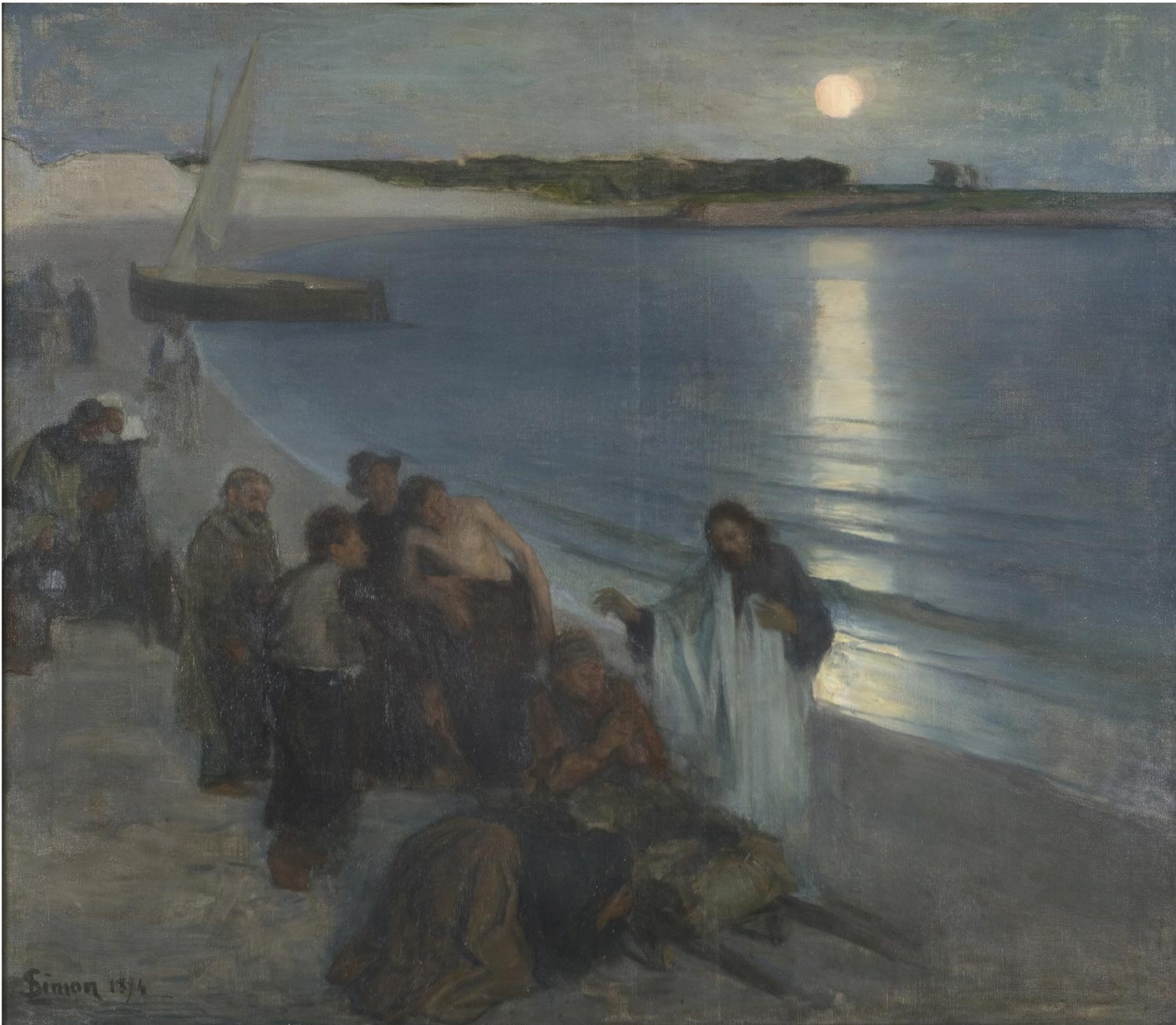
Lucien Simon-Christ Performing MiraclesReading through the sixth chapter of Mark, I recently noticed a way that Jesus relates to his disciples which is, at first, incredibly encouraging, but then gets exceedingly hard.

This is right after he had sent his disciples out, two by two, to try out this whole “ministry thing” by themselves. According to Mark, it was an incredibly powerful and effective time of ministry for them. They saw powerful things done, and they were able to play a part in them. They return from their first “ministry internship”, and this is where we pick up the story.

The apostles gathered around Jesus, and told him all that they had done and taught. He said to them, “Come away to a deserted place all by yourselves and rest a while.” For many were coming and going, and they had no leisure even to eat.
Mark 6.30-31

Jesus’ pastoral concern extends not only to his flock but also to the shepherds. They have done so much ministry and now he insists that they withdraw and rest and eat. Also, they shouldn’t simply do this by themselves as individuals, but with those who are also doing ministry. The leaders of the church should rest together as fellow weary workers.
Continue reading

Job’s Friends are Right! Job’s Friends are Wrong.| Job 8.5-7,20-22


If you will seek God
and make supplication to the Almighty,
if you are pure and upright,
surely then he will rouse himself for you
and restore to you your rightful place.
Though your beginning was small,
your latter days will be very great.
Job 8:5-7

We mock Job’s friends, but what this guy says here is exactly what happens at the end of the book! Its practical, prophetic, and foreshadowing the end. We need to cut these guys a break.

“See, God will not reject a blameless person,
nor take the hand of evildoers.
He will yet fill your mouth with laughter,
and your lips with shouts of joy.
Those who hate you will be clothed with shame,
and the tent of the wicked will be no more.”
Job 8.20-22

Okay, though I defended this guy earlier, this here is BS.

See other Marginalia here. Read more about the series here.

Jesus Getting Snarky Over the Sabbath | Luke 6.1-5


One sabbath while Jesus was going through the grainfields, his disciples plucked some heads of grain, rubbed them in their hands, and ate them. But some of the Pharisees said, “Why are you doing what is not lawful on the sabbath?”

Jesus answered, “Have you not read what David did when he and his companions were hungry? He entered the house of God and took and ate the bread of the Presence, which it is not lawful for any but the priests to eat, and gave some to his companions?” Then he said to them, “The Son of Man is lord of the sabbath.”
Luke 6.1-5

I’ll be honest, I really don’t understand Jesus’ logic here. Yes, I get that Jesus is referencing this David story to simply say that there is precedent for eating food (even holy food) on the Sabbath. But if that’s the case, his logic is this: “You don’t like what I’m doing? Well, based on a very simplistic reading of the Bible, someone else did it, therefore I can do it.”

He does know that David also did the whole adultery and murder thing with Bathsheeba, right? Just because someone else did it, doesn’t explain why you have the right to do it. Secondly, after saying saying all this, he goes ahead and says that it doesn’t even matter anyway because he is “lord of the Sabbath”.

So, in the end, it seems to me like Jesus is just trying to be snarky here.

See other Marginalia here. Read more about the series here.

Does Paul Not Believe in Original Sin? | Romans 7.9-11


I was once alive apart from the law, but when the commandment came, sin revived and I died, and the very commandment that promised life proved to be death to me. For sin, seizing an opportunity in the commandment, deceived me and through it killed me.
Romans 7.9-11

Hmm…is it just me, or does this does seem to go against the idea of Original Sin? It sounds like Paul is saying that he was born in purity and “alive-ness”, and it was only later that the law killed him. He does not seem to be saying here that he thinks he was born in death (yes, yes, I know Ephesians says otherwise, but I’m trying to stick to the text in question!)

See other Marginalia here. Read more about the series here.

When your church’s “cultural relevance” fails | Acts 14.11-18


When the crowds saw what Paul had done, they shouted in the Lycaonian language, “The gods have come down to us in human form!” Barnabas they called Zeus, and Paul they called Hermes, because he was the chief speaker. The priest of Zeus, whose temple was just outside the city, brought oxen and garlands to the gates; he and the crowds wanted to offer sacrifice.

When the apostles Barnabas and Paul heard of it, they tore their clothes and rushed out into the crowd, shouting, “Friends, why are you doing this? We are mortals just like you, and we bring you good news, that you should turn from these worthless things to the living God, who made the heaven and the earth and the sea and all that is in them. In past generations he allowed all the nations to follow their own ways; yet he has not left himself without a witness in doing good—giving you rains from heaven and fruitful seasons, and filling you with food and your hearts with joy.”

Even with these words, they scarcely restrained the crowds from offering sacrifice to them.
Acts 14.11-18

This is in contrast to Paul’s later methods at Mars Hill in Chapter 17. Here we see that not every “contextualization” is created equal. Sometimes, your “relevance” could be dragging people to worship yourself or false idols. As preachers, we should always be on the lookout for this, and to constantly speak against it.

On another note, that bold part (v.15) should be the model for every single sermon.

See other Marginalia here. Read more about the series here.

Jesus in His Father’s House: Rebuke, Encouragement, & Promise | Luke 2.46-51


After three days they found him in the temple, sitting among the teachers, listening to them and asking them questions. And all who heard him were amazed at his understanding and his answers. When his parents saw him they were astonished; and his mother said to him, “Child, why have you treated us like this? Look, your father and I have been searching for you in great anxiety.” He said to them, “Why were you searching for me? Did you not know that I must be in my Father’s house?” But they did not understand what he said to them. Then he went down with them and came to Nazareth, and was obedient to them. His mother treasured all these things in her heart.
Luke 2.46-51

These are Jesus’ first words in Luke. I wonder if this is a prophetic word for all of us looking for redemption, salvation, peace, and God’s presence. I wonder if he looks at us, and says “Why were you looking for me? Didn’t you know I’d be in my Father’s house?” In two short and simple questions, Jesus gives us a rebuke (Why have you run yourself ragged looking in all the wrong places?), an encouragement (You have found me nonetheless.), and a promise (And I’ll always be right here for you to find me.).

No wonder this was something for Mary to treasure. We should treasure it as well.

See other Marginalia here. Read more about the series here.

Name the Darkness: Jesus & Our Persistent Demons | Mark 5:6-9


When he saw Jesus from a distance, he ran and bowed down before him; and he shouted at the top of his voice, “What have you to do with me, Jesus, Son of the Most High God? I adjure you by God, do not torment me.” For he had said to him, “Come out of the man, you unclean spirit!” Then Jesus asked him, “What is your name?” He replied, “My name is Legion; for we are many.”
Mark 5:6-9

Well this is interesting. It seems like Jesus had said words of exorcism earlier and it, in a sense, hadn’t “worked”. I wonder if the tradition behind this story was of a man so demon possessed that Jesus’ first try at getting rid of them failed. That certainly seems to be the case here. Jesus had commanded the demon to leave the man, and it didn’t.

Now, I don’t like pulling what seems like “self-help lessons” from things like this, or appealing to pop psychology, but this could be instructive in a ministry context. Jesus has appealed to his word and his authority to bring healing and to cast out the disorder and evil in this person’s life. It hasn’t worked. It is so big, it goes so far back into the past, and the issues seem so numerous, that it just isn’t going to take a quick shot to the soul.

So in light of this, how does Jesus respond? He asks the person’s name. Yes, the demon responds, but there’s no indication that Jesus is only talking to the unclean spirit here. He asks the man name, and he answers by identifying himself by his evil. But this is still progress. He gives name to what is haunting and hurting him, and this diagnoses his soul and gives Jesus the insight on how to bring healing to this man.

Giving name is powerful for healing and change and even getting rid of demons.

See other Marginalia here. Read more about the series here.
God, Social Justice, & Social Welfare | Job 5.15-16


But he saves the needy from the sword of their mouth,
from the hand of the mighty.
So the poor have hope,
and injustice shuts its mouth.
Job 5:15–16

I want to take this to all of my conservative friends. They are right that much of the life circumstances of the poor are often from the “sword” coming from their own mouth. But we also see here that their lot is not only attributed to “the sword of their mouth”, but also “the hand of the mighty”. And either way, regardless of the cause of their situation (and its persistence), the people of God are called to follow God’s lead in a commitment to pursue their freedom from these types of bondage–both within them and without. The good news is that this not only gives them hope, but it also shuts the mouth of injustice itself.

And this doesn’t seem to just be in individual ways, but even in systemic ones. Does it not follow, then, that Christian can (should?) in good conscience see their role as political beings as a means by which to accomplish these systemic ends? Perhaps it’s not just for individual Christians and Churches to “serve the poor”, but Christians utilizing political capital to mobilize government resources to follow God’s lead? Just asking.

See other Marginalia here. Read more about the series here.

How Preaching Saved Me from Evangelicalism’s Bible


bible-pulpit-sepia

If I’ve learned anything the past few years, it’s that Evangelical Fundamentalism is absolutely right: as I’ve embraced more and more what conservatives often label a “liberal” view of the Bible, it really has negatively affected my spiritual and devotional life.

When you think the Bible is itself the “infallible, inerrant, Word of God”–when you think that the precise words themselves hold a magical power–you do approach the Bible with a greater amount of awe, respect, and mysticism. I’ve written before how it wasn’t until college that I read any of the Gospels on my own, because I had this fear of reading the “literal, unfiltered” words of Jesus. They seemed so big and other-worldly to me.

I’ve loved the Bible my whole life. I still have the first Bible I was ever given as a child. I still vividly remember the evening on my parent’s bed after they had read a Psalm that had been stuck in the middle of the stories about David that it finally clicked for me that the Bible wasn’t just narratives, but also poems and other kinds of writing.

My Southern Baptist upbringing has got it engrained in me that my entire spiritual and devotional life should revolve around this book. No matter how much I tell myself otherwise, something in me always has (and always will) “evaluate” my spiritual health by how I engage the Scriptures, in both quantity and quality.
Continue reading

Logos Bible Software & Evangelical Insecurity


devil-jesus-arm-wrestle

I use and love Logos Bible Software for my Bible study and seminary work. It really is an amazing piece of software. You can amass such a huge library of books and resources that all connect and sync up to one another.

The one problem is that they can only put the time and resources into putting out books that people will actually buy. This means that their library selection has long been skewed towards a certain demographic: American Conservative Evangelicals, usually of the “Neo-Reformed” variety.

I don’t tend to like the books that are geared for this market. Their theological assumptions seem to come first, and the text seems to often come second. I love reading robust, scholarly commentaries and books that help grow and stretch me; books that focus on the messiness of Scripture and how it is historically and culturally conditioned. Yes, this means I end up preferring writings from “liberal” (God, I hate that term) perspectives and institutions, even if my actual theological conclusions are fairly conservative.

So it’s been frustrating to me that Logos was lacking in this scholarship and thinking for some time. But in the past year, I’ve noticed this changing. More and more commentary series and scholarship book bundles are coming out by Logos that I am loving (though my bank account hasn’t). Maybe I just never noticed them before, I don’t know. But either way, I’m noticing it now, and I’m really happy.

Or rather, I was.
Continue reading

Relentless Mercy (I’m never looking at Jonah the same way again) [QUOTE]


The forceful rejection of the doctrine of mercy is voiced by a man who was willing to die rather than cause others to die, and who was willing to leave his native land and pay with his life rather than serve the compassionate God. His vigorous and sincere opposition to divine mercy is striking evidence that it is desperately needed. Just as the flight is unqualified, so is the pursuit relentless…

Jonah must bow his head before the absolute sovereignty of the divine will…before he can hear and understand the explanation given by God, who forgives without being lenient. The gates of escape are shut in the prophet’s face; precisely this provides the opening of the gates of repentance to the transgressors with its full significance, since both are direct outcomes of the Lord’s love for His creatures.

The paradoxical tension between the Lord’s inordinate severity with Jonah and His extraordinary leniency with Nineveh teaches us about the absolute sovereignty of the divine will; it is resolved only when Jonah comes to realize that the will of the Lord is not arbitrary, but compassionate, for those who are near and for those who are far from Him. 

–from the JPS Bible Commentary on Jonah, by Dr. Uriel Simon

As Jesus said: the Bible is NOT “the Word” | Mark 4:33


With many such parables he spoke the word to them, as they were able to hear it…
Mark 4.33

Those that are not Christians can still do righteousness. But Take note: it is within the parable that the “word” is found. It is not the parables themselves. It is a vehicle for “the word” even as it is not that word itself. The “word of God” is not as simplistic as one ancient text or book. It must be discerned, sought after, and found. The Word is within the Bible’s words–“behind them”, in a sense–it is not the words themselves. We can’t confuse this.

See other Marginalia here. Read more about the series here.