Fragments from a speech by Job| Selections of Job 6 & 7


For the arrows of the Almighty are in me;
my spirit drinks their poison;
the terrors of God are arrayed against me.
Job 6.4

What a beautiful, yet tragic series of lines.

“Teach me, and I will be silent;
make me understand how I have gone wrong.
How forceful are honest words!
But your reproof, what does it reprove?
Job 6.24-25

It must not be easy to spend this time of sadness and pain, and also ask for teaching. Yes, he is asking for answers to the wrong questions. But it seems he’s still willing and wanting to listen.

“Remember that my life is a breath;
my eye will never again see good.
The eye that beholds me will see me no more;
while your eyes are upon me, I shall be gone.
As the cloud fades and vanishes,
so those who go down to Sheol do not come up;
they return no more to their houses,
nor do their places know them any more.
Job 7.7-10

Oh, if only he could know about Jesus. On another note, I wonder how this connects to his “my redeemer lives” section later on.

What are human beings, that you make so much of them,
that you set your mind on them,
visit them every morning,
test them every moment?
Job 7.7-17-18

Well that’s interesting. Almost the same lines appear in Psalm 8, except there they are words of praise and worship of God. but here, they seem more like words of accusation, complaint and lament against God.

Why do you not pardon my transgression
and take away my iniquity?
For now I shall lie in the earth;
you will seek me, but I shall not be.”
Job 7.7-17-18

But resurrection!

See other Marginalia here. Read more about the series here.

Jonah: a Children’s Story of Verbs


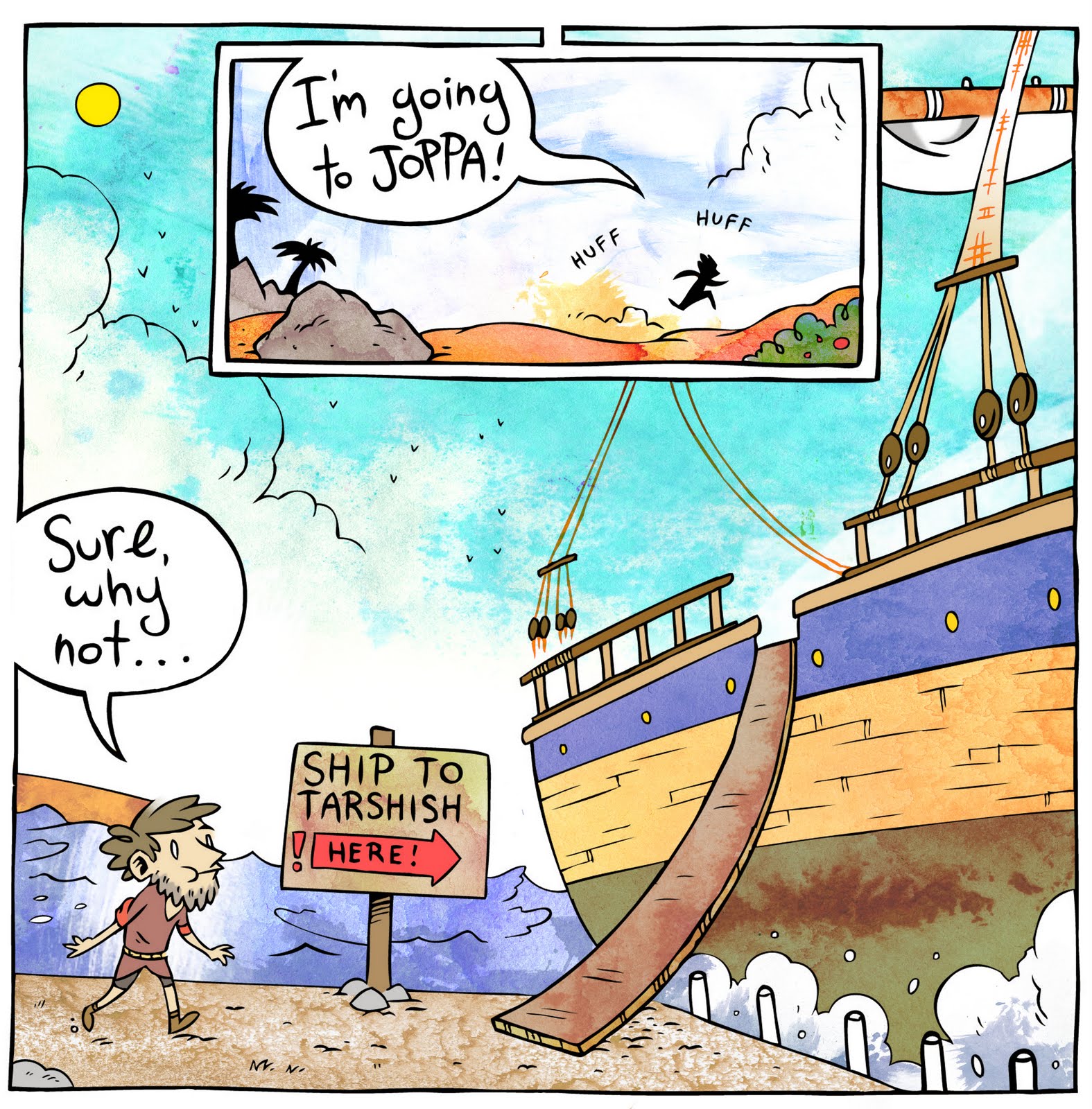
Jonah-boat-comicMy Hebrew class has moved from learning grammar to the actual process of translation and interpretation. To do this, we’re going through the book of Jonah. Our first interpretive assignment was to look at all the Jonah-related verbs in the first six verses and draw some theological conclusions. Here was my contribution.

But first, my incredibly literal and somewhat stilted translation of the opening verses [Jonah 1.1-6], including all the odd word order and idioms of Hebrew:

(1) And the word of the LORD was to Jonah son of Amittai, in order to say, (2) “Rise, go to Ninevah, the large city, and cry out against her because their evil arose to my face.” (3)And Jonah rose in order to flee in the direction of Tarshish from the toward-facing faces [Hebrew idiom for “Presence”] of the LORD and went down to Joppa and he reached a ship going to Tarshish and he gave its fare and went down in it in order to enter with them to Tarshish away from the toward-facing faces of the Lord. (4) And the LORD hurled a large wind upon the sea and it manifested as a large storm among the sea and the ship thought to shatter towards itself. (5) And the sailors were afraid and they cried out, man to his God, and they were made to throw the receptacles which were in the ship into the sea away from them towards making themselves small and Jonah had gone down into the rear of the vessel and had laid down and slept heavily. (6) And the chief sailor came to him and said to him, “Why are you sleeping? Arise! Cry out towards your gods! Perhaps the god of you will bear us in mind and we will not perish.”

And now for some lessons we can draw…
Continue reading

My Gospel Terror, Acts, & Letters [photo sermon]


Acts-bible-lomo

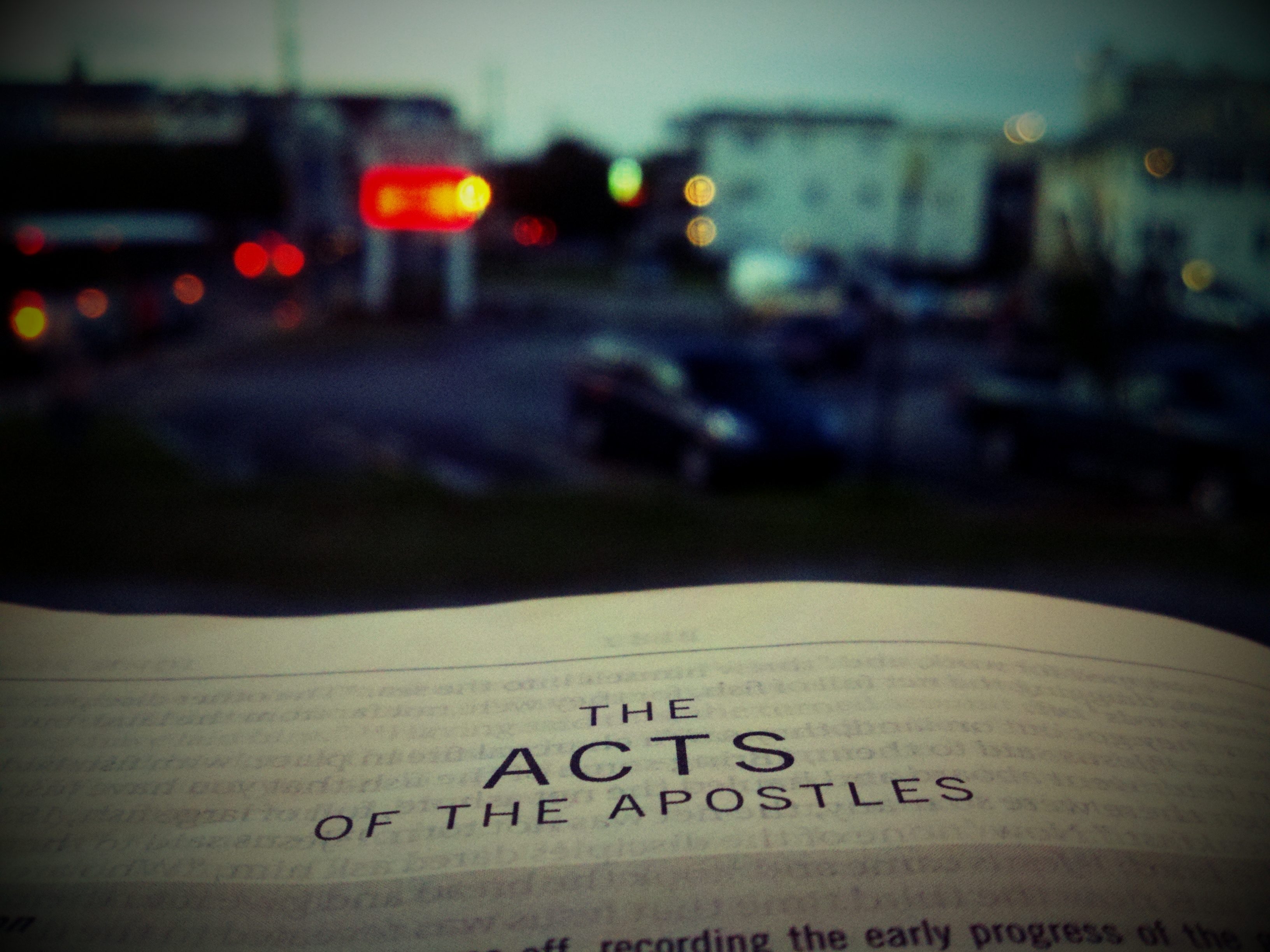
Each week, WordPress has a Weekly Photo Challenge, where they give a theme and invite people to highlight photography representing that theme, accompanied by a few meditations on it. OccasionallyI try and write a “photo sermon” or meditation based on those themes, accompanied by a photo of mine . This week’s theme is “Letters“.

* * * * *

I grew up in church and grew up loving the Bible. I did devotionals and sat in Sunday School classes for the vast majority of my life. And yet, it wasn’t until I got to my junior year of college and took a class on the Gospels that I read any of the Gospels all the way through. Sure, I had probably heard most of the Gospels preached on or excerpted in devotionals and books, but I had never read a Gospel from beginning to end.

At the time, I thought it was because they seemed too holy. It felt like too much for my young soul to handle to read the very words of Jesus on my own. It was too weighty for me and scared me. Maybe I just wanted to wait until I could drink whiskey or wine while reading them.
Continue reading

Fundamentalist vs. Pentecostals vs. the Cross | 1 Corinthians 1.27-31


For the message about the cross is foolishness to those who are perishing, but to us who are being saved it is the power of God. For it is written,

“I will destroy the wisdom of the wise,
    and the discernment of the discerning I will thwart.”

Where is the one who is wise? Where is the scribe? Where is the debater of this age? Has not God made foolish the wisdom of the world? For since, in the wisdom of God, the world did not know God through wisdom, God decided, through the foolishness of our proclamation, to save those who believe. For Jews demand signs and Greeks desire wisdom, but we proclaim Christ crucified, a stumbling block to Jews and foolishness to Gentiles, but to those who are the called, both Jews and Greeks, Christ the power of God and the wisdom of God. For God’s foolishness is wiser than human wisdom, and God’s weakness is stronger than human strength.
1 Corinthians 1.27-31

So good. And also really appropriate for this age. The fundamentalists want knowledge and certainty, and the Pentecostals want experience and signs. But we preach Christ crucified.

See other Marginalia here. Read more about the series here.

You don’t own your Baptism. Jesus does. | Romans 6.3-4


Do you not know that all of us who have been baptized into Christ Jesus were baptized into his death? Therefore we have been buried with him by baptism into death, so that, just as Christ was raised from the dead by the glory of the Father, so we too might walk in newness of life.
Romans 6.3-4

Technically, there is only one baptism that has ever taken place. Christ’s. All other baptisms are baptisms in his own. He is the one that walked in newness of life. He is the one who was baptized. He is the forerunner for all of Christian life–even it’s Covenantal participation by baptism. How beautiful is that?

See other Marginalia here. Read more about the series here.

Confirm everything, even the Holy Spirit | Acts 13.2-3


While they were worshiping the Lord and fasting, the Holy Spirit said, “Set apart for me Barnabas and Saul for the work to which I have called them.” Then after fasting and praying they laid their hands on them and sent them off.
Acts 13.2-3

I love this. Because they were so in tune with God and his Spirit, even after the Holy Spirit tells them something, they still feel they need to fast and pray before doing it. Those early Christians weren’t just willy-nilly following whatever spiritual whim and inspiration they got. They were careful and made sure they were hearing God rightly. May we do the same.

See other Marginalia here. Read more about the series here.

John, the Holy Spirit, & Prenatal Worship| Luke 1.12-15, 41-45


When Zechariah saw him, he was terrified; and fear overwhelmed him. But the angel said to him, “Do not be afraid, Zechariah, for your prayer has been heard. Your wife Elizabeth will bear you a son, and you will name him John. You will have joy and gladness, and many will rejoice at his birth, for he will be great in the sight of the Lord. He must never drink wine or strong drink; even before his birth he will be filled with the Holy Spirit.
Luke 1.12-15

When Elizabeth heard Mary’s greeting, the child leaped in her womb. And Elizabeth was filled with the Holy Spirit and exclaimed with a loud cry, “Blessed are you among women, and blessed is the fruit of your womb. And why has this happened to me, that the mother of my Lord comes to me? For as soon as I heard the sound of your greeting, the child in my womb leaped for joy. And blessed is she who believed that there would be a fulfillment of what was spoken to her by the Lord.”
–vv.41-45

The angel’s prophecy might be a foreshadow of John’s leaping in Jesus’ presence before he is born. If that’s the case, then being “filled with the Holy Spirit” being overjoyed in the presence of God. This is surely a theme throughout the Gospel and Acts: who has the Holy spirit and what that causes in those people, namely joy.

Secondly, this is such a beautiful passage and an evidence that children can experience spiritual things before their born. David says elsewhere that he loved God even while in the womb. This should (hopefully) mess with the heads of those that deny the place on infant baptism in God’s Church.

See other Marginalia here. Read more about the series here.

Sometimes God’s Heart breaks mine | Mark 4:10-12


When he was alone, those who were around him along with the twelve asked him about the parables. And he said to them, “To you has been given the secret of the kingdom of God, but for those outside, everything comes in parables in order that

‘they may indeed look, but not perceive,
    and may indeed listen, but not understand;
so that they may not turn again and be forgiven.’”

Mark 4.10-12

I simply don’t understand what this says about the heart of God. It seems at odds with everything else Jesus does. Is this just a temporary thing in order for the Gentiles to join in the mystery of redemption? Or is it truly as cold and calloused as this seems? Any help here would be appreciated.

See other Marginalia here. Read more about the series here.

Job, God, & Satan (Can I get some help from the scholar’s out there?)| Job 1.6-7


One day the heavenly beings came to present themselves before the Lord, and Satan also came among them. The Lord said to Satan, “Where have you come from?” Satan answered the Lord, “From going to and fro on the earth, and from walking up and down on it.”
Job 1:6-7

Anyone out there know how the ancient Israelites would have received these words? I see no other parallel in the OT to something similar to this (maybe the Psalms about God’s combat with the other gods?). I find it so confusing.

The one thing I am confident of, though, is that the conflating that Christians often do with this stuff is out of line. The way that (especially Evangelicals) use these verses to set up a systematic theology of “Satan” is absurd and does damage to the texts. Also, there is no indication that this is the same entity that is the serpent in the garden, nor the “Morning Light”, nor the NT Beelzebul, nor the beast of Revelation. Heck, there’s no clear connection between this particular “Satan” and the NT “Satan”.

See other Marginalia here. Read more about the series here.

An Egalitarian Easter Week Meditation [QUOTE]


From Cyprian, 3rd-century bishop of Carthage, to a virgin consecrated by the church:

““I will multiply,” says God to the woman, “thy sorrows and thy groanings, and in sorrow thou shalt bring forth children, and thy desire shall be to thy husband, and he shall rule over thee.” You are free from this sentence. You do not fear the sorrows and the groans of women. You have no fear of child-bearing; nor is your husband lord over you; but your Lord and Head is Christ, after the likeness and in place of man; with that of men your lot and your condition is equal. . . .”

Liturgy & Readings for Holy Saturday (2014)


This is from the Liberti 2014 Lent & Easter Prayerbook. Download the book for free for poetry and extended reflections for this week and next.

WORSHIP

call to prayer.

Be pleased, O God, to deliver us;
O LORD, make haste to help us!
–Psalm 70.1

the Gloria.

Glory be to God the Father, God the Son,
and God the Holy Spirit.
As it was in the beginning, so it is now,
and so it shall ever be, world without end.
Amen!
-the “Gloria Patri” !

the Psalm.
Continue reading

Liturgy & Readings for Good Friday (2014)


This is from the Liberti 2014 Lent & Easter Prayerbook. Download the book for free for poetry and extended reflections for this week and next.

WORSHIP

call to prayer.

Be pleased, O God, to deliver us;
O LORD, make haste to help us!
–Psalm 70.1

the Gloria.

Glory be to God the Father, God the Son,
and God the Holy Spirit.
As it was in the beginning, so it is now,
and so it shall ever be, world without end.
Amen!
-the “Gloria Patri” !

the Psalm.
Continue reading

Liturgy & Readings for Maundy Thursday (2014)


This is from the Liberti 2014 Lent & Easter Prayerbook. Download the book for free for poetry and extended reflections for this week and next.

WORSHIP

call to prayer.

Be pleased, O God, to deliver us;
O LORD, make haste to help us!
–Psalm 70.1

the Gloria.

Glory be to God the Father, God the Son,
and God the Holy Spirit.
As it was in the beginning, so it is now,
and so it shall ever be, world without end.
Amen!
-the “Gloria Patri” !

the Psalm.
Continue reading

Liturgy & Readings for Holy Wednesday (2014)


This is from the Liberti 2014 Lent & Easter Prayerbook. Download the book for free for poetry and extended reflections for this week and next.

WORSHIP

call to prayer.

Be pleased, O God, to deliver us;
O LORD, make haste to help us!
–Psalm 70.1

the Gloria.

Glory be to God the Father, God the Son,
and God the Holy Spirit.
As it was in the beginning, so it is now,
and so it shall ever be, world without end.
Amen!
-the “Gloria Patri” !

the Psalm.
Continue reading