Liturgy & Readings for Holy Wednesday (2014)


This is from the Liberti 2014 Lent & Easter Prayerbook. Download the book for free for poetry and extended reflections for this week and next.

WORSHIP

call to prayer.

Be pleased, O God, to deliver us;
O LORD, make haste to help us!
–Psalm 70.1

the Gloria.

Glory be to God the Father, God the Son,
and God the Holy Spirit.
As it was in the beginning, so it is now,
and so it shall ever be, world without end.
Amen!
-the “Gloria Patri” !

the Psalm.
Continue reading

The Darkest Week in Human History.


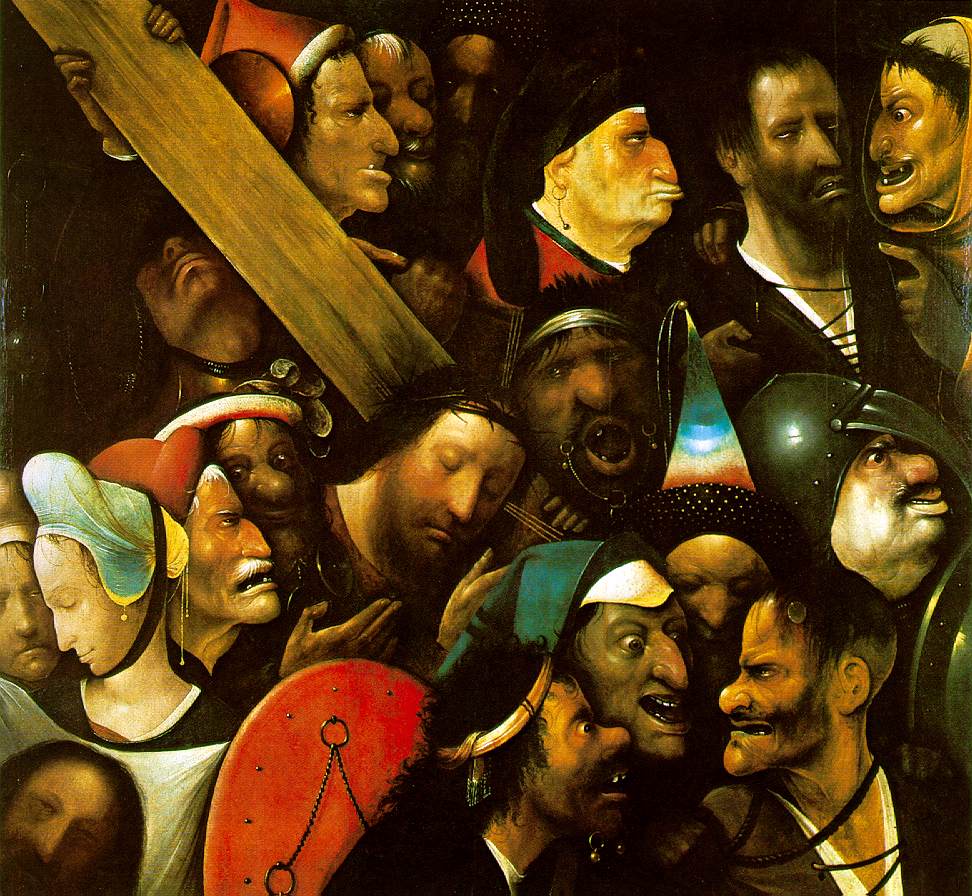
bosch-christ-carrying-the-crossIn our Holy Week reading of the Parable of Tenants, we see the startling revelation that the long-awaited Messiah—the One sent of God to accomplish salvation and liberation for his people—will be rejected by those very people.

And yet, this rejection was not limited to these religious leaders, or even to the ethnic group they represented. During Jesus’ Passion Week—which we meditate upon during this Holy Week—we see Jesus rejected at every level of his Creation.

On Palm Sunday, a large group accompanies Jesus, proclaiming his blessedness. This is not the group that later cries out to crucify him. Instead, it might be worse. These are people from the Jerusalem “suburbs” who have been receiving Jesus’ teaching for months. They accompany Jesus to Jerusalem, and then…. they just disappear, showing their ultimate apathy and indifference towards him.
Continue reading

Palm Sunday: “The Emperor Has No Clothes” [POEM]


I feel far, Lord.
But I know you’re here.  I know it.
(Do I?)

(Can I?)

It’s the nature of the matter; a matter of nature, I suppose.
Perhaps only now I feel at the deepest existential depths:
“I believe! Help my unbelief!”

Or in a word: Hosanna

That cry.  That plea.

The certainty of uncertainty.
The pregnancy of a pause.
The pondering of a moment.

That moment.  The moment.  

The moment that dressed my doubt in assurance.
But that emperor has no clothes
(or so everything says).

So where does my assurance lie?
Where do my feet stand?

My body pelted with rain, snow, and hail;
I pray my heart rests beside a fire,
drinking tea,
rocking in a chair,
my shoulders draped in that most costly of quilts –
my Rest.

Clothe me–
with the coat I lay on your path–
for this emperor is naked

and needs his King.

[read my other Holy Day poetry here]
all writings licensed: Creative Commons License

We worship Christ and…. the Resurrection? | Acts 17 & 24


Also some Epicurean and Stoic philosophers debated with him. Some said, “What does this babbler want to say?” Others said, “He seems to be a proclaimer of foreign divinities.” (This was because he was telling the good news about Jesus and the resurrection.)
Acts 17:18

One of the funniest moments in Acts. Notice they accuse him of preaching foreign “divinities” (plural). The Greek word for Resurrection is Anastasis. Paul has rolled in preaching “ton Iesous kai thn Anastasin”, or “the Jesus and the Resurrection”. The Philosophers think that Paul is preaching about two gods: “Jesus” and his wife, “Resurrection”.

I have a hope in God—a hope that they themselves also accept—that there will be a resurrection of both the righteous and the unrighteous. Therefore I do my best always to have a clear conscience toward God and all people.
Acts 24:15-16

Paul is obsessed with the resurrection. Well technically, Luke is. If you see the charge against Paul earlier, it was that he was preaching Christ and the Resurrection. They thought he was teaching two gods. Apparently, he must have been talking about the Resurrection so passionately. Almost as passionately as Christ.

They did not accuse him of preaching Jesus and the Cross, Jesus and the Tomb, Jesus and the Jews, Jesus and Grace through Faith, or even Jesus and the New Creation! It was Jesus and the Resurrection. The Resurrection is Paul’s way out of trouble. It’s his way of telling his story. Of causing divisions between himself and some Jews, and to show his solidarity with others. It’s everything to who Paul is and what he’s come to do.

See other Marginalia here. Read more about the series here.

Yep. The gospels depict Jesus as God. | Matthew 28.1-10


After the sabbath, as the first day of the week was dawning, Mary Magdalene and the other Mary went to see the tomb. And suddenly there was a great earthquake; for an angel of the Lord, descending from heaven, came and rolled back the stone and sat on it. His appearance was like lightning, and his clothing white as snow. For fear of him the guards shook and became like dead men. But the angel said to the women, “Do not be afraid; I know that you are looking for Jesus who was crucified. He is not here; for he has been raised, as he said. Come, see the place where he lay. Then go quickly and tell his disciples, ‘He has been raised from the dead, and indeed he is going ahead of you to Galilee; there you will see him.’ This is my message for you.” So they left the tomb quickly with fear and great joy, and ran to tell his disciples. Suddenly Jesus met them and said, “Greetings!” And they came to him, took hold of his feet, and worshiped him. Then Jesus said to them, “Do not be afraid; go and tell my brothers to go to Galilee; there they will see me.”
Matthew 28.1-10

Wow.  This here clearly says that they worshiped Jesus. And he does not at all correct them or steer them to worship elsewhere. This is in stark contrast to the angel in Revelation.

See other Marginalia here. Read more about the series here.

Resurrection: Matthean Apologetics | Matthew 27.62-66


The next day, that is, after the day of Preparation, the chief priests and the Pharisees gathered before Pilate and said, “Sir, we remember what that impostor said while he was still alive, ‘After three days I will rise again.’ Therefore command the tomb to be made secure until the third day; otherwise his disciples may go and steal him away, and tell the people, ‘He has been raised from the dead,’ and the last deception would be worse than the first.” Pilate said to them, “You have a guard of soldiers; go, make it as secure as you can.” So they went with the guard and made the tomb secure by sealing the stone.
Matthew 27.62-66

Apologetics by the gospel writer at work, haha. We know in subsequent debates that this was a major argument by the Jews, so this is a very important record that Matthew is putting down. He has to prove as best as he can that Jesus did indeed rise from the dead, and that his body was secure.

See other Marginalia here. Read more about the series here.

Cool Hand Luke’s “Of Man”: a favorite album is now free (and perfect for Lent)


cool-hand-luke-of-man-coverIf you don’t care about the commentary, and just want the amazing music, you can get it at Noisetrade. If you’d like to listen to the album first, just press play:


Someone’s “favorites” are a weird thing to define.  They are prone to fickleness, are tied so closely with whatever else is subjectively happening in one’s life, and usually bear little resemblance to what that person would consider as the technically “best” of any particular thing. So when you have a “favorite” that sustains that title for years–decades, even–it’s a big deal.

Since high school my favorite band has been Cool Hand Luke. Back then they were a little hardcore screamo band. At that time, to get their CD, you had to mail a check to the lead singer’s house. As time when on, their style changed at the very same time and in the very same way as my own. It felt like we were growing together.

Around my senior year of high school, they came out with an album called Wake Up,  O SleeperAnyone who’s heard of CHL probably knows them from this stunningly powerful work of art. It quickly became the most influential and “favorite” album of mine. And it has been ever since.

Towards the end of college, I became pretty good friends with the lead singer. For a while, every few months, we’d talk for a couple of hours on the phone. He was discerning whether to go to seminary and what to do about the financial mess their shady manager had left the band in. I got to see his heart and the heart behind the beautiful music they made.

Eventually, he got married, I started seminary, and he decided it was time to end the band and begin seminary himself. But there was one last project he felt he had to do.

Of Man.

Continue reading

Death & Life; Names & Vows | Genesis 3.20-21


The man named his wife Eve, because she was the mother of all living. And the Lord God made garments of skins for the man and for his wife, and clothed them.
Genesis 3.20-21

I don’t know why I’ve never noticed this before. Why does Adam only name Eve after they sin? Further, of all the things to do after receiving the curse from God, he does this covenantal, marital act: he gives her a name.

I know this isn’t in this text, nor was it on the mind of the original writer, but it reminds me of the odd line in Revelation where God promises to give each person a new name that only He and they will know.

It seems that in the whole sweep of redemptive history, the Bride of the first Adam received a new name when he brought death, just as the Bride of the second Adam receives a new name when he brings life.

See other Marginalia here. Read more about the series here.

prayer & meditation for Ascension Day


Grant, we pray, Almighty God, that as we believe your only-begotten Son our Lord Jesus Christ to have ascended into heaven, so we may also in heart and mind there ascend, and with him continually dwell; who lives and reigns with you and the Holy Spirit, one God, for ever and ever. Amen.

(from the the Book of Common Prayer & the site Morning Prayer)

Also read my own meditations on this Holy Day.
Continue reading

Trickle-Up Resurrection (Guatemala Lessons)


Rothko-easterMy church is currently in a series called “Resurrection Stories” in which we’re going through each of the non-Jesus stories of resurrections (or “resuscitations”—whatever) found in the Bible. It is, after all, still Easter.

A few weeks ago, as we were talking about Elisha raising the Shunnamite’s son, our pastor pointed out that most of these resurrection stories seem to center more on the people around the dead person than the dead person themselves. And so, in a sense, these resurrections are more for the people affected by death than the one dead; the ones that “receive” the true resurrection power are mostly those around the resurrected one.

Further, as he pointed out, most all of these people that “receive” the truest benefits of these resurrections are women—the most alienated and disempowered group throughout world history.
Continue reading

It’s Still Easter: a Theology of Color [photo sermon]


philly-tree-pink-spring

This week’s WordPress Photo theme is “Color“. Rather than simply writing about different pictures I’ve taken, I’m instead trying to write “photo sermons” based on these topics. In these posts, I want to try and use the photo itself as my “text”–trying to see how God reveals himself in his “other” book, in addition to the Bible.

In our last photo sermon, I talked about how I love that Easter comes around Spring time and so the natural world beautifully reflects the spiritual truth being celebrated. Also in line with this truth is the fact that Easter–just like Spring–is not just one day–it’s an entire season in the Church calendar.

It takes time for beauty and truth to get into and blossom within our souls. It takes preparation and anticipation for the roots of our hearts to quicken like the trees around us–to feel life coursing in them once more.

This is beautiful. And it doesn’t need to be this way.
Continue reading

{Easter friday} | prayer & readings for Easter Week (2013)


For Easter Week: reading schedule/reflections.

prayer.

Almighty Father, who gave your only Son to die for our sins and to rise for our justification: Give us grace so to put away the leaven of malice and wickedness, that we may always serve you in pureness of living and truth; through Jesus Christ your Son our Lord, who lives and reigns with you and the Holy Spirit, one God, now and for ever. Amen.
(from the liberti Lent & Easter 2012 prayerbook & the Book of Common Prayer)

Continue reading

{Easter thursday} | prayer & readings for Easter Week (2013)


For Easter Week: reading schedule/reflections.

prayer.

Almighty and everlasting God, who in the Paschal mystery established the new covenant of reconciliation: Grant that all who have been reborn into the fellowship of Christ’s Body may show forth in their lives what they profess by their faith; through Jesus Christ our Lord, who lives and reigns with you and the Holy Spirit, one God, for ever and ever. Amen.
(from the liberti Lent & Easter 2012 prayerbook & the Book of Common Prayer)

Continue reading

The Cross vs. The Resurrection


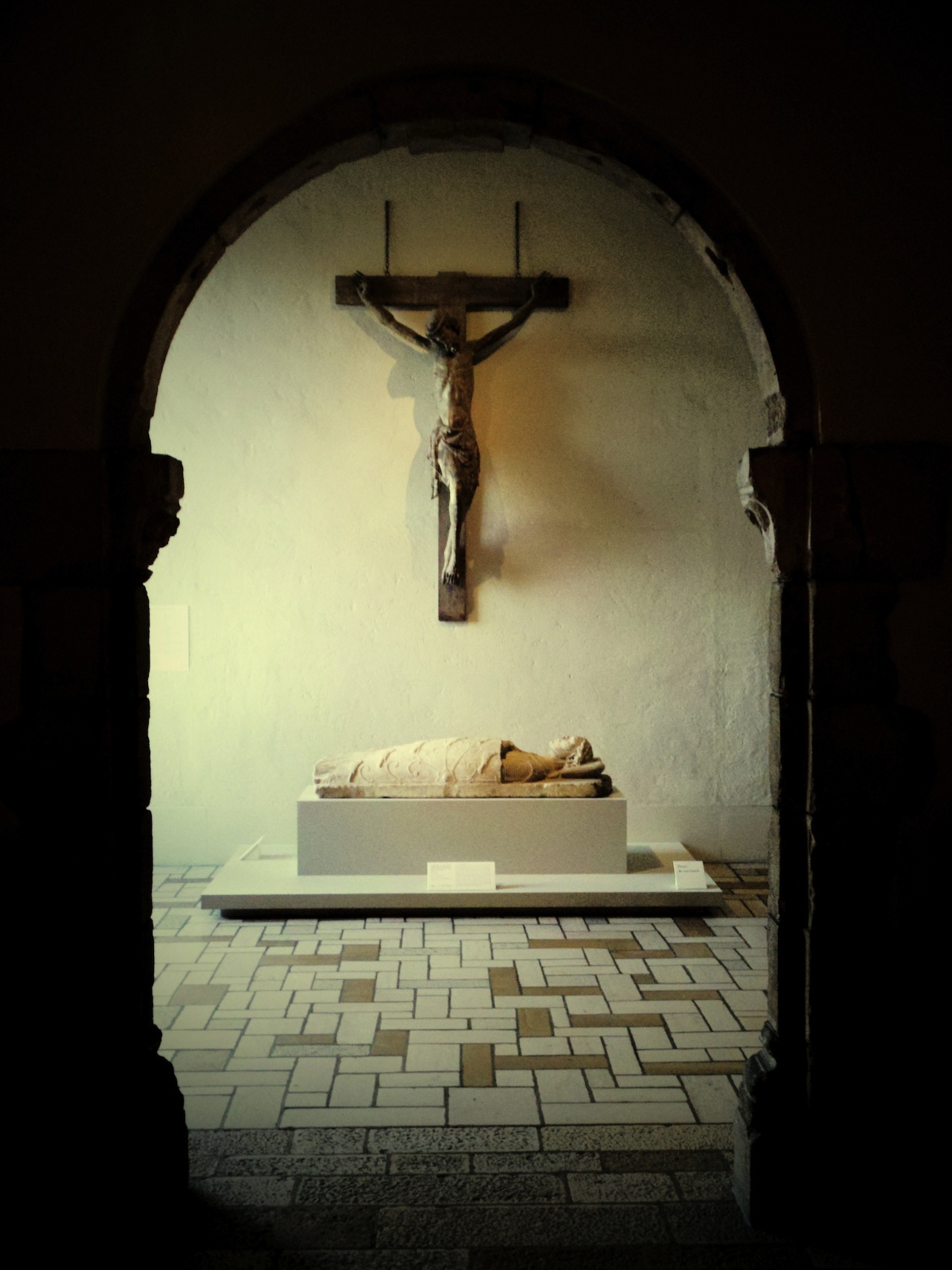
art-museum-crucifix-death-pmaIn Christian theology, there is a seemingly small thing that really influences so much of one’s theological outlook and even how they think they should live as a Christian.

Are you “Team Cross” or “Team Resurrection”?

Yeah, yeah, I know that the right answer is “both”, but really, most people tend to emphasize one more than the other.

What got me thinking about this was a Facebook post I saw on Easter evening. The poster said that the Resurrection was not when Jesus conquered sin and death. Instead, Jesus did that on the Cross, and the Resurrection was “simply” the “validation” of what Jesus did.

In other words, all that Jesus came to accomplish was done on Good Friday. God the Father saw it, thought it was awesome, so he went ahead and raised Jesus on Sunday.

In other other words, if the Resurrection never happened, nothing “essential” to salvation would be lost, merely the “proof” that it had been accomplished.

It really stuck with me, and no matter how much I tried to re-articulate it in my mind, give him the benefit of the doubt, or pick apart my own presuppositions, I really couldn’t shake how strongly I disagreed with this statement.

Continue reading