Easter Honey Rum (Recipe)


Recipe

  • 1 bottle of Gold Rum (or 12oz in a mason jar if you’re doing a half batch)
  • 200g/7oz of Honeycomb, crushed (or half that for the smaller batch)

Crush the honeycomb and add to container with rum. Let sit in a cool, dark place, “buried” for three days (get it?). Put the rum through a coffee filter or cheese cloth into its permanent container. Enjoy the heck out of it. It’s like candy.

* * * *

It’s Easter! He is risen indeed. Alleluia!

Easter is a season, not just a day, so your “official” Easter cocktail is coming in the next couple of days. But today, I’m posting the recipe for an ingredient for that cocktail: Easter Honey Rum.

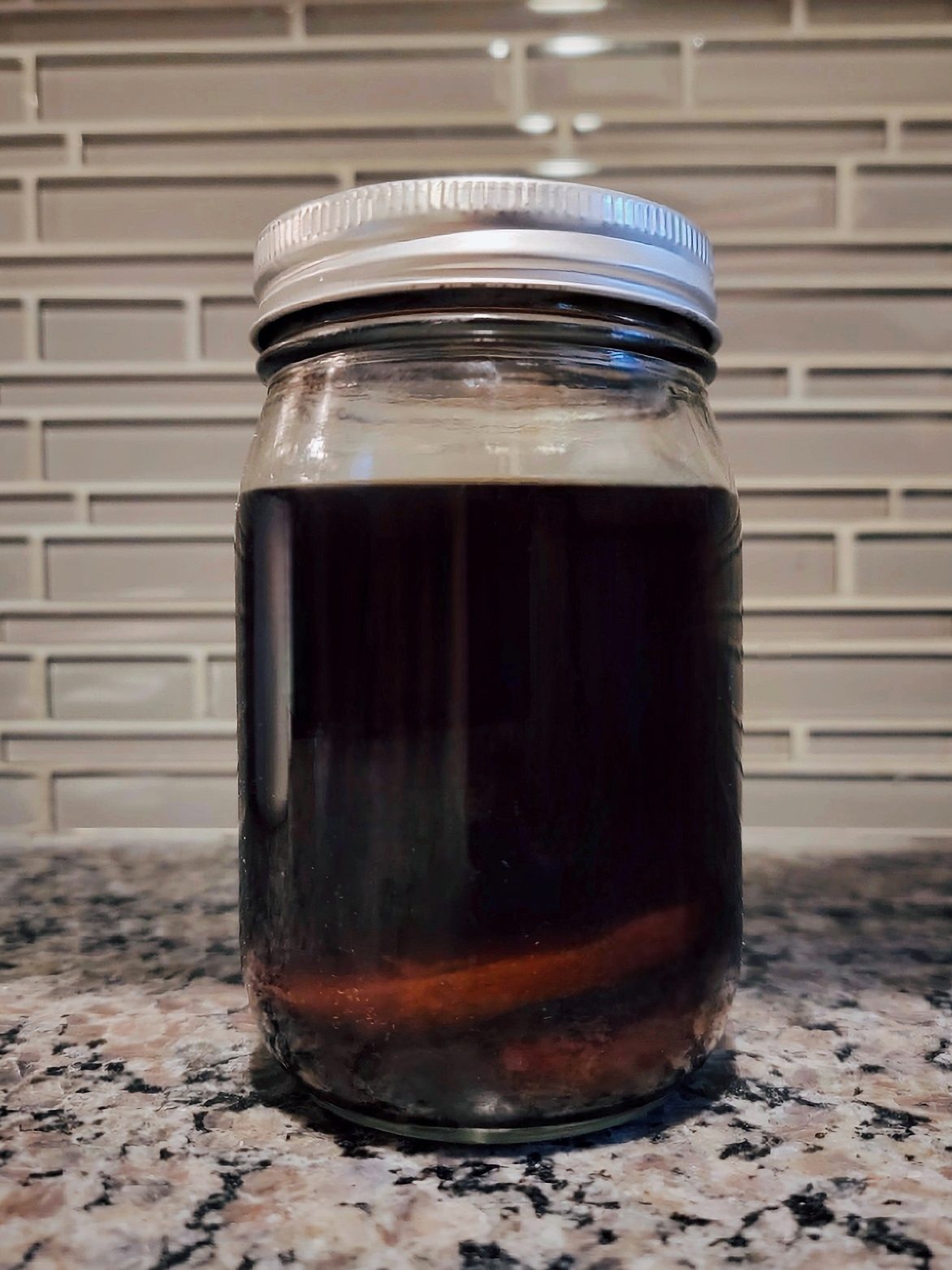
You may have heard of “fat washing” liquors. It’s a fascinating process that yields interesting results. Using honeycomb is called “wax-washing” and after this, I am a huge fan.

The resulting rum is like a cocktail in a spirit. It has body and viscosity and a dominant floral sweetness that is still balanced. It’s almost like candy.

To me, this is a great Easter spirit. Bright, golden, sweet, yet strong. It is the old rum, but washed into something new and better.

Continue reading

Razing Hell Espresso Martini | a Holy Saturday cocktail


Recipe

  • 1.5 oz Smoky Lenten Bourbon
  • 1.5 oz Espresso or Cold Brew Concentrate
  • .75 oz Coffee Liqueur
  • .25 oz Demerara Syrup
  • Garnish: 4 drops Angostura
  • Rim: Cocoa Bitters and 1/8-1/4 tsp each of Salt, Smoked Paprika, Cayenne Pepper based on spice preference.

Wet the rim of your coupe or martini glass with cocoa bitters and dip it in the spice mix to coat. Place in freezer to chill. Shake all other ingredients (except Angostura) with ice and fine strain into the chilled glass. In the foam of the drink, add 4-5 drops of Angostura bitters and use a toothpick to “draw” them into the shape of a cross.

View other Holy Day cocktails.

* * * *

It’s Holy Saturday, the final day of Lent. During this past Holy Week, I’ve needed to find various ways to say “man, a lot happened on this day”. Not so today. Here is the entirety of what the Bible says about Jesus and his disciples this day:

On the sabbath they rested according to the commandment. (Lk 23:56b)

That’s it. This vacuum has invited a lot of theological speculation on just what might have been happening in the time between Jesus’ death and resurrection.

Most of Christian history has answered this question with some version of what’s called “The Harrowing of Hell“, based largely on an odd verse in 1 Peter 4 about Jesus preaching the gospel “even to the dead” and captured in the Apostle’s Creed when it says Jesus “descended to the dead”.

Different versions are more or less literal about it, but at the very least, this means that whatever “hell” is, Jesus endured it on behalf of those who never will. And in so doing it, he conquered it in some way, de-fanging it of its power and authority. He harrowed it, razed it–overcame it.

Continue reading

Good Friday | a cocktail


Recipe

  • 1.5 oz Lillet Blanc
  • .75 oz Dry Gin
  • .25 oz St. Germain
  • .25 oz White Vinegar
  • 2 dashes Celery Bitters
  • .25 oz Gentian Amaro or Aperol (float)
  • Garnish: cherry

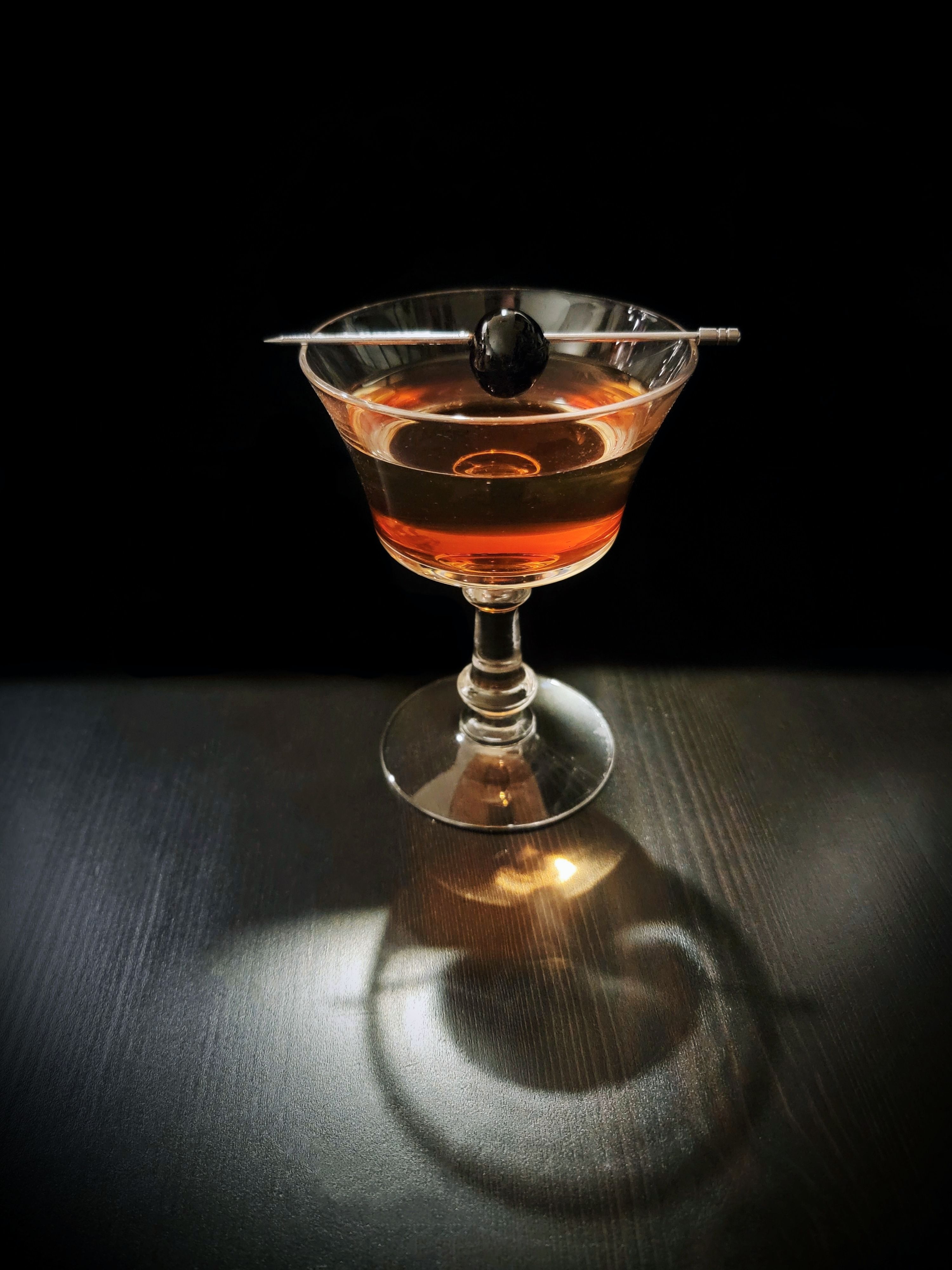
Add all ingredients (except the Gentian spirit) to a mixing glass with ice. Stir until chilled. Strain into chilled coupe. Add the Gentian Amaro (or Aperol). Garnish with a cherry on a cocktail pick, letting its syrup drip into the glass.

View other Holy Day cocktails.

* * * *

Today is Good Friday, the day on which Jesus faced an unjust Roman trial, was crucified, and even experienced the forsaking of God. It is a violent, unjust, and sad day, only made “good” by subsequent events.

Good Friday is our salvation. It is the moment God himself entered into the greatest fear and consequence of sin and human frailty. It is God’s answer to the suffering of the world: not giving an answer for why it exists, but experiencing it himself and conquering it.

It is bittersweet. It is an unexpected coronation and enthroning over the world and its authorities by letting them do their worst and yet still be beaten.

My first instinct for a Good Friday cocktail would be a dark, smoky, and bitter whiskey drink. But as I reflected on it more, I went in another direction.

Continue reading

Triduum | a Holy Weekend cocktail


Recipe

  • 1 oz Whiskey
  • 1 oz Cognac or Brandy
  • .5 oz Gentian Amaro
  • .5 oz Green Chartreuse
  • 2 dashes Salt & Smoke Bitters
  • 2 dashes Orange Bitters
  • Garnish: 3 Olives

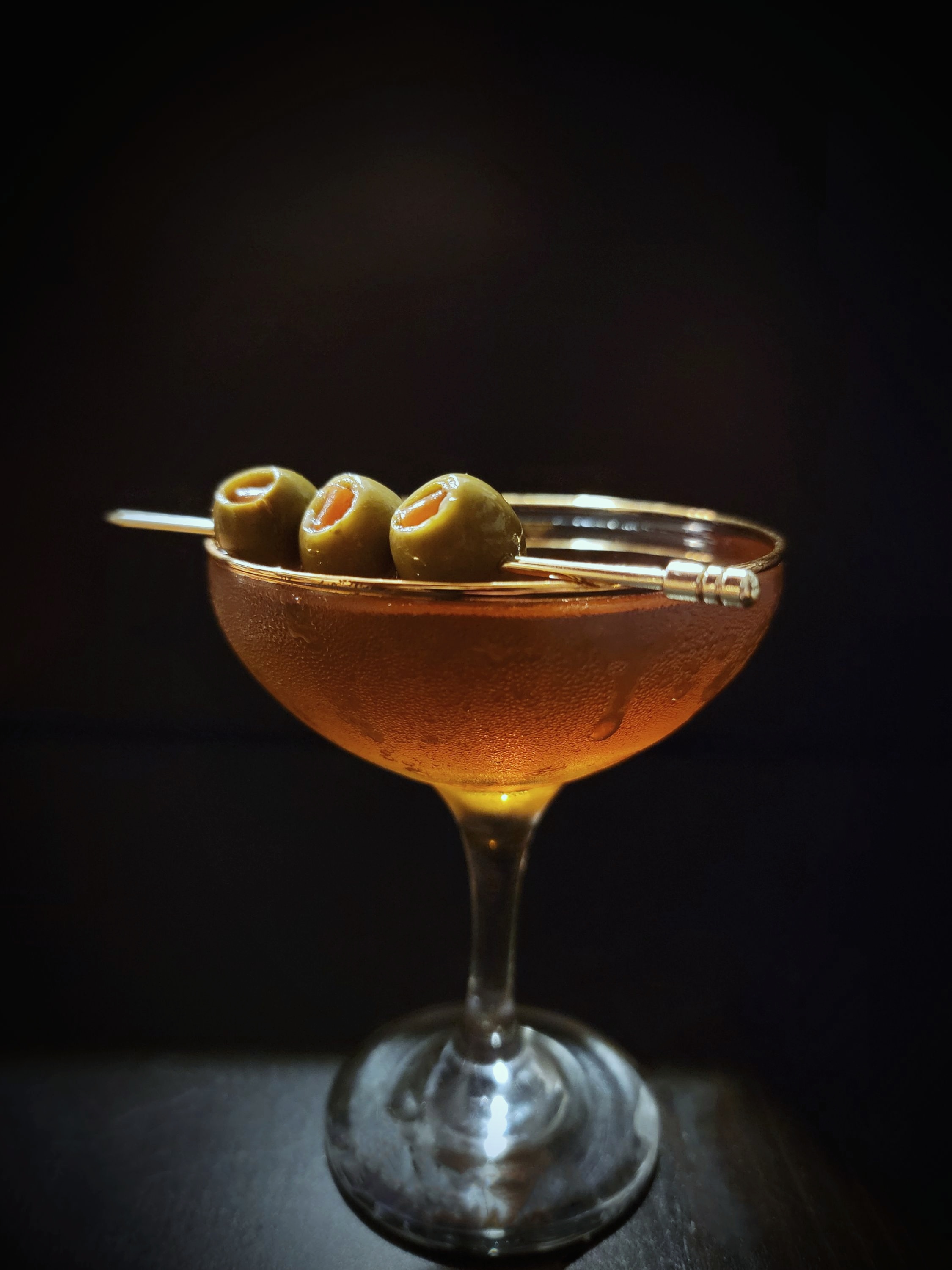
Strain all ingredients in mixing glass until very chilled and extra diluted (45-60 seconds). Strain into a chalice, wine glass, or coupe. Garnish with three olives on a cocktail pick.

View other Holy Day cocktails.

* * * *

I’ve been doing one cocktail for each day of Holy Week, but the three days starting with Maundy Thursday are there own special holiday, called the Paschal Triduum (the “three” days are from Thursday night to Easter morning). So I’m offering a bonus cocktail for this weekend.

This drink is boozy with an herbal sweetness, with a touch of sweetness.

Similar to my Maundy Thursday cocktail, the whiskey and cognac/brandy are for the bread and wine of Thursday. The smoke and amaro are for the darkness and blood of Friday. The chartreuse hearkens burial herbs and the quiet, restful devotion of the monks who still make it to this day. The orange bitters hint at the Easter brightness to come.

The three olives are for each day of the Triduum. They also remind us of the Mount of Olives, as well as the saltiness of tears in both the Passover meal and crucifixion witnesses.

Continue reading

Body & Blood | A Maundy Thursday Cocktail


Recipe

  • 2 oz Red wine
  • 2 oz Wheat (or Rye) Whiskey
  • .25 oz Orange Curacao
  • .75 oz Ube Syrup
  • 2 dashes Angostura Bitters
  • 2 dashes Orange Bitters
  • .5 oz Water
  • tiny pinch of salt
  • Olive garnish

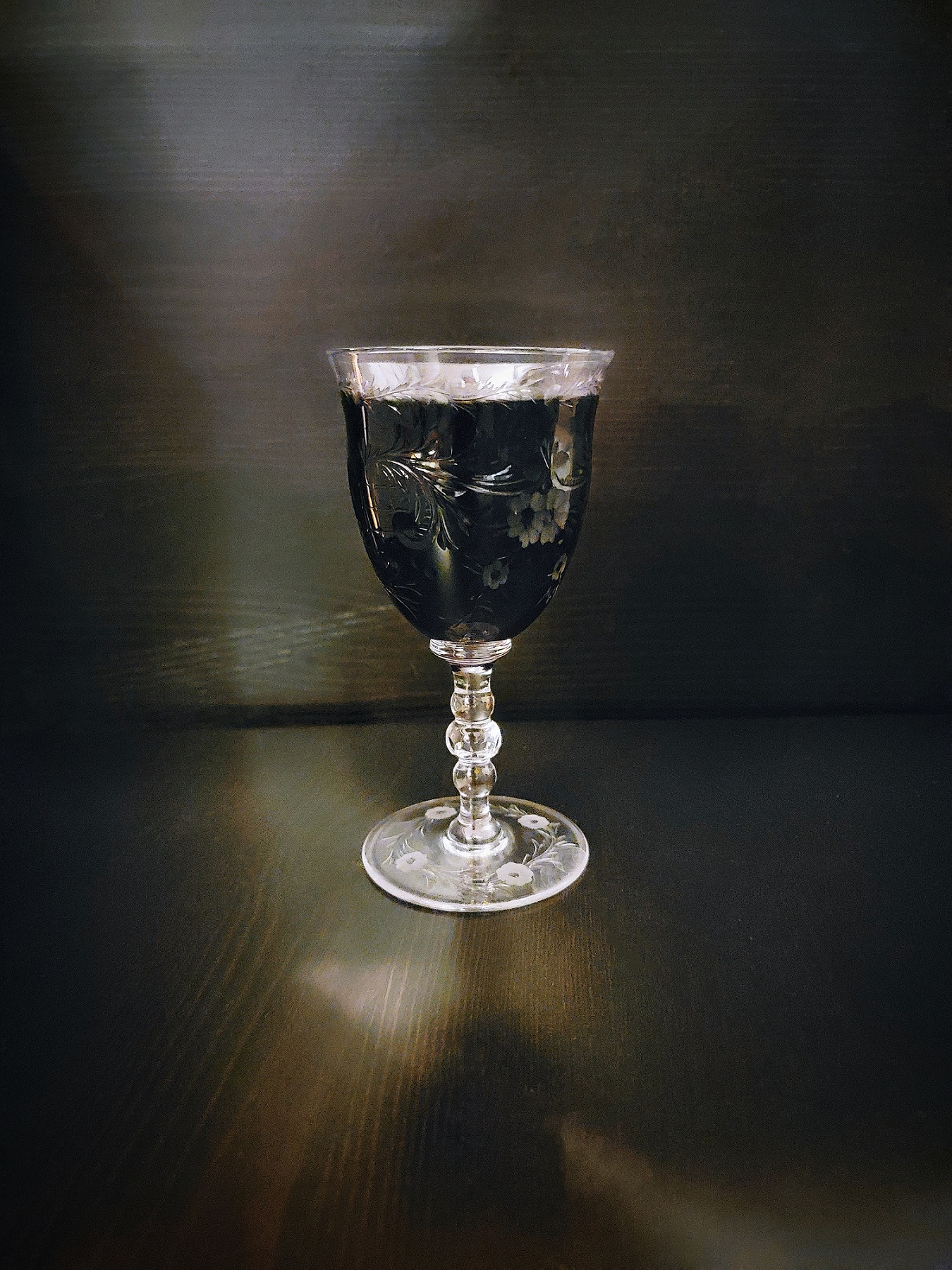
Add all ingredients to a mixing glass without ice and stir well to incorporate everything. Pour into a wine glass and at serve room temperature. Garnish with a single olive.

View other Holy Day cocktails.

* * * *

Today is Maundy Thursday, one of the fullest, strangest, and most complicated days of Holy Week. So here is a cocktail to match.

A lot happens on this day: Jesus washing his disciples’ feet, the Passover meal and first Communion, his farewell address (also called the “High Priestly Prayer“), his prayers in Gethsemane, the arrest, and his late-night trial before the Jewish authorities.

It’s an emotional roller coaster of a day. There is joy, singing, praying, accusation, defensiveness, injustice, and emotions so intense Jesus sweats blood. There is also a random naked guy running through Gethsemane that scholars have no idea what to make of.

While honoring the events of the day, I’ve tried to craft a cocktail that captures this sense of confusion, contrasts, and upended expectations. And I think this drink does exactly that.

Continue reading

Bitter Betrayal | A Holy Wednesday Cocktail


Recipe

  • 1 oz Campari
  • 1 oz Montenegro Amaro
  • 1 oz Fernet Branca
  • 2 dashes Orange Bitters
  • 1 small ice cube (yes, it’s an ingredient)

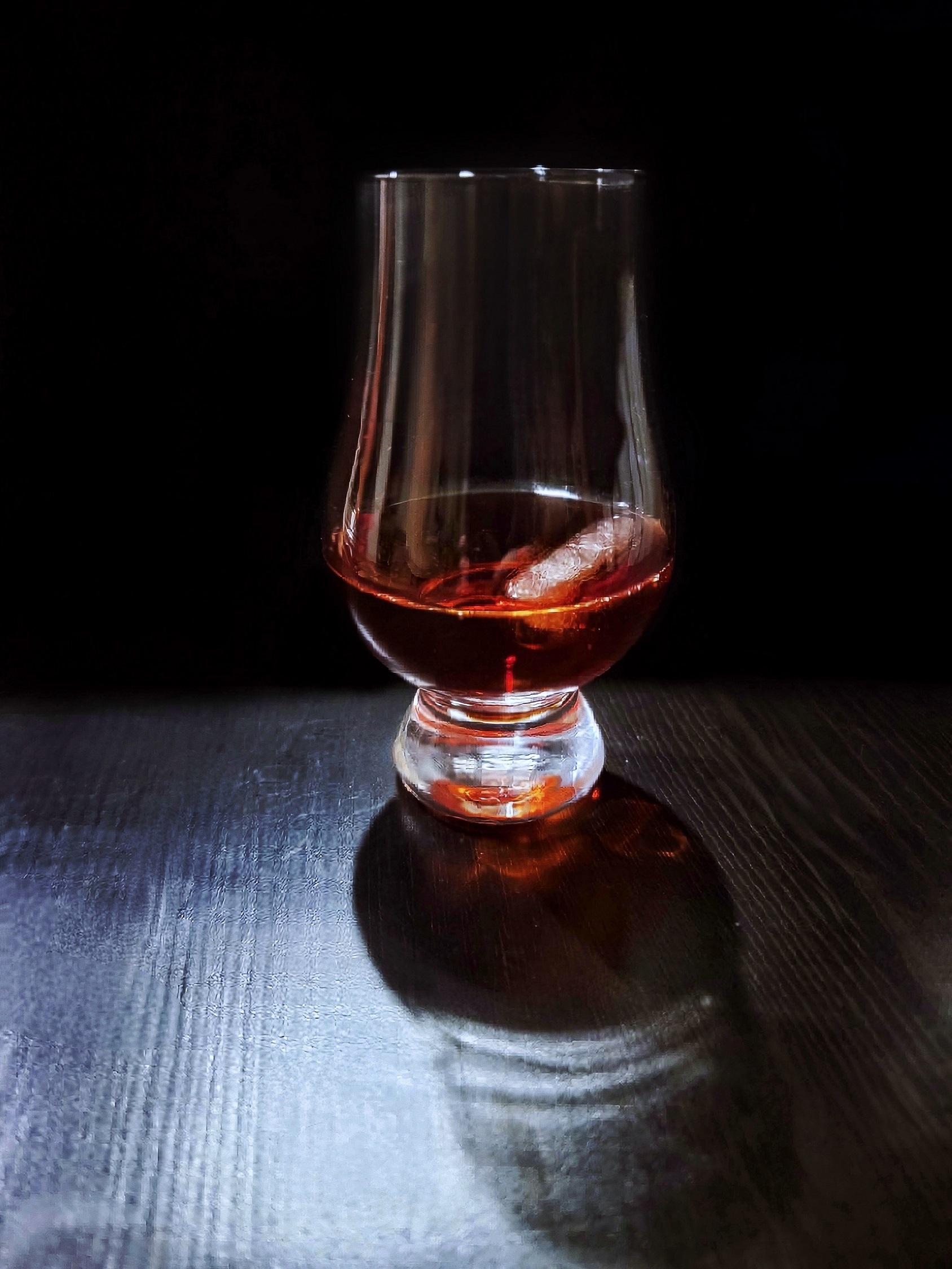
Add all spirits into a small glass. Add one small ice cube and swirl until it is mostly melted. Enjoy.

View other Holy Day cocktails.

* * * *

I am doing a cocktail for each day of Holy Week based on the events that happened on those days. Today’s cocktail is really obvious, incredibly straightforward, and very, very good.

Holy Wednesday is the day that Judas betrayed Jesus. It’s a strange event in the gospels, with hardly any details. We don’t know Judas’ motives, why he was paid the amount he was, or the events leading to his betrayal.

The only details we get are that Jesus saw it coming, and the gospel writers saw this as one of the purest acts of evil and betrayal that’s ever been done.

So today’s cocktail tries to capture the bitterness of this betrayal–bitterness so great that it even ate away at Judas himself to the point of suicide.

So for this drink, I simply got the three bitterest ingredients I have, and threw them together with some orange bitters. And I am shocked how well it all came together.

The resulting drink is dark and complex, with both an herbal and fruit bitterness, and a bright pop of citrus and hint of mint. It is brash and subtle, all at once.

You will either love or hate this drink.

Continue reading

Lent-Infused Bourbon | a Holy Tuesday spirit


Recipe

  • 12 oz (half a bottle) High Proof Bourbon
  • 3 tsp Lapsang Souchong Tea
  • 1 tbsp White sugar
  • .25-.5 tsp Vanilla Extract
  • 1 large Orange Wheel, halved

Add all ingredients to a 16oz airtight mason jar. Shake and let sit in a cool, dry place. Shake it once or twice every day. Start tasting after day 3. Once you like the taste, you can strain the solids if you want. After day 5 or so, the taste won’t change and it’s fine to keep everything in the jar if you want.

View other Holy Day cocktails.

* * * *

We continue our Holy week cocktails with something a little different for Holy Tuesday–a liquor infusion!

This recipe makes a high proof bourbon that is very smoky, with a touch of citrus and sweetness that really gives a lot of complexity, perfect for Lenten reflection whether you drink it straight or in a cocktail (it makes an amazing Old Fashioned).

On Holy Monday, Jesus went into the temple and overturned tables, clearing out money changers. This surely was disruptive and provocative, so what does he do on Tuesday? Return to the temple and spend the day debating the religious leaders on a huge range of topics.

Jesus exposes the priests and teachers as hypocrites before the common people, announces God’s rejection of them, and even prophesies the destruction of the very temple in which they are arguing. And at the end of it all, God in Jesus has been fully and finally rejected by the religious institution and its leaders. The stage is set, and they prepare to kill him.

Continue reading

“Though the Fig Tree Not Blossom…” | A Holy Monday Cocktail


Recipe

  • 2 oz Brandy
  • 1 oz Lemon Juice
  • .75 oz Fig Syrup
  • .5 tsp Rose Water
  • 1 Egg White

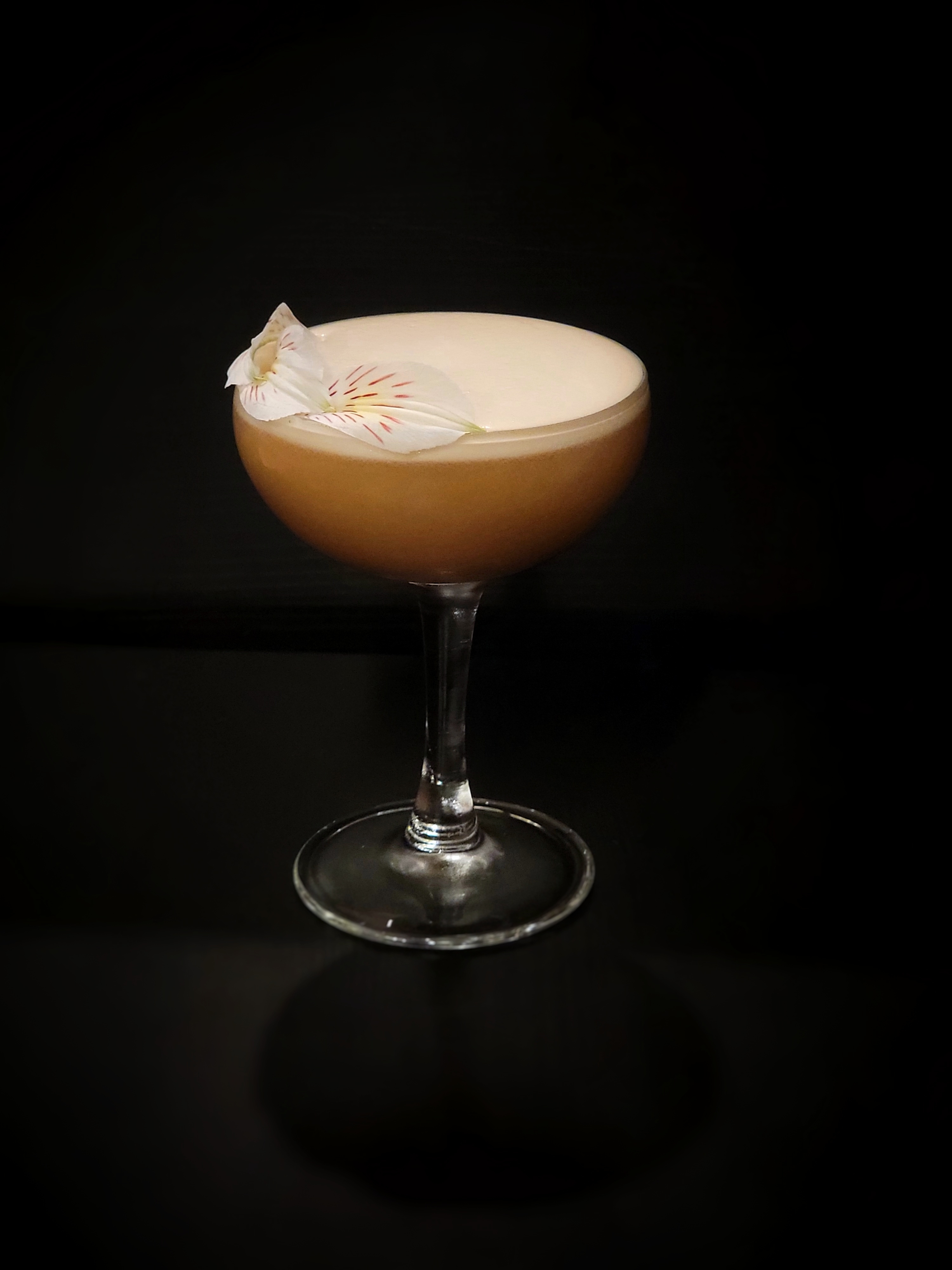
Add all ingredients to a shaker without ice. Shake vigorously for 30-45 seconds. Add ice and shake again for 10-15 seconds. Double strain into a chilled coupe and garnish with flower petals.

View other Holy Day cocktails.

* * * *

Thursday through Sunday get all the attention in Holy Week, but significant and symbolic things also happened on the other weekdays. So I’m making a cocktail for each one.

On Monday morning, while on his way to the Jerusalem Temple, Jesus is hungry and sees a fig tree with leaves on it, so it should have fruit he can eat. This one does not. It’s also not the season for the tree to have leaves in the first place.

Jesus sees in the tree a symbol of the Temple itself. It has the outward appearance of bearing fruit but is barren, and it does not know its season. Likewise, the temple has become a place of commerce and routine, not realizing that now is the time of the Messiah.

God in Jesus is rejected by creation itself and his very temple, where the worship and prayer of his people ought to be. So Jesus curses this fig tree and clears out the money-changers in the Temple.

This cocktail tries to capture some of these themes. Its name comes from Habakkuk 3: “Though the fig tree does not blossom and no fruit is on the vines…yet I will rejoice in the Lord; I will exult in the God of my salvation.”

The grape brandy and soft texture hearken to the wine and solemnity of the temple, and the drink’s flavor is like a fig tree in bloom. But all this is–literally–soured by the lemon juice. It’s an unexpected drink that confuses the senses as you discern the flavors and the balance.

Continue reading

Palm Sunday Cocktail


Recipe

  • 2 oz Light Rum
  • 1 oz Lime Juice
  • .75 oz Toasted Coconut Syrup
  • .75 tsp Pandan Extract
  • 2 dashes Grapefruit Bitters
  • 2 dashes Rhubarb Bitters
  • .25 oz Jamaican Rum float (optional)

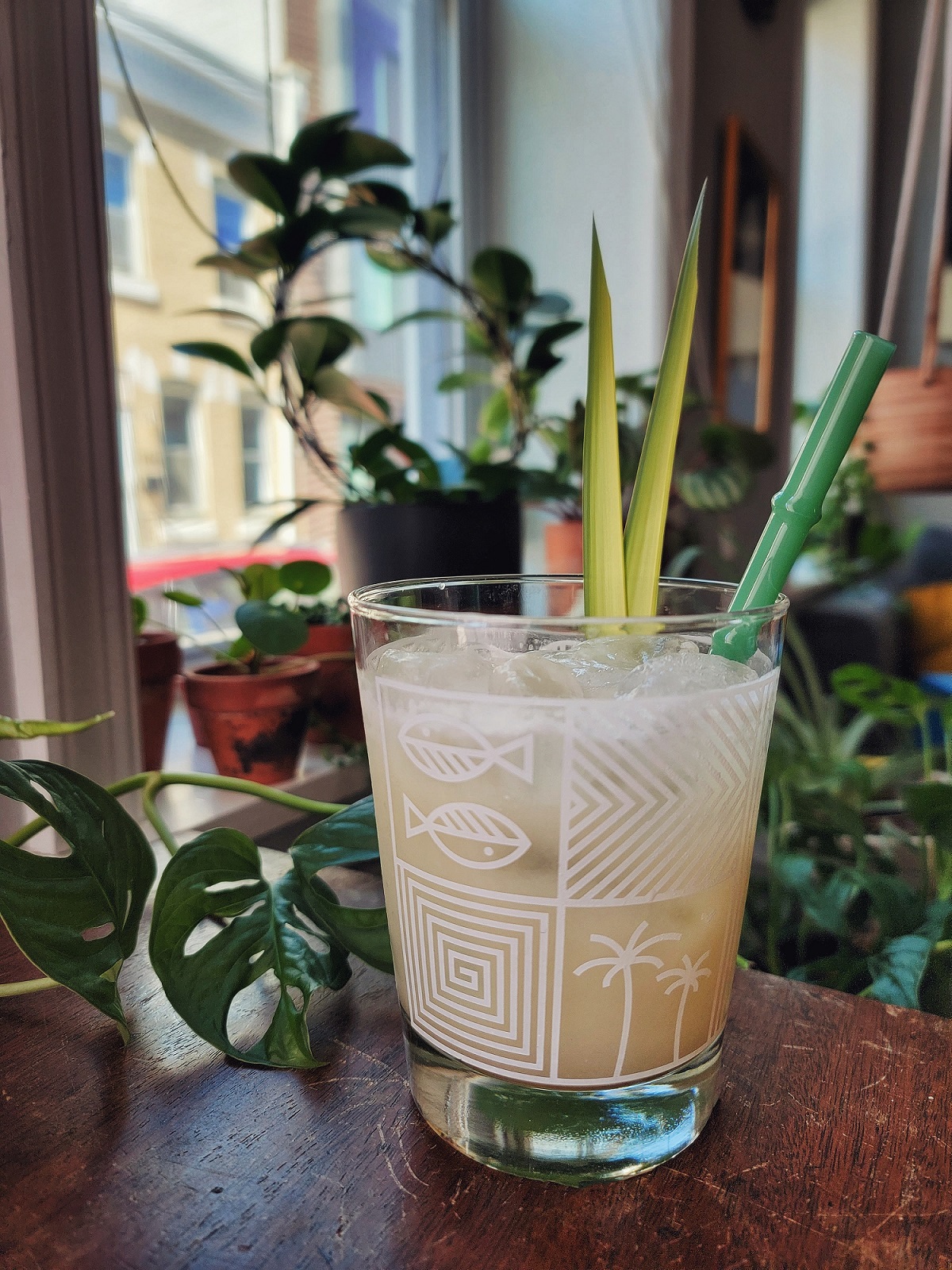
Add all ingredients (except the Jamaican rum) to a shaker. Add ice and shake. Free pour all contents into a glass and top with the remaining rum. Add a straw and garnish with pineapple or palm fronds.

View other Holy Day cocktails.

* * * *

It’s Holy Week, the most important and consequential seven days in all of human history, when Jesus suffered, died, and was raised. Each of these days carries significance, so I’m crafting a cocktail for each one.

But it all begins on Palm Sunday: a strange day full of hope, expectation, worship, and joy (and quite a bit of human misunderstanding). Lent is a season of brooding and fasting, but because Sundays are still feast days (and because of palms, of course) we’re doing a tiki drink!

On Palm Sunday, Jesus entered the city of Jerusalem in a way that symbolized to the Jewish people that he was their long-awaited king coming to rescue them from their exile.

The people come out and lay their coats and palm leaves on the road, ushering Jesus with fevered excitement and joy. However, while they thought he was coming as a violent, political, conquering king, he instead intended to save them from an even deeper spiritual exile.

I tried to capture these contrasts in this drink. It is a riff on a daiquiri, and is bright, refreshing, and tart, with multiple fruit bitters for complexity. However through the middle of it are these deep, heavier notes of toasted coconut and pandan. It’s a fantastic drink.

Blessed is he who drinks in the name of the Lord. Cheers!

Continue reading

Ash Wednesday Cocktail


Recipe

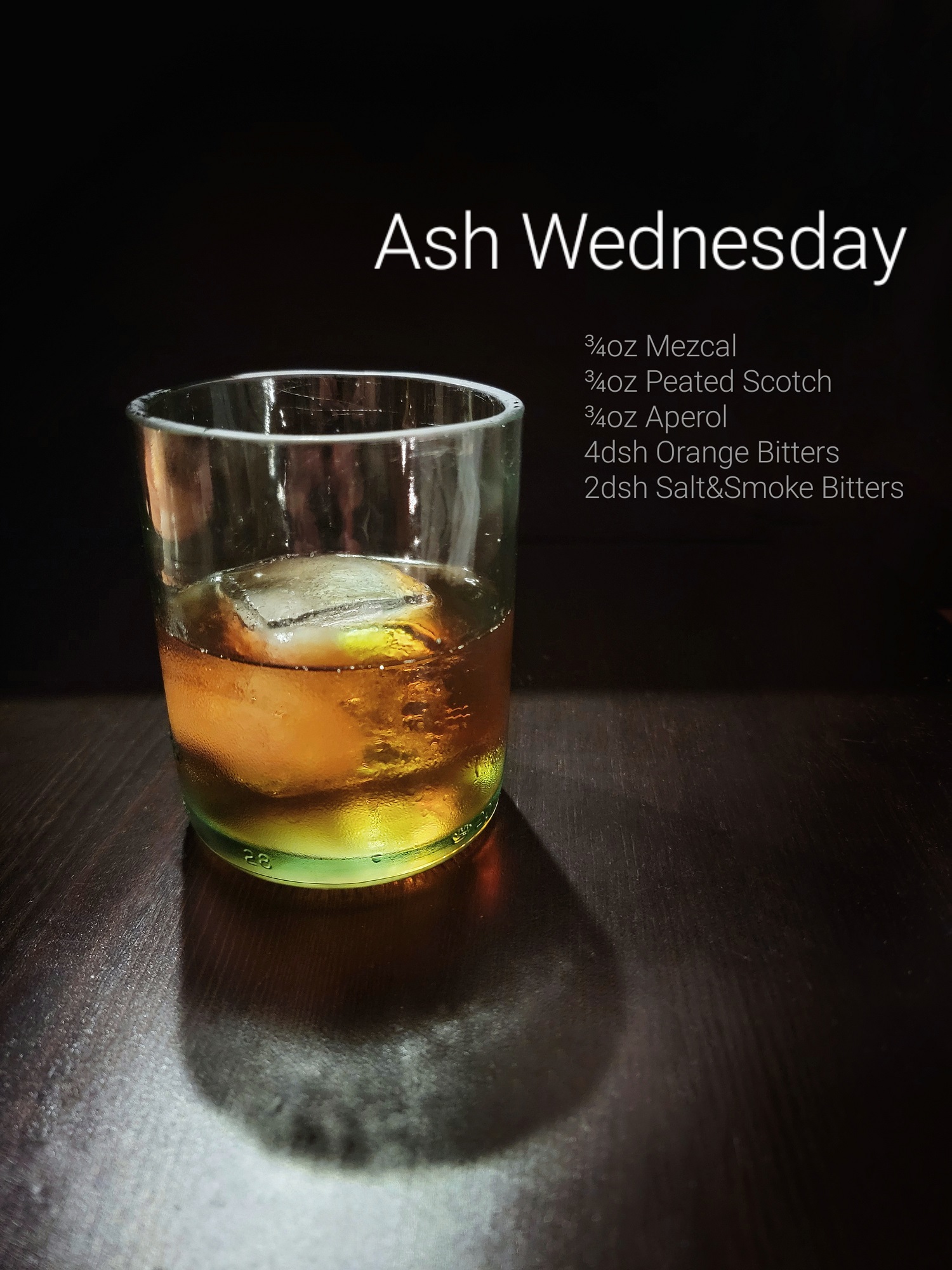
  • .75oz Mezcal
  • .75oz Peated Scotch
  • .75oz Aperol
  • 5 dashes Orange Bitters
  • 2 dashes Smoke and Salt Bitters

Build drink in an old fashioned glass over a large ice cube. Stir all ingredients. No garnish.

* * * *

With a new church season, we have a new cocktail. This one is named after Ash Wednesday, the holy day that begins Lent.

Lent is a season of fasting, reflection, and repentance. We focus on our mortality, our sins, and the darkness in the world that led Jesus to the Cross.

Ash Wednesday specifically is a time that Christians have crosses drawn on their foreheads in ash as an outward sign of their internal awareness of their death and sins. It is reflective, somber, simple, elemental, and dark.

With that in mind, I crafted this cocktail, which is strong, dark, and smoky with a subtle bittersweetness underneath it all. It really is meditative and lovely, while also packing a real punch.

Continue reading

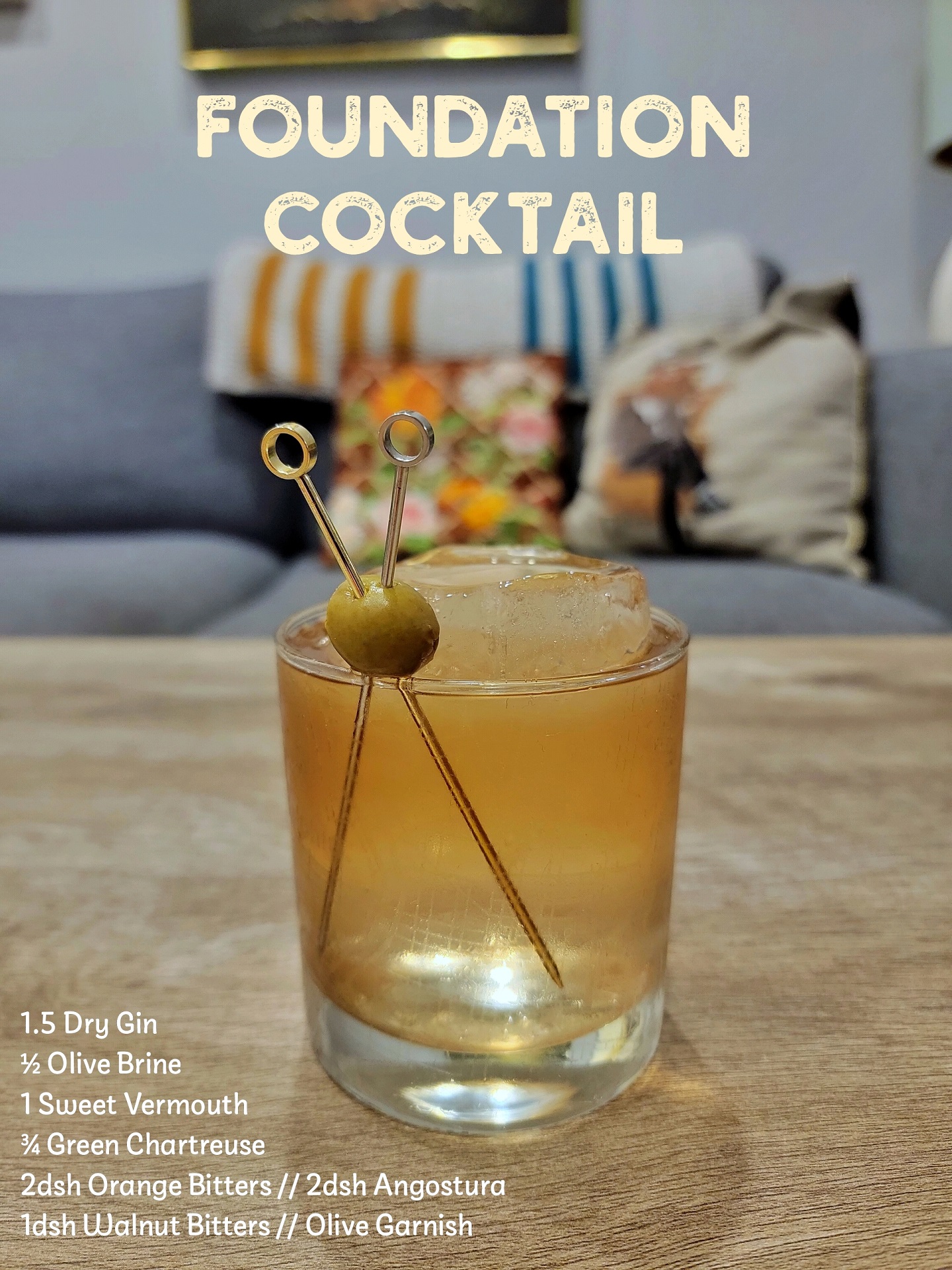
Foundation Cocktail (for the Feast of Peter’s Confession)


Recipe

  • 1.5oz Dry Gin
  • 1oz Sweet Vermouth
  • .75oz Green Chartreuse
  • .5oz Olive Brine
  • 2 dashes Orange Bitters
  • 2 dashes Angostura Bitters
  • 1 dash Walnut Bitters
  • Garnish with Olive

Thematically, you should build the cocktail in the glass with the ice, but this is a lot of liquid. So the other option is to stir all ingredients in a mixing glass and pour over a large ice cube and serve the rest in a sidecar glass on the side. Garnish with an olive speared by two picks.

* * * *

And on this rock, I will build my… cocktail.

January 18 is a multi-layered date in the Christian Church calendar. Primarily, it is a feast day to celebrate the moment when Peter confesses that Jesus is the Messiah. But a lot of other things happen in this same passage that are also included in this day.

Peter gets his name changed from Simon to Peter. Catholics would say that Jesus appoints Peter as the first pope here. Jesus also says the word “church” here for the first time, as he says he will build it on this “rock” of Peter, so this is also considered the honorary birthday of the church.

Lastly, the World Council of Churches chose this feast day as an appropriate kick-off for the annual Week of Prayer for Christian Unity. So like I said, it’s a lot, and so is this cocktail.

The drink is strong and maybe the most subtly complex drink I’ve ever made. It has a lovely progression from light saltiness in the front into a deep, quiet sweetness in the back. It’s an acquired taste, but one I’d proudly feature on a cocktail menu. So enjoy the drink while meditating on the church’s foundational moment and praying a prayer for Christian unity

Continue reading

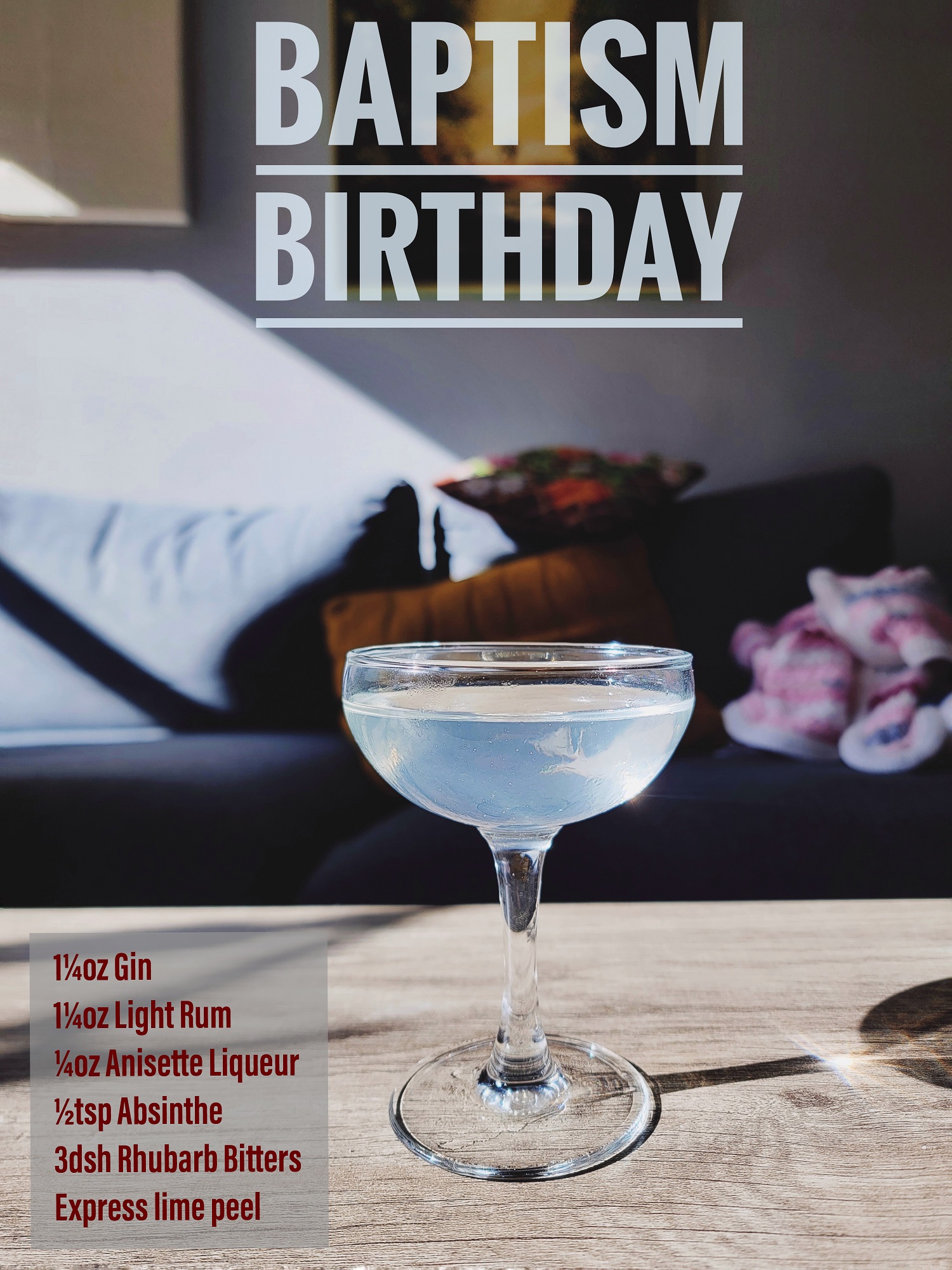
Baptism Birthday (a Holy Day cocktail)


Recipe

  • 1.5oz Gin
  • 1.5oz Light Rum
  • .25 Anisette Liquer
  • .5 barspoon Absinthe
  • 3 dashes Rhubarb Bitters
  • Express a lime peel over the top

Stir all ingredients in mixing glass and strain into a martini glass or coupe. Express the oils of a lime peel over the top. No garnish.

* * * *

For a several years now, I have celebrated my annual “baptism birthday” to reflect on my baptism, my membership in the family of God, and the seal of assurance God has on me.

It’s beautiful and meaningful, and it deserved a cocktail. And, seeing as yesterday was the Feast of the Baptism of our Lord, this seems like a good time to share it with you.

My goal was to make a drink like baptism–it looks like it’s just water but there’s a lot more going on.

Boy, did I succeed.

The drink is a lovely balance of floral and nutty with some herbal spice to it. These flavors really meld well together to create a complex bouquet of flavors that’s really striking (why don’t more drinks mix gin and rum!?).

This drink is a favorite of mine for its meaning, aesthetic, and taste, and I hope it can become that way to you. As you drink it, remember your own baptism and the promise of God to mark you and keep you as his child.

Ingredients

I used a juicy, citrus-forward, and very flavorful gin rather than a dry gin. For the rum, I used Maggie’s Farm White Rum, which is fantastic and has more character than most light rums, but whatever you have should work fine. Absinthe is an acquired taste, but it’s used in such small quantities and there are enough competing strong flavors that Absinthe-haters should not fear. It’s a lovely accent on the drink.

The only somewhat obscure ingredients are the bitters and liqueur. I supposed you could use orange bitters in place of rhubarb, but only if they are a very strong sweet orange flavor. The Fee Brothers Rhubarb Bitters taste almost like sweet tarts, with a unique strong burst of flavor (it’s especially delicious added to plain seltzer). So if you can get your hands on those, they’re worth your time.

Lastly, when most people think of Anise in cocktails, they think absinthe, but the liqueur is a very different beast. Absinthe begins with anise, but adds a lot of bittering agents. Anisette adds sugar, coriander, and other ingredients that make a very sweet, nutty flavor. So much so that you might be able to substitute Amaretto into this drink.

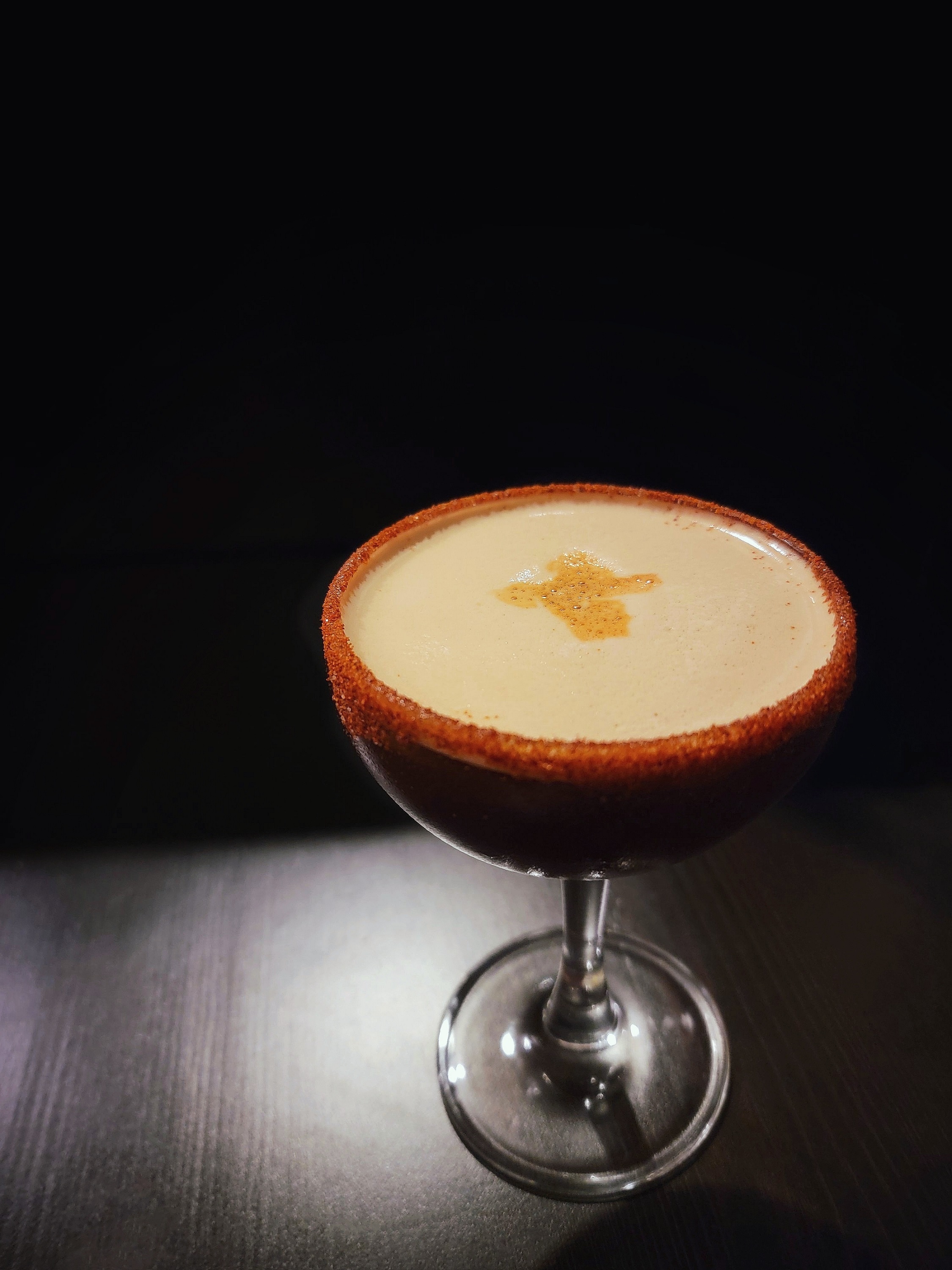
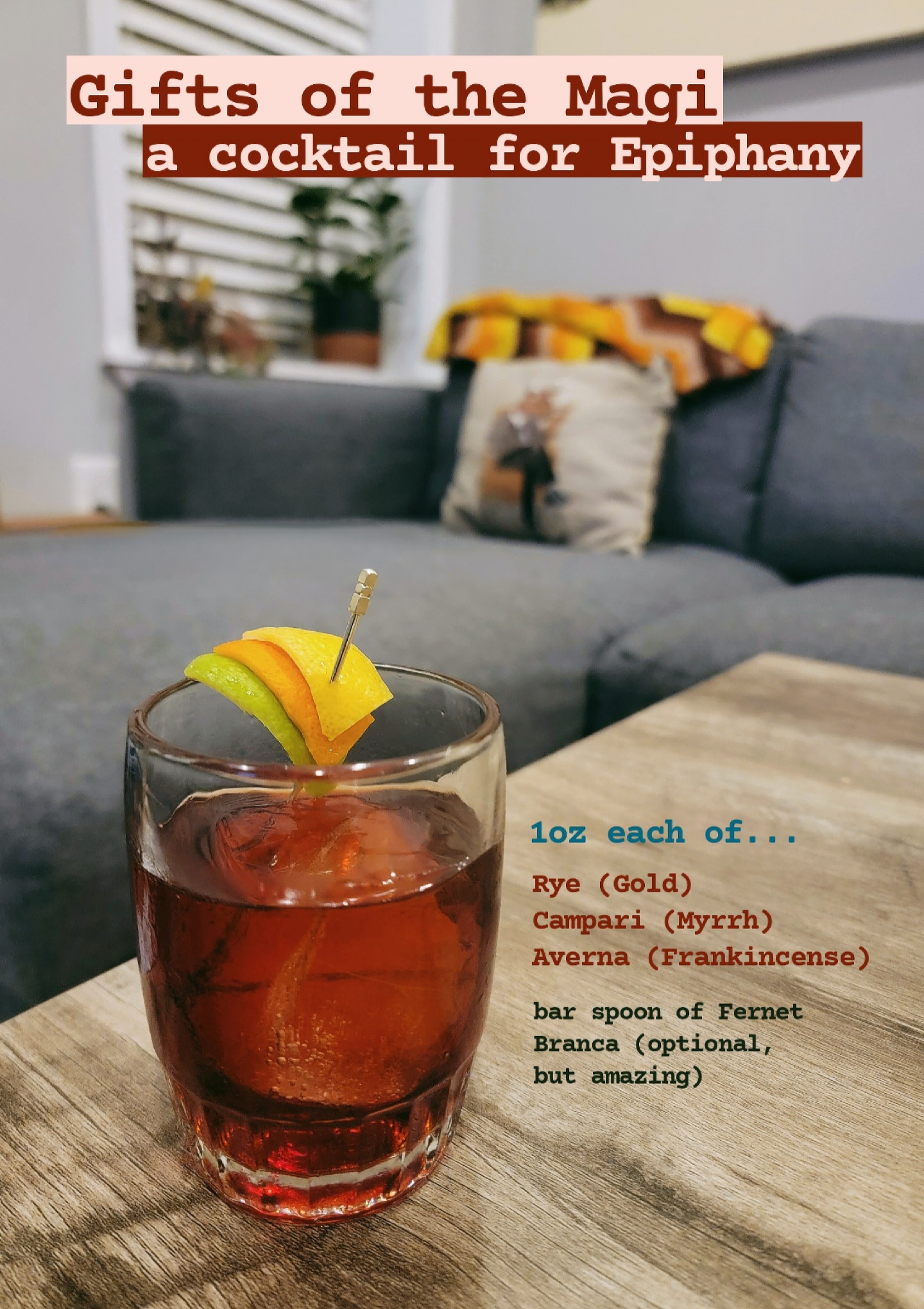
“Gifts of the Magi” (an Epiphany cocktail)


Recipe

  • 1oz Rye (for Gold)
  • 1oz Campari (for Myrrh)
  • 1oz Averna (for Frankincense)
  • .25oz Fernet Branca (optional)
  • Garnish with a trinity of Lemon, Lime, and Orange peels

Stir all ingredients in mixing glass and pour over fresh ice. Garnish with a peel each of lemon, lime, and orange.

* * * *

Tonight begins the season of Epiphany, a season that covers a lot of ground thematically and in the life of Christ. It begins January 6, with a celebration of the Wise Men visiting Jesus when he was three years old–and that’s what tonight’s cocktail is for.

At its core, it’s a riff on a Boulevardier, but wow is it good and different than the original. I think I prefer it. The Averna lends a lot of depth and complexity that vermouth often lacks.

The drink is in honor of the Magi. The Bible does not specify how many their were, but tradition says three. So we have here an equal three parts cocktail for each of the Wise Men’s gifts.

Rye gives its beautiful golden hue. “Myrrh” comes from the Aramaic word for “bitter”, so Campari it is. Lastly, my understanding is that Frankincense has a piney, sweet taste/aroma with a touch of orange, and this sounds a lot like Averna, my favorite amaro.

This drink is fantastic like this, but if you want an extra bit of depth and meaning, throw in a bar spoon of Fernet Branca which, to me, is the most “Epiphany” spirit out there–dark and bitter, with that bright minty note breaking through. I love it, and it complements the drink really well, though I know it’s an acquired taste.

Like this cocktail, I hope this season of Epiphany (and it’s interesting and unexpected melange of holy days) is one full of meaning, depth, and complexity for you. Cheers!

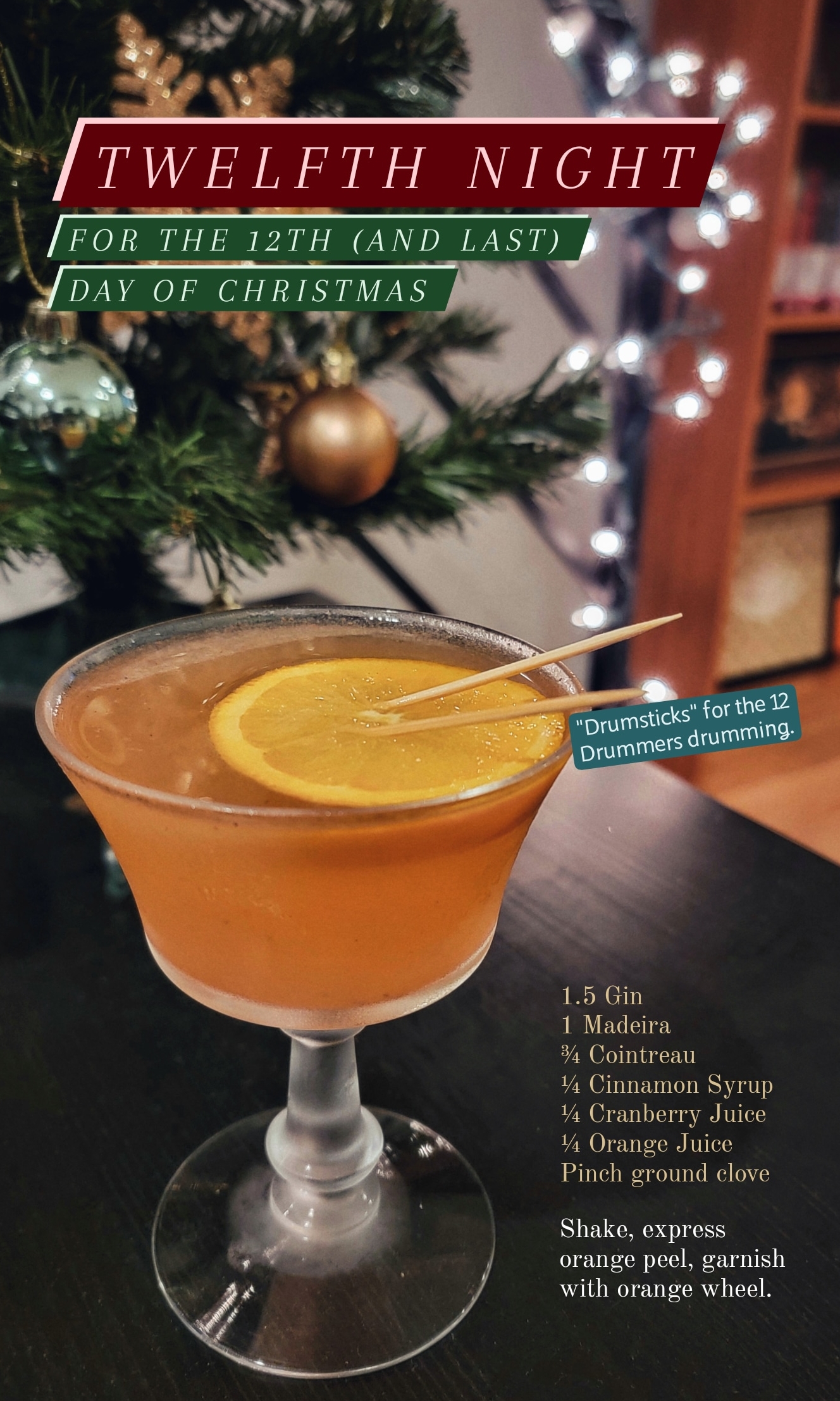
“Twelfth Night” (a cocktail for the last day of Christmas)


Recipe

  • 1.5oz Gin
  • 1oz Dry Madeira
  • .75oz Cointreau
  • .25oz Cinnamon Syrup
  • .25oz Cranberry Juice
  • .25oz Orange Juice
  • Pinch of ground clove
  • Orange Wheel garnish

Shake all ingredients, including the clove. Strain into a chilled coupe. Express an orange peel over the top. Garnish with an orange wheel and two toothpicks.

* * * *

The final night of the 12-day Christmas season is called “Twelfth Night”. It’s the last day of gift-giving, decorations, many food and drink traditions (including wassail!), and a Shakespeare play—and now I have a cocktail for it! And don’t forget the “drumstick” garnishes in honor of the song’s 12 drummers drumming.

This is an amazing Christmas cocktail. It has dark fruit notes, with a touch of brightness, and a lot of complexity and depth without being a “sweet” drink. It definitely straddles the line between a sipper and easy drinking. It is a slight variation of this drink in honor of the play.

The ingredients are mostly self-explanatory, except for the madeira. I don’t have a ton of experience with it, but I know there’s huge variation between the different types and brands. For this I used Broadbent Rainwater Medium Dry Madeira. Your mileage may vary depending on what you find. You may be able to substitute a port or even a dark sweet vermouth.

Enjoy this drink and have the merriest of final Christmas evenings before we head into the season of Epiphany!

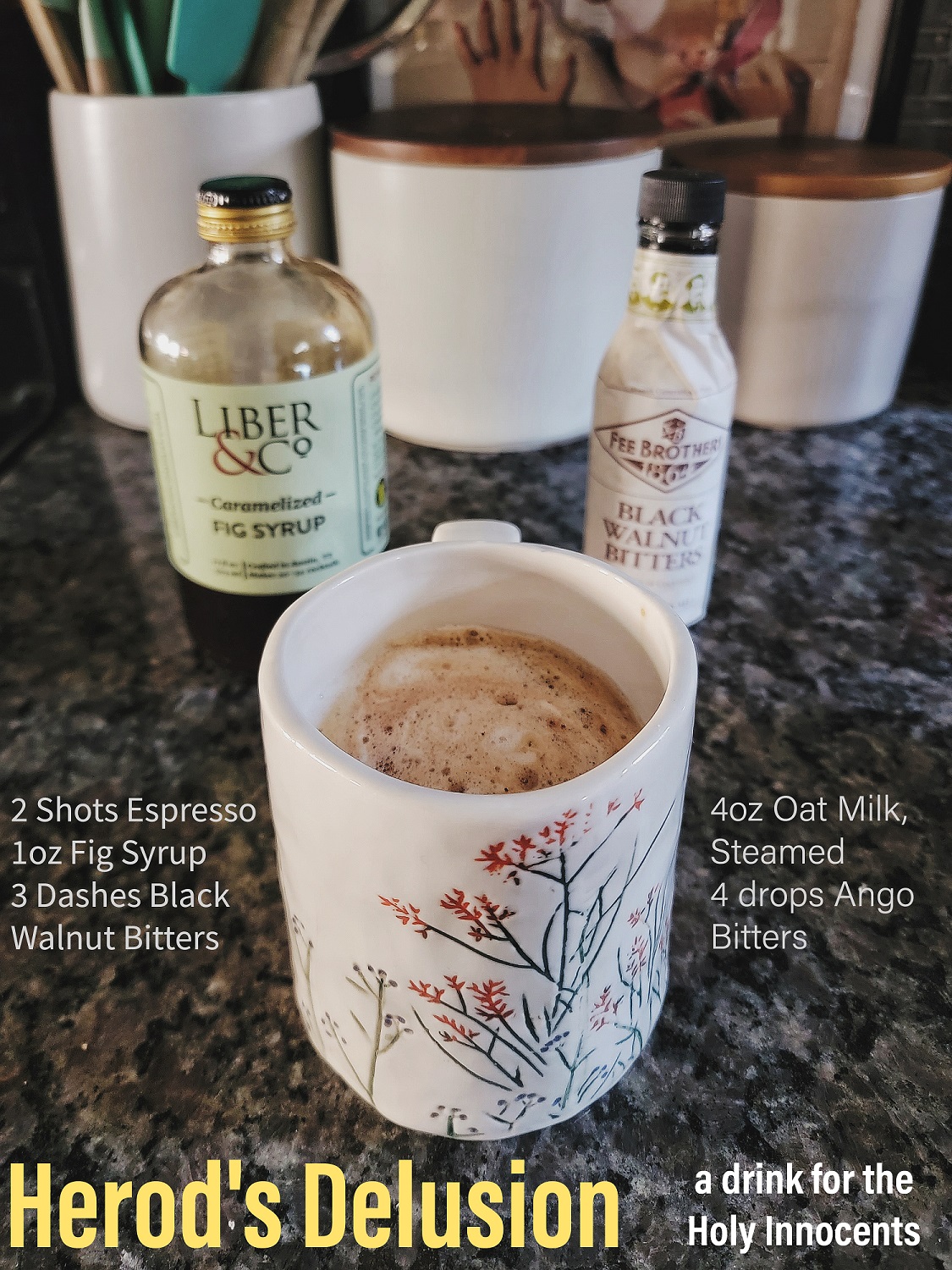
Herod’s Delusion (A Drink for the Holy Innocents)


Recipe

Pour espresso over the fig syrup. Add walnut bitters to the milk and steam it. Put four drops of Angostura on top of the foam.

* * * *

December 28th is a Christian Holy Day that reflects on the slaughter of the “Holy Innocents”–infants massacred in Bethlehem by King Herod, who was trying to kill the infant Jesus. It is an incredibly dark part of the Christmas story which we can often overlook in the midst of all the joy and pageantry of the season.

In Matthew 2, the wise men come to Herod saying they’re looking for an infant in Bethelehem who would grow up to become king (which was news to Herod). He told them to let him know when they had found this baby, but after finding Jesus they heeded the warning of a dream and left without telling Herod.

In a rage, he “killed all the children in and around Bethlehem who were two years old or under”, trying to kill Jesus. But Mary and Joseph had already fled.

The story brings up a lot of questions, both historical and theological–and there are no easy answers (here’s a reflection on it from my old pastor).

But the Christian Church has come to honor these infants as the first martyrs of Christianity. They died not only for Jesus, but also in his place. Augustine beautifully says, “they are the first buds of the Church killed by the frost of persecution”.

It is with a lot of these themes in mind that I offer this drink. It may seem trite and minimizing to make a latte in “honor” of such a dark event, but I find these creative and sensory experiences truly aid my own reflection. The intentionality and car that goes into the preparation involves my full self and helps me participate in this more deeply. Hopefully it does the same for you.

And the drink is full of more depth and symbolism than you might think. Bitters represent weeping. Figs are a scriptural symbol for Israel as a nation. Walnuts are an ancient symbol of fertility and children, and in Christianity they were used as an image of the Trinity (due to their layers). The Angostura drops remind us of the bloodshed on that day.

This is a warming, comforting drink in this cold season. It perfectly balances the bitter and the sweet, which is precisely what we strive to do with this story on this day.