Liturgy & Readings for Good Friday (2014)


This is from the Liberti 2014 Lent & Easter Prayerbook. Download the book for free for poetry and extended reflections for this week and next.

WORSHIP

call to prayer.

Be pleased, O God, to deliver us;
O LORD, make haste to help us!
–Psalm 70.1

the Gloria.

Glory be to God the Father, God the Son,
and God the Holy Spirit.
As it was in the beginning, so it is now,
and so it shall ever be, world without end.
Amen!
-the “Gloria Patri” !

the Psalm.
Continue reading

Longing for Liturgy (a Catechumen’s reflection on Holy Week) {by David Schrott}


In recent years, and prior to my Orthodox catechesis, I heard many a Protestant writer or preacher lament that Easter was not of enormous import to most Christians when it was the eminent Christian holiday.  I didn’t share that view. Easter was an after-thought for me – another spring holiday without much real significance. Little did I know that it was the cultural liturgy of the market-place that informed my position towards the holiest of Christian celebrations.

Liturgies form us. Whether they are cultural or religious, we are moved to be formed in the image of something and in the West, the market-place is driven by the most powerful liturgy called Consumerism. Christmas is the most powerful holiday in our culture and not because of what it is or what it means; it is the most powerful because of the 30-something day cultural liturgy from Black Friday til Christmas day that forms our hearts not toward God, but towards pretty much everything else. As James K.A. Smith notes in his book Desiring the Kingdom, the Culture understands liturgical formation better than the modern church does.photo1

The Holy Orthodox Church is not the modern church.  Before I decided that Orthodoxy was the church of the Apostles, the Fathers and Christ himself, I longed for liturgy without knowing what I was longing for. I think this is the basis of the modern Evangelical root of church innovation. The Western Christian wishes to attach himself or herself to something, but doesn’t know how or have the framework for doing so; so innovation in church methods based on market research emerge. A few years ago, I’d fast all of Good Friday (and accidentally get drunk when breaking fast that night with beer and bread; Lord have mercy!) or round up friends for a Maundy Thursday dinner or try to watch the Passion movie. These were my own personal longings for connectedness to Holy Week and the larger Church; these were longings for liturgy. Little did I know that there was already a place where these connections existed and they existed nearly unchanged for most of 2000 years.
Continue reading

Holy Week Music: Mozart’s “Requiem”


Klimt-Death-LifeOne of the primary ways I relate to the Church Calendar is through music (hence the free Mixtapes I put out each season). Even when I am terrible at engaging at an intellectual or even a practical devotional way, I am really intentional about filling my life with music that will still put my soul in the proper posture for the particular season.

For this Lent, I found myself spending significant time with Mozart’s Requiem, a “Mass for the Dead”. This was his last (and still mysterious) piece–unfinished before he died. Before Holy Week was over, and as we enter into the Holy Weekend, I wanted to offer this to as a way you might be able to engage in these last few days of Lent. Here is the audio, and below that you will find an English translation of the entire Mass. The words are achingly haunting and beautiful and deserve your perusal whether you have time for the music or not. Have a blessed Lent.

W. A. MOZART, REQUIEM
English Translation, from St. Matthew’s choir
Continue reading

Liturgy & Readings for Maundy Thursday (2014)


This is from the Liberti 2014 Lent & Easter Prayerbook. Download the book for free for poetry and extended reflections for this week and next.

WORSHIP

call to prayer.

Be pleased, O God, to deliver us;
O LORD, make haste to help us!
–Psalm 70.1

the Gloria.

Glory be to God the Father, God the Son,
and God the Holy Spirit.
As it was in the beginning, so it is now,
and so it shall ever be, world without end.
Amen!
-the “Gloria Patri” !

the Psalm.
Continue reading

Liturgy & Readings for Holy Wednesday (2014)


This is from the Liberti 2014 Lent & Easter Prayerbook. Download the book for free for poetry and extended reflections for this week and next.

WORSHIP

call to prayer.

Be pleased, O God, to deliver us;
O LORD, make haste to help us!
–Psalm 70.1

the Gloria.

Glory be to God the Father, God the Son,
and God the Holy Spirit.
As it was in the beginning, so it is now,
and so it shall ever be, world without end.
Amen!
-the “Gloria Patri” !

the Psalm.
Continue reading

The Darkest Week in Human History.


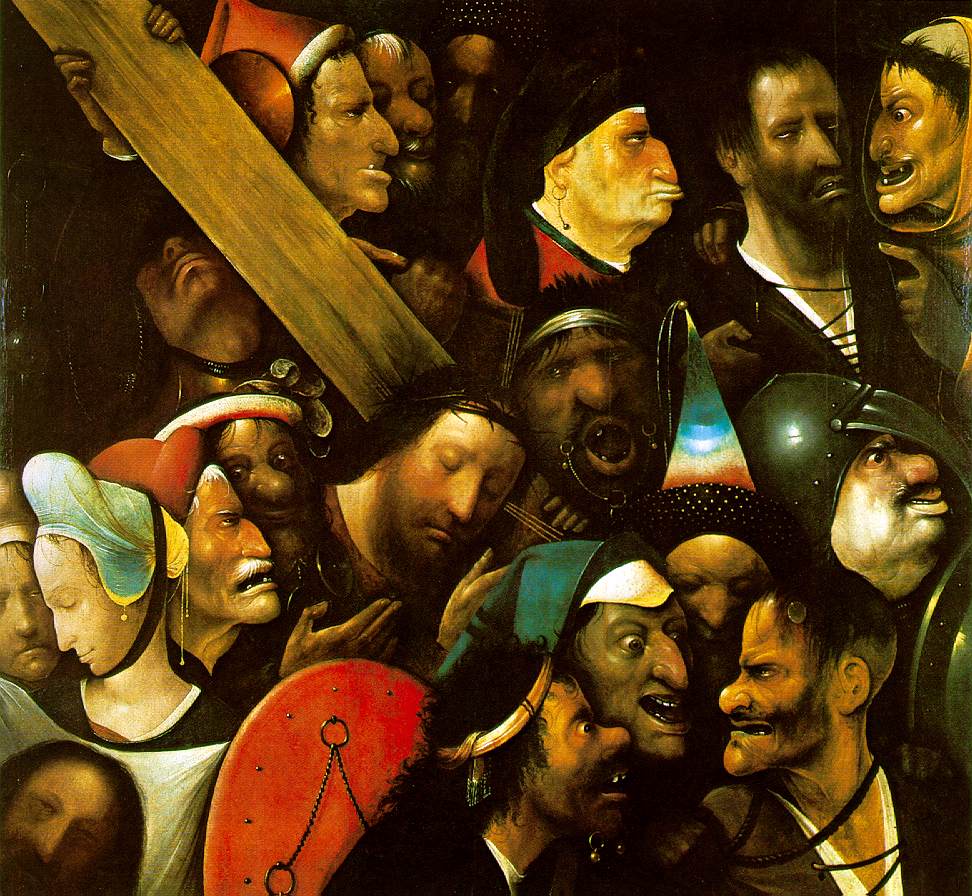
bosch-christ-carrying-the-crossIn our Holy Week reading of the Parable of Tenants, we see the startling revelation that the long-awaited Messiah—the One sent of God to accomplish salvation and liberation for his people—will be rejected by those very people.

And yet, this rejection was not limited to these religious leaders, or even to the ethnic group they represented. During Jesus’ Passion Week—which we meditate upon during this Holy Week—we see Jesus rejected at every level of his Creation.

On Palm Sunday, a large group accompanies Jesus, proclaiming his blessedness. This is not the group that later cries out to crucify him. Instead, it might be worse. These are people from the Jerusalem “suburbs” who have been receiving Jesus’ teaching for months. They accompany Jesus to Jerusalem, and then…. they just disappear, showing their ultimate apathy and indifference towards him.
Continue reading

Palm Sunday: “The Emperor Has No Clothes” [POEM]


I feel far, Lord.
But I know you’re here.  I know it.
(Do I?)

(Can I?)

It’s the nature of the matter; a matter of nature, I suppose.
Perhaps only now I feel at the deepest existential depths:
“I believe! Help my unbelief!”

Or in a word: Hosanna

That cry.  That plea.

The certainty of uncertainty.
The pregnancy of a pause.
The pondering of a moment.

That moment.  The moment.  

The moment that dressed my doubt in assurance.
But that emperor has no clothes
(or so everything says).

So where does my assurance lie?
Where do my feet stand?

My body pelted with rain, snow, and hail;
I pray my heart rests beside a fire,
drinking tea,
rocking in a chair,
my shoulders draped in that most costly of quilts –
my Rest.

Clothe me–
with the coat I lay on your path–
for this emperor is naked

and needs his King.

[read my other Holy Day poetry here]
all writings licensed: Creative Commons License

Timothy’s Tears: A Holy Week Pre-Game | 2 Tim 1, Acts 16 & 20


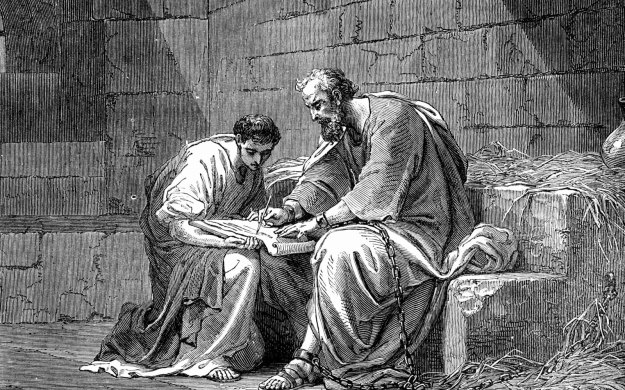
paul-and-timothy

This is part of our Lent series, “The Weeping Word“, where we look at different moments of crying, lament, and tears in the Scriptures.

To Timothy, my beloved child…

I am grateful to God—whom I worship with a clear conscience, as my ancestors did—when I remember you constantly in my prayers night and day. Recalling your tears, I long to see you so that I may be filled with joy.
2 Timothy 1.2-4

Next week is Holy Week, the high (or low?) point of Lent, leading to the crescendo of Easter. It will be a time of darkness, reflection, lament, and meditation. But we’re not there yet. Before the seriousness of Holy Week arrives, I thought I’d share with you a funny memory that’s connected to our Lent series on tears in the Bible.

I was sitting in the little campus ministry Bible Study my junior year of college. Our style of Bible Study was simply sitting down with an eloquent, wise, and gifted pastor, and then walking verse-by-verse through a given book of the Christian Scriptures.

Having just finished nearly a year in the book of Romans, we were just starting our next book: 2 Timothy. Many scholars believe it was Paul’s last letter he wrote before he died. And he wrote it to the man he mentored more than any other we know about: Timothy, a young elder at the church in Ephesus who was still struggling to get this little church plant off the ground.
Continue reading

Death & Life; Names & Vows | Genesis 3.20-21


The man named his wife Eve, because she was the mother of all living. And the Lord God made garments of skins for the man and for his wife, and clothed them.
Genesis 3.20-21

I don’t know why I’ve never noticed this before. Why does Adam only name Eve after they sin? Further, of all the things to do after receiving the curse from God, he does this covenantal, marital act: he gives her a name.

I know this isn’t in this text, nor was it on the mind of the original writer, but it reminds me of the odd line in Revelation where God promises to give each person a new name that only He and they will know.

It seems that in the whole sweep of redemptive history, the Bride of the first Adam received a new name when he brought death, just as the Bride of the second Adam receives a new name when he brings life.

See other Marginalia here. Read more about the series here.

Crazy thought of the day: God Died. [QUOTE]


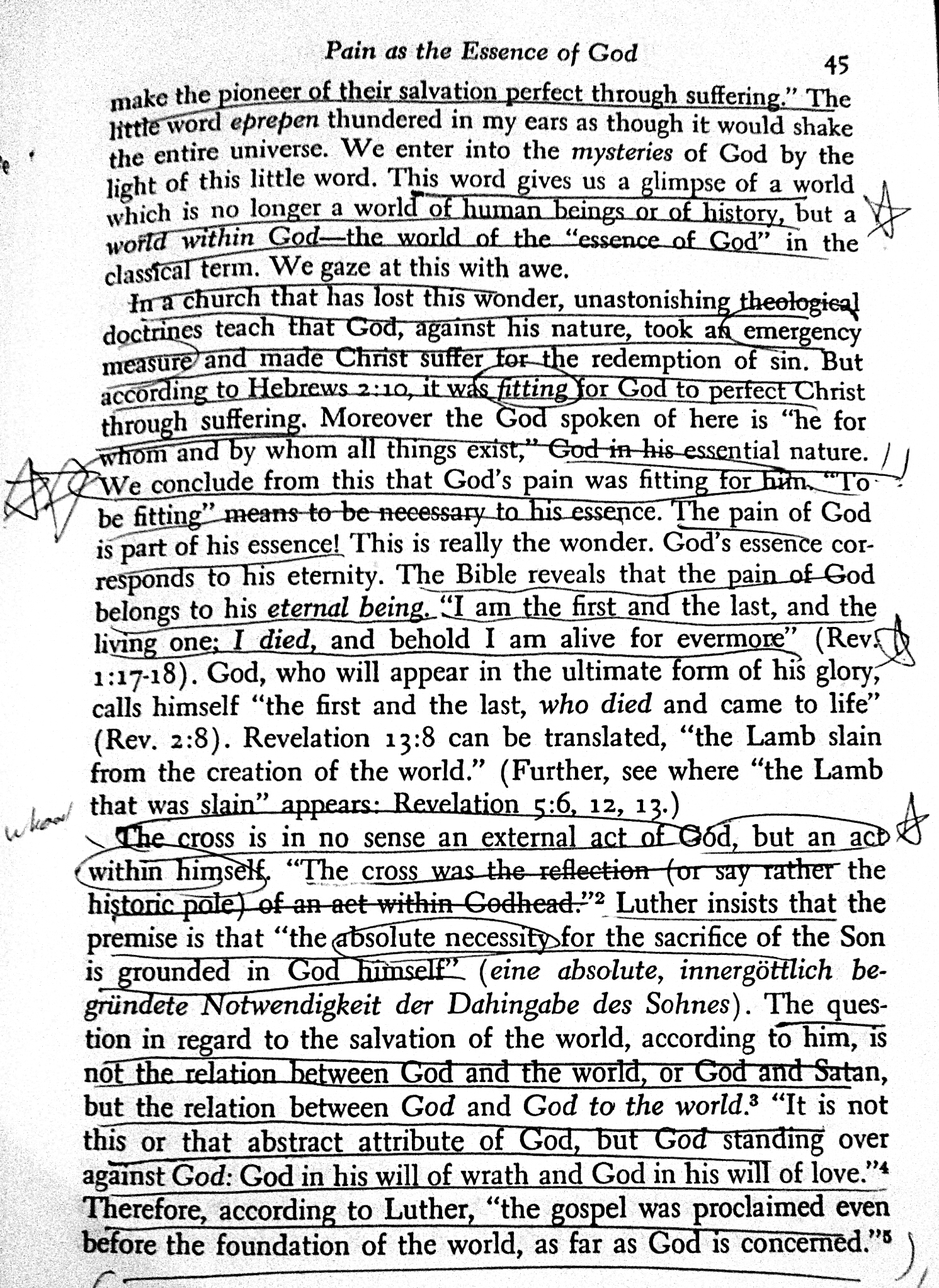
“The task of witnessing to the gospel is to vitalize the astonishing fact of the gospel. The message “the Son of God has died” is indeed most astonishing…. God has died! If this does not startle us, what will? The church must keep this astonishment alive. The church ceases to exist when she loses this astonishment. Theology, the precise understanding of the gospel, must be seized by this astonishment more than anyone else. It is said that philosophy begins with wonder; so theology begins with wonder. The wonder of philosophy pales before the wonder of theology. The person astonished by the tidings “God has died” can no longer be astonished at anything else.”

Kazoh Kitamori, Theology of the Pain of God

“Coffee Crucifix” (a sonnet for National Coffee Day)


Coffee Crucifix

Crescent ring under porcelain smooth
___stain the wood-stained finish.
______(It is finished.)
___Marked with muddy water;
___mark the merry day; to
___marry the murdered man.

Floral notes in blackened waves
___crash the shore of trembled lips.
Choral bright, in darkest night,
___wake the tone of trebled kiss.

Younger tastes left open-wide; older eyes made
satisfied.

Mark the wood: complex simplicity.
Pierce my heart: storied infinity.

[read my other Holy Week poetry here]

all writings licensed: Creative Commons License

Trickle-Up Resurrection (Guatemala Lessons)


Rothko-easterMy church is currently in a series called “Resurrection Stories” in which we’re going through each of the non-Jesus stories of resurrections (or “resuscitations”—whatever) found in the Bible. It is, after all, still Easter.

A few weeks ago, as we were talking about Elisha raising the Shunnamite’s son, our pastor pointed out that most of these resurrection stories seem to center more on the people around the dead person than the dead person themselves. And so, in a sense, these resurrections are more for the people affected by death than the one dead; the ones that “receive” the true resurrection power are mostly those around the resurrected one.

Further, as he pointed out, most all of these people that “receive” the truest benefits of these resurrections are women—the most alienated and disempowered group throughout world history.
Continue reading