Sin: God’s Favorite Part of Being God


sandorfi-le-pardon-wide

Lent is a time that we dwells a lot on Sin. It’s a preparation for Easter and celebrating the Resurrection, and so to prepare for this, we must meditate on those things that Resurrection itself addressed. Resurrection was a response to Sin and Death. The more we feel and dwell in the reality of our Sin and Death, the more tangible Resurrection becomes.

This can seem morose, annoying, unnecessary, or not in line with our identity as Christians. Should we do this though it might make us depressed, feel like self-focused navel-gazing, or if it distracts us from much of the rest of our Christian living?

There’s definitely a time and place for it and a degree after which it becomes unhealthy, but more than what this does for/to us or our emotional state, could I offer another reason that it’s good to have times where we bring our focus to our weakness and sinfulness?

God loves it.
Continue reading

Cool Hand Luke’s “Of Man”: a favorite album is now free (and perfect for Lent)


cool-hand-luke-of-man-coverIf you don’t care about the commentary, and just want the amazing music, you can get it at Noisetrade. If you’d like to listen to the album first, just press play:


Someone’s “favorites” are a weird thing to define.  They are prone to fickleness, are tied so closely with whatever else is subjectively happening in one’s life, and usually bear little resemblance to what that person would consider as the technically “best” of any particular thing. So when you have a “favorite” that sustains that title for years–decades, even–it’s a big deal.

Since high school my favorite band has been Cool Hand Luke. Back then they were a little hardcore screamo band. At that time, to get their CD, you had to mail a check to the lead singer’s house. As time when on, their style changed at the very same time and in the very same way as my own. It felt like we were growing together.

Around my senior year of high school, they came out with an album called Wake Up,  O SleeperAnyone who’s heard of CHL probably knows them from this stunningly powerful work of art. It quickly became the most influential and “favorite” album of mine. And it has been ever since.

Towards the end of college, I became pretty good friends with the lead singer. For a while, every few months, we’d talk for a couple of hours on the phone. He was discerning whether to go to seminary and what to do about the financial mess their shady manager had left the band in. I got to see his heart and the heart behind the beautiful music they made.

Eventually, he got married, I started seminary, and he decided it was time to end the band and begin seminary himself. But there was one last project he felt he had to do.

Of Man.

Continue reading

Politics & Tithe | Ezra 8.35-36


At that time those who had come from captivity, the returned exiles, offered burnt offerings to the God of Israel, twelve bulls for all Israel, ninety-six rams, seventy-seven lambs, and as a sin offering twelve male goats; all this was a burnt offering to the Lord. They also delivered the king’s commissions to the king’s satraps and to the governors of the province Beyond the River; and they supported the people and the house of God.
Ezra 8.36

Interesting line… Is this saying that they had people “on staff” who managed their civil tithe to the secular authority (taxes), and the lay people supported the House of God? Is this like tax accountants “on staff” among the leadership of the temple?

See other Marginalia here. Read more about the series here.

Lent & Ash Wednesday for Kids (….or maybe not)


rabu-abuLast night, my church had their Ash Wednesday service. I had the honor of helping lead the liturgy by offering the greeting and opening introduction/ explanation. Unlike most times we gather, the kids stayed in the service so I was asked to make sure my opening words were at least somewhat comprehensive to children.

This turned out to be one of the most helpful exercises for me. I ended up spending more time thinking through these brief opening words than I normally do and crafting each line as intentionally as possible. And so, for the heck of it, I thought I’d throw this up on the blog for anyone who was struggling with explaining Lent and/or Ash Wednesday to their young ones, and also to get your thoughts on how best to communicate this to kids. Here’s what I said:

(Lent: Two things hold us back)

Tonight kicks off the Church season of Lent. Most all of us live our lives wanting to be better people than we are right now. But if we’re honest, there are two things that can get in the way of that sometimes and make us frustrated as we try and become the people we want to be.
Continue reading

Ash Wednesday Benediction [POEM]


ash-wednesday-faces-of-the-faithful-photos

The shape of the promise is death 
Say the word, feel the space, build the coffin in your mouth
Climb inside and make it yours

For it is

That tomb washed white, emerges in life,
enslaves in death, watches the end

agape

Expiration exorcism, cast the spirit, cast it low;
Cast your eyes and feel the blow
Cast the lots

Carve the promise into your bones, your forehead

Let your face shine with Moses glory: that of the immortal God
–that suffering, dying, ashen glory-story

May your face shine with Ash
As you wear the world’s judgment embedded in your skin, in your body,
May you feel the world’s death in your face, may you hold it before your eyes

May the flame that licked the palm find its end in you.
Bear the flame the world shall never know, precisely so it never will

Take their judgment and rub it on our faces and cast it to proclaim

Lift up your eyes

Wear it loud

The shape of the promise is death

[read my other Holy Day poetry here]
all writings licensed: Creative Commons License

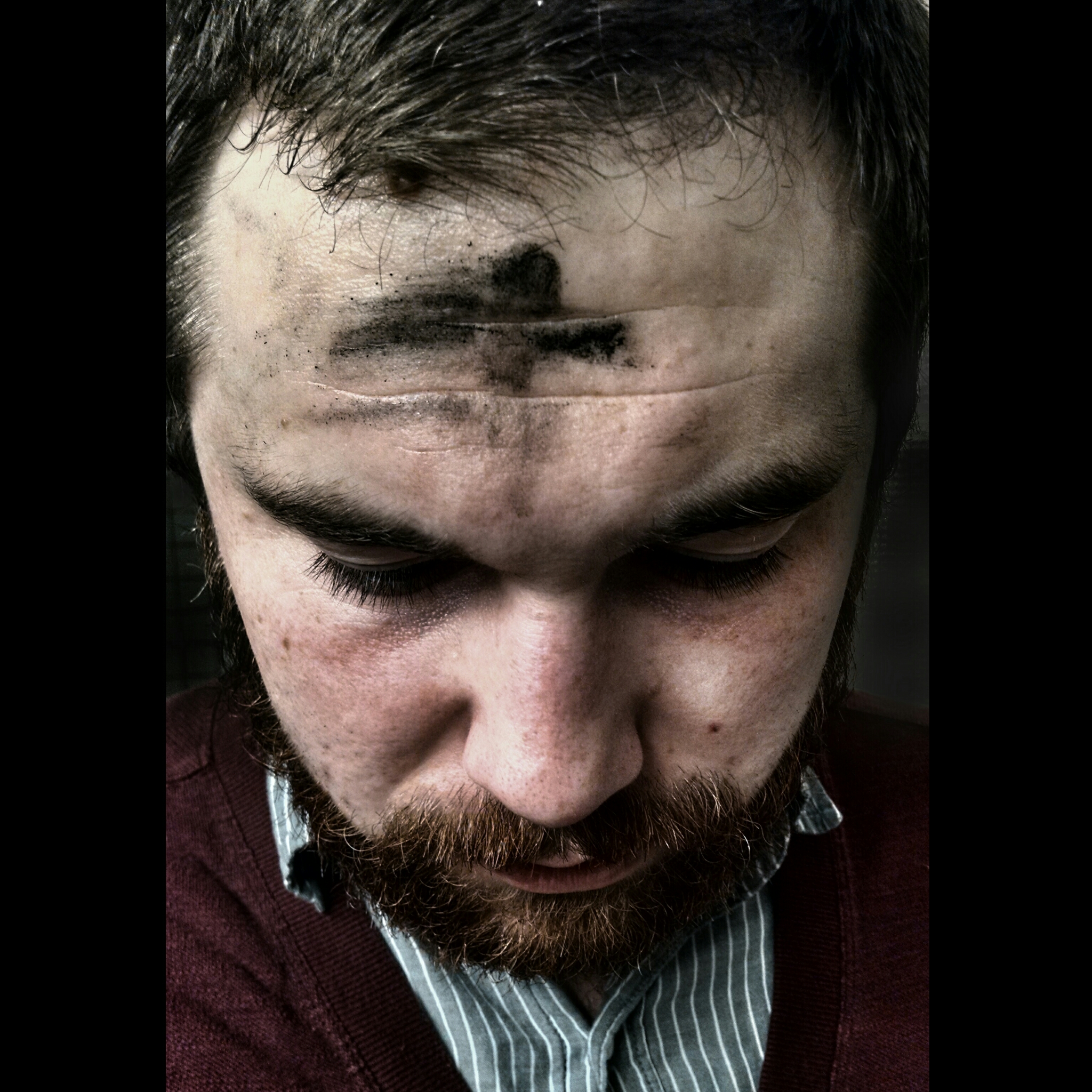
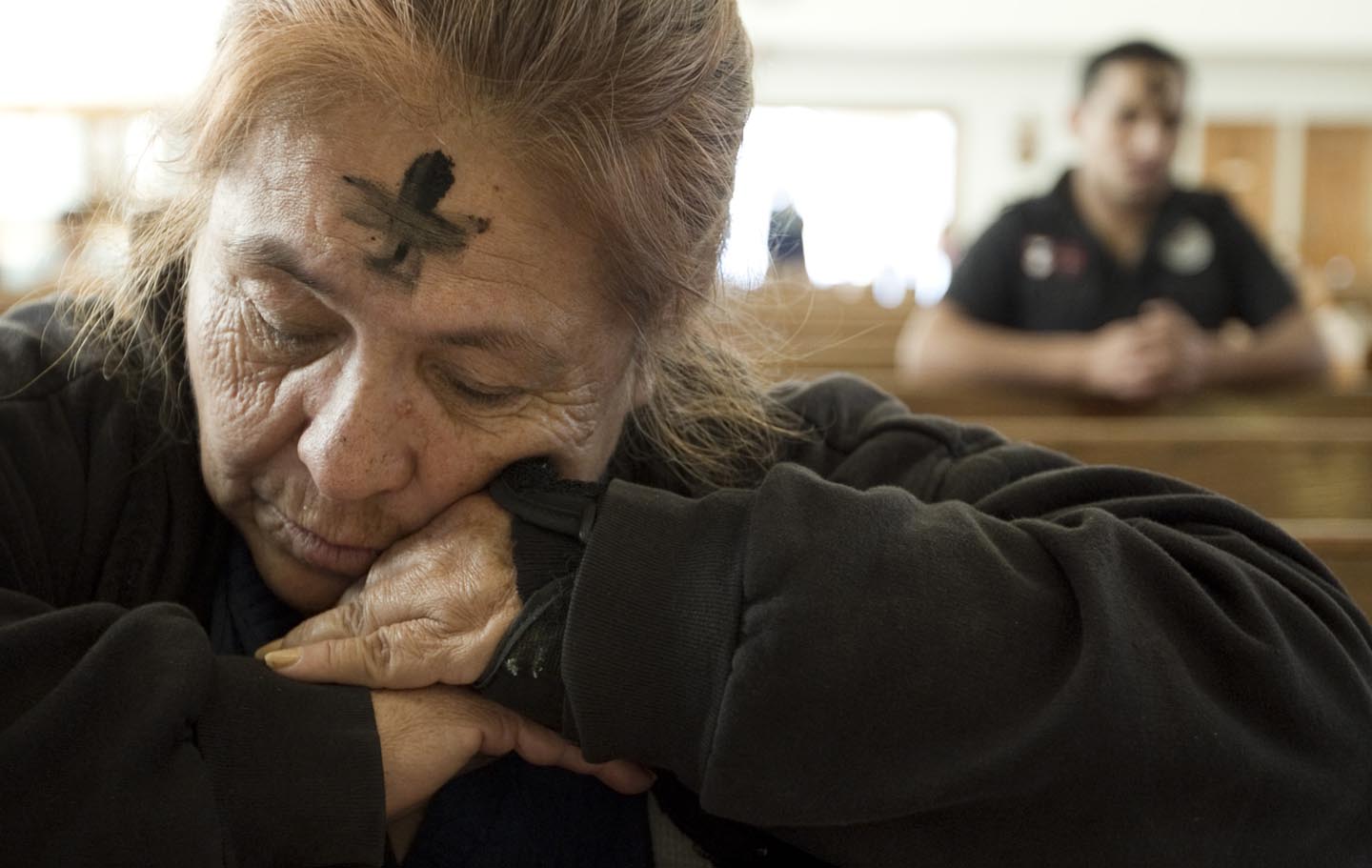
Welcome to Ash Wednesday. Lent begins.


ash-wednesday-pew-lentToday is Ash Wednesday. In just under two months from today we’ll come to the highest point in the Christian Church calendar, Easter. That is where we’ll celebrate Christ’s Resurrection and how God’s perfect world broke into the present and our greatest enemies–sin and death–were conquered and shown to have no more dominion over us and the rest of the world. It’s meant to be the most effusive, overflowing, even ridiculous time of joy.

And yet, when we look at Jesus’ Resurrection, we see that before it ever took place, there was Death. And before that, there was an entire lifetime of loneliness, pain, suffering weakness, and isolation. We see that it was a life surrounded by evil forces and whispers that haunt and hurt Jesus and the people he loved.

And so, our early Church Mothers and Father thought it would be wise to have this time before Easter to prepare, so we might end up celebrating during Easter all the more.

Resurrection was itself a statement against our two greatest enemies: Sin and Death. And so to participate in Resurrection, we take the time of Lent to meditate and press into those things to which Resurrection was the response. We do this not out of morbidity, but out of anticipation.

Continue reading

Lent begins tomorrow. (Will you just give it a try?)


Jesus & The Cross

I grew up in a church tradition that did not take seriously the Christian Church Calendar. Even as I went to college and moved into communities that took some level of tradition more seriously (which was usually limited to quoting Puritans and Reformers in sermons), the Church Calendar wasn’t that big of a deal. It was seen as something sort-of cool that could be incorporated into the already established life of the Church; a buffet from which leaders could pick and choose some aspects that might be helpful in organizing some sermon series or songs. But it certainly wasn’t seen as something that a church should actually incorporate itself into, or build it’s own rhythm around.

I’ve had the privilege of having this paradigm rocked the past several years at my church, and have fallen in love with the Church calendar. It influences much of the rhythm and timbre of my everyday life–both ecclesial and otherwise. I find such life in living within a stream of thought that was not simply created within the past generation by baptizing modern Western American cultural ideas.

I love finding myself as embedded within the cloud of witnesses that have gone before me as possible–even those I may disagree with passionately and fundamentally. Because, at the end of the day, they are my family, and families have traditions. Sure, you can be “that guy” that does his own thing and doesn’t participate in the family rhythms, but where’s the life in that?

Continue reading

Insecurity Leads to Fasting? | Ezra 8:21-23


Then I proclaimed a fast there, at the river Ahava, that we might deny ourselves before our God, to seek from him a safe journey for ourselves, our children, and all our possessions. For I was ashamed to ask the king for a band of soldiers and cavalry to protect us against the enemy on our way, since we had told the king that the hand of our God is gracious to all who seek him, but his power and his wrath are against all who forsake him. So we fasted and petitioned our God for this, and he listened to our entreaty.
Ezra 8:21-23

What an odd and beautifully honest aside. At first I was put off by the logic here. “I proclaimed a fast…For I was ashamed.” I thought “that’s a terrible reason to have a fast!” But the more I thought about it the more I realized that, of course!, that’s the right time to fast! When you are most unsure, most in need, most insecure. This is when “we might deny ourselves before our God.”

See other Marginalia here. Read more about the series here.

Death & Life; Names & Vows | Genesis 3.20-21


The man named his wife Eve, because she was the mother of all living. And the Lord God made garments of skins for the man and for his wife, and clothed them.
Genesis 3.20-21

I don’t know why I’ve never noticed this before. Why does Adam only name Eve after they sin? Further, of all the things to do after receiving the curse from God, he does this covenantal, marital act: he gives her a name.

I know this isn’t in this text, nor was it on the mind of the original writer, but it reminds me of the odd line in Revelation where God promises to give each person a new name that only He and they will know.

It seems that in the whole sweep of redemptive history, the Bride of the first Adam received a new name when he brought death, just as the Bride of the second Adam receives a new name when he brings life.

See other Marginalia here. Read more about the series here.

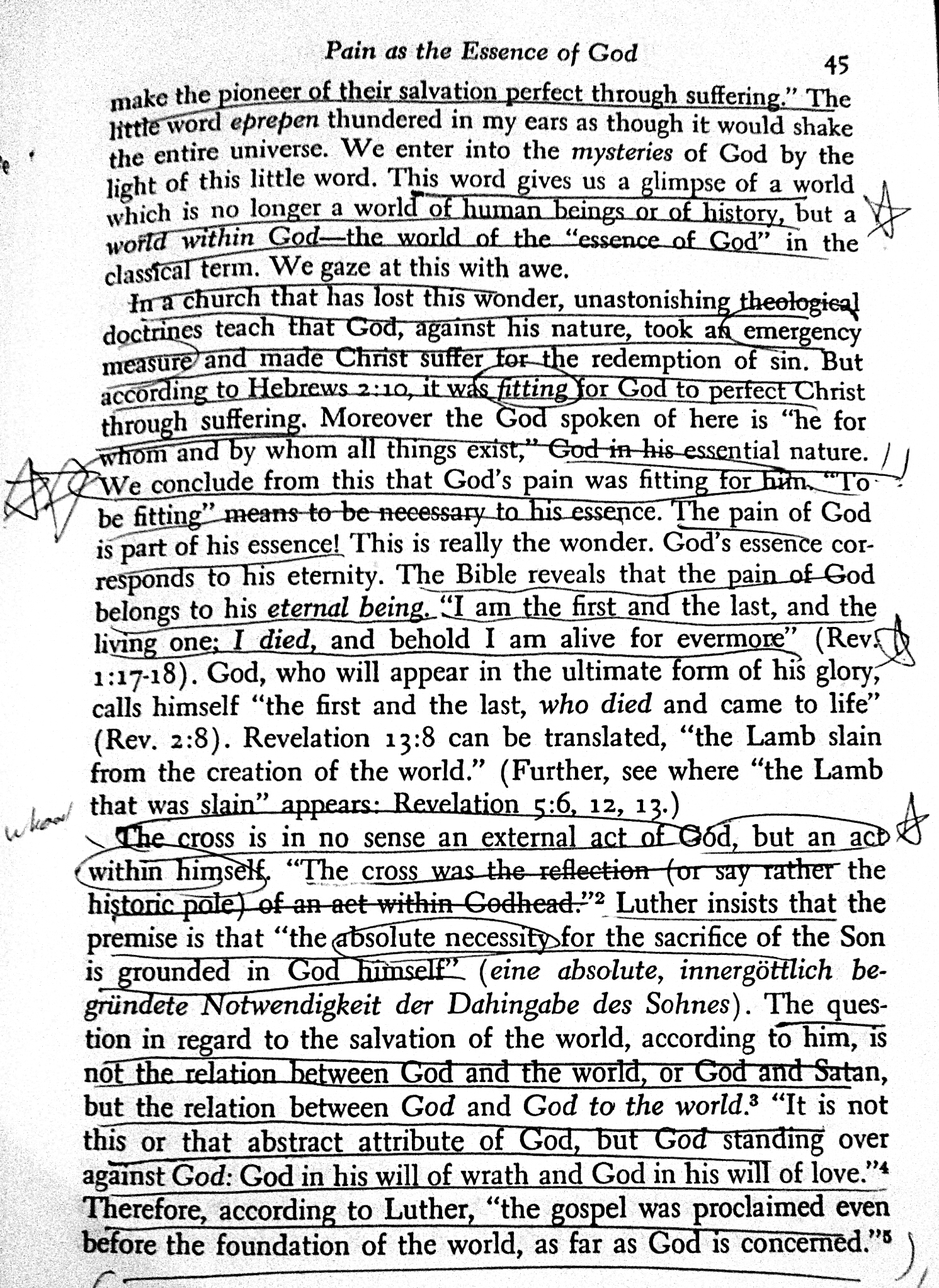
Crazy thought of the day: God Died. [QUOTE]


“The task of witnessing to the gospel is to vitalize the astonishing fact of the gospel. The message “the Son of God has died” is indeed most astonishing…. God has died! If this does not startle us, what will? The church must keep this astonishment alive. The church ceases to exist when she loses this astonishment. Theology, the precise understanding of the gospel, must be seized by this astonishment more than anyone else. It is said that philosophy begins with wonder; so theology begins with wonder. The wonder of philosophy pales before the wonder of theology. The person astonished by the tidings “God has died” can no longer be astonished at anything else.”

Kazoh Kitamori, Theology of the Pain of God

“Coffee Crucifix” (a sonnet for National Coffee Day)


Coffee Crucifix

Crescent ring under porcelain smooth
___stain the wood-stained finish.
______(It is finished.)
___Marked with muddy water;
___mark the merry day; to
___marry the murdered man.

Floral notes in blackened waves
___crash the shore of trembled lips.
Choral bright, in darkest night,
___wake the tone of trebled kiss.

Younger tastes left open-wide; older eyes made
satisfied.

Mark the wood: complex simplicity.
Pierce my heart: storied infinity.

[read my other Holy Week poetry here]

all writings licensed: Creative Commons License

Trickle-Up Resurrection (Guatemala Lessons)


Rothko-easterMy church is currently in a series called “Resurrection Stories” in which we’re going through each of the non-Jesus stories of resurrections (or “resuscitations”—whatever) found in the Bible. It is, after all, still Easter.

A few weeks ago, as we were talking about Elisha raising the Shunnamite’s son, our pastor pointed out that most of these resurrection stories seem to center more on the people around the dead person than the dead person themselves. And so, in a sense, these resurrections are more for the people affected by death than the one dead; the ones that “receive” the true resurrection power are mostly those around the resurrected one.

Further, as he pointed out, most all of these people that “receive” the truest benefits of these resurrections are women—the most alienated and disempowered group throughout world history.
Continue reading

{Easter friday} | prayer & readings for Easter Week (2013)


For Easter Week: reading schedule/reflections.

prayer.

Almighty Father, who gave your only Son to die for our sins and to rise for our justification: Give us grace so to put away the leaven of malice and wickedness, that we may always serve you in pureness of living and truth; through Jesus Christ your Son our Lord, who lives and reigns with you and the Holy Spirit, one God, now and for ever. Amen.
(from the liberti Lent & Easter 2012 prayerbook & the Book of Common Prayer)

Continue reading