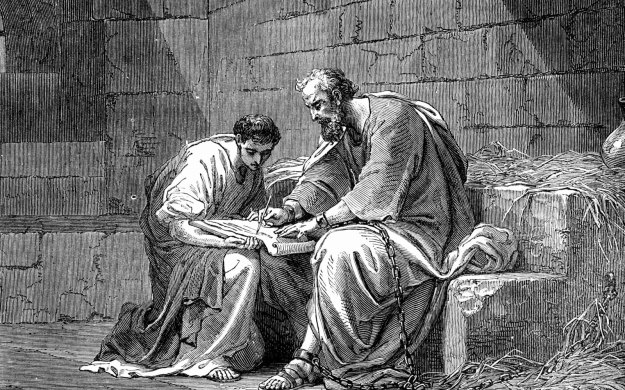
The Elements [a Good Friday poem]


death-of-salesman-clothes-hangerWelcome, hello
Come in.

Take your shoes off
Set down your suitcase
And hang your jacket

Enjoy the fire; enjoy the tea
Rock in the chair, back and forth

That’s all you can do right now.
Rest.

Your items will still be there when it’s done.

Your shoes–
the mud will be dry, they’ll feel like new
to aid you on your way

Your suitcase–
is not all that important, frankly
take it or leave it
it doesn’t do much

And your coat–
yes, it just hangs there, dripping from the storm
the rip in its side as apparent as ever

But it will dry out and stiffen once more.
Ready to clothe you and hold you;

To keep what’s within,
within.
To keep what’s without,
without.

To speed you home in health.

But for now

Let us wait.
Let us drink.
Let us rest.
Let us cry.

Let us feel the searing heat of flame lap our feet in the hearth below.

___________________________

[read my other Holy Day poetry here]
all writings licensed: Creative Commons License

Liturgy & Readings for Good Friday (2014)


This is from the Liberti 2014 Lent & Easter Prayerbook. Download the book for free for poetry and extended reflections for this week and next.

WORSHIP

call to prayer.

Be pleased, O God, to deliver us;
O LORD, make haste to help us!
–Psalm 70.1

the Gloria.

Glory be to God the Father, God the Son,
and God the Holy Spirit.
As it was in the beginning, so it is now,
and so it shall ever be, world without end.
Amen!
-the “Gloria Patri” !

the Psalm.
Continue reading

Longing for Liturgy (a Catechumen’s reflection on Holy Week) {by David Schrott}


In recent years, and prior to my Orthodox catechesis, I heard many a Protestant writer or preacher lament that Easter was not of enormous import to most Christians when it was the eminent Christian holiday.  I didn’t share that view. Easter was an after-thought for me – another spring holiday without much real significance. Little did I know that it was the cultural liturgy of the market-place that informed my position towards the holiest of Christian celebrations.

Liturgies form us. Whether they are cultural or religious, we are moved to be formed in the image of something and in the West, the market-place is driven by the most powerful liturgy called Consumerism. Christmas is the most powerful holiday in our culture and not because of what it is or what it means; it is the most powerful because of the 30-something day cultural liturgy from Black Friday til Christmas day that forms our hearts not toward God, but towards pretty much everything else. As James K.A. Smith notes in his book Desiring the Kingdom, the Culture understands liturgical formation better than the modern church does.photo1

The Holy Orthodox Church is not the modern church.  Before I decided that Orthodoxy was the church of the Apostles, the Fathers and Christ himself, I longed for liturgy without knowing what I was longing for. I think this is the basis of the modern Evangelical root of church innovation. The Western Christian wishes to attach himself or herself to something, but doesn’t know how or have the framework for doing so; so innovation in church methods based on market research emerge. A few years ago, I’d fast all of Good Friday (and accidentally get drunk when breaking fast that night with beer and bread; Lord have mercy!) or round up friends for a Maundy Thursday dinner or try to watch the Passion movie. These were my own personal longings for connectedness to Holy Week and the larger Church; these were longings for liturgy. Little did I know that there was already a place where these connections existed and they existed nearly unchanged for most of 2000 years.
Continue reading

Holy Week Music: Mozart’s “Requiem”


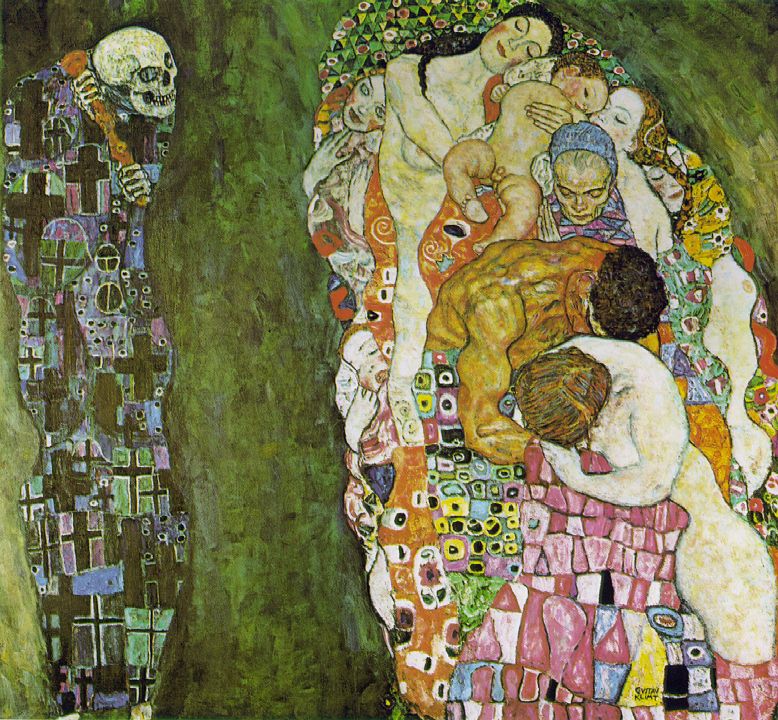
Klimt-Death-LifeOne of the primary ways I relate to the Church Calendar is through music (hence the free Mixtapes I put out each season). Even when I am terrible at engaging at an intellectual or even a practical devotional way, I am really intentional about filling my life with music that will still put my soul in the proper posture for the particular season.

For this Lent, I found myself spending significant time with Mozart’s Requiem, a “Mass for the Dead”. This was his last (and still mysterious) piece–unfinished before he died. Before Holy Week was over, and as we enter into the Holy Weekend, I wanted to offer this to as a way you might be able to engage in these last few days of Lent. Here is the audio, and below that you will find an English translation of the entire Mass. The words are achingly haunting and beautiful and deserve your perusal whether you have time for the music or not. Have a blessed Lent.

W. A. MOZART, REQUIEM
English Translation, from St. Matthew’s choir
Continue reading
Liturgy & Readings for Maundy Thursday (2014)


This is from the Liberti 2014 Lent & Easter Prayerbook. Download the book for free for poetry and extended reflections for this week and next.

WORSHIP

call to prayer.

Be pleased, O God, to deliver us;
O LORD, make haste to help us!
–Psalm 70.1

the Gloria.

Glory be to God the Father, God the Son,
and God the Holy Spirit.
As it was in the beginning, so it is now,
and so it shall ever be, world without end.
Amen!
-the “Gloria Patri” !

the Psalm.
Continue reading

Liturgy & Readings for Holy Wednesday (2014)


This is from the Liberti 2014 Lent & Easter Prayerbook. Download the book for free for poetry and extended reflections for this week and next.

WORSHIP

call to prayer.

Be pleased, O God, to deliver us;
O LORD, make haste to help us!
–Psalm 70.1

the Gloria.

Glory be to God the Father, God the Son,
and God the Holy Spirit.
As it was in the beginning, so it is now,
and so it shall ever be, world without end.
Amen!
-the “Gloria Patri” !

the Psalm.
Continue reading

The Darkest Week in Human History.


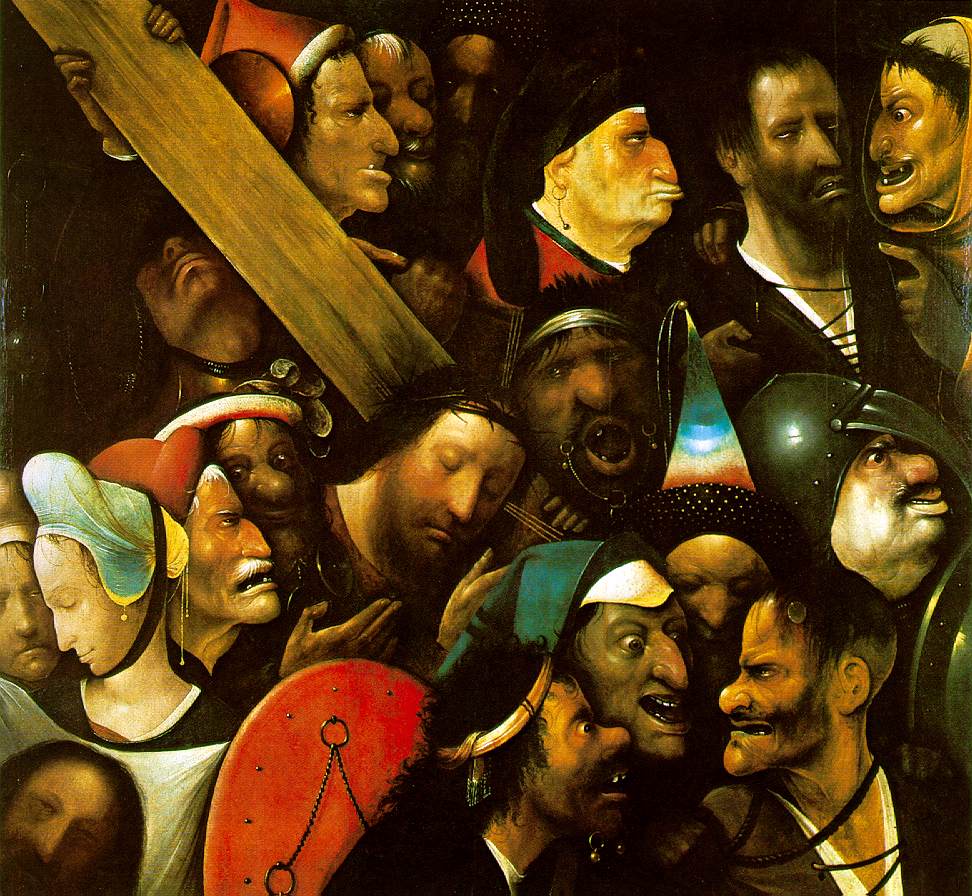
bosch-christ-carrying-the-crossIn our Holy Week reading of the Parable of Tenants, we see the startling revelation that the long-awaited Messiah—the One sent of God to accomplish salvation and liberation for his people—will be rejected by those very people.

And yet, this rejection was not limited to these religious leaders, or even to the ethnic group they represented. During Jesus’ Passion Week—which we meditate upon during this Holy Week—we see Jesus rejected at every level of his Creation.

On Palm Sunday, a large group accompanies Jesus, proclaiming his blessedness. This is not the group that later cries out to crucify him. Instead, it might be worse. These are people from the Jerusalem “suburbs” who have been receiving Jesus’ teaching for months. They accompany Jesus to Jerusalem, and then…. they just disappear, showing their ultimate apathy and indifference towards him.
Continue reading

Palm Sunday: “The Emperor Has No Clothes” [POEM]


I feel far, Lord.
But I know you’re here.  I know it.
(Do I?)

(Can I?)

It’s the nature of the matter; a matter of nature, I suppose.
Perhaps only now I feel at the deepest existential depths:
“I believe! Help my unbelief!”

Or in a word: Hosanna

That cry.  That plea.

The certainty of uncertainty.
The pregnancy of a pause.
The pondering of a moment.

That moment.  The moment.  

The moment that dressed my doubt in assurance.
But that emperor has no clothes
(or so everything says).

So where does my assurance lie?
Where do my feet stand?

My body pelted with rain, snow, and hail;
I pray my heart rests beside a fire,
drinking tea,
rocking in a chair,
my shoulders draped in that most costly of quilts –
my Rest.

Clothe me–
with the coat I lay on your path–
for this emperor is naked

and needs his King.

[read my other Holy Day poetry here]
all writings licensed: Creative Commons License

Timothy’s Tears: A Holy Week Pre-Game | 2 Tim 1, Acts 16 & 20


paul-and-timothy

This is part of our Lent series, “The Weeping Word“, where we look at different moments of crying, lament, and tears in the Scriptures.

To Timothy, my beloved child…

I am grateful to God—whom I worship with a clear conscience, as my ancestors did—when I remember you constantly in my prayers night and day. Recalling your tears, I long to see you so that I may be filled with joy.
2 Timothy 1.2-4

Next week is Holy Week, the high (or low?) point of Lent, leading to the crescendo of Easter. It will be a time of darkness, reflection, lament, and meditation. But we’re not there yet. Before the seriousness of Holy Week arrives, I thought I’d share with you a funny memory that’s connected to our Lent series on tears in the Bible.

I was sitting in the little campus ministry Bible Study my junior year of college. Our style of Bible Study was simply sitting down with an eloquent, wise, and gifted pastor, and then walking verse-by-verse through a given book of the Christian Scriptures.

Having just finished nearly a year in the book of Romans, we were just starting our next book: 2 Timothy. Many scholars believe it was Paul’s last letter he wrote before he died. And he wrote it to the man he mentored more than any other we know about: Timothy, a young elder at the church in Ephesus who was still struggling to get this little church plant off the ground.
Continue reading

The Tears of John: the Turning-Point of History


job-silohetteToday we continue our Lent series, “The Weeping Word“, looking at different moments of crying, lament, and tears in the Scriptures.

The Bible has 66 books. After 39 of those Old Testament books, God’s people are left with these words:

Lo, I will send you the prophet Elijah before the great and terrible day of the Lord comes. He will turn the hearts of parents to their children and the hearts of children to their parents, so that I will not come and strike the land with a curse.

And the Hebrew Scriptures end. God’s people sit wondering what the heck is happening to God’s promises, all while God just gives them another promise: “I will send Elijah, and I will not curse the land”. That’s it.
Continue reading

Our infinitely compassionate (and delegating) God | Exodus 3.7-8


Then the Lord said, “I have observed the misery of my people who are in Egypt; I have heard their cry on account of their taskmasters. Indeed, I know their sufferings, and I have come down to deliver them from the Egyptians, and to bring them up out of that land to a good and broad land, a land flowing with milk and honey….
Exodus 3.7-8

Notice the verbs hear that God uses to describe how he relates to his people. He observes, hears, knows, and comes down. How intimate, tender, and powerful. Also, it’s a little funny that he says that he has come down to save if his people right as he’s commissioning Moses to do it for him.

See other Marginalia here. Read more about the series here.

Matthew & Judas’ Repentance?! | Matthew 27.3-5


When Judas, his betrayer, saw that Jesus was condemned, he repented and brought back the thirty pieces of silver to the chief priests and the elders. He said, “I have sinned by betraying innocent blood.” But they said, “What is that to us? See to it yourself.” Throwing down the pieces of silver in the temple, he departed; and he went and hanged himself.
Matthew 27.3-5

I can’t figure out what Matthew’s characterization of Judas is. He did all the things that a true disciple would in light of his sin. He repents, confesses, and tries to make right. Maybe this is meant to contrast Judas and Peter, perhaps? Both reject Jesus, both face conviction for their actions. Judas, though, runs away from God in shame, but Peter runs to Jesus. Conspicuously, though, there’s no “restoration” passage for Peter here like there is in John.

And yet, this word “repent” is still used here! I should check this another time, unless anyone out there knows: is that term “repent” ever used in a negative sense in the book of Matthew? What is repentance to Matthew?

See other Marginalia here. Read more about the series here.

The Joy of Mark & the Looming Cross | Mark 2.1-2


When he returned to Capernaum after some days, it was reported that he was at home. So many gathered around that there was no longer room for them, not even in front of the door; and he was speaking the word to them.
Mark 2.1-2

Who would have guessed where this story was ultimately heading? Who could see at this point the shadow of the Cross? There’s such joy and excitement at this point in the story. To know where it ends, gives these verses an odd weightiness to them.

See other Marginalia here. Read more about the series here.