Liturgy & Readings for Maundy Thursday (2014)


This is from the Liberti 2014 Lent & Easter Prayerbook. Download the book for free for poetry and extended reflections for this week and next.

WORSHIP

call to prayer.

Be pleased, O God, to deliver us;
O LORD, make haste to help us!
–Psalm 70.1

the Gloria.

Glory be to God the Father, God the Son,
and God the Holy Spirit.
As it was in the beginning, so it is now,
and so it shall ever be, world without end.
Amen!
-the “Gloria Patri” !

the Psalm.
Continue reading

Liturgy & Readings for Holy Wednesday (2014)


This is from the Liberti 2014 Lent & Easter Prayerbook. Download the book for free for poetry and extended reflections for this week and next.

WORSHIP

call to prayer.

Be pleased, O God, to deliver us;
O LORD, make haste to help us!
–Psalm 70.1

the Gloria.

Glory be to God the Father, God the Son,
and God the Holy Spirit.
As it was in the beginning, so it is now,
and so it shall ever be, world without end.
Amen!
-the “Gloria Patri” !

the Psalm.
Continue reading

The Darkest Week in Human History.


bosch-christ-carrying-the-crossIn our Holy Week reading of the Parable of Tenants, we see the startling revelation that the long-awaited Messiah—the One sent of God to accomplish salvation and liberation for his people—will be rejected by those very people.

And yet, this rejection was not limited to these religious leaders, or even to the ethnic group they represented. During Jesus’ Passion Week—which we meditate upon during this Holy Week—we see Jesus rejected at every level of his Creation.

On Palm Sunday, a large group accompanies Jesus, proclaiming his blessedness. This is not the group that later cries out to crucify him. Instead, it might be worse. These are people from the Jerusalem “suburbs” who have been receiving Jesus’ teaching for months. They accompany Jesus to Jerusalem, and then…. they just disappear, showing their ultimate apathy and indifference towards him.
Continue reading

Palm Sunday: “The Emperor Has No Clothes” [POEM]


I feel far, Lord.
But I know you’re here.  I know it.
(Do I?)

(Can I?)

It’s the nature of the matter; a matter of nature, I suppose.
Perhaps only now I feel at the deepest existential depths:
“I believe! Help my unbelief!”

Or in a word: Hosanna

That cry.  That plea.

The certainty of uncertainty.
The pregnancy of a pause.
The pondering of a moment.

That moment.  The moment.  

The moment that dressed my doubt in assurance.
But that emperor has no clothes
(or so everything says).

So where does my assurance lie?
Where do my feet stand?

My body pelted with rain, snow, and hail;
I pray my heart rests beside a fire,
drinking tea,
rocking in a chair,
my shoulders draped in that most costly of quilts –
my Rest.

Clothe me–
with the coat I lay on your path–
for this emperor is naked

and needs his King.

[read my other Holy Day poetry here]
all writings licensed: Creative Commons License

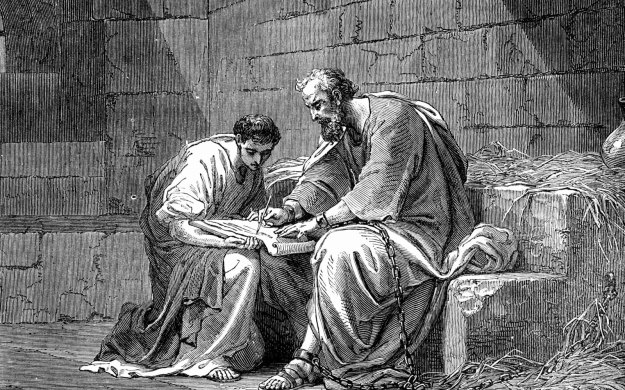
Timothy’s Tears: A Holy Week Pre-Game | 2 Tim 1, Acts 16 & 20


paul-and-timothy

This is part of our Lent series, “The Weeping Word“, where we look at different moments of crying, lament, and tears in the Scriptures.

To Timothy, my beloved child…

I am grateful to God—whom I worship with a clear conscience, as my ancestors did—when I remember you constantly in my prayers night and day. Recalling your tears, I long to see you so that I may be filled with joy.
2 Timothy 1.2-4

Next week is Holy Week, the high (or low?) point of Lent, leading to the crescendo of Easter. It will be a time of darkness, reflection, lament, and meditation. But we’re not there yet. Before the seriousness of Holy Week arrives, I thought I’d share with you a funny memory that’s connected to our Lent series on tears in the Bible.

I was sitting in the little campus ministry Bible Study my junior year of college. Our style of Bible Study was simply sitting down with an eloquent, wise, and gifted pastor, and then walking verse-by-verse through a given book of the Christian Scriptures.

Having just finished nearly a year in the book of Romans, we were just starting our next book: 2 Timothy. Many scholars believe it was Paul’s last letter he wrote before he died. And he wrote it to the man he mentored more than any other we know about: Timothy, a young elder at the church in Ephesus who was still struggling to get this little church plant off the ground.
Continue reading

The Tears of John: the Turning-Point of History


job-silohetteToday we continue our Lent series, “The Weeping Word“, looking at different moments of crying, lament, and tears in the Scriptures.

The Bible has 66 books. After 39 of those Old Testament books, God’s people are left with these words:

Lo, I will send you the prophet Elijah before the great and terrible day of the Lord comes. He will turn the hearts of parents to their children and the hearts of children to their parents, so that I will not come and strike the land with a curse.

And the Hebrew Scriptures end. God’s people sit wondering what the heck is happening to God’s promises, all while God just gives them another promise: “I will send Elijah, and I will not curse the land”. That’s it.
Continue reading

Where on Earth is Jesus’ Bethlehem? | Luke 2.1-5


In those days a decree went out from Emperor Augustus that all the world should be registered. This was the first registration and was taken while Quirinius was governor of Syria. All went to their own towns to be registered. Joseph also went from the town of Nazareth in Galilee to Judea, to the city of David called Bethlehem, because he was descended from the house and family of David. He went to be registered with Mary, to whom he was engaged and who was expecting a child. While they were there, the time came for her to deliver her child. And she gave birth to her firstborn son and wrapped him in bands of cloth, and laid him in a manger, because there was no place for them in the inn.
Luke 2.1-5

Recent archaeological evidence suggests that this Bethlehem is not the traditional site, but “Bethlehem of the Galilee” (which would make sense). The traditional site is 150km from Jerusalem, whereas this other, newer proposed site is only 7km. A lot easier for Mary. Although some dispute this, pointing out that Justin Martyr in the 2nd-century identified the traditional site as the correct site. Who knows?

See other Marginalia here. Read more about the series here.

What the heck is Preaching, even?


peter-preaching-statueFor my preaching class, we’ve been trying to get at what this weird thing called “preaching” really is. It’s not a lecture, it’s a not a conversation, it’s not a debate. So what is it? Here are some of my random thinking on this. But I’d love to hear yours.

As much as I want something far more profound and original, I have not been able to find anything simpler and clearer than Alan of Lille‘s definition: “Preaching is an open and public instruction in faith and behavior, whose purpose is the forming of men [sic].”

Continue reading

Our infinitely compassionate (and delegating) God | Exodus 3.7-8


Then the Lord said, “I have observed the misery of my people who are in Egypt; I have heard their cry on account of their taskmasters. Indeed, I know their sufferings, and I have come down to deliver them from the Egyptians, and to bring them up out of that land to a good and broad land, a land flowing with milk and honey….
Exodus 3.7-8

Notice the verbs hear that God uses to describe how he relates to his people. He observes, hears, knows, and comes down. How intimate, tender, and powerful. Also, it’s a little funny that he says that he has come down to save if his people right as he’s commissioning Moses to do it for him.

See other Marginalia here. Read more about the series here.

Matthew & Judas’ Repentance?! | Matthew 27.3-5


When Judas, his betrayer, saw that Jesus was condemned, he repented and brought back the thirty pieces of silver to the chief priests and the elders. He said, “I have sinned by betraying innocent blood.” But they said, “What is that to us? See to it yourself.” Throwing down the pieces of silver in the temple, he departed; and he went and hanged himself.
Matthew 27.3-5

I can’t figure out what Matthew’s characterization of Judas is. He did all the things that a true disciple would in light of his sin. He repents, confesses, and tries to make right. Maybe this is meant to contrast Judas and Peter, perhaps? Both reject Jesus, both face conviction for their actions. Judas, though, runs away from God in shame, but Peter runs to Jesus. Conspicuously, though, there’s no “restoration” passage for Peter here like there is in John.

And yet, this word “repent” is still used here! I should check this another time, unless anyone out there knows: is that term “repent” ever used in a negative sense in the book of Matthew? What is repentance to Matthew?

See other Marginalia here. Read more about the series here.

We worship Christ and…. the Resurrection? | Acts 17 & 24


Also some Epicurean and Stoic philosophers debated with him. Some said, “What does this babbler want to say?” Others said, “He seems to be a proclaimer of foreign divinities.” (This was because he was telling the good news about Jesus and the resurrection.)
Acts 17:18

One of the funniest moments in Acts. Notice they accuse him of preaching foreign “divinities” (plural). The Greek word for Resurrection is Anastasis. Paul has rolled in preaching “ton Iesous kai thn Anastasin”, or “the Jesus and the Resurrection”. The Philosophers think that Paul is preaching about two gods: “Jesus” and his wife, “Resurrection”.

I have a hope in God—a hope that they themselves also accept—that there will be a resurrection of both the righteous and the unrighteous. Therefore I do my best always to have a clear conscience toward God and all people.
Acts 24:15-16

Paul is obsessed with the resurrection. Well technically, Luke is. If you see the charge against Paul earlier, it was that he was preaching Christ and the Resurrection. They thought he was teaching two gods. Apparently, he must have been talking about the Resurrection so passionately. Almost as passionately as Christ.

They did not accuse him of preaching Jesus and the Cross, Jesus and the Tomb, Jesus and the Jews, Jesus and Grace through Faith, or even Jesus and the New Creation! It was Jesus and the Resurrection. The Resurrection is Paul’s way out of trouble. It’s his way of telling his story. Of causing divisions between himself and some Jews, and to show his solidarity with others. It’s everything to who Paul is and what he’s come to do.

See other Marginalia here. Read more about the series here.

The Joy of Mark & the Looming Cross | Mark 2.1-2


When he returned to Capernaum after some days, it was reported that he was at home. So many gathered around that there was no longer room for them, not even in front of the door; and he was speaking the word to them.
Mark 2.1-2

Who would have guessed where this story was ultimately heading? Who could see at this point the shadow of the Cross? There’s such joy and excitement at this point in the story. To know where it ends, gives these verses an odd weightiness to them.

See other Marginalia here. Read more about the series here.

Hagar: Tears, Empowerment, & the Faithfulness of God


Corot_Hagar_in_the_WildernessToday we continue our Lent series, “The Weeping Word“, looking at different moments of crying, lament, and tears in the Scriptures.

In the early chapters of the Bible, there is perhaps no greater symbol of injustice than Hagar, the Egyptian servant of Abraham and Sarah. She is under forced labor, and is made by her master’s wife to bear a child by an old man. She is, in essence, a sex slave. After Hagar has her son, Sarah deals very harshly with her, causing Hagar to run away. God chases her down:

The angel of the Lord found her by a spring of water in the wilderness, the spring on the way to Shur. And he said, “Hagar, slave-girl of Sarai, where have you come from and where are you going?”

Continue reading

God & Job | Job 1.8


The Lord said to Satan, “Have you considered my servant Job? There is no one like him on the earth, a blameless and upright man who fears God and turns away from evil.”
Job 1.8

We so often forget that this whole thing was God’s idea, and he initiated it. He is the first one to drop Job’s name and suggest this scheme to Satan.

See other Marginalia here. Read more about the series here.