And the Lord said, “What have you done? Listen; your brother’s blood is crying out to me from the ground!
—Genesis 4.10
I was taking another look at the verses I wrote about earlier this week, and was struck by a few more thoughts I wanted to share. As I said then, the passage is structured liturgically. The story of Cain and Abel follows the flow of liturgy that God’s people have used for the duration of their existence. (It’s usually something like this: Call to Worship–>Call to Confession–>Passing the Peace–>Word–>Sacrament–>Benediction)
I pointed out that the blood-soaked soil “crying out” was the first instance of lament in the Bible, and it appears in the “Call to Confession” section of this odd liturgy-story, and it shows us how the world bears the weight of our own sin. Looking at it again, though, I see it means much more than just that.
Now the chief priests and the elders persuaded the crowds to ask for Barabbas and to have Jesus killed. The governor again said to them, “Which of the two do you want me to release for you?” And they said, “Barabbas.” Pilate said to them, “Then what should I do with Jesus who is called the Messiah?” All of them said, “Let him be crucified!” Then he asked, “Why, what evil has he done?” But they shouted all the more, “Let him be crucified!”
—Matthew 27.20-23
Man, Matthew really does go out of his way to show that the Jews were at fault for Jesus’ death.
See other Marginaliahere. Read more about the series here.
Our Lent series this year is “The Weeping Word“, where we’re meditating on key places in the Scriptures where Lament, crying, tears, and weeping happen. Today, we look at the first instance of this in the Bible.
There is a particular rhythm that God’s people have always used in their liturgy. If you pay attention, you’ll see this rhythm pop up in lots of different places throughout the Christian Scriptures. My favorite unexpected place where this shows up is in the story of Cain and Abel.
Worship
The story opens with these two brothers coming to worship, answering an implied Call to Worship that issues from God. This is where the liturgical rhythm begins. God calls us to worship him, and we respond by offering him this worship to him.
But everyone comes to worship from different places, and not everyone’s heart and offering is pure.
And the Lord had regard for Abel and his offering, but for Cain and his offering he had no regard. So Cain was very angry, and his countenance fell. The Lord said to Cain, “Why are you angry, and why has your countenance fallen? If you do well, will you not be accepted? And if you do not do well, sin is lurking at the door; its desire is for you, but you must master it.”
Our worship gets twisted and directed towards the wrong things, and this is what we call sin. Offering worship wrongly and to the wrong things. Wrong worship produces wickedness within us.
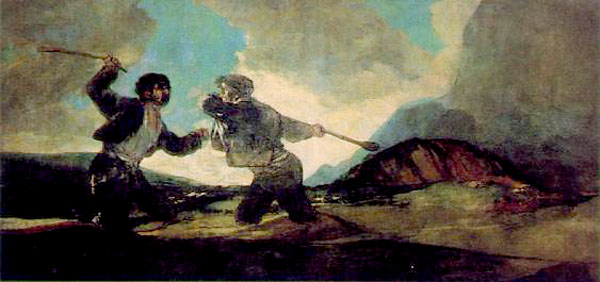
“Cain said to his brother Abel, “Let us go out to the field.” And when they were in the field, Cain rose up against his brother Abel, and killed him.
After the sabbath, as the first day of the week was dawning, Mary Magdalene and the other Mary went to see the tomb. And suddenly there was a great earthquake; for an angel of the Lord, descending from heaven, came and rolled back the stone and sat on it. His appearance was like lightning, and his clothing white as snow. For fear of him the guards shook and became like dead men. But the angel said to the women, “Do not be afraid; I know that you are looking for Jesus who was crucified. He is not here; for he has been raised, as he said. Come, see the place where he lay. Then go quickly and tell his disciples, ‘He has been raised from the dead, and indeed he is going ahead of you to Galilee; there you will see him.’ This is my message for you.” So they left the tomb quickly with fear and great joy, and ran to tell his disciples. Suddenly Jesus met them and said, “Greetings!” And they came to him, took hold of his feet, and worshiped him. Then Jesus said to them, “Do not be afraid; go and tell my brothers to go to Galilee; there they will see me.”
—Matthew 28.1-10
Wow. This here clearly says that they worshiped Jesus. And he does not at all correct them or steer them to worship elsewhere. This is in stark contrast to the angel in Revelation.
See other Marginaliahere.Read more about the series here.
But the Lord afflicted Pharaoh and his house with great plagues because of Sarai, Abram’s wife.
—Genesis 12:17
The LORD enacts vengeance for the sake of his daughters. He hates injustice against them, even when the perpetrators are oblivious that they are perpetrating it.
See other Marginaliahere. Read more about the series here.
Blessed is that slave whom his master will find at work when he arrives. Truly I tell you, he will put that one in charge of all his possessions. But if that wicked slave says to himself, ‘My master is delayed,’ and he begins to beat his fellow slaves, and eats and drinks with drunkards, the master of that slave will come on a day when he does not expect him and at an hour that he does not know. He will cut him in pieces and put him with the hypocrites, where there will be weeping and gnashing of teeth.
—Matthew 24.46-51
Good lord, really? That’s unnecessarily over-the-top. I don’t like when I come across lines like this.
See other Marginaliahere. Read more about the series here.
The next day, that is, after the day of Preparation, the chief priests and the Pharisees gathered before Pilate and said, “Sir, we remember what that impostor said while he was still alive, ‘After three days I will rise again.’ Therefore command the tomb to be made secure until the third day; otherwise his disciples may go and steal him away, and tell the people, ‘He has been raised from the dead,’ and the last deception would be worse than the first.” Pilate said to them, “You have a guard of soldiers; go, make it as secure as you can.” So they went with the guard and made the tomb secure by sealing the stone.
—Matthew 27.62-66
Apologetics by the gospel writer at work, haha. We know in subsequent debates that this was a major argument by the Jews, so this is a very important record that Matthew is putting down. He has to prove as best as he can that Jesus did indeed rise from the dead, and that his body was secure.
See other Marginaliahere. Read more about the series here.
This is a copy of the letter that King Artaxerxes gave to the priest Ezra, the scribe, a scholar of the text of the commandments of the Lord and his statutes for Israel:
—Ezra 7:11
Well look at that! Ezra is described as a priest, scribe, scholar, and teacher of the Law (and, let’s not forget: a “doer” of it as well!). No false academic/pastoral dichotomies here!
See other Marginaliahere. Read more about the series here.
I gathered them by the river that runs to Ahava, and there we camped three days. As I reviewed the people and the priests, I found there none of the descendants of Levi. Then I sent for Eliezer, Ariel, Shemaiah, Elnathan, Jarib, Elnathan, Nathan, Zechariah, and Meshullam, who were leaders, and for Joiarib and Elnathan, who were wise, and sent them to Iddo, the leader at the place called Casiphia, telling them what to say to Iddo and his colleagues the temple servants at Casiphia, namely, to send us ministers for the house of our God. Since the gracious hand of our God was upon us, they brought us a man of discretion, of the descendants of Mahli son of Levi son of Israel, namely Sherebiah, with his sons and kin
—Ezra 8.15-18
Here, you see Ezra refuse to settle for who he had before him. He was determined to see that the ministers to God’s people be the absolute most qualified people they could be. They had to be Levites. There were none there. Did he just throw up his hands and say that they had to “settle” for who was there and willing? No! He went out and sought qualified ministers.
See other Marginaliahere. Read more about the series here.
Lent is a time that we dwells a lot on Sin. It’s a preparation for Easter and celebrating the Resurrection, and so to prepare for this, we must meditate on those things that Resurrection itself addressed. Resurrection was a response to Sin and Death. The more we feel and dwell in the reality of our Sin and Death, the more tangible Resurrection becomes.
This can seem morose, annoying, unnecessary, or not in line with our identity as Christians. Should we do this though it might make us depressed, feel like self-focused navel-gazing, or if it distracts us from much of the rest of our Christian living?
There’s definitely a time and place for it and a degree after which it becomes unhealthy, but more than what this does for/to us or our emotional state, could I offer another reason that it’s good to have times where we bring our focus to our weakness and sinfulness?
If you don’t care about the commentary, and just want the amazing music, you can get it at Noisetrade. If you’d like to listen to the album first, just press play:
Someone’s “favorites” are a weird thing to define. They are prone to fickleness, are tied so closely with whatever else is subjectively happening in one’s life, and usually bear little resemblance to what that person would consider as the technically “best” of any particular thing. So when you have a “favorite” that sustains that title for years–decades, even–it’s a big deal.
Since high school my favorite band has been Cool Hand Luke. Back then they were a little hardcore screamo band. At that time, to get their CD, you had to mail a check to the lead singer’s house. As time when on, their style changed at the very same time and in the very same way as my own. It felt like we were growing together.
Around my senior year of high school, they came out with an album called Wake Up, O Sleeper. Anyone who’s heard of CHL probably knows them from this stunningly powerful work of art. It quickly became the most influential and “favorite” album of mine. And it has been ever since.
Towards the end of college, I became pretty good friends with the lead singer. For a while, every few months, we’d talk for a couple of hours on the phone. He was discerning whether to go to seminary and what to do about the financial mess their shady manager had left the band in. I got to see his heart and the heart behind the beautiful music they made.
Eventually, he got married, I started seminary, and he decided it was time to end the band and begin seminary himself. But there was one last project he felt he had to do.
At that time those who had come from captivity, the returned exiles, offered burnt offerings to the God of Israel, twelve bulls for all Israel, ninety-six rams, seventy-seven lambs, and as a sin offering twelve male goats; all this was a burnt offering to the Lord. They also delivered the king’s commissions to the king’s satraps and to the governors of the province Beyond the River; and they supported the people and the house of God.
—Ezra 8.36
Interesting line… Is this saying that they had people “on staff” who managed their civil tithe to the secular authority (taxes), and the lay people supported the House of God? Is this like tax accountants “on staff” among the leadership of the temple?
See other Marginaliahere. Read more about the series here.
Last night, my church had their Ash Wednesday service. I had the honor of helping lead the liturgy by offering the greeting and opening introduction/ explanation. Unlike most times we gather, the kids stayed in the service so I was asked to make sure my opening words were at least somewhat comprehensive to children.
This turned out to be one of the most helpful exercises for me. I ended up spending more time thinking through these brief opening words than I normally do and crafting each line as intentionally as possible. And so, for the heck of it, I thought I’d throw this up on the blog for anyone who was struggling with explaining Lent and/or Ash Wednesday to their young ones, and also to get your thoughts on how best to communicate this to kids. Here’s what I said:
(Lent: Two things hold us back)
Tonight kicks off the Church season of Lent. Most all of us live our lives wanting to be better people than we are right now. But if we’re honest, there are two things that can get in the way of that sometimes and make us frustrated as we try and become the people we want to be. Continue reading →




 the long way home