Catholics Aren’t Crazy: an Advent & Communion Theological P.S. (for those who care) | Advent {7a}


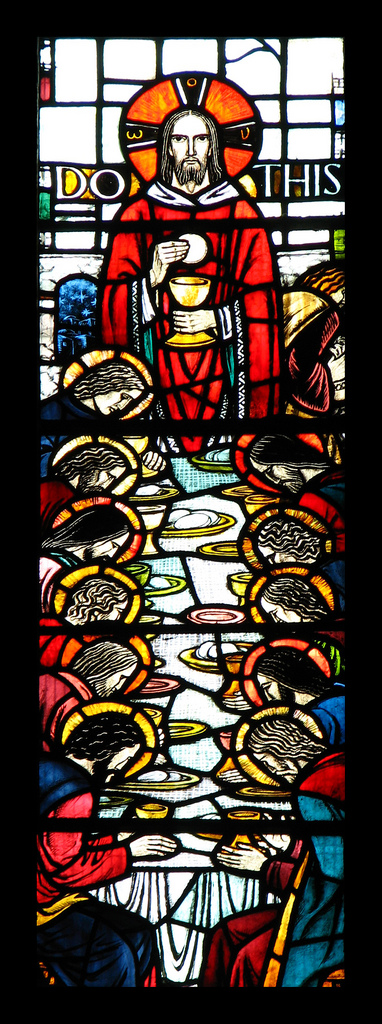
After my previous post on how Communion is no more a “symbol” than Advent itself, I can already hear some people right now thinking: “Wait. Isn’t this the Catholic idea of communion?” (As if that would be the worst thing.) I’ve mentioned some of my Communion views before in this ongoing series, and what I articulated is a synthesis and summary of the ideas of many theologians, both Protestant and Catholic. The pop idea of the Catholic view on the Eucharist is not really right or helpful (as is the pop conception of most of Catholic doctrine). Catholicism’s “Eucharist problem” is more historical and rhetorical than theological.

In the earliest decades and centuries of church history, people were able to simply maintain the simple doctrine that at Communion, they are receiving the true presence of Christ in the Bread and the Wine (source, albeit biased). In the middle ages, though, people starting asking themselves “Wait, what does that actually mean?” Differing answers started forming and a diversity of opinion about the Eucharist began taking place. The leaders of the Church tried to bring some commonality to this. In fact, the medieval Catholic church made a few “errant” teachers affirm these statements in 1078 and 1079:
Continue reading
The Holy Sacrament of Advent {7}


There is an abiding idea and assumption that plagues us humans. It has come up at various times in various worldviews with various names. It’s found in the implications of what Zoroastrians called the conflict between “Asha” and “Druj”, what Plato called “Dualism”, Diogenes called “Cynicism”, first-century heretics called “Gnosticism”, Descartes: “Rationalism”, Kant: “Idealism”, Bacon: “Empiricism”, French Enlightenment-ers: “Materialism”, Modernists: “Realism”, Postmodernists: “Pragmatism” and “Constructivism”, so on and so forth through the ages.

The thing all of these ideas have in common is a separation between the material and the immaterial; the abstract and the physical; the temporal and eternal; the objective and subjective; the spiritual and the human. Further, they tend to elevate one over the other.

We can’t really escape this (I’ve written about this before).

One of the basic obvious tenets of finitude is that we can’t be in two places at once, neither physically nor intellectually. To perfectly hold the delicate balance between these poles of the seen and unseen is difficult, if not impossible.

But Advent can help us.

Continue reading

The Formation of God | Advent {6}


All last week, I offered some meditations on this season of Advent. I actually have several more I’ll be posting more or less every day until Christmas, but today I’ll be offering the last in this little alliterated series in which we’ve been exploring how in the Advent event, Jesus took on our creaturely form, care-taking function, comprehensive fallenness, and now, communal formation.

We spend a lot of time and energy in this season focusing on how Jesus has changed everything and how the implications of Advent change much of our lives and existences. But Jesus did not merely come to change and affect things, but to also be changed and affected by them.
Continue reading

Artist John Singer Sargent on the Advent {5}


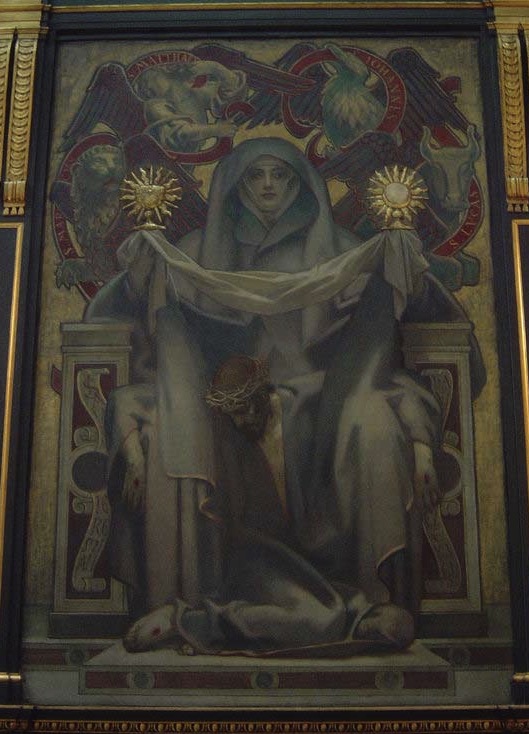
image

“Being made man, I am maker of man, and redeemer of what I have made. God in the flesh, I redeem body and soul.”

“On the cross is the figure of the dead Christ, with the figures of Adam and Eve, typifying Humanity, kneeling on either side. They are bound closely to the body of Christ, since all are of one flesh, and each holds a chalice to receive the Sacred Blood. About the feet of Adam is entangled the Serpent of Temptation. Above the arms of the cross there is inscribed in Latin “The sins of the world have been redeemed.” At the foot of the cross the Church is symbolized by the Pelican feeding its young, while around it doves symbolize the Seven Gifts of the Holy Spirit.”

Read a full description of the pieces here. Find the official website for the commission here.

__________

Continue reading

What Christ did not taste, Christ did not redeem. | Advent {4}


This Advent season, we’ve been meditating on how the Advent reminds us how God took on our creaturely form, care-taking function, comprehensive fallenness, and communal formation.

First, a question.

Think back on the Christmas story. After Jesus is born, when he’s about three years old, the wise men go to King Herod and say that they’re looking for this newborn King. Herod is shocked to hear about a child-king having been born right under his nose, whose potential future reign threatens his own, and so he puts out a decree calling for the death of all children ages three and under (in history and art this is referred to as “The Slaughter of the Innocents”. An angel comes to Joseph in a dream and tells him to flee to Egypt to prevent this from happening.

Here’s the question:

Why flee to Egypt? If they stayed and Herod killed the child Jesus, would that not still be Jesus, the Son of God–the Incarnate God–dying unjustly at the hands of a Roman provincial governor attempting to cement the reign of the powers and principalities of the world? Why go to all that effort to wait 30 years later for the same thing to happen on a cross?
Continue reading

our failed function, God’s full faithfulness | Advent {3}


This week, I’m meditating on a few particular aspects of the Advent event. I’m thinking through and writing about how, in Jesus, God inhabited our creaturely form, care-taking function, comprehensive fallenness, and communal formation.

As I said in the teaching I gave over the summer about the Nature and Narrative of the Bible, the opening chapters of the Bible describe this divine act of creating in very architectural terms; the same words are later used in describing the building of the tabernacle and the temple. In this we see that God’s act of creating was, in essence, building this world as his temple in which he would rest (for more on this see John Walton’s amazing book, The Lost World of Genesis One, or just watch this short video).

In the story, he builds and establishes this Temple-World, and then creates and ordains two priests–Adam and Eve–to be his representatives in this temple to care for it and work in it faithfully. In the ancient world, temples were usually placed in the midst of large and beautiful gardens which acted as extensions of the temple itself; to care for the garden was to care for the temple, and to make the garden larger was to expand the scope and size of the temple.
Continue reading

Advent, Evolution, & Absolution


It’s Advent. A time where we especially orient ourselves towards rejoicing and celebrating the fact that God did not remain far off and merely create a “legal” or “dogmatic” satisfaction for the plight of his creation and creatures. Rather, he broke into it and came into his creation and among his creatures. In this year’s Advent series, we’re exploring how, in this Coming, Jesus took on our creaturely form, care-taking functioncomprehensive fallenness, and communal formation.

First, God took physical, human, creaturely form. In the study I did–and subsequent lecture I gave–on Beauty a couple of years ago, I defined “Beauty” as the attribute of something that expressed complexity simply. Is not this God-in-human-flesh (theologically referred to as the Incarnation) the most beautiful of all miracles to take place? The Infinitely Complex God inhabits the simplest of human forms: a child.
Continue reading

Welcome to Advent. 2011. {1}


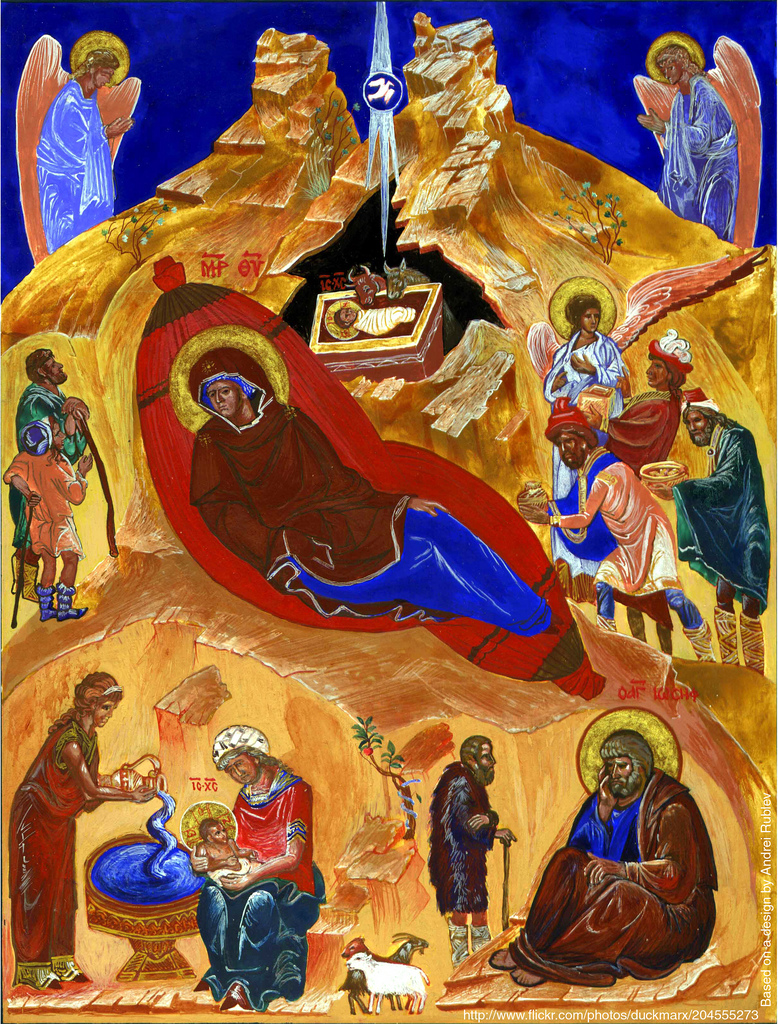
Yesterday was Day 1 of the season of the Church Calendar known as Advent (latin for “coming) . From now until Christmas, we spend time intentionally mediating upon the truth this season brings: God has come among us, clothed in the vestiges of human flesh.

Yes, this time of year was arbitrarily chosen centuries ago to recast pagan lunar festivals in a new light. Yes, many of the traditions of Christmas (fir trees, gift-giving, wreaths, etc.) find their source in pagan socio-religious rites. Yes, Jesus was probably more likely born in April, not December. Yes, Christmas has been co-opted by commercialism and consumerism. Nevertheless, this time has been set aside for nearly two millennia so that Christians around the world could, with one mind and heart, dwell upon the depths of the glory given to us in the events that transpired all those years ago.
Continue reading

The Scandal of Holy Week {v}: conclusion & benediction


As I said in Part 1, this series was originally given as a sermon to a group of prisoners attending my church’s prison ministry. This is the conclusion and benediction I gave them at the end. This post picks up right after the end of Part 4, where we listed out practical ways that Jesus prepares his disciples for them forsaking him and the ways he reveals himself to already-wayward disciples, thereby calling them back to Him. I encourage you to read the other parts of this message: Part 1: the forsaking of GodPart 2: the Grace of JesusPart 3: the limits of Grace?Part 4: the restoration of disciplesPart 5: conclusion & benediction]

Conclusion

These are not guarantees: all these different practical things I’ve mentioned are not the “magic formula” for how to restore your faith if you feel you’ve lost or forsaken it. Sometimes none of these things are necessary; the Centurion did not seem to have any of these things. Sometimes, you’ll do all of these things for years–decades, even–and nothing will change.

All I can tell you is that He is worth it. The God of Holy Week is a God worthy to be wrestled against for years and years and years and years until he finally meets you, even if it is for the briefest of moments before slipping away back into frustration, doubt and sin.
Continue reading

The Scandal of Holy Week {iv}: the restoration of disciples


[Update: this series has been completed. Part 1: the forsaking of GodPart 2: the Grace of JesusPart 3: the limits of Grace?Part 4: the restoration of disciplesPart 5: conclusion & benediction]
In Part 1 of this series, we saw that we will all forsake Jesus many times in our lives, just as the disciples did on the Thursday night of Holy Week. In Part 2, we saw that in light of this abandonment, Jesus responds to those that forsake him by being unconditionally and unlimitedly gracious towards them in their forsaking of him. In Part 3, we looked at just how scandalous and beautiful this grace is and how and why we often try and limit it. Today, we give practical ways that we can prepare ourselves to come back to our Lord, even after we have forsaken him in our own “Thursday” seasons.

As we saw in Part 1, Holy Week was a week-long process in which everything–creation, creatures, and God Himself–all forsook Jesus, turning their back on him. We’ve said several times now that true disciples of Jesus are not those that never forsake Jesus, but they are those that after forsaking him, turn back. And so, to help us see how we do this, let’s look at the first person in this story to turn back.

Continue reading

The Scandal of Holy Week {iii}: the limits of Grace?


[Update: this series has been completed. Part 1: the forsaking of GodPart 2: the Grace of JesusPart 3: the limits of Grace?Part 4: the restoration of disciplesPart 5: conclusion & benediction]

In part 1 of this series, we looked at the original Holy Week and saw how everything and everyone has and will forsake Jesus. We said that “Thursday”–the day when the disciples forsook Jesus–will come for every disciple. In part 2, we saw that Jesus, as he relates to those that have forsaken him and those that will do so, responds and relates to them on the basis of pure, unfettered grace. Today we look at why this matters and what it looks like in our lives.

We’ve seen that every disciple will forsake Jesus, but the true disciples of God are the ones that come back after they have left him. And further, it is my contention that what brings people back is not fear, not Law, but the unbounded and free Grace of Jesus.

But let’s be honest–this process can be a long one. It can be months, years, or even decades before these true disciples of God return to Him. People can go very far down the path of sin’s temptations, and still be Christians. In fact, any of us can go very far down the path of sin’s temptations and still absolutely be beloved, regenerated, Christian children of God.
Continue reading

The Scandal of Holy Week {ii}: the Grace of Jesus


[Update: this series has been completed. Part 1: the forsaking of GodPart 2: the Grace of JesusPart 3: the limits of Grace?Part 4: the restoration of disciplesPart 5: conclusion & benediction]

Last week, we saw how Holy Week, kicked off by Jesus’ “Triumphal Entry” into Jerusalem, was merely the beginning of a series of events that led to everything around Jesus forsaking him. We went on to ask how disciples of Christ might avoid their own version of “Thursday”–the night the disciples betrayed and forsook Jesus. The reality is, though, that every disciple of Christ has, does, and will forsake Jesus many times over. And so, the proper question to bring to Holy Week is not “how might I keep myself from forsaking Jesus”, but rather “how does Jesus respond to those–including myself–that will end up forsaking him?” I went on to say

“The answer I want to fight for? Jesus responds to all of our forsaking him with pure, unadulterated, offensive, and scandalous Grace. My main point in this message is this: A disciple is not someone who never forsakes Jesus; it’s someone who, after forsaking him, comes back.

Today we will look back at Holy Week to see the ways that Jesus demonstrates this scandalous Grace to those that have and will turn their backs and abandon him.
Continue reading

On Easter: “Adam Killed a Bird, But Jesus Brought Him Back” (a poem)


_____________________________________________________

Adam Killed a Bird, But Jesus Brought Him Back

Now looking through the glass not dim, Coltrane all around;
he sets a tone of dissonance, rightly now it seems.
For as the beauty clothes me in, a tragedy is found:
woodchips below – a resting place – long for love supreme.

For there he lies with outstretched span, stricken by a car;
afflicted by our fallenness, and smitten by our thorns.
He struggles with the weight of pain, not getting very far.
To stop, release his spirit’s breath – give way to Death’s dark door.

I prayed a prayer, and thought some thoughts, and something in me burned.
Oh I see my Savior, the pains he took! For me: protect,
for prone to wander, weak I am, to that which I once yearned.
Until you did in me and Him- my soul: You resurrect.

And thus to show He heard my prayer and strengthen my weak frame,
up pops the bird, into the air; and now my soul shall do the same.

[read my other Holy Week poetry here]

all writings licensed: Creative Commons License

On Holy Saturday: “Better Your Arms Around Me (Penelope’s Window)” (a poem)


_____________________________________________________

Better Your Arms Around Me (Penelope’s Window)

You know why I’m standing here.
You know what I’m going to say.
The look behind your eyes betrays you.
Your sleeping head goes away.

Dreams lie as you do;
Dreams lie all night;
like you do.

Pacing back and forth on Friday,
Before you lay these words in my head.
Hoping my closed mouth mined gold
to give you, to give you.
Continue reading

On Good Friday: “Scotchful Thoughts on Treason & War” (a poem)


_____________________________________________________

Scotchful Thoughts on Treason & War

You’re stronger than Scotch, though that’s not what my throat urgently screams at the moment. Ah, the struggles of an artist, a mystic, one whose deep cries out for yours – to express the inexpressible.  To package in words that which can’t be contained.  You’ve caringly — lovingly, even — taken me, torn open my chest, pulled out my heart, and have affectionately run my broken body into your knee such that I am torn in two
_____– one spirit, one flesh:

All of reality stands at this heralding moment:
_____Wide-eyed, eager – youthful
_____anticipation abounds.
Hands on knees looking forward, rocking back
_____so on and so forth they watch:
_____smiles ear to ear.
Continue reading