Congrats to the Women of the Church of England!


female-woman-bishop-anglican-communionI thought it would make more headlines this week in the U.S, but it didn’t, so I thought I’d put it here. Two days ago, the Church of England voted overwhelmingly to allow for female bishops in their ranks. They had for twenty years now allowed for female priests but–as is the odd logic that accompanies church hierarchies such as this–they thought it a step too far to allow women to be bishops. I don’t know. But either way, let us rejoice their is one more place in the world where women can fully and freely exercise the gifts God has given them.

Click here for more posts in my occasional series on Women in the Church.

Faith & Grace Alone: Job & the New Perspective on Paul| Job 9


job-silohetteHow then can I answer him,
choosing my words with him?
Though I am innocent, I cannot answer him;
I must appeal for mercy to my accuser.
Job 9.14-15

Job says he is innocent, but he says he still needs mercy. What does this mean? Perhaps he does see not people in the simplistic way that we often do–or at least as simplistic as we see the ancient Israelites.

Just like in the Christian scheme, I’m starting to think that the ancient Israelites also thought that people were considered righteous only on account of graciously being in covenant with God. All the sacrifices, festivals, laws, etc. were more as signs that they were the people of God; they were not how people became part of that group in the first place. In other words, the sacrifices and laws were outward displays that they were fully righteous before God’s eyes; they weren’t the ways that they “earned” righteousness or forgiveness.
Continue reading

The Trinity building the Church! | Acts 20.28


Keep watch over yourselves and over all the flock, of which the Holy Spirit has made you overseers, to shepherd the church of God that he obtained with the blood of his own Son.
Acts 20.28

Wow, here’s the whole Trinity at work in leading God’s church! Would that we give more attention to this Trinitarian nature to the sustaining of our churches. Also, notice how Jesus’ blood “obtained” the Church. He didn’t merely create the space of possibility. He went out and got it. It is is his.

See other Marginalia here. Read more about the series here.

The Sermon’s Essence & Power | 1 Corinthians 2.1-5


When I came to you, brothers and sisters, I did not come proclaiming the mystery of God to you in lofty words or wisdom. For I decided to know nothing among you except Jesus Christ, and him crucified. And I came to you in weakness and in fear and in much trembling. My speech and my proclamation were not with plausible words of wisdom, but with a demonstration of the Spirit and of power, so that your faith might rest not on human wisdom but on the power of God.
1 Corinthians 2.1-5

This encourages me so much in preaching. No matter the exegesis, eloquence, or whatever, we preach Christ and him crucified, and that makes a good sermon. We also live a life in accordance with that outside of the sermon and it supports our preaching as well. Just as in the nature of God Himself, our words and our deeds cannot be separated from one another.

See other Marginalia here. Read more about the series here.

Righteous Works; Wicked People | Romans 6.20


When you were slaves of sin, you were free in regard to righteousness.
Romans 6.20

Those that are not Christians can still do righteousness. But when they do it, it is from a place that is not their essence. I can’t think of an analogy right now. But, they are free to do righteous sings even though they are not considered righteous people. Is that a good way to put it?

See other Marginalia here. Read more about the series here.

In a sense, God CAN’T favor the righteous| Job 9.1-4


Then Job answered:

“Indeed I know that this is so;
but how can a mortal be just before God?
If one wished to contend with him,
one could not answer him once in a thousand.
He is wise in heart, and mighty in strength
—who has resisted him, and succeeded?
Job 9.1-4

It seems here that Job is no longer clinging to his earlier idea that he is indeed righteous and pure. Instead, he is admitting that his friend is correct: he is sinful and has done wrong things. But, he also points out that God is not a God that would insist that every single little sin and wrong-doing be brought to mind and confessed before relating favorably towards someone.

Job is saying that people are too sinful for God to structure the world in such a way that the righteous are related to in one way and the wicked in another, because everyone belongs fully in that latter camp. There can only be two sets of rules if there are two teams playing the game.

He is in effect saying what Paul says in Romans 3, that all people have sinned and fallen short of the glory of God, therefore there is no distinction among people. Ironically, then, Job’s defense here is not necessarily the he is righteous, but rather that he is far too messed up for his friends’ version of reality to be right.

Also of note, the rest of this chapter is more or less Job proclaiming the very things that God uses to rebuke him at the end of the book. Job really does seem to know this stuff.

See other Marginalia here. Read more about the series here.

Is There No Rest for God’s Weary Ministers? | Mark 6


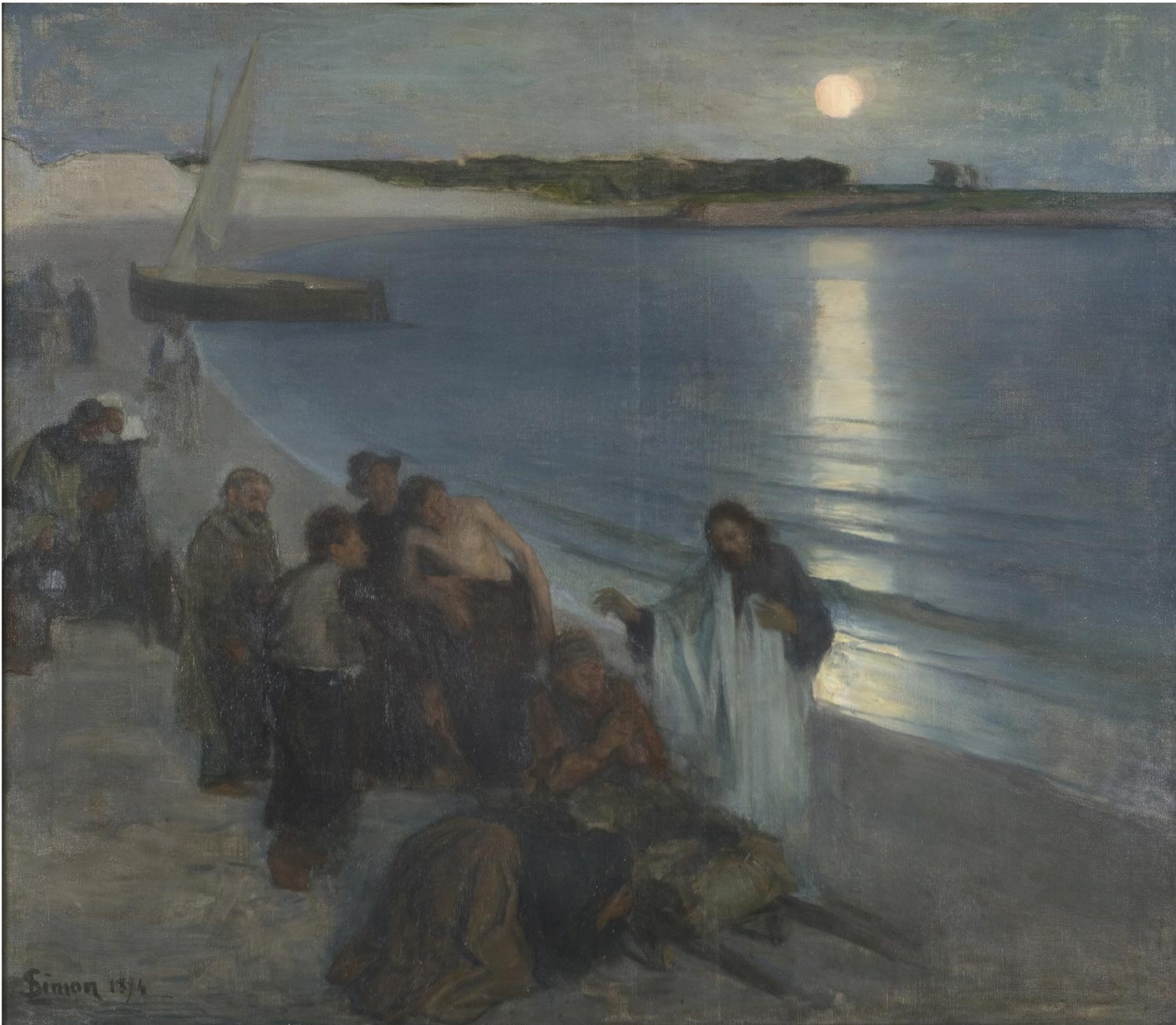
Lucien Simon-Christ Performing MiraclesReading through the sixth chapter of Mark, I recently noticed a way that Jesus relates to his disciples which is, at first, incredibly encouraging, but then gets exceedingly hard.

This is right after he had sent his disciples out, two by two, to try out this whole “ministry thing” by themselves. According to Mark, it was an incredibly powerful and effective time of ministry for them. They saw powerful things done, and they were able to play a part in them. They return from their first “ministry internship”, and this is where we pick up the story.

The apostles gathered around Jesus, and told him all that they had done and taught. He said to them, “Come away to a deserted place all by yourselves and rest a while.” For many were coming and going, and they had no leisure even to eat.
Mark 6.30-31

Jesus’ pastoral concern extends not only to his flock but also to the shepherds. They have done so much ministry and now he insists that they withdraw and rest and eat. Also, they shouldn’t simply do this by themselves as individuals, but with those who are also doing ministry. The leaders of the church should rest together as fellow weary workers.
Continue reading

Job’s Friends are Right! Job’s Friends are Wrong.| Job 8.5-7,20-22


If you will seek God
and make supplication to the Almighty,
if you are pure and upright,
surely then he will rouse himself for you
and restore to you your rightful place.
Though your beginning was small,
your latter days will be very great.
Job 8:5-7

We mock Job’s friends, but what this guy says here is exactly what happens at the end of the book! Its practical, prophetic, and foreshadowing the end. We need to cut these guys a break.

“See, God will not reject a blameless person,
nor take the hand of evildoers.
He will yet fill your mouth with laughter,
and your lips with shouts of joy.
Those who hate you will be clothed with shame,
and the tent of the wicked will be no more.”
Job 8.20-22

Okay, though I defended this guy earlier, this here is BS.

See other Marginalia here. Read more about the series here.

Does Paul Not Believe in Original Sin? | Romans 7.9-11


I was once alive apart from the law, but when the commandment came, sin revived and I died, and the very commandment that promised life proved to be death to me. For sin, seizing an opportunity in the commandment, deceived me and through it killed me.
Romans 7.9-11

Hmm…is it just me, or does this does seem to go against the idea of Original Sin? It sounds like Paul is saying that he was born in purity and “alive-ness”, and it was only later that the law killed him. He does not seem to be saying here that he thinks he was born in death (yes, yes, I know Ephesians says otherwise, but I’m trying to stick to the text in question!)

See other Marginalia here. Read more about the series here.

Does Paul Believe in a Hell that Saves? | 1 Corinthians 3.10-17


According to the grace of God given to me, like a skilled master builder I laid a foundation, and someone else is building on it. Each builder must choose with care how to build on it. For no one can lay any foundation other than the one that has been laid; that foundation is Jesus Christ. Now if anyone builds on the foundation with gold, silver, precious stones, wood, hay, straw—the work of each builder will become visible, for the Day will disclose it, because it will be revealed with fire, and the fire will test what sort of work each has done. If what has been built on the foundation survives, the builder will receive a reward. If the work is burned up, the builder will suffer loss; the builder will be saved, but only as through fire.

Do you not know that you are God’s temple and that God’s Spirit dwells in you? If anyone destroys God’s temple, God will destroy that person. For God’s temple is holy, and you are that temple.
1 Corinthians 3.10-17

Part of the problem with how we talk about Hell is the confusing diversity of images and language used to talk about it in the Bible. This is true here.

I don’t want to read too much into this few words, but at least in the first part, Paul seems to be saying that what gets burned in the fires of judgment are more the works of someone than the person themselves. In fact, it seems that the wicked come out the other side of the fire “saved”, with all their useless works and such having been burned away.

But then, the next section clearly says that God destroys “that person” (not just their works). But because it comes right after the statement of the person being saved by their wicked works being burned away, I wonder if this isn’t Paul saying, “yeah, that refining, restorative, salvific fire I just talked about? God will take each person through that destruction–the one that saves.”

Man, the more I’m on the lookout to see any universalistic statements by Paul, the more I’m starting to see things that could definitely be taken that way.

See other Marginalia here. Read more about the series here.

Should Protestantism Still Be a Thing?


Roger-Smith-cc-rosary-bible

For years now, I have described my place in the Christian family as a “Protesting Catholic“. I love Catholicism (and Orthodoxy. I’m so sorry you are so frequently left out of these discussions–I’m as guilty of doing this as any). I love the entire Church family, in fact, and I can’t think of a tradition from which I have not benefited greatly from it nuancing, sharpening, refining, or deepening my theological thinking in some way.

A friend posted this interview with Stanley Hauerwas, on his new book on the “end times”. It’s a brief interview with some nice quotes and sentiments from the elder public theologian, but this set of lines particularly caught my eye:

My suggestion [that Protestantism may be coming to an end] is meant to be a reminder that Protestantism is a reform movement. When it becomes an end in itself it becomes unintelligible to itself. Protestants who don’t long for Christian unity are not Protestant. There is also the ongoing problem that Catholics have responded to the Protestant critique in a way that the Protestant critique no longer makes much sense. Accordingly, the question is: why do we continue to be kept apart?

I wholeheartedly agree with Hauerwas about the heart of Protestantism and how it should long for unity and, eventually and hopefully, end. So why is Protestantism still a thing I embrace? Why am I not fleeing to Rome, to our Mother Church? Let me offer a few words.

Continue reading

When your church’s “cultural relevance” fails | Acts 14.11-18


When the crowds saw what Paul had done, they shouted in the Lycaonian language, “The gods have come down to us in human form!” Barnabas they called Zeus, and Paul they called Hermes, because he was the chief speaker. The priest of Zeus, whose temple was just outside the city, brought oxen and garlands to the gates; he and the crowds wanted to offer sacrifice.

When the apostles Barnabas and Paul heard of it, they tore their clothes and rushed out into the crowd, shouting, “Friends, why are you doing this? We are mortals just like you, and we bring you good news, that you should turn from these worthless things to the living God, who made the heaven and the earth and the sea and all that is in them. In past generations he allowed all the nations to follow their own ways; yet he has not left himself without a witness in doing good—giving you rains from heaven and fruitful seasons, and filling you with food and your hearts with joy.”

Even with these words, they scarcely restrained the crowds from offering sacrifice to them.
Acts 14.11-18

This is in contrast to Paul’s later methods at Mars Hill in Chapter 17. Here we see that not every “contextualization” is created equal. Sometimes, your “relevance” could be dragging people to worship yourself or false idols. As preachers, we should always be on the lookout for this, and to constantly speak against it.

On another note, that bold part (v.15) should be the model for every single sermon.

See other Marginalia here. Read more about the series here.

Name the Darkness: Jesus & Our Persistent Demons | Mark 5:6-9


When he saw Jesus from a distance, he ran and bowed down before him; and he shouted at the top of his voice, “What have you to do with me, Jesus, Son of the Most High God? I adjure you by God, do not torment me.” For he had said to him, “Come out of the man, you unclean spirit!” Then Jesus asked him, “What is your name?” He replied, “My name is Legion; for we are many.”
Mark 5:6-9

Well this is interesting. It seems like Jesus had said words of exorcism earlier and it, in a sense, hadn’t “worked”. I wonder if the tradition behind this story was of a man so demon possessed that Jesus’ first try at getting rid of them failed. That certainly seems to be the case here. Jesus had commanded the demon to leave the man, and it didn’t.

Now, I don’t like pulling what seems like “self-help lessons” from things like this, or appealing to pop psychology, but this could be instructive in a ministry context. Jesus has appealed to his word and his authority to bring healing and to cast out the disorder and evil in this person’s life. It hasn’t worked. It is so big, it goes so far back into the past, and the issues seem so numerous, that it just isn’t going to take a quick shot to the soul.

So in light of this, how does Jesus respond? He asks the person’s name. Yes, the demon responds, but there’s no indication that Jesus is only talking to the unclean spirit here. He asks the man name, and he answers by identifying himself by his evil. But this is still progress. He gives name to what is haunting and hurting him, and this diagnoses his soul and gives Jesus the insight on how to bring healing to this man.

Giving name is powerful for healing and change and even getting rid of demons.

See other Marginalia here. Read more about the series here.

God, Social Justice, & Social Welfare | Job 5.15-16


But he saves the needy from the sword of their mouth,
from the hand of the mighty.
So the poor have hope,
and injustice shuts its mouth.
Job 5:15–16

I want to take this to all of my conservative friends. They are right that much of the life circumstances of the poor are often from the “sword” coming from their own mouth. But we also see here that their lot is not only attributed to “the sword of their mouth”, but also “the hand of the mighty”. And either way, regardless of the cause of their situation (and its persistence), the people of God are called to follow God’s lead in a commitment to pursue their freedom from these types of bondage–both within them and without. The good news is that this not only gives them hope, but it also shuts the mouth of injustice itself.

And this doesn’t seem to just be in individual ways, but even in systemic ones. Does it not follow, then, that Christian can (should?) in good conscience see their role as political beings as a means by which to accomplish these systemic ends? Perhaps it’s not just for individual Christians and Churches to “serve the poor”, but Christians utilizing political capital to mobilize government resources to follow God’s lead? Just asking.

See other Marginalia here. Read more about the series here.

How Preaching Saved Me from Evangelicalism’s Bible


bible-pulpit-sepia

If I’ve learned anything the past few years, it’s that Evangelical Fundamentalism is absolutely right: as I’ve embraced more and more what conservatives often label a “liberal” view of the Bible, it really has negatively affected my spiritual and devotional life.

When you think the Bible is itself the “infallible, inerrant, Word of God”–when you think that the precise words themselves hold a magical power–you do approach the Bible with a greater amount of awe, respect, and mysticism. I’ve written before how it wasn’t until college that I read any of the Gospels on my own, because I had this fear of reading the “literal, unfiltered” words of Jesus. They seemed so big and other-worldly to me.

I’ve loved the Bible my whole life. I still have the first Bible I was ever given as a child. I still vividly remember the evening on my parent’s bed after they had read a Psalm that had been stuck in the middle of the stories about David that it finally clicked for me that the Bible wasn’t just narratives, but also poems and other kinds of writing.

My Southern Baptist upbringing has got it engrained in me that my entire spiritual and devotional life should revolve around this book. No matter how much I tell myself otherwise, something in me always has (and always will) “evaluate” my spiritual health by how I engage the Scriptures, in both quantity and quality.
Continue reading