My problem with “quiet times” (some rest for the journey?)


prayer-hands-bible

If you’ve spent any real time in the Church, you probably are well-aware that there are some practical things that “mature Christians” end up doing (or so we hear) to “pursue Christ” and intimacy with God on days other than Sunday. Usually, this is some set of practices, disciplines, and rituals that surround two key things: the Bible and Prayer.

In the Bible Belt, where I’m from, the common term to describe this is the “quiet time”. This can be a devotional that includes a snippet of Bible verses with some meditations and prayers. It could be reading a passage and then journaling about it. It can even be going through an established liturgy of prayer with rotations of Scripture found throughout (here’s my favorite).

Whatever form it takes, it’s usually a subjective engagement (prayer) with the “objective” revealing of God (the Bible). It is usually rooted in the Bible, and even the prayer or journaling is seen as a response to how God reveals Himself in the Scripture. “Quiet times” are, fundamentally speaking, time spent with God in the Bible.

I’m sure the experience is very different in other branches of the Christian family tree, but at least in Evangelicalism (my bread-and-butter), “quiet times” become the go-to litmus test for one’s own spiritual health. If people are going through difficult times, we nudge them towards the Bible more. If we are to feel spiritually vital, healthy and mature, we gain the impression, over time, that it must flow from regular, disciplined quiet times.

But as I have lived through my own pursuit of the elusive “consistent quiet time”, dealt with decades of feelings of spiritual inadequacy, and seemingly had every time of requesting prayer on my behalf be about trying to get the grace to have these quiet times, I have slowly realized there are problems with how we have conceived of the “quiet time”. Come walk with me a little bit.

Continue reading

Millennials, Media, & Meta-Churching


coffee-client-mugFor those of you out there that keep track of the “Christian blogosphere” (and if you don’t, you’re probably better for it), there’s a very weird discussion happening amongst many different writers and thinkers about “millennials” (those born from the early 80s to early 2000s), and how they relate to the church.

A couple of weeks ago Rachel Held Evans wrote a post for CNN’s religion blog in which she said that millennials are leaving the church because they don’t find substance there; but rather, all they seem to find are hypocritical, judgmental, and bigoted people that want to fight over silly things. She said that this desire for substance is why the millennials that do stay in the church are leaning towards more liturgical traditions. She encouraged church leaders to look at millennials and consider whether their departure might be speaking to systemic issues that are plaguing the American evangelical church.

Continue reading

“Simplistic Atheism: a final response” by Daniel Bastian [GUEST POST]


de Goya-fight with cudgels"

(Note: These exchanges are now complete. There is a Table of Contents to the discussion now available.)

Well, it seems that we were not in fact done with this little series. After my final post, Daniel chose to take me up on my offer to have the final word (as I normally try to do in exchanges like this). He has chosen to respond, point-by-point, to my list of what things would lead me to embrace Atheism. If you feel like any of the points still demand a reply from me, or if you have any questions about what Daniel says, feel free to to comment here, on Facebook, or get in touch with me privately. For my part, though, I consider this particular set of exchanges finished. Once again, I thank Daniel for this exchange. I hope you enjoyed it as well.

Paul,

When I initially decided to compile a list of criteria that would convince me my conclusion on the question of theism was wrong, I had sincere hope that a Christian, Muslim or other person of faith would tally up a corresponding register. I am glad to see you rose to the challenge and enrolled in this dialogue. It has been a wonderfully enlightening experience for me, and I do hope that sentiment is mutual.

I read your piece the day it was posted and while at first I found much of it persuasive, the more I reflected the more I realized it was probably the list I would have drafted two years ago, before I renounced my faith. Much of your criteria seems to rest firmly on the aesthetic appeal of the Christian narrative. And this would seem to slot right in line with your epistemological moorings-a concern for the communal connection, compelling force and overall mesmerism of a worldview over against its underlying facticity.

Yet it seems this only holds true up to a certain threshold, given a few of the items on your list. You seem to be OK with affirming the faith given its impact on your life, the power of influence you’ve seen it have on history, and the way it has shaped others with which you’ve crossed paths. But if you were to discover beyond reasonable doubt that this narrative was based on so much myth, that this loosely corroborated Yeshua the gospels are based on was a mere mortal (item #1), you would relinquish the faith forthwith.

Thus it seems to me that our epistemic divergence is one of degree, not of type. With that in mind, I’ll attach some brief notes beside the items in your list. Continue reading

The Historical, Political & Theological Roots of Urban Pain


26359563536I’m trying to get an early start on reading my seminary books (which I’m still trying to purchase–thank you so much to all who have helped out!). I’m currently enjoying Mark Gornik’s To Live in Peace: Biblical Faith & the Changing Inner City. I’ve read similar books before, and expected more of the same, but this really is a much higher level-analysis of urban policy than I thought it would be. He is writing from the context of the inner city community of Sandtown, in West Baltimore. I’m really liking it and encourage you to check it out yourself.


I wanted to devote my entire post today to a series of excerpts from his section going through the historical and theological roots of urban and racial difficulties. In light of recent comments–especially by conservatives–demonizing those who live at this level and at these places in the world (or demonizing the government policies that serve them), I found this appropriate in offering us some perspective.

On a side note, for newer readers: I do not ascribe to a particular party and I actively speak out against both of the main ones wherever I see injustice, hypocrisy, and absurdity. This just happens to be an area of policy where Republicans are far more guilty. Here are the excerpts (the bold-faced lines are my emphases). Continue reading

Abstinence is Not Chaste (Exercise Your Celibacy!)


Sandorfi-AngeYeah, I’ll admit it. I belong to that ever-decreasing group that thinks that our human sexuality is a big enough deal that how we exercise it has profound implications for human, societal, and spiritual flourishing. Further, I believe God has woven in the design of the world particular rhythms and ways in which sexuality lends itself to that flourishing. I see it as something so integral to our souls and bodies that there is a type of care and stewardship that we are lovingly called to exercise with it. And sometimes “stewardship” means placing limits on oneself.

I’ve talked about what this stewardship looks like in various other contexts, but for the purpose of this post, I’m focusing on one in particular. My focus today–to put it plainly–is on the idea that people who aren’t married aren’t “supposed” to have sex.

This isn’t a systematic defense of that idea. I know there are lots of differences of opinions and nuances (even among Christians) on this. I know that we talk about this in the abstract in one way, and when we get to particular people and situations, these “clear” ideas break-down quickly. I get that. But just walk with me for a little bit.
Continue reading

Simplistic Atheism {4}: What could make me an Atheist?


paul-schrott-painting-11-11

(Note: These exchanges are now complete. There is a Table of Contents to the discussion now available.)

In this series of exchanges with my friend Daniel, I’ve tried to argue that his Facebook post on why he is an Atheist expressed an overall view of the world that is too small and too simplistic. I think this is because of his empiricist method and materialist conclusion about reality–that all there is is what we can see, touch, feel, etc.

Some concluding remarks

My whole point has not simply been that Daniel’s facts or even his method is wrong. But rather, it finds its proper place, meaning, fullness, and possibility within the Christian view of reality. I have argued in each of my posts that Christianity does not “refute” reason, science, history, skepticism, textual messiness, historical difficulty, or even doubt. Instead, the Gospel encompasses it all, and each of those things find a greater fulfillment in their use, cohesion in the whole of the world, and reality within that place.

Continue reading

New Testament & History: Christians can be confident [a retort]


bible-schrott-coffee-paul

(Note: These exchanges are now complete. There is a Table of Contents to the discussion now available.)

Update: Daniel has posted a reply below.

When I have these kinds of exchanges on the blog, I really try to let the other person have the last word. After all, I have home field advantage here. I was absolutely ready to move on to my last part of this ongoing exchange with my friend Daniel Bastian in response to his Facebook post about his Atheism.

Last week, I wrote a post trying to give a cursory response to some of his claims about the Bible and miracles. Daniel wrote a response, posted a couple of days ago. I offered a brief response to his critique of my view of miracles. I was really eager to get back to writing about other things.

But it seems I can’t. Not yet.

I’m starting seminary back up this Fall, not simply because I’m interested in all the “knowledge” about the Bible, but because I feel I actually have a (pastoral?) concern for the spiritual well-being of people. I care a lot about what people might see on this blog, and I care that they are able to receive these things in ways that will be ultimately helpful to them.

And I fear that his post, at least for Christians not well-read in these issues, will cloud the waters more than clear them. Don’t get me wrong. Christians should wrestle with what Daniel has written in earlier posts, especially when it comes to the more abstract philosophical concerns of God’s existence and work in this world. These are things that don’t have easy or even clear responses by Christians. I’m not worried about Christians having restless nights or days as they wrestle with legitimate difficulties in the seeming difference between what they believe about God and the way the world seems to be.

But, when it comes to the Bible and the Resurrection, I don’t think we are on as shaky ground as Daniel makes it seem. Let’s discuss.

Continue reading

“New Testament Historicity: A Response” by Daniel Bastian [GUEST POST]


run-down-Bible

(Note: These exchanges are now complete. There is a Table of Contents to the discussion now available.)

Today continues an on-going exchange between myself and a friend of mine, Daniel Bastian. These were inspired by a Facebook post he wrote about why he is Atheist (in this current post, whenever he says “OP”, he means “original post” and is referencing that). Last week, I wrote a post about the trustworthiness of the Scriptures and miracles. Here is his response.

Update: I have some responses posted for his section on miracles in this post. And, honestly, I feel he gets so many things wrong int his post, I’ll have to write another response to this tomorrow. 

More important update: I have a full response to this article now posted.

Paul,

Thank you for the thoughtful post. I think this is your most cohesive piece yet and, better yet, even dives below the surface of a few of my arguments. And allow me to just say up front that it is truly a breath of fresh air to commune with a non-fundamentalist on matters of faith. Rarely do I find a Christian with a sophisticated understanding of the faith’s foundational texts and the underlying nuance operative in these discussions. It is truly refreshing.

In my response I’d like to first address the broader themes of your post and then drill into a few of the more specific items you have noted. Along the way, I will correct some errors, highlight some omitted details, and point out some oversights and oversimplifications that obscure the analysis of New Testament historicity.

At the first, it seems that you still resist recognizing the non-Christian-centric applications of my arguments. Yes, some of my arguments did single out Christianity, as that is the religion I retired from at age 25 and is thus the one in which I am most conversant. However, if you were to step outside the hermetically sealed Christian bubble for just a moment, their broader implications should become apparent. Let’s try again.
Continue reading

How We Prove God (a prayer by Karl Barth)


hands-pray-sepia“Dear heavenly Father, we ask you to give us all your Holy Spirit, and to give it continually, that it may awaken, enlighten, encourage, and enable us to dare to take the small and large steps of moving out of comfort with which we can comfort each other and into hope in you. Turn us away toward you! Do not allow us to hide from you! Do not let us do anything without you! Show us how glorious you are and how glorious it is to trust and obey you!

We would ask the same for all people, that the nations and governments may bow to your Word, and that they will be willing to work for justice and peace on earth, that your Word may be understood and taken to heart by all those who are poor, sick, imprisoned, troubled, oppressed, and unbelieving; that through word and deed it may be made known to them; and that it may be perceived by them as the answer to their sighs and cries; that all Christian churches and confessions may learn to recognize it anew and serve it with renewed faithfulness; that its truth may be and remain bright here and now in all of humanity’s error and confusion, until such a time as it shall ultimately enlighten all people and all things.

You are glorified, you who make us free in Jesus Christ, your Son, by confessing and standing on this: that our hope is in you. Amen.”

— from Karl Barth, “Pentecost” in Fifty Prayers

(Note: This was posted as part of a series of back-and-forths between an Atheist friend and myself. These exchanges are now complete. There is a Table of Contents to the discussion now available.)

Simplistic Atheism {3}: The Bible, Miracles, & History


schrott-bibles-paul-coffee

(Note: These exchanges are now complete. There is a Table of Contents to the discussion now available.)

We continue our response to Daniel Bastian’s blistering critique of religious belief. Part 1 tried to respond to what seems to be Daniel’s basic understanding of the world, reason, and spirituality. Part 2 focused entirely on his use of scientific claims and findings to discredit (at least the need for) religiosity. Yesterday, Daniel responded to Part 2 (here was my response). Today, we narrow in on his views of the Bible, miracles, and history.

A Simplistic Bible

(Disclosure: a lot of this is cut-and-paste from various comments here and on Facebook. Also, I’ve taught a few classes that have a more detailed discussion of a theology of Scripture. Those can be found here, here, and here.)

The points about the Bible in Daniel’s post were especially difficult to read. In fact, they were my inspiration for my post last week talking about how Christianity can shape the types of Atheistic beliefs people come to. My frustration came from the fact that, since Daniel originally wrote this (a while ago), I’ve watched him engage with and express respect for others that offer substantive critiques to what he ended up re-posting last week.

In his points, he expresses a view of the Bible that is mechanical, wooden, systematic, simplistic, and puts expectations on the text that it doesn’t even place on itself. It seems like he is only responding to the modernist, fundamentalist view of the Bible (what I called a “Straw Bible”), and I know his thinking is far more nuanced than that–I couldn’t understand why he still perpetuated this. But nevertheless, he did, so I’ll address it as it’s posted.
Continue reading

Simplistic Atheism {2}: Science “versus” Theology


darwin-buddy-jesus-humor

(Note: These exchanges are now complete. There is a Table of Contents to the discussion now available.)

I’m doing a little series this week responding to a Facebook post by a friend of mine named Daniel Bastian. He outlined twenty things that would make him change his mind about Atheism. The piece is well-organized and thought out, I encourage everyone to read it and wrestle through it themselves.

In line with my belief that these sorts of discussions always seem to end up at differences in hermeneutics (interpretive filters) rather than facts, I wrote a post talking about what appeared to be Daniel’s bigger commitments and understandings of the world, human reason, and assumptions about spirituality (also read the Facebook comments).

I was, of course, accused of still not engaging with his specific points, even as I sought to talk about principles behind the points. And so, I’m excited to say that with today and tomorrow, we will be hitting many of Daniel’s specific points
Continue reading

Simplistic Christianity; Simplistic Atheist: a response [GUEST POST]


(Note: These exchanges are now complete. There is a Table of Contents to the discussion now available.)

Earlier today, I posted an introductory post in response to a Facebook note by my friend Daniel. Before I posted it, I had a few friends read the post to see if they thought it would be taken especially personally and shut down, rather than promote, further conversation. They said that it was on the line, but they didn’t think it was too personal. Unfortunately, it seems I (we) were wrong.

Daniel responded in a comment, but I thought it deserved a more prominent place on the blog. I’ve included his response below, and included some brief words of clarification to his points.

__________________________________

Paul,

While I do appreciate your taking the time to respond, I don’t appreciate the flagrant misrepresentation. The religious opinion and intellectual caliber you ascribe to me in this piece in no way reflect my actual disposition and are so off-piste that I quickly lost track of whether you were talking about me or some nondescript internet denizen with which you have passing familiarity.

To set the record straight, you do not know me personally, and you clearly know even less about my views of religion and the serious, contemplative academic respect for and to detail to which I approach the topic. If you have a question about my views on an issue, ask me. Ask me. Don’t implant your own thoughts onto my character and radiate them in a public post. It’s unprofessional and ventures headlong into character intrusion.

To avoid further blatantly misinformed opinion from surfacing, I have tremendous respect for people of any and all religious persuasion, though I may depart from them on the metaphysics of their beliefs. I am under no delusion that theism, and Christian theism, can be dismissively fit into a box rather than a broad spectrum of nuance and theological nicety. Fundamentalism is *not* the truest articulation of Christianity and in fact is the most injurious strain of Christianity in its long history. There *are* legitimate theistic views to be voiced and I can entertain and respect those voices without affirming them for myself. I do so regularly and incorporate many of these voices in both my reading list and my book reviews on various websites.
Continue reading

Simplistic Christianity leads to Simplistic Atheism: it’s our fault


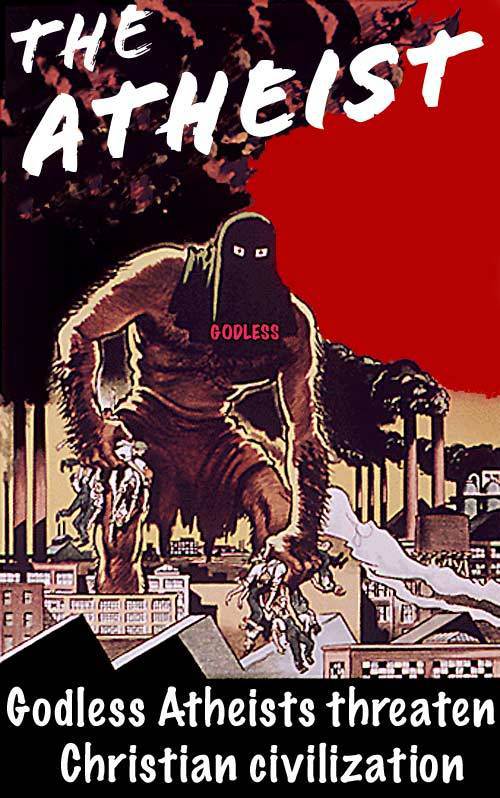
Atheist-monster-poster(Note: These exchanges are now complete. There is a Table of Contents to the discussion now available.)

“I walk outside my house, I look around, and it doesn’t seem apparent to me that there is a God. I just don’t feel it. It doesn’t seem to be the natural conclusion of reality when I live life and look around. I see the world, and the existence of God doesn’t feel like a natural conclusion one could draw.”

I stare down into my coffee, catching the corner of my pastor’s glasses in the dark reflection.

“Well”, he says, “I know it doesn’t fix how you feel, but in the grand scope of human history, and even the global humanity living today, that opinion you just expressed is in the extreme, extreme minority. Most people living in the past and now have found looked at the world and have not been able to come to any conclusion other than their being a God.”

Crap. He was right. What I thought was such an objective engagement with the world around me, was (of course) still the product of the cultural forces from which I drink deeply. History and developmental psychology have shown us that religiousness is the default mode of the human heart.

We are by nature religious. It takes other, external forces to push back against that and move us away from it. And this fact is no apologetic for religion. It’s neither a point “for” or “against” religion. We are also by nature selfish and willing to do whatever it takes to be the fittest and survive. We try not to give into this natural drive and through education and conditioning try to move away from it.

Continue reading

Listen to the Hurting {ii}: how now shall we suffer?


Rothko-untitled-2Yesterday I wrote about how our offense and struggle with evil and suffering in the world is often detached from the feelings and words of those that actually endure much of it. I said that intense Suffering doesn’t seem to produce an extinguishing of faith to those that experience it.

People have often said that the deep suffering and injustice of the world is one thing that led them to Atheism or skepticism, but this seems to be more the case for those that observe and think about the idea of suffering, more than enduring it themselves. Yes, there are stories of those that lose their faith in the midst of their suffering, but they really are so few and far between.

This is one of the main themes of Dostoevsky’s Brothers Karamazov. The most powerful argument for Atheism I’ve ever read is in the famous “Grand Inquisitor” chapter. After reading it, I was so deeply shaken for a few weeks after. And it was written by a Christian.

One of the central themes of the book is that Atheism is an absolutely logical and reasonable system, but not one that can be consistently lived out. When observing the world and its injustice intellectually and from a top-down perspective, Atheism is probably more easily sensible than Christianity. But, as the book goes on to show, no matter the philosophical veracity of Atheism, no one can truly live real, actual human life as a fully-consistent Atheist and flourish as a human, in human relationships, and in human society.

Even if people think about suffering Atheistically, people usually live in the midst of it religiously.
Continue reading

Listen to the Hurting {i}: why Suffering is a silly reason to be an Atheist


Adolph Gottlieb-rolling

Update: Part 2 is up.

In the religious circles I walk in, I hear about injustice and suffering quite a bit. Theology friends constantly muse about how to view these things in light of biblical revelation. Atheist and skeptic friends constantly point to these things as the inherent illogical inconsistencies that undermine religious faith.

And caught in the middle are many, many more friends, who live their lives trying to navigate their jobs, families, and relationships the best they can–all while these questions haunt them in their quieter moments or right before they sleep. Unlike the other two groups above, they don’t feel like they have answers. And this can lead to periods of doubt, insecurity, and frustration.

For every group, though, questions abound in these conversations. Oftentimes, they have a religious flavor. Why does this stuff happen? How does this relate to the goodness of God? What does it mean for the reality of God? How is God just when this stuff is real? Why does God seem absent?

And yet…

These are almost never the questions I hear from the people actually going through the suffering.
Continue reading