Advent, Evolution, & Absolution [RE-POST]


Today, I’m re-posting a piece I wrote exactly a year ago for last year‘s Advent series. During this year‘s, we’re seeing how the Advent event affects parts of our lives that we usually don’t associate with it. Today, it’s Advent and Evolution. You can follow the series here.

It’s Advent. A time where we especially orient ourselves towards rejoicing and celebrating the fact that God did not remain far off and merely create a “legal” or “dogmatic” satisfaction for the plight of his creation and creatures. Rather, he broke into it and came into his creation and among his creatures. In this year’s Advent series, we’re exploring how, in this Coming, Jesus took on our creaturely formcare-taking functioncomprehensive fallenness, and communal formation.

First, God took physical, human, creaturely form. In the study I did–and subsequent lecture I gave–on Beauty a couple of years ago, I defined “Beauty” as the attribute of something that expressed complexity simply. Is not this God-in-human-flesh (theologically referred to as the Incarnation) the most beautiful of all miracles to take place? The Infinitely Complex God inhabits the simplest of human forms: a child.

Continue Reading –>

Advent & Mary: Ordained as Prophetess, Priestess, & Queen


Tanner-the-anunciation-mary

This Advent, we’re seeing how this season affects parts of our lives we usually don’t associate with it. Follow the series here. This post is also filed in the series “Catholics Aren’t Crazy” and “Women Leading Stuff in Churches“.

If a woman is revered by the church for giving the faithful their savior, then surely women are good enough for leadership roles in the church to save it. –Vishwanath Ayengar

I ran across that quote in some letters to the editor of Newsweek a couple of years back in response to a cover story arguing that if women were ordained as priests in the Catholic Church, there wouldn’t have been any sex abuse scandal. I don’t know if that’s true, but the quote is insightful and (hopefully) thought-provoking.

I can hear conservatives now: Well, God used a donkey to speak! He used Caiaphas the high priest to unknowingly prophesy about Jesus before sentencing him to death! He used Judas to bring about Christ’s crucifixion and therefore our salvation! It doesn’t mean that they were fit to be ordained pastors!

Yeah, yeah, I get it. This post isn’t necessarily meant as a “proof” or “defense” of women’s place in ministry (though it’s a part of my on-going series on the topic). I just want to revel a bit in some divine mystery. Can we all just put our swords down and marvel?
Continue reading

Advent & Politics: The Government is on His Shoulders


laureti-triumph-christianity-pagan-statue

This Advent season, we’re seeing how the Advent event affects parts of our lives that we usually don’t associate with this time. You can follow the series here.

The book of Isaiah is a minefield for biblical studies, mainly because of the development it seems its contents went through to get to its final form. It appears to be a strange stitching together of many writings, perhaps by many people, for several different purposes. But in all of its complexity and mystery, there is one theme that it consistently holds throughout its contents: politics. The political movements of the nation of Israel and the nations around it–and God’s movement in and through all of it–occupy most every chapter of the book.

Interestingly, this is also where many of the most dramatic and explicit messianic prophecies are found–specifically Advent prophecies. When telling the Christmas story, the gospels quote Isaiah (I believe) more than any other Old Testament book. Images of virgins, Emmanuel, Davidic lineage, “roots of Jesse”, and John’s “voice crying in the wilderness” all find their source here.

There seems to be an intimate connection between politics and Advent.
Continue reading

I’m going on a Bloggers Trip to Guatemala with Lemonade Int’l. (happy 8th blog-versary)


lemonade-guatemala-1 BloggersDate

Eight years ago, today, I began this blog as a cathartic response to my frustration at a girl in my dorm. It was a very strange post full of rambling, weird logic, bad grammar, and typos. Not much has changed since then in those respects, but I do want to let you all know about an amazing opportunity that this 8-year endeavor has offered me.

Recently, some old friends of mine (that I happen to have hooked up) got me connected to this amazing non-profit, Lemonade International. LI does great development work in the La Limonada neighborhood of Guatemala, the largest urban slum community in Central America.

LI shares my own convictions that international development work should utilize local resources (instead of bringing in outside talent for everything), empower communities (instead of simply giving them aid), and build long-term relationships (instead of “short-term” “missions” programs) in order to reverse injustice. Here’s a trailer for a documentary about their community and their work:
Continue reading
Herman Bavinck on the Advent Incarnation


The doctrine of Christ is not the starting point, but it certainly is the central point of the whole system of dogmatics. All other dogmas either prepare for it or are inferred from it. In it, as the heart of dogmatics, pulses the whole of the religious-ethical life of Christianity. It is ‘the mystery of godliness’ (1 Tim. 3:16). From this mystery all Christology has to proceed. If, however, Christ is the incarnate Word, then the incarnation is the central fact of the entire history of the world; then, too, it must have been prepared from before the ages and have its effects throughout eternity…the incarnation is not an incidental decree that emerged later: it was decided and determined from eternity. There was not time when the Son did not exist; there was also no time when the Son did not know he would assume and when he was not prepared to assume the human nature from the fallen race of Adam. The incarnation was prepared from eternity; it does not rest in the essence of God but in the person. It is not a necessity as in pantheism, but neither is it arbitrary or accidental as in Pelagianism.

Reformed Dogmatics, Vol. 3, pp. 274; 276-277 (found this by way of friend-of-the-blog Austin Ricketts)

Free Advent Mixtape Available Now!


Advent-Mixtape-Cover

Update: I got some inspiration and updated the Mixtape, changing the song selection/order a little bit from when this was originally posted. Sorry for the inconvenience.

A new church season, a new mixtape. You can find this year’s Advent Mixtape above, in the appropriately-named tab, or just click here. It’s free, and you can stream, download, or share it.

It’s very similar to last year’s except with some songs removed, added, and re-ordered. I definitely think this one is better. (Let me know what you think!) Be sure to read my post introducing Advent this year, including ways than you can more intentionally participate in this season. I hope this Mixtape can play some role in your time as well.

Here’s some more info, from the “Advent Mixtape” page:
Continue reading

Welcome to Advent, 2012.


This Sunday marks the first Sunday of Advent. This is the New Year’s Day of the Christian Church Calendar. It’s the season in which we celebrate and meditate upon the “Advent” (latin for “Coming”) of Jesus into the world in the Incarnation. This season begins this Sunday and lasts until Christmas.

In this time, we stare deeply into the reality that the Creator God of the universe came into human form by way of human birth.

The season is marked (as with every Church season) with a profound tension. We meditate on the darkness into which Christ entered the world, as well as the light he brought in his Coming. Advent is a time that we sit in the tension of past, present, and future, and see how this most-differentiating belief of Christianity has profound implications on these places in time, and indeed, the whole of human life and experience.

This is why, for this year’s Advent, I’ll be doing a series meditating on how Advent affects seemingly unrelated parts of human life: art, politics, sexuality, singlenesswomen’s ordination, social justice, Evolution, suffering, humor, the city, and more.

There are several other ways you can engage in this season:
Continue reading

N.T. Wright: Egalitarianism isn’t “progressive”; it’s biblical. Others object.


The Rt Revd N T (Tom) Wright delivering the Ja...Alas, due to my obsessive commitment to not let blogging get in the way of the relationships in my life, my promised post on the historical context of 1 Timothy will not be coming today (and may have to wait until next week). Instead, as part of this ongoing series, today I’d like to offer to all of you an excellent Op-ed that biblical scholar N.T. Wright posted in The Times of London (copublished here).

Last week, the Church of England voted not to allow any female bishops (though they have, for some time, allowed female priests). Prime Minister David Cameron bemoaned this, telling the Church they needed to “get with the programme” and ordain women bishops because that’s just where the world is right now, apparently. (This issue is also causing other political problems for the Church.)

Wright, who supports female bishops wrote the Op-Ed blasting Cameron for encouraging the Church to “get with the times”, saying that that is never a reason why the Church should do anything. He continues, blasting the idea of naive “progressivism” that has dominated monder thought.

Instead, he says, the Church should ordain female bishops because it’s biblical, not because it’s “cool” or “progressive”. He goes on to say that appealing to the culture does damage to the truth that it is biblical, and reinforces the patently false idea that those that oppose female ordination are the ones reading Scripture “literally” and “faithfully” while egalitarians are only listening to “culture”.

The Op-ed is brief, snarky, and powerful. Needless to say, it garned some thoughts from conservatives on this side of the pond. Doug Wilson did not just one, but two posts on it, and Denny Burke also wrote against it. The Internet Monk then brilliantly deconstructed their responses.

And so, I give you these men (why is it always men!) to read and discuss in the space below. Have fun.

A Prayer for Thanksgiving


Father in Heaven, Creator of all and source of all goodness and love, please look kindly upon us on this Thanksgiving and receive our heartfelt gratitude in this time of giving thanks:

We thank you for the splendor of the whole creation, for the beauty of this world, for the wonder of life, and for the mystery of love.

We thank you for the blessing of family and friends, and for the loving care which surrounds us on every side.

We thank you for setting us at tasks which demand our best efforts, and for leading us to accomplishments which satisfy and delight us.

We thank you also for those disappointments and failures that lead us to acknowledge our dependence on you alone.

We thank you for all the graces and blessings you have bestowed upon us, both spiritual and temporal: our faith and religious heritage, our food and shelter, our health, the loves we have for one another, our family and friends.

Above all, we thank you for your Son Jesus Christ; for the truth of his Word and the example of his life; for his steadfast obedience, by which he overcame temptation; for his dying, through which he overcame death; and for his rising to life again, in which we are raised to the life of your kingdom.

Grant us the gift of your Spirit, that we may know him and make him known; and through him, at all times and in all places, may give thanks to you in all things.

Dear Father, in Your infinite generosity, please grant us continued graces and blessing throughout the coming year.

Amen.

(modified from The Book of Common Prayer)

Two quick questions for all you complementarians out there….


I’m still in the process of writing my first post on a specific text (1 Timothy 2:8-15). It’s not done yet (I chose to have an amazing of night full of wings and really good friends instead of writing it).

Because of the impending holiday weekend and the travel days that it entails, I’ll probably be putting that one up on Monday (sorry to get everyone fired up just to drop you for almost a week), but in the meantime, I wanted to solicit some help from my more conservative friends out there (also usually called “complementarians“) on a couple of questions I’ve had during this on-going series on Women in the Church. First:

Under a complementarian view, what would the traits of a failed husband in this respect look like? In other words, what does a “feminine” husband look like? Does that look anything like the way you think women are supposed to act in the home?

What I’m getting at is this: when I think of these answers (on both extremes), I think of terms like “weak, passive, indecisive, silent, not-present, abusive, exploitative, manipulative, and aggressive”.
Continue reading

Women & the Church: 2 things that began changing my mind


the journey

If it’s not obvious so far, I wanted to make something clear before we begin: these posts in this series on Women the Church are walking through the same path my own journey took get to where I am.

In my last post, there was a concern that a friend brought up that I didn’t get to talking about the biblical texts enough. Well, this is because both egalitarians and complementarians are looking at the same biblical texts. In my own shifts on this issue, the key changes were not “new” Bible verses I found.
Continue reading

Women & the Church: we’re ALMOST to the Bible, but first…


Well, we’ve gone through some of my own journey and some of the ways this discussion goes, but the real meat of this discussion centers around a few key biblical texts. Various refutes and refutations’ refutes can be found with any easy Google search. I don’t necessarily want to re-hash the more widely-publicized textual minutiae of the issue, though some of that will be necessary.

In this post, I could easily just list the three primary offending texts and then talk about how my view differs from others’ views. But those other people’s views don’t come out of thin air. They are based in many more (and, epistemologically more important) assumptions and bigger issues that usually never get touched on.

And so, as I continue this series, today I just want to touch on the ways people go about using the Bible in this, and then defending how I feel like we should use the Bible here. After this post, beginning next week, I promise we’ll start getting into actual biblical texts. But we need to do this first.

Because, as anyone that has studied theology begins to realize, everything comes back to your chosen interpretive method and filters–what’s usually referred to as a “hermeneutic”.

Continue reading

Christian egalitarians: authority-fearing, culture-worshipping, Bible-hating, puppy-kicking liberals (and other truths)


I hate pontificating.

Now, don’t get me wrong. Often, we can only hate most deeply that which we know most truly. Going through the annals of this very blog and my own conversations (especially during college), pontification makes frequent guest appearances.

By “pontification” I mean saying something authoritatively more for the sake of emphasizing the authority with which you say it than the point for which you did. It’s speaking to your base and those who agree with you, and it often says more about you than it does for the topic at hand. And generally, especially for issues where there is deep disagreement, it accomplishes absolutely nothing more than entrenching each side.

Continuing this series on gender relationships in the church, I don’t want to do that. I really don’t. But too often, this is the case.

Continue reading

On women leading & teaching stuff in churches: a story


Women, and their role in shaping society’s power structures, are at the fore-front of our nation’s consciousness and cultural discussion right now–Evangelical and otherwise.

Socio-politically: Maureen Dowd wrote about it this past week. Hanna Rosin wrote a book about this happening. Sandra Fluke got Rush Limbaugh into a tizzy and then spoke at the Democratic National Convention. Republican leaders, for some reason, could simply not stop talking about rape. Mitt Romney bragged about his binders full of them. Last week, Americans elected the largest number of females to Congress than it ever has.

In Evangelicalism: Rachel Held Evans brought attention to misogyny and patriarchalism at one of the bastions of the Neo-Reformed. Her new book, which already carried some controversy, has been criticized and patronized by conservative evangelicals, including one of the top female thinkers of that flock (Evans’ response, a scholar’s rebuttal). Concerning said bastion, after a rough search and count for the phrase “Complementarianism”, it seems that over half of the results appeared this year alone. At the time of this writing, a different bastion of the Neo-Reformed, upon visit to their site has as the featured video: “Complementarianism: Essential or Expendable?”. The Church of England just announced their new Archbishop of Canterbury, Justin Welby, and one of the main issues being talked about is his views on women’s ordination.

And so, I’m starting a series of posts (as I usually do) to offer up some of my thoughts on the Christianity side of this discussion–thoughts which I hope are helpful to us all. But first, I find it only fair to tell you all my journey into this and where I stand. I’ve hinted at it before, but a fuller treatment might be in order.

Continue reading

Weekly Photo Challenge: Renewal


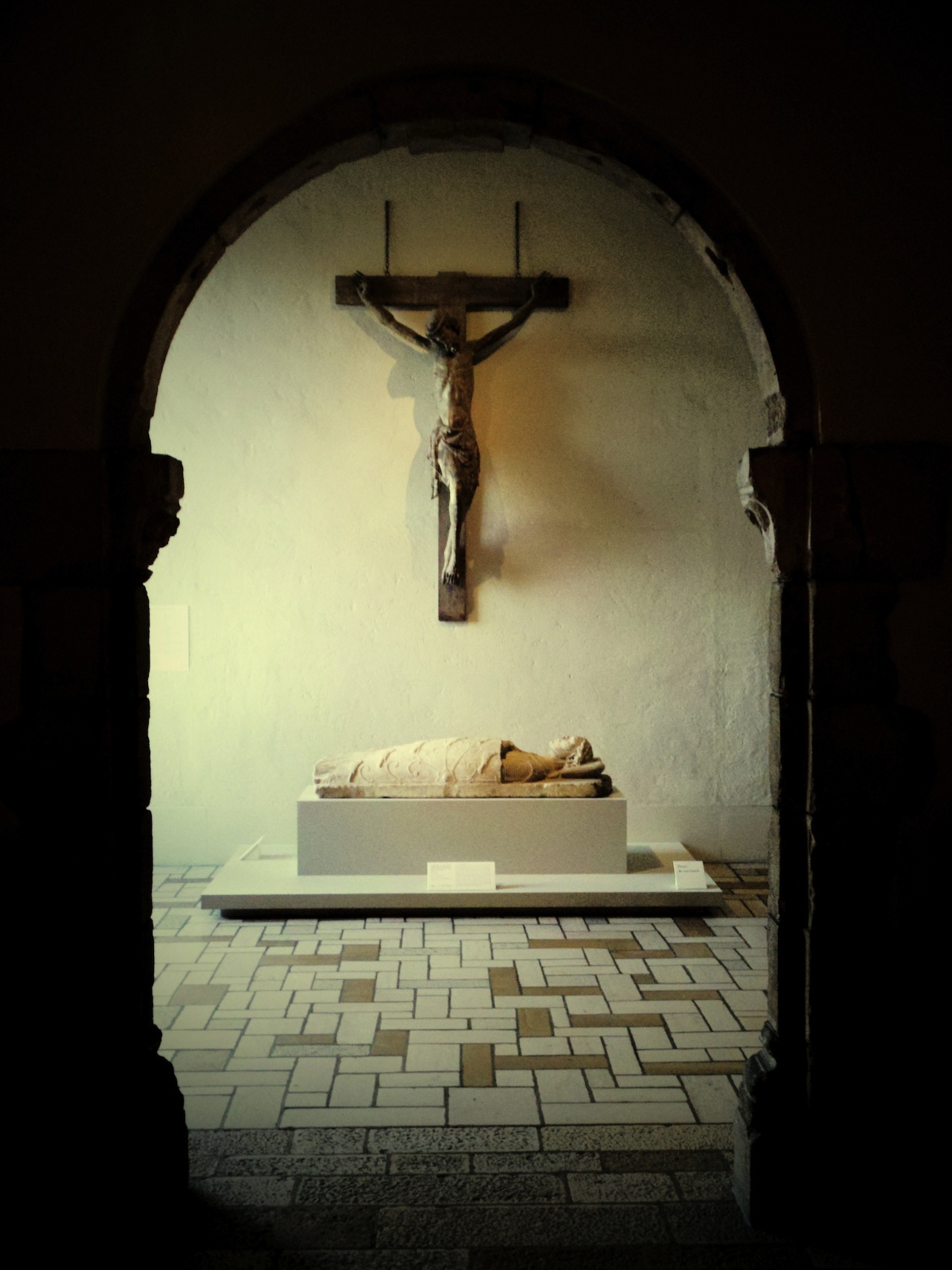
This week’s WordPress Weekly Photo Challenge theme is “Renewal“.  This here is a picture of one of my favorite rooms in the Philadelphia Museum of Art. It’s in the medieval art section (a section which, as I’ve written before, carries much significance to my soul).

I still remember the first time I turned the corner and saw this crucifix on the wall. It’s crude, yet so beautiful. It faces another, dimly-lit room in which there is a medieval-era altar on which there was taken countless pieces of Eucharist.

The last time I was at the museum, though, I noticed a bit of symbolism I’d never noticed (and I have no idea why). This crucifix is positioned above a 13th-century knight’s tomb effigy. After spending some time in reflection near the aforementioned altar, I looked back through the arch and for the first time noticed that the gaze of the dying Christ seemed to be settling not on the museum passer-bys, but on the effigy of the dead knight before him.

The Christ’s gaze of sadness and pity no longer seemed to be for his own sufferings, but for the death and suffering of this one that lay before him. This gaze seemed to carry with it not only sadness, but also a stoic confidence that through this act, he would bring an end to this knight’s sleep.

Through this act of loss and sadness, here is a picture now of rebirth and renewal, made all the more meaningful as I took this picture from the steps of that altar, bathed in darkness, on which was consecrated and served Christ’s body, broken for our renewal and light–then, and today.

See my past Weekly Photo Challenges here.

___________________________

Continue reading