When your church’s “cultural relevance” fails | Acts 14.11-18


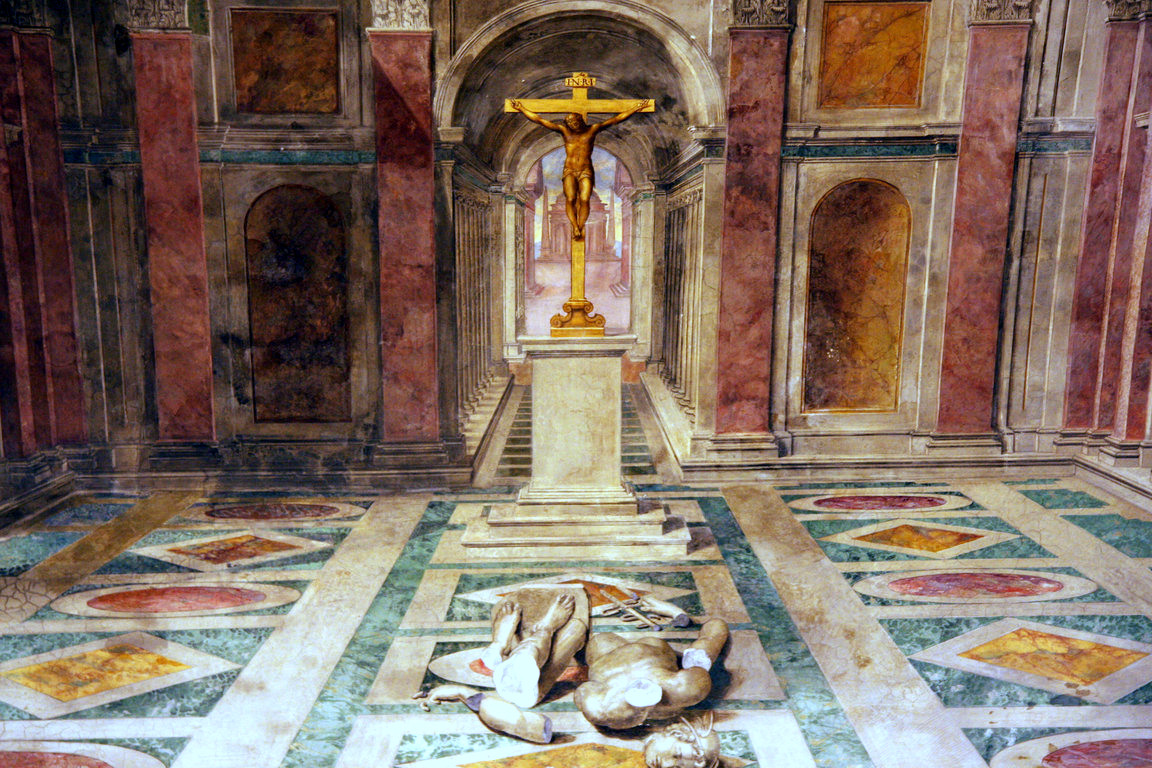
When the crowds saw what Paul had done, they shouted in the Lycaonian language, “The gods have come down to us in human form!” Barnabas they called Zeus, and Paul they called Hermes, because he was the chief speaker. The priest of Zeus, whose temple was just outside the city, brought oxen and garlands to the gates; he and the crowds wanted to offer sacrifice.

When the apostles Barnabas and Paul heard of it, they tore their clothes and rushed out into the crowd, shouting, “Friends, why are you doing this? We are mortals just like you, and we bring you good news, that you should turn from these worthless things to the living God, who made the heaven and the earth and the sea and all that is in them. In past generations he allowed all the nations to follow their own ways; yet he has not left himself without a witness in doing good—giving you rains from heaven and fruitful seasons, and filling you with food and your hearts with joy.”

Even with these words, they scarcely restrained the crowds from offering sacrifice to them.
Acts 14.11-18

This is in contrast to Paul’s later methods at Mars Hill in Chapter 17. Here we see that not every “contextualization” is created equal. Sometimes, your “relevance” could be dragging people to worship yourself or false idols. As preachers, we should always be on the lookout for this, and to constantly speak against it.

On another note, that bold part (v.15) should be the model for every single sermon.

See other Marginalia here. Read more about the series here.

Name the Darkness: Jesus & Our Persistent Demons | Mark 5:6-9


When he saw Jesus from a distance, he ran and bowed down before him; and he shouted at the top of his voice, “What have you to do with me, Jesus, Son of the Most High God? I adjure you by God, do not torment me.” For he had said to him, “Come out of the man, you unclean spirit!” Then Jesus asked him, “What is your name?” He replied, “My name is Legion; for we are many.”
Mark 5:6-9

Well this is interesting. It seems like Jesus had said words of exorcism earlier and it, in a sense, hadn’t “worked”. I wonder if the tradition behind this story was of a man so demon possessed that Jesus’ first try at getting rid of them failed. That certainly seems to be the case here. Jesus had commanded the demon to leave the man, and it didn’t.

Now, I don’t like pulling what seems like “self-help lessons” from things like this, or appealing to pop psychology, but this could be instructive in a ministry context. Jesus has appealed to his word and his authority to bring healing and to cast out the disorder and evil in this person’s life. It hasn’t worked. It is so big, it goes so far back into the past, and the issues seem so numerous, that it just isn’t going to take a quick shot to the soul.

So in light of this, how does Jesus respond? He asks the person’s name. Yes, the demon responds, but there’s no indication that Jesus is only talking to the unclean spirit here. He asks the man name, and he answers by identifying himself by his evil. But this is still progress. He gives name to what is haunting and hurting him, and this diagnoses his soul and gives Jesus the insight on how to bring healing to this man.

Giving name is powerful for healing and change and even getting rid of demons.

See other Marginalia here. Read more about the series here.

God, Social Justice, & Social Welfare | Job 5.15-16


But he saves the needy from the sword of their mouth,
from the hand of the mighty.
So the poor have hope,
and injustice shuts its mouth.
Job 5:15–16

I want to take this to all of my conservative friends. They are right that much of the life circumstances of the poor are often from the “sword” coming from their own mouth. But we also see here that their lot is not only attributed to “the sword of their mouth”, but also “the hand of the mighty”. And either way, regardless of the cause of their situation (and its persistence), the people of God are called to follow God’s lead in a commitment to pursue their freedom from these types of bondage–both within them and without. The good news is that this not only gives them hope, but it also shuts the mouth of injustice itself.

And this doesn’t seem to just be in individual ways, but even in systemic ones. Does it not follow, then, that Christian can (should?) in good conscience see their role as political beings as a means by which to accomplish these systemic ends? Perhaps it’s not just for individual Christians and Churches to “serve the poor”, but Christians utilizing political capital to mobilize government resources to follow God’s lead? Just asking.

See other Marginalia here. Read more about the series here.

Logos Bible Software & Evangelical Insecurity


devil-jesus-arm-wrestle

I use and love Logos Bible Software for my Bible study and seminary work. It really is an amazing piece of software. You can amass such a huge library of books and resources that all connect and sync up to one another.

The one problem is that they can only put the time and resources into putting out books that people will actually buy. This means that their library selection has long been skewed towards a certain demographic: American Conservative Evangelicals, usually of the “Neo-Reformed” variety.

I don’t tend to like the books that are geared for this market. Their theological assumptions seem to come first, and the text seems to often come second. I love reading robust, scholarly commentaries and books that help grow and stretch me; books that focus on the messiness of Scripture and how it is historically and culturally conditioned. Yes, this means I end up preferring writings from “liberal” (God, I hate that term) perspectives and institutions, even if my actual theological conclusions are fairly conservative.

So it’s been frustrating to me that Logos was lacking in this scholarship and thinking for some time. But in the past year, I’ve noticed this changing. More and more commentary series and scholarship book bundles are coming out by Logos that I am loving (though my bank account hasn’t). Maybe I just never noticed them before, I don’t know. But either way, I’m noticing it now, and I’m really happy.

Or rather, I was.
Continue reading

The Privilege of Holiness; The Holiness of Privilege


laureti-triumph-christianity-pagan-statue

I was at a coffee shop this past weekend doing some schoolwork when this beautiful lesbian couple came in, got some coffee, and left. I don’t know what it was about them, but they were stuck in my mind for quite a while after this. I wondered how the America church would be relating to gays at this point had sweet, loving relationships like that been the primary display Evangelicals had seen all these years.

I remembered that, as I was growing up, one of the primary Evangelical apologetics against gay rights was the whole litany of emotional, psychological, and societal detriments that come with homosexuality. I can’t tell you how many times I was told about the higher rates of depression, suicide, relationship abuse, physical health problems, STDs, and rampant unsafe sexual practices among the majority of gay population. The implicit (and sometimes explicit) suggestion was that, when someone moves so radically against “the way God designed things”, great problems are sure to follow.

Continue reading

Wolterstorff: the liturgy & worship of lament [quote]


job-silohetteLast week, I was in Michigan again for my seminary program. Tomorrow I will post some reflections on my time there. Today, I want to offer you this amazing post-length excerpt by Nicholas Wolterstorff from an amazing piece of his called, “Trumpets, Ashes, & Tears” (pdf):

I suggest that there is yet one more thing which the believer experiences in his life of dispersion and which he brings with him to the liturgy….

As we human beings travel through life we experience pain and suffering–in part our own, in part that of others. Some of this pain and suffering is non-innocent suffering; it is punishment for, or the consequence of, moral evil. But not all of it is that.

The suffering of the Israelites in the brickyards of Egypt was not the consequence of their sin, nor was the suffering of the Jews in the camps of Auschwitz. Some of the suffering of our world even resists our seeing it as the counterpart of anyone’s sin–the accidental death of a child, for example.

Continue reading

Fragments from a speech by Job| Selections of Job 6 & 7


For the arrows of the Almighty are in me;
my spirit drinks their poison;
the terrors of God are arrayed against me.
Job 6.4

What a beautiful, yet tragic series of lines.

“Teach me, and I will be silent;
make me understand how I have gone wrong.
How forceful are honest words!
But your reproof, what does it reprove?
Job 6.24-25

It must not be easy to spend this time of sadness and pain, and also ask for teaching. Yes, he is asking for answers to the wrong questions. But it seems he’s still willing and wanting to listen.

“Remember that my life is a breath;
my eye will never again see good.
The eye that beholds me will see me no more;
while your eyes are upon me, I shall be gone.
As the cloud fades and vanishes,
so those who go down to Sheol do not come up;
they return no more to their houses,
nor do their places know them any more.
Job 7.7-10

Oh, if only he could know about Jesus. On another note, I wonder how this connects to his “my redeemer lives” section later on.

What are human beings, that you make so much of them,
that you set your mind on them,
visit them every morning,
test them every moment?
Job 7.7-17-18

Well that’s interesting. Almost the same lines appear in Psalm 8, except there they are words of praise and worship of God. but here, they seem more like words of accusation, complaint and lament against God.

Why do you not pardon my transgression
and take away my iniquity?
For now I shall lie in the earth;
you will seek me, but I shall not be.”
Job 7.7-17-18

But resurrection!

See other Marginalia here. Read more about the series here.

Jonah: a Children’s Story of Verbs


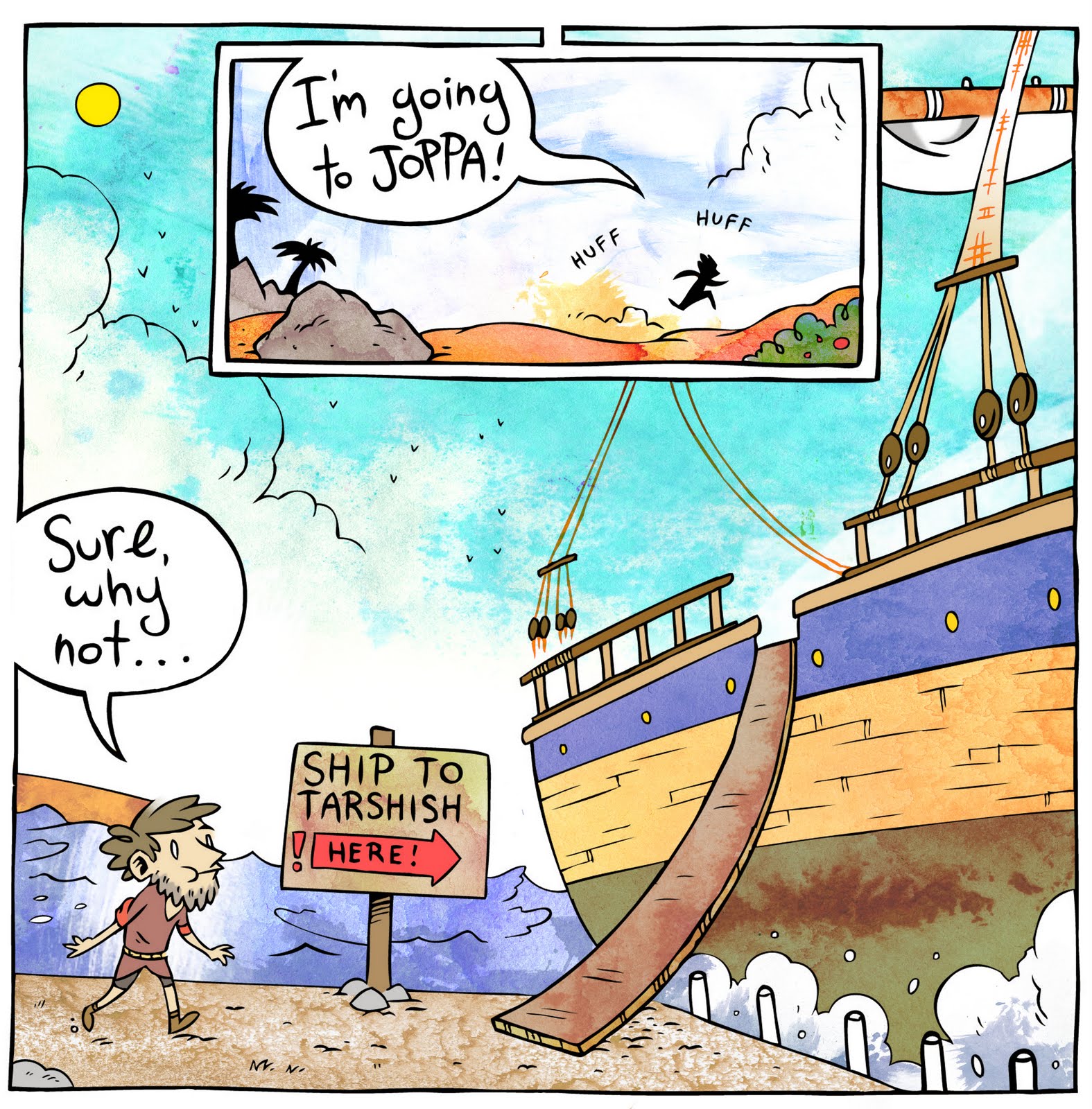
Jonah-boat-comicMy Hebrew class has moved from learning grammar to the actual process of translation and interpretation. To do this, we’re going through the book of Jonah. Our first interpretive assignment was to look at all the Jonah-related verbs in the first six verses and draw some theological conclusions. Here was my contribution.

But first, my incredibly literal and somewhat stilted translation of the opening verses [Jonah 1.1-6], including all the odd word order and idioms of Hebrew:

(1) And the word of the LORD was to Jonah son of Amittai, in order to say, (2) “Rise, go to Ninevah, the large city, and cry out against her because their evil arose to my face.” (3)And Jonah rose in order to flee in the direction of Tarshish from the toward-facing faces [Hebrew idiom for “Presence”] of the LORD and went down to Joppa and he reached a ship going to Tarshish and he gave its fare and went down in it in order to enter with them to Tarshish away from the toward-facing faces of the Lord. (4) And the LORD hurled a large wind upon the sea and it manifested as a large storm among the sea and the ship thought to shatter towards itself. (5) And the sailors were afraid and they cried out, man to his God, and they were made to throw the receptacles which were in the ship into the sea away from them towards making themselves small and Jonah had gone down into the rear of the vessel and had laid down and slept heavily. (6) And the chief sailor came to him and said to him, “Why are you sleeping? Arise! Cry out towards your gods! Perhaps the god of you will bear us in mind and we will not perish.”

And now for some lessons we can draw…
Continue reading

Must-Read: The meteoric, costly & unprecedented rise of incarceration in America [LINK]


I promise, this is the most important thing you’ll read today. One of the many stunning facts: in this report:

“As a result of these trends, black men younger than 35 without a high school degree are now more likely in America to be imprisoned than employed in the labor market”

http://www.washingtonpost.com/blogs/wonkblog/wp/2014/04/30/the-meteoric-costly-and-unprecedented-rise-of-incarceration-in-america/

Sometimes God’s Heart breaks mine | Mark 4:10-12


When he was alone, those who were around him along with the twelve asked him about the parables. And he said to them, “To you has been given the secret of the kingdom of God, but for those outside, everything comes in parables in order that

‘they may indeed look, but not perceive,
    and may indeed listen, but not understand;
so that they may not turn again and be forgiven.’”

Mark 4.10-12

I simply don’t understand what this says about the heart of God. It seems at odds with everything else Jesus does. Is this just a temporary thing in order for the Gentiles to join in the mystery of redemption? Or is it truly as cold and calloused as this seems? Any help here would be appreciated.

See other Marginalia here. Read more about the series here.

Job, God, & Satan (Can I get some help from the scholar’s out there?)| Job 1.6-7


One day the heavenly beings came to present themselves before the Lord, and Satan also came among them. The Lord said to Satan, “Where have you come from?” Satan answered the Lord, “From going to and fro on the earth, and from walking up and down on it.”
Job 1:6-7

Anyone out there know how the ancient Israelites would have received these words? I see no other parallel in the OT to something similar to this (maybe the Psalms about God’s combat with the other gods?). I find it so confusing.

The one thing I am confident of, though, is that the conflating that Christians often do with this stuff is out of line. The way that (especially Evangelicals) use these verses to set up a systematic theology of “Satan” is absurd and does damage to the texts. Also, there is no indication that this is the same entity that is the serpent in the garden, nor the “Morning Light”, nor the NT Beelzebul, nor the beast of Revelation. Heck, there’s no clear connection between this particular “Satan” and the NT “Satan”.

See other Marginalia here. Read more about the series here.

A Holy Saturday kind-of Easter (on doubting the Resurrection)


Rothko-blue-and-gray

The culmination of Lent is Holy Weekend, prefaced by Maundy Thursday and consisting of Good Friday, Holy Saturday, and Easter Sunday. I realized that each year that I have been really intentional about my Lenten engagement, one of those four “Holy Days” seems to overshadow the the others and carry over into this Easter season (yes, it’s a season).

There are some years where the foreshadowing and ever-repeating Presence of Jesus in Communion makes Maundy Thursday the highlight (or lowlight?) of Lent. Some years, the utter darkness, weight, and drama of Good Friday overtake me and linger in my mind well into Easter season. And still others, no matter how I try to reflect and meditate on sinfulness and fallenness, I still can’t escape the lighted joy and horizon-cresting dawn of Easter, whose anticipation overshadows (or over-brightens?) my Lenten experience, making all the doom and gloom seem foreign to me.

For me, this year is a Holy Saturday kind-of Easter.
Continue reading

Here’s absolutely everything the Gospels say was happening on Holy Saturday


The next day, that is, after the day of Preparation, the chief priests and the Pharisees gathered before Pilate and said, “Sir, we remember what that impostor said while he was still alive, ‘After three days I will rise again.’ Therefore command the tomb to be made secure until the third day; otherwise his disciples may go and steal him away, and tell the people, ‘He has been raised from the dead,’ and the last deception would be worse than the first.” Pilate said to them, “You have a guard of soldiers; go, make it as secure as you can.” So they went with the guard and made the tomb secure by sealing the stone.
–Matthew 27.62-66

On the sabbath they rested according to the commandment.
–Luke 23:56b

Yep. That’s it.

See other Marginalia here. Read more about the series here.

Sabbath [a Holy Saturday poem]


Rothko-Black-RedOn the 1st Day: God created Palm Trees and Donkeys
On the 2nd Day: He created Fig Trees and Temples
On the 3rd Day: He created Scribes and Pharisees
On the 4th Day: He created Silver and Kisses
On the 5th Day: He created Bread, Wine, and Gardens
On the 6th Day: He created a Tree, Nails, and Thorns

And on the 7th Day: God rested from His labor.

And there was evening
And there was mourning…

___________________________

[read my other Holy Day poetry here]
all writings licensed: Creative Commons License

Liturgy & Readings for Holy Saturday (2014)


This is from the Liberti 2014 Lent & Easter Prayerbook. Download the book for free for poetry and extended reflections for this week and next.

WORSHIP

call to prayer.

Be pleased, O God, to deliver us;
O LORD, make haste to help us!
–Psalm 70.1

the Gloria.

Glory be to God the Father, God the Son,
and God the Holy Spirit.
As it was in the beginning, so it is now,
and so it shall ever be, world without end.
Amen!
-the “Gloria Patri” !

the Psalm.
Continue reading