The Body of Christ, Broken (a guest post for Restoration Living)


family-old-moustache

Yeah, that’s my family (I’m in the front left). This was one Easter Sunday in the 90’s in Dallas, Texas, at a time and place where (I promise) it was absolutely appropriate to dress like that for Easter (except the glasses, of course). I look at this picture a lot, and not just to chuckle. I find it so oddly and powerfully symbolic of what life in the Bible Belt was like.

You see, my family was deeply wounded by “Church folk” throughout my childhood. Just as in the picture, people in the Church would live their Christian lives dressed up and looking good, all while wearing masks, disguising who they really were. When things were hard at home, people at church had no categories to process it. After all, to be a Christian is to be cleansed by Jesus and walk in new life, right? Failures, sins, and brokenness were seen as signs of some disobedience – some place where you weren’t “okay.”

_______________

And so begins a guest post I wrote for a wonderful site that should be on all of your radars, Restoration Living. Read the rest of the post here.

Weekly Must-Reads {2.12.14} | Creation, Masturbation, & Communism


guy-newspaper-reading

Well, it’s been a good long while since I’ve posted a Reading List for you all to enjoy–too long, in fact. These were some of my favorite things I read this week. What were some of yours?

__________

In defense of creationists | The Week
Michael Brendan Dougherty

I referenced this at the end of my post yesterday, but this is a stunningly beautiful piece that wrestles with humanizing those that frustrate us the most in the Christian family. A must-read for sure.

Escaping the Prison of the Self: C.S. Lewis on Masturbation | First Things
Wesley Hill

Don’t overlook this piece too quickly. It is an incredibly powerful piece that speaks to how all of us–married, single, gay, straight–engage our sexuality in this world. It showed me how having celibate unmarried people in the world is necessary for healthy marriages, as well as how masturbation ruins even good friendships.

Continue reading

I think we all need a reminder: Ken Ham is on our team.


ken-ham-banner

Okay, this one is a tough one to write.

Most all of us know by now about the Great Debate that happened a couple of weeks ago between Bill Nye and Ken Ham on whether or not Creationism is a viable model for human origins. If you’ve followed this blog for an real period of time, you know it’s no secret that I do not think it’s a viable model, and I’ve been quite vocal about that in this space.

So I felt the frustration when Ken Ham was treated like the stand-in for every Christian that wants to take the Bible seriously. I felt better when smart Christians responded well. I chuckled at those that poked fun of him and other Creationists, debunked their logic, or discredited the historical stream in which he finds himself. I gave into the private mocking.

I was then really encouraged when I read this report in Christianity Today that shows that Americans are not as divided on this issue as some polls make it seem. I was overjoyed with knowing that more Christians than ever were leaving the Ken Hams of the world in the dust of irrelevance, their budgets and voices shrinking in the distance.

As the discourse went on, I began to thinking to myself: I think we’re winning! But then yesterday, I felt like I woke from a fog and thought: Wait. Who are we fighting?
Continue reading

Donald Miller is just plain wrong about church. But it’s not his fault.


donald-miller-bw-1

Donald Miller, author of Blue Like Jazz, started a little kerfuffle last week when he wrote about how he doesn’t really go to church any more. He doesn’t learn much about God through sermons, and he doesn’t connect with God through songs. Church just doesn’t connect with him in any way and doesn’t fit within his own learning style, which is far more participatory. He says the Church is all around us and in believers so he feels free to “have church” in the way(s) that most connect him to God and others.

Well, this caused quite the backlash. He wrote again a couple of days ago in response, but it seems that most people still really disagree with him.

But here’s the problem: Donald Miller is absolutely right in everything he says if he still insists on calling himself an “Evangelical”, or at least using that as his frame of reference.

If you consider yourself an Evangelical in any traditional sense, and you’re looking at Donald Miller’s church practices with dismay, well then welcome to your future–the logical conclusion of your theology and how you’ve practiced church for a few generations now.
Continue reading

Abraham almost loses his son & he worships?! | Genesis 22.13-14


 And Abraham looked up and saw a ram, caught in a thicket by its horns. Abraham went and took the ram and offered it up as a burnt offering instead of his son. So Abraham called that place “The LORD will provide”; as it is said to this day, “On the mount of the LORD it shall be provided.”
Genesis 22.13-14

This is right after the whole “sacrifice Isaac” thing. To me, this such an odd response. Not only does Abraham worship God after this, which is crazy enough as it is, but he also sets up a memorial to remember this by! If I were him, I’d need some space from this God for a bit and I’d want to forget this incident as soon as possible.

I’ve always thought it odd that the book of Hebrews puts such an emphasis on Abraham and calling him the “father of faith” and extols his faith so much. Whenever I read that I think about how he had Ishmael with Hagar, due to a lack faith, and (twice) gave his wife up to be the wife of someone else because he was scared they’d kill him–another example of a lack of faith!

But then I read things like this and I think to myself, “Oh yeah, now I get it.”

See other Marginalia here. Read more about the series here.

That elusive Rest of all rests…


oldrich-kulhanek-untitled2At my job, I have this client (nowadays they’re called “participants”) who’s unlike any other I’ve known. He’s got some sort of complicated cocktail of mental health issues going on. Whatever they are, they’ve come together to create the most agitated, anxious, hyper, manic, rapid-thinking individual I’ve ever seen.

He’s the kind of guy whose own thoughts race a million miles an hour in addition to the other voices in his head doing so as well. He craves attention and simply has to be the center of it at all times; the more people around, the more dramatic and performative he becomes. He acts out like a child in any way to get the attention he craves, all while his inside hums and buzzes with a constant anxiety.

He can easily talk non-stop for hours with random things setting off new associations and new lines of thought and one topic flowing into another topic that seems unrelated, save for a color, a location, or even a word in common with the prior one. The first time I met him, his thoughts became so fast and so loud, he started screaming and clawing at his head just to get them to quiet down.

He evokes little sympathy from those around him, including myself. He seems to thrive on the fact that he can so affect people–even if it’s in a negative, irritating way.

Continue reading

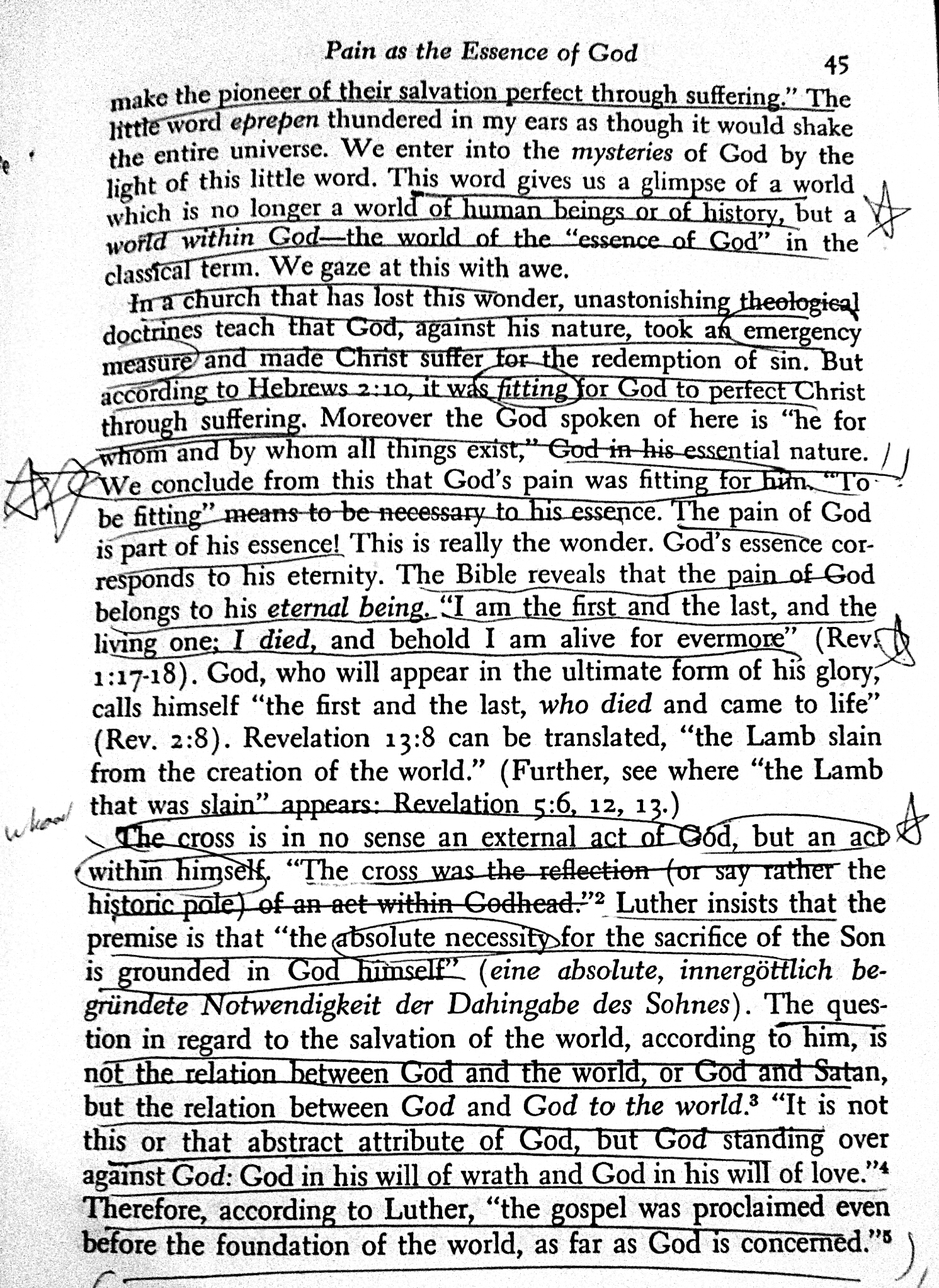
Crazy thought of the day: God Died. [QUOTE]


“The task of witnessing to the gospel is to vitalize the astonishing fact of the gospel. The message “the Son of God has died” is indeed most astonishing…. God has died! If this does not startle us, what will? The church must keep this astonishment alive. The church ceases to exist when she loses this astonishment. Theology, the precise understanding of the gospel, must be seized by this astonishment more than anyone else. It is said that philosophy begins with wonder; so theology begins with wonder. The wonder of philosophy pales before the wonder of theology. The person astonished by the tidings “God has died” can no longer be astonished at anything else.”

Kazoh Kitamori, Theology of the Pain of God

Christians, Contraceptives, & Civil Disobedience (ii)


Nicolas-Poussin-peter-john-healing-lame-manOkay, I lied. This will be three posts, not just two.

Last week, in light of Catholic institutions moving more towards Civil Disobedience in light of certain provisions in the Affordable Care Act, we looked at Acts 4 to see if there was any guidance we could get in this. We talked about how (1) Civil Disobedience is not warfare against the laws of your geographic home, but simply living in light of your spiritual home–the Kingdom of God. We also pointed out (2) that the State is not around to comply with our every theological preference and whim, and therefore some discretion needs to be used to evaluate what’s “worth” Civil Disobedience.

Today we keep going. I want to offer some summary conclusions, but first let’s point out the last thing the Acts 4 passage helps us see: the work we do in society prior to our Civil Disobedience.
Continue reading

Advent & Hoping for God to be With Us


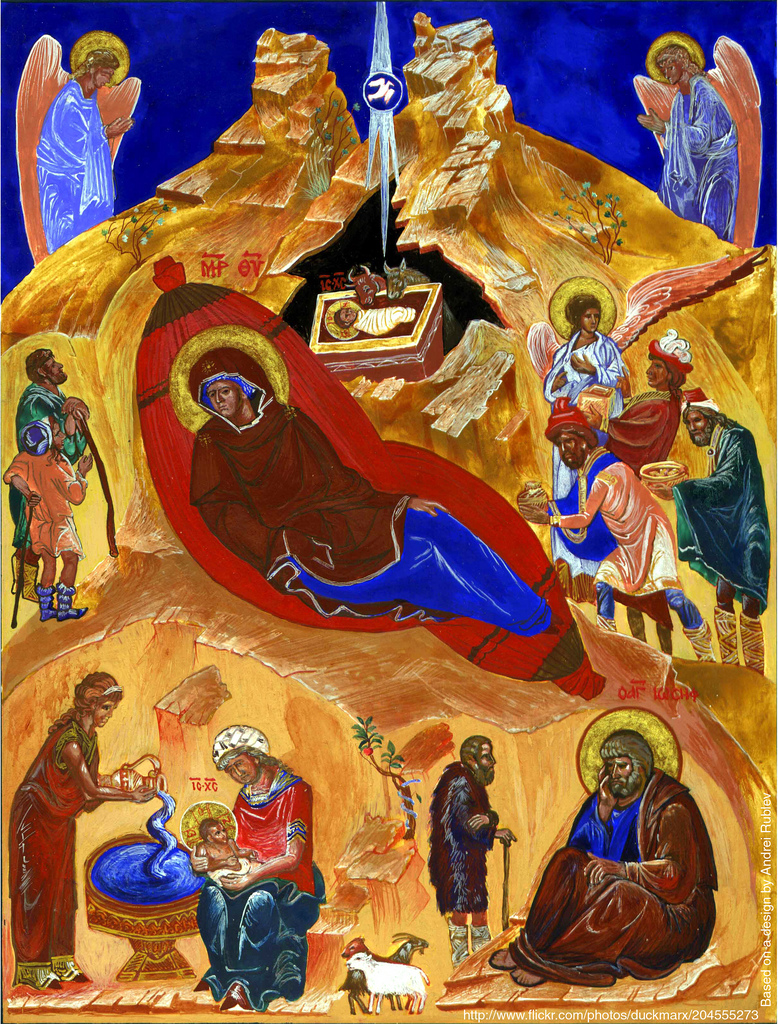
icon-Nativity-christmasThis is the meditation I wrote that appeared in this weekend’s reading and reflection in Liberti Church’s Advent 2013 Prayerbook, which can be downloaded for free.

The Reading:

Again the Lord spoke to Ahaz, saying, Ask a sign of the Lord your God; let it be deep as Sheol or high as heaven. But Ahaz said, I will not ask, and I will not put the Lord to the test. Then Isaiah said: “Hear then, O house of David! Is it too little for you to weary mortals, that you weary my God also? Therefore the Lord himself will give you a sign. Look, the young woman is with child and shall bear a son, and shall name him Immanuel.

If you’ve been keeping up with this Prayerbook (or any Advent guide), then congratulations! I hope it’s spoken to you and you have experienced God in its readings and meditations.

That being said, you might be wondering: why is this Prayerbook continuing after Christmas Day?

It was only a couple of years ago I found out that in the Church Calendar, Christmas is not just a day—it’s an entire season! Advent Season leads into Christmas Season. Why is this? Advent has a similar relationship to Christmas that Lent does to Easter: it’s meant to be the time of reflection, preparation, and repentance that prepares us for the unbridled, no limits, over-the-top celebration and joy of Christmas. Our spiritual ancestors knew that celebration takes time and preparation. That’s what Advent has been.

But now we’re in the Christmas Season—the time of complete unfettered celebration. But why?
Continue reading

A Biblical Critical Advent: Luke’s Cosmic Christmas


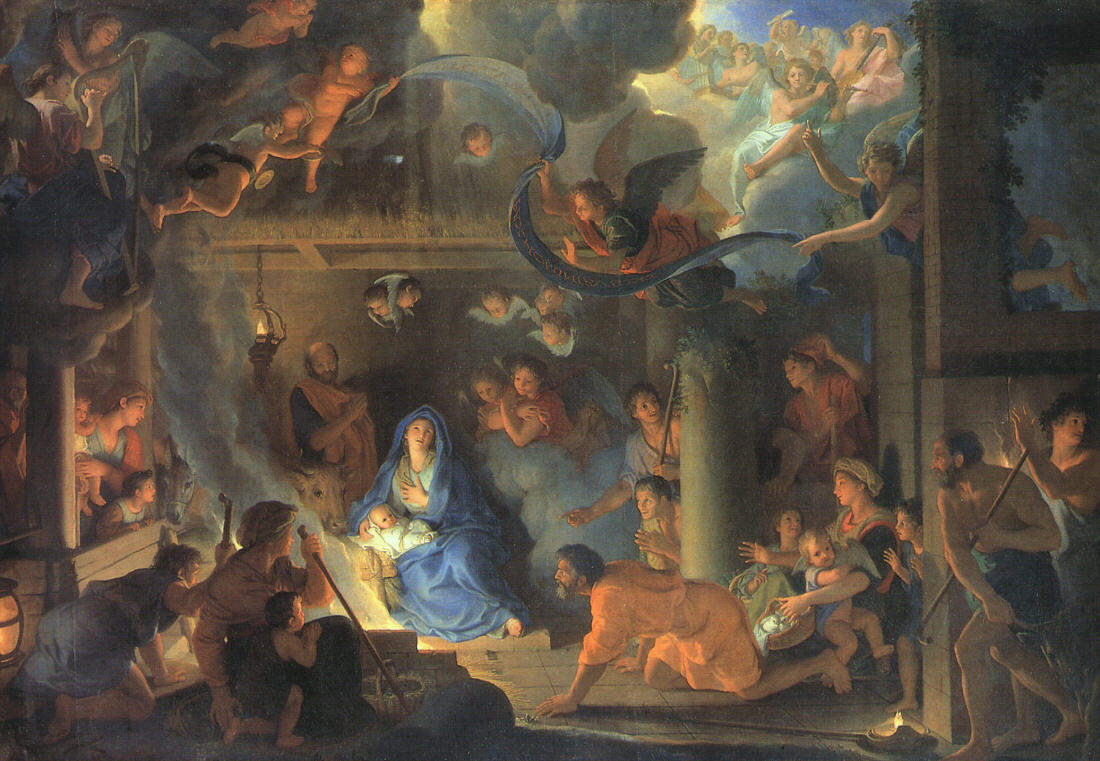
Charles-le-Brun-Adoration-of-ShepherdsFor Advent this year, I wanted to put up a few posts looking at Matthew and Luke’s Nativity stories as they were meant to be read: as two separate stories with their own purposes and themes. We often just mush them together, and I think we lose something in that process. Last week, we sat with Matthew’s Nativity story. Today, we turn to Luke’s Christmas.

Matthew’s Nativity focuses on how Christmas plays right into Israel’s own story; how this is exactly how the Jewish Messiah should be expected to have come into the world. Luke’s Gospel, on the other hand, emphasizes Jesus’ significance to the entire world, all parts of society, and the entire cosmic order.

In other words, Jesus’ mission in Luke is much larger than simply Israel. These and other Lukan themes are brought out quite strongly and explicitly in his Nativity narratives. Today we’ll see how he does this through signs of the universal mission of Jesus, the story’s emphasis on the lowly and powerless, and his stories of Spirit-filled joy.

Continue reading

Advent & Longing for Home


Sandorfi-MadeleineThis is the meditation I wrote that appears in a reading and reflection in Liberti Church’s Advent 2013 Prayerbook, which can be downloaded for free.

There is an incredibly profound way in which we don’t feel at Home in our own humanity.

Too often, Christians see their own personal spiritual growth as a loss, a lessening, or an abandoning of their own humanity. This can lead us to subtly use people and things to try and find our soul’s Home. And so we awake to find anxiety, manipulation, doubt, guilt, and self-loathing ruling and reigning so many parts of our lives and relationships. (Am I alone in this?)

We can sometimes think of Christianity as a process of our souls leaving the “Home” of their weakened humanity and finding a “new, spiritual Home” in Jesus. The logic goes that you were originally one way, then Jesus “saved” you, and now you are able (and are commanded) to be something else, now that you are His.

But Advent radically flies in the face of this.
Continue reading

A Biblical Critical Advent: Matthew’s Old Testament Christmas


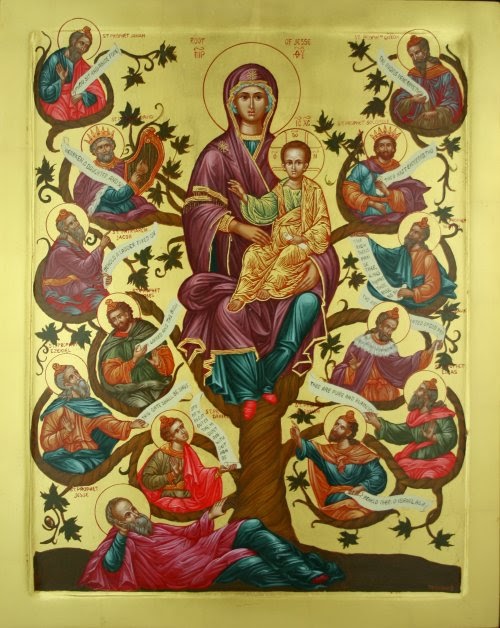
root-jesse-matthew-icon

For Advent this year, I wanted to put up a few posts looking at Matthew and Luke’s Nativity stories as they weren’t meant to be read: as two separate stories with their own purposes and themes. We often just mush them together, and I think we lose something in that process. Today, we look at Matthew’s Christmas Story.

It’s well-known that the Gospel of Matthew portrays Jesus as the fulfillment of Jewish messianic expectations. But the path Matthew takes in doing this moves against the way most messianic expectations played themselves out at time. Matthew recalibrates these expectations to show how even in Jesus’ infancy and birth, his “Messiah-ness” includes a retelling of Israel’s own history, both good and bad.

You can see this especially clearly in the way Matthew crafts his version of the Nativity story. Today, we’ll look at three particular aspects of this story that show his unique thematic and purposeful crafting of the birth story: his use of people and names, geography, and the fulfillment of the Old Testament.
Continue reading

Advent & Hoping for Justice


Massacre-of-innocentsThis is the meditation I wrote that appears in today’s reading and reflection in Liberti Church’s Advent 2013 Prayerbook, which can be downloaded for free.

First, a question.

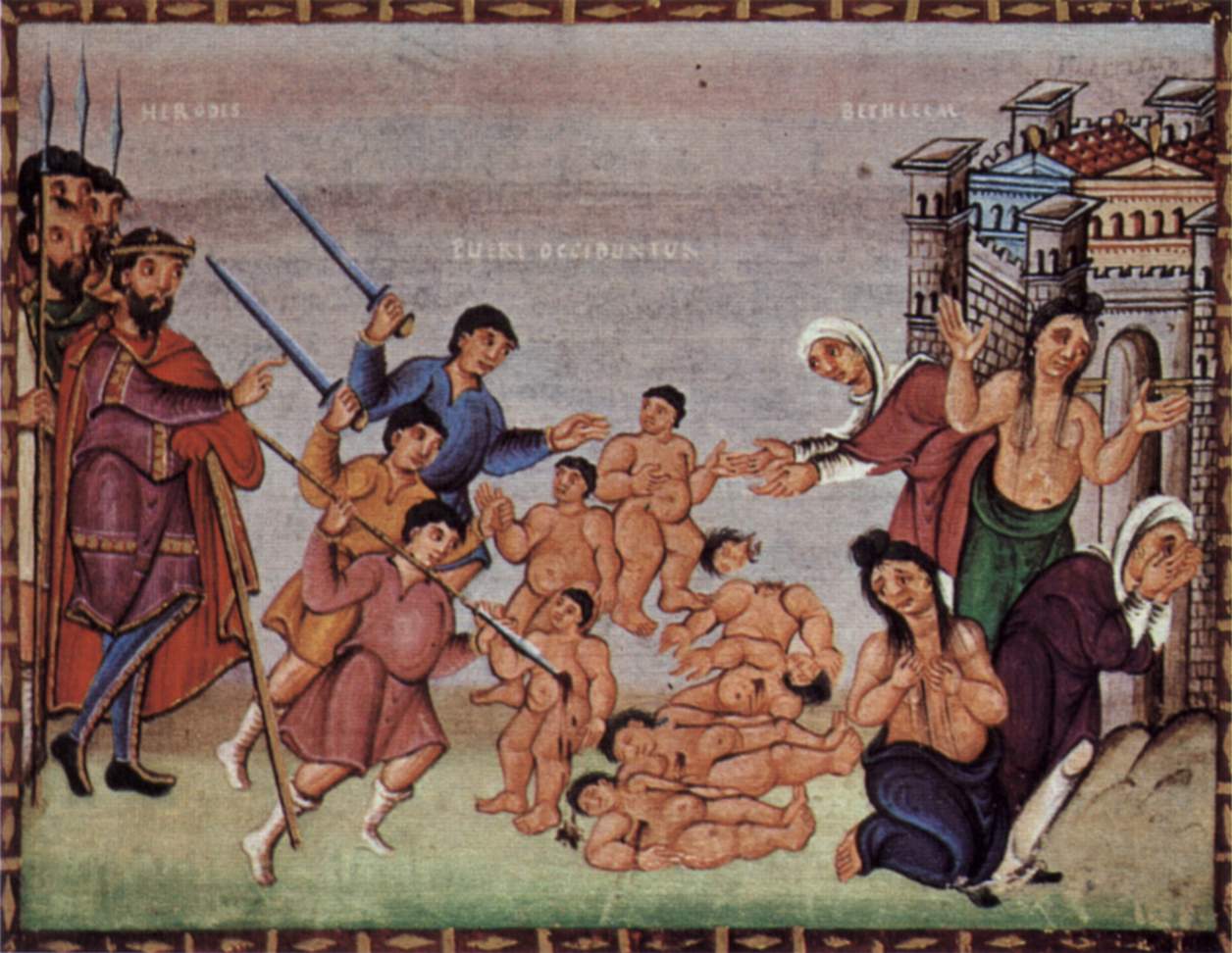
Think back on the Christmas story. After Jesus is born, when he’s about three-years old, King Herod puts out a decree calling for the death of all infants, trying to kill Jesus. An angel comes to Joseph in a dream and tells him to flee to Egypt to prevent Jesus from dying in this slaughter.

Here’s the question: why flee to Egypt?

If they stayed and Herod killed the child Jesus, wouldn’t that still be the Son of God dying unjustly at the hands of a Roman provincial governor? Why go to all that effort to wait 30 years later for the same thing to happen on a cross?
Continue reading