Philly’s Outdoor Feeding Ban: Good for the City, the Church, & the Gospel (i)


Update: the second (and final) part of this article is up, where we discuss some ways to look at this theologically.

Just over a month ago, Mayor Michael Nutter of Philadelphia announced a controversial plan to ban the outdoor feeding of homeless individuals in the city parks and on the Benjamin Franklin Parkway, home to many of this city’s finest museums, including the soon-to-open (and just as controversial) Barnes Foundation.

This has been met with the expected and understandable anger and protest from many of the city’s hunger-based non-profits and faith-based homeless ministries that participate in these outdoor feedings (the ban is still in process and has not been enforced yet). Some leading homeless advocates support it.

Many of these religious groups understandably feel like this move is an over-reach of cold, heartless government, trying to keep the church from doing its God-given call to feed the hungry and clothe the naked. Many have felt like this is an imposition on the religious freedom of the Christians of Philadelphia.

I would like to, as humbly as possible, disagree.

Continue reading

“15 Glances” at the Crucifix | Lent {11}


In the tradition of giving honor where it’s due, I’ve like to offer up the post that served a the inspiration for this whole series I’ve been doing on “The Lamb Eternally Slain” (which still isn’t done, even though it’s no longer Lent. It’ll be okay, though). The post is by Ben Myers, a thoughtful and thought-provoking theologian who draws from many theological corners for his thinking (much like myself). Here it is:

The Icon of the Cross: 15 Glances | Faith & Theology

Austin Ricketts, who wrote a couple of the posts in this series, sent to me this post of Ben’s nearly nine months ago. I still remember where I was as I read it and was caught up in it’s transcendent, sweeping reflections on the icon of the Cross. (Yes, we are referring here to “icon” as in the artistic representation of religious things for use in meditation or worship. Don’t worry, fellow Protestants, icons aren’t nearly as bad or idolatrous of a thing as we were raised being told.) I had the idea then for this blog series on my blog, but held on to it until Lent, thinking it most appropriate for this time (instead of Advent, haha).

In his post, Myers spends some time jotting down 15 reflections (or “glances”) on this icon. I have copied a few of my favorites below, but please check out the full post–there’s far more beauty in store for you.

Continue reading

on Holy Saturday: “to death, a sonnet” [a poem]


to death, a sonnet

A fear as frank as frankness be
I hold within this frame so dear;
so dear please hold me, till this dark is past
_____— till the darkness passes mine eye.

But to be so engraced I know I must face
_____– and lose-
___________to this spectre this prospect requires.

O this still darkest night, I lie here betwixt
competing rays
__________of glory’s gaze.
One lies ahead; one lies to my face
___both wooing and charming a choice from my hands:

___________to re-seize and be lived,
___________or release and be sieved?

[read my other Holy Week poetry here]

[image by Mark Rothko]

all writings licensed: Creative Commons License

Chesterton on the Atheism of God on Good Friday [QUOTE] | Lent {10}


When the world shook and the sun was wiped out of heaven, it was not at the crucifixion, but at the cry from the cross: the cry which confessed that God was forsaken of God. And now let the revolutionists choose a creed from all the creeds and a god from all the gods of the world, carefully weighing all the gods of inevitable recurrence and of unalterable power. They will not find another god who has himself been in revolt. Nay (the matter grows too difficult for human speech), but let the atheists themselves choose a god. They will find only one divinity who ever uttered their isolation; only one religion in which God seemed for an instant to be an atheist.

–from Chesterton’s Orthodoxy, as quoted by philosopher  Slavoj Zisek, in this article on “German Idealism & Christianity, from Hegel to Chesterton” (via Micah Towery). Read the rest of this Lent series on “The Lamb Eternally Slain”

on Good Friday: “Coffee Crucifix” [a poem]


Coffee Crucifix

Crescent ring under porcelain smooth
___stain the wood-stained finish.
______(It is finished.)
___Marked with muddy water;
___mark the merry day; to
___marry the murdered man.

Floral notes in blackened waves
___crash the shore of trembled lips.
Choral bright, in darkest night,
___wake the tone of trebled kiss.

Younger tastes left open-wide; older eyes made
satisfied.

Mark the wood: complex simplicity.
Pierce my heart: storied infinity.

[read my other Holy Week poetry here]

all writings licensed: Creative Commons License

Maundy Thursday, Narrative & Sacrament | Lent {9}


Today is Maundy Thursday which is the time in the Christian Church calendar where we celebrate the institution of the Lord’s Supper; it also initiates the three Holy Days of Good Friday, Holy Saturday, and Easter Sunday.

I was raised as a Southern Baptist in Dallas, Texas. Liturgy, Church calendars, Holy Days, and Prayer books were as foreign to me as R-rated films, alcohol, and dancing. Now, though, as I’m looking for a Church to go to for a Good Friday service, even the Presbyterian church service all my friends are going to doesn’t feel liturgical and structured enough for me. What happened?

In the last few years between going to seminary (and dropping out) and changing churches, I have fallen in love with both liturgy and Sacrament.

Continue reading

From His Father [GUEST POEM]


by Jen Huber

He can easily say what he has lived by:
God and belonging; known from childhood.

He was raised to believe in what was taught
To stand by his father’s belief in his Father
Accept the judgement of another,
The forgiveness of one another
Believing in something unseen

From generation to generation
This belonging to faith has remained
And grasped his life long-lived
And to know that his Father carried
Him throughout his time

He can easily say what he has died for

[image credit: Lauren Chandler]

Nietzsche, the Cross, & the Weight of the World | Lent {8}


If every second of our lives recurs an infinite number of times, we are nailed to eternity as Jesus Christ was nailed to the cross.  It is a terrifying prospect. In the world of eternal return the weight of unbearable responsibility lies heavy on every move we make. That is why Nietzsche called the idea of eternal return the “heaviest of burdens”. If eternal return is the heaviest of burdens, then our lives can stand out against it in all their splendid lightness.

But is heaviness truly deplorable and lightness splendid?

…. The heavier the burden, the closer our lives come to earth, the more real and truthful they become.

Conversely, the absolute absence of a burden causes man to be lighter than air, to soar into the heights, take leave of the earth and his earthly being, and become only half real, his movements as free as they are insignificant.

What then shall we choose ? Weight or lightness?

— Milan Kundera, The Unbearable Lightness of Being
Continue reading

Free Holy Week Music: Cool Hand Luke’s “Of Man” & Lent Mixtape


All of us know that one of the things that can affect our mood like no other is music. And so, to that end, I wanted to tell you about one of my favorite albums ever, by my favorite band ever (they’ve had that title since I was in high school, so I promise, I’m not just exaggerating for effect), Cool Hand Luke’s Of Man.

Continue reading

Holy Week & Meditations on Radical Grace


Last year, on Palm Sunday, I got the privilege to deliver a little message to a group of men at the prison ministry my church does each month. I ended up building off of that message and its outline and writing a series of blog posts meditating on Holy Week and the radical, scandalous grace inherent in the story and actions of Jesus over those days. For your mediation this year over Holy Week, I wanted to post these links for your perusal and, hopefully, your blessing.

The Scandal of Holy Week

{i} the forsaking of God | In this post, we meditate on the fact that Holy Week was the week-long process by which everything–from humanity to creation to God Himself— forsakes Jesus. We see that true disciples are not those that never forsake Jesus. In fact, we will all forsake Jesus in radical ways at some point.
Continue reading

On Palm Sunday (or, “Oh, the Glory, the Beauty, & the Tragedy of Being Human!”) [REPOST]


This past Sunday was Palm Sunday, the Christian holiday that ushers in Holy Week. It celebrates the “triumphal entry” of Jesus into Jerusalem (Mk 11:1-11). Seen with the insight of hindsight, though, this is one of the oddest “triumphal entries” one could imagine. It is the triumphal kick-off for what will be the death of the Son of God.

Lately, I’ve been thinking about the common “courtroom” analogy for the Gospel. You’ve surely heard it: You are standing before a judge. You are guilty. The punishment is death. It is a right and just penalty for your crimes. But then Jesus comes in and freely offers to take your punishment for you on your behalf so you can be set free. Will you accept this gracious offer?

Many an atheist has pointed out the logical flaws in this analogy, but I think there are even bigger issues I have with it. Really, it only works if the parties involved in this switch are seen as equals. A pure man for a guilty man — seems like an even trade, right? But how then does the death of this one man absolve the sins of a multitude? How is this even just?

Continue reading

Love: The Beginning & End of Divine Suffering | Lent {7b} [GUEST POST]


[Yesterday, my good friend Austin Ricketts kicked off this two-part post, part of my own Lent series, talking about how the “disposition” or “intention” of God is Love, firstly exercised towards God’s own Self in the Trinity. And this Love moves away from the lover toward the loved as it is given. Therefore….]

Update II: In an interesting twist, Austin has since recanted these comments, though I still entirely agree with these original ones. So….I’m going to keep them up, but with this comment.

death & distinction in God

The reason why death is an appropriate notion by which to understand this relation, then, is that death entails separation or distinction between two or more things that otherwise belong together.

Death is not an end of life, necessarily, but rather a limit and transition.  For humans, the Bible points out that there is a limit and transition that occurs at material death.  At that time, humans exist as a bodiless soul, at least until the final resurrection.

Death is a separation or distinction between two or more things that naturally belong together; in the case of humans—a body and a soul.

Considering God again, “separation” can’t really be the right word.  Distinction is more orthodox.  I mentioned earlier that it is incorrect to see a “lessening” of the Father’s being when transitioning to the Son.  That’s because there isn’t a lessening of being at all.  Quite the opposite.
Continue reading

Love: The Beginning & End of Divine Suffering | Lent {7a} [GUEST POST]


[Note: Today, we have another post by my good friend Austin Ricketts. I asked for him to write some of his thoughts on the current Lent series I’m doing and this is what he came up with. He’s written other things for my blogs before, and each time, I end up with my mind blown. This post certainly follows in that tradition. This piece is a bit longer (even after breaking it up into two posts), but I encourage you to read it in its entirety. Really, you will not be disappointed.]

Update: Part 2 of this post is up.

Update II: In an interesting twist, Austin has since recanted these comments, though I still entirely agree with these original ones. So….I’m going to keep them up, but with this comment.

When delving into the mystery of the Trinity, it is inevitable that one approaches Light too bright to see through, a mountain too high to climb, a cave too deep to spelunk.  That this is the case does not mean that one shouldn’t move into any light, climb as highly as she can, spelunk as deeply as he may.  That would be an unbiblical quietism, and unhealthy for the soul.  The soul needs exercise.

Here I attempt to exercise my soul by exorcizing the ancient demons called simplicity and impassiblity.  I pray that I do this while abiding in love.  But I do it nonetheless.
Continue reading

The Slain God of Evolution | Lent {6}


This Lent, we’ve been going through a series meditating on some of the implications of the fact that we worship a God who was “slain before the foundations of the world”–in eternity past–and therefore has some aspect of “slain-ness” to his very nature.

In the last couple of posts, we’ve been focusing on what this means for the many references in which the Bible says that the world was created “through Jesus”. What might it mean that the world came into being through a suffering and slain Lord? What might it mean for our own suffering?

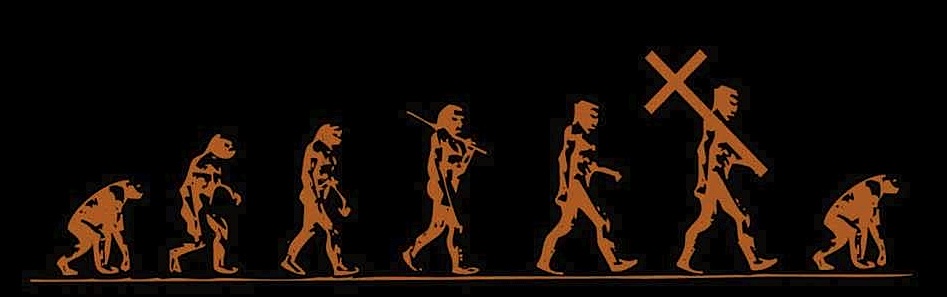
This got me thinking about Evolution.

Obviously, the main vehicle driving Natural Selection is death and dying. This is one of the biggest hindrances that Christians have to the idea of Evolution. If our usual categories are correct of a “good” creation “falling”, and only then ushering “death” into the world, how does the thoughtful Christian deal with the realities of Evolution?

I think this Lenten idea of God’s “slain-ness” can help.
Continue reading

Christ’s Heart Breaking in Us | Lent {5}


Lent is a season in which God’s people meditate on the slaying of Jesus on the Cross and all that is within them (and outside of them) that made that Cross necessary. So to that end, we’ve been doing a series meditating on the fact that Christ is the Lamb who was “slain before the foundations of the world”. We’ve been thinking through what it might mean that Jesus, in some sense, has been suffering for all time.

[suffering]

We’ve said that the Cross was an in-breaking of the suffering essence of God into our world. Think of it as a volcano that emerges after a millennia of quiet tectonic plate shifts. Eternity and infinity–past, present and future–break into the world at the Cross; eternity is the backdrop against which the death of Christ occurs.

We’ve also said that the world has a certain “slain-ness” to it as well, due to being created “through” a slain and suffering Christ.

Today I want to ask: What might that mean for our own suffering and death?
Continue reading