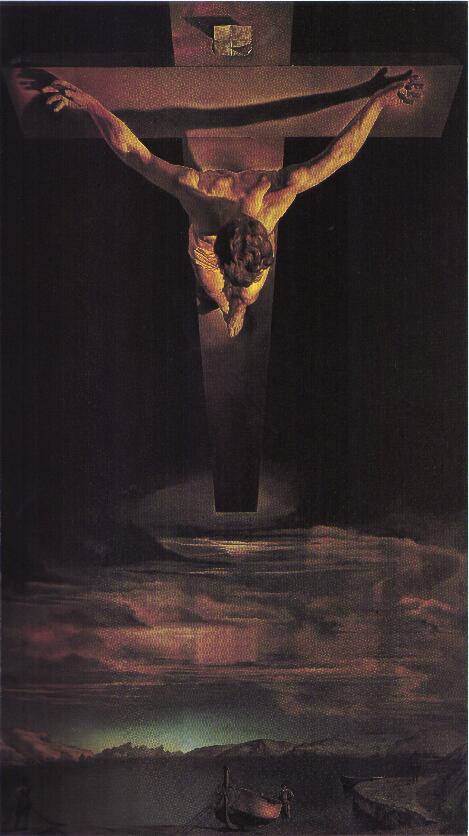
Creation: a suffering world through a suffering Lord | Lent {4}


Lent is a season in which God’s people meditate on the slaying of Jesus on the Cross and all that is within them (and the world) that made that Cross necessary. To that end, we’ve been meditating on the fact that Christ is the Lamb who was “slain before the foundations of the world”. We’ve been thinking through what it might mean that Jesus, in some sense, has been suffering for all time (and some theological issues along the way).

So far, we’ve talked about how this is a reflection of an eternal attribute of Jesus. There has been an aspect of suffering and death woven into the depths of his nature and character since before time began.

But at some point, time began.
Continue reading

The Cross: eternal Beauty made present | Lent {2}


Earlier this week, I kicked off this year’s Lent series with a question.

This season, we’ll be meditating on the biblical idea that Jesus, in some mysterious way, was slain in eternity past. And so, I asked what this means for the Cross of Jesus:

Was it an eternal truth breaking into the temporal realm, or was it itself such a powerful event that it echoed backwards and forwards through the past and future?

My vote? Jesus’ suffering and “slain-ness” is an eternal attribute of who he is, and the Cross was this aspect of the nature of God breaking into our reality. The Crucifixion was, in effect, God drawing the curtain back on a heavenly reality that had, until that point, only been hinted at.

I side with this for two main reasons: the essence of God, and the election of God.

Continue reading

Weekly Must-Reads {3.7.12} | abortion & Obama’s abuses


In light of the recent birth control controversy, there’s been a revived discussion about abortion and the “personhood” of babies, especially after a paper justifying the aborting of newborns was published in a major journal. Also, in response to rising criticisms for how the Obama administration has abused their seizure of Executive power to pretty scary levels, Obama’s Attorney General, Eric Holder, gave a speech [transcript] at Northwestern University on Monday defending the administration’s actions. Today’s articles deal with these issues.

Grab some coffee, and let’s go.

__________

__________

HIGHLIGHTS

The New Scar on My Soul | American Thinker

If you read nothing else from this post, please let it be this. I found myself crying in the middle of the coffee-shop I was in as I read this. Please, anyone, help give me a reasonable framework from which to respond to this. I need something beyond empty rhetoric, powerless outrage and sadness, and unrealistic policy aspirations. And also, please, if you find yourself on the pro-choice side of this, I would love your thoughts on this topic after reading this post. I’m really struggling here.

The Obama Administration and Targeted Killings: “Trust Us” | Council on Foreign Relations

Such a good article giving a brief–yet substantive–analysis of Holder’s speech and how it holds up to legal, moral, and common-sensical scrutiny. Please read this. Also, for a very comprehensive (yet fairly brief and easy-to-read) summary of the history and background of this all-important topic and its relevance today, CFR put together this Backgrounder.

Continue reading

God, eternally-slain | Lent series {1:intro}


“…the Lamb who was slain before the foundation of the world.” –Revelation 13.8

“…you were ransomed…with the precious blood of Christ, like that of a lamb without blemish or spot, who was foreknown before the foundation of the world but was made manifest in the last time for your sake.” –1 Peter 1:18-20

“Jesus Christ and him crucified… a secret and hidden wisdom of God, which God decreed before the ages for our glory” –1 Corinthians 2:1,7

Today, I just want to briefly introduce the Lent series I’ll be doing (while listening to some free Lenten music!). It will be a meditation on an idea that only explicitly appears a few times in the Bible, but it’s truth echoes throughout the Scriptures. It’s mind-boggling in both its scope and implication, and yet gets so little treatment from mainstream Protestantism.

The idea? That Christ was slain in eternity past–before anything was; before any sin had been done by a single human.
Continue reading

Please help me give my money away! [UPDATED]


As I said the other day while introducing Lent this year, the Lenten season has historically been marked by three practices of those that participate in it. Prayer and fasting tend to get most of the attention, but almsgiving is another component of a Lent-historically-done-well. Almsgiving is the ancient term for giving materially of your resources for the purpose of charity, love, and grace.

I have never been good at giving my money away. Tithing has always been difficult for me to practice; giving to the homeless has been hard; and I always have a good excuse why I’m not able to give to some cause greater than myself. Sure, I’ll talk about the organization or even write a blog post in support of it, but it’s hard for me to part ways with my money.

This season, however, I wanted to try an experiment to fight against this and hope and pray that God meets me in it and grows me in deep, lasting ways.

This Lent, I want to give away some of my money everyday. For Monday through Saturday (the Church considers Sundays Lent “mini-breaks”), I want to give some amount of money to a non-profit or charity that can use it to help others.

But I need help.

If you have a non-profit or charity or social justice organization that you particularly like, could you leave a comment below telling me what it is?
Continue reading

I’m a one issue voter: some responses & clarifications {Pt.2}


“Free people, remember this maxim: We may acquire liberty, but it is never recovered if it is once lost.” –Jean-Jacques Rousseau

[UPDATE: Part 3, “specific abuses of Executive Power” is up]

Yesterday, I wrote a post about how I’ve become so burdened by the abuse of civil liberties by the Executive branch, that I have decided that this is a big enough of a deal–and the time is crucial enough–to warrant this being the one issue I use to determine who I’m voting for this Presidential election.

I knew I was brief yesterday, but wow. That post ended up causing a lot of emails, texts, comments and Facebook posts from people really cautious about what I had said, and had a lot of clarifying questions for me. Some issues will become clearer as I continue to write about this, but I wanted to address some crucial things up front.

First, some definition

As Wikipedia puts it: “Civil liberties are simply defined as individual legal and constitutional protections from entities more powerful than an individual, for example, parts of the government, other individuals, or corporations.” To put it another way, our “civil liberties” are what is clearly laid out in the Bill of Rights.
Continue reading

For now, I’m a one issue voter: a President’s Day lament {Pt.1}


“The preservation of the sacred fire of liberty…is finally staked, on the experiment entrusted to the hands of the American people” — George Washington

[UPDATEPart 2, “some responses & clarifications” is now posted.]

[UPDATE II: Part 3, “specific abuses of Executive Power” is up]

America’s Founding Fathers consistently referred to our country as a  “grand experiment”, and on this President’s Day–and good ol’ George’s birthday–I want to meditate on this for a little bit. What was (is?) so “experimental” about America?

There seems to be a repeated  “life-cycle” to nearly every great power in the entire history of the world. In the beginning of most of these nations, the “power” and authority is more or less decentralized (perhaps in a localized, tribal, or feudal system–or in our case, States).

Over the course of time, though, this “power” becomes increasingly centralized: first, into one part of society (usually to the wealthy and their businesses), then it gathers into one part of the government, and then it continues onward until it is ultimately centralized in one person.
Continue reading

A Shout-Out to My Mennonite Pacifists Out There…


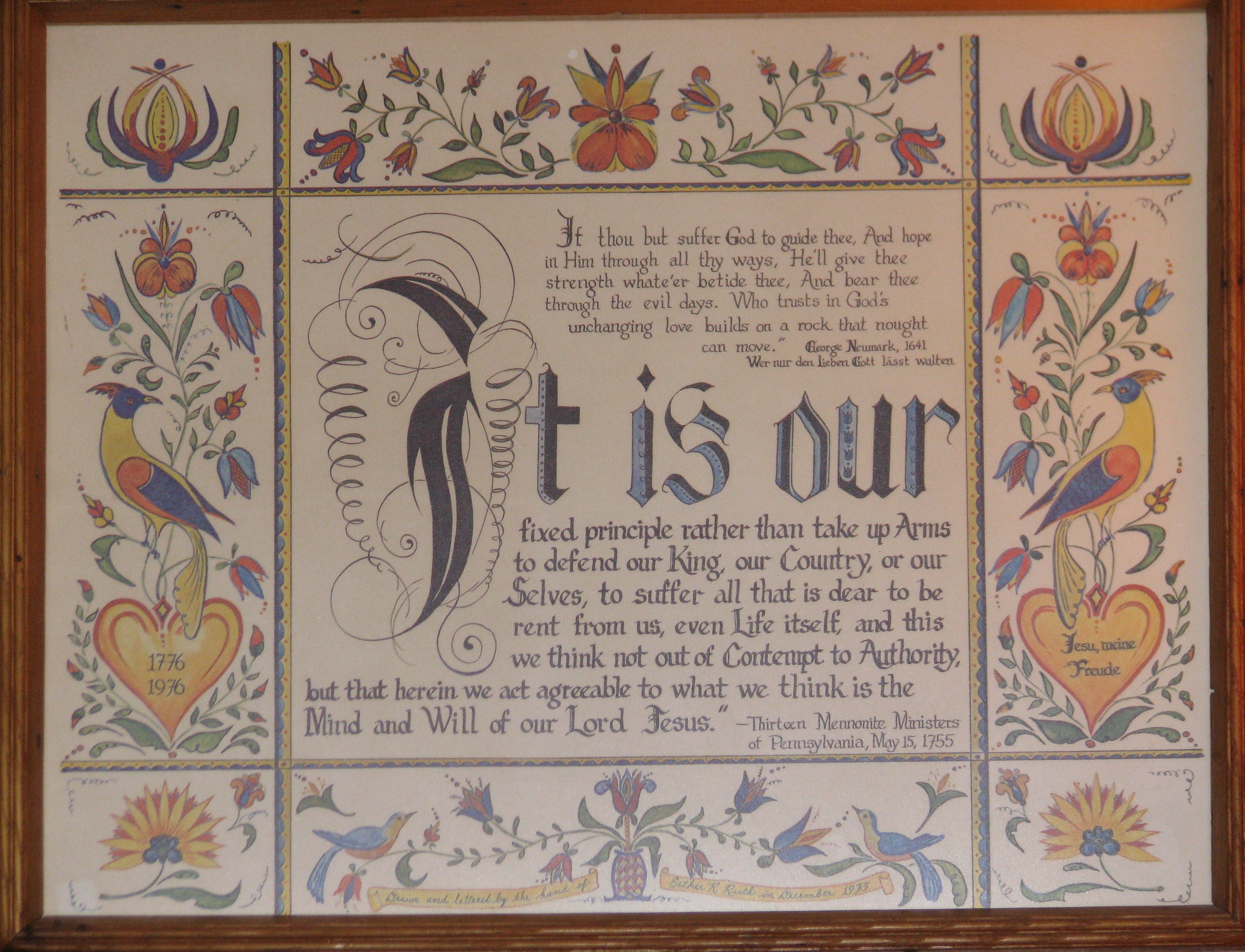
Being in Pennsylvania, I meet lots of people that either consider themselves Mennonite, or at least were raised that way. One of the most well-known aspects of Mennonite belief is their unwavering commitment to pacifism (or, as a commenter corrected me below, the Mennonite “doctrine of nonresistance”). Hanging out with one of my new raised-Mennonite friends the other evening, she showed me (with pride) the above picture that has hung in one of their family’s houses for a long time. It struck me as beautiful as well, especially the second quote. Here it is, nicely typed out for optimal readability and convenience:

“It is our fixed principle rather than take up Arms to defend our King, our Country, or our Selves, to suffer all that is dear to be rent from us, even Life itself, and this we think not out of Contempt to Authority, but that herein we act agreeable to what we think is the Mind and Will of our Lord Jesus.”

–Thirteen Mennonite Ministers of Pennsylvania, May 15, 1755

Continue reading

HAPPY ADVENT!! {10}


Well, it’s here. The day we’ve been building up to and meditating upon. This is the day we joyfully celebrate the King who broke into our reality and ushered in His Kingdom and our salvation by coming in the form of a little child.

Even though this time can be tough for some (my grandfather died a year ago tomorrow), I do hope and pray that we are all able to have at least one good laugh this year and see the smile of at least one person we love and that we know loves us. And eat good food. And drink good drink. And listen to bad, cheesy music. (On a side-note: the picture above is a picture of the wall-hanging that went up in my house every year as I grew up. And now I have it. I love it.)

Don’t worry, this isn’t really a whole other post. This Advent season has been an especially fruitful time for my writing (as my Facebook Wall obviously shows). I want to thank everyone that has been telling me how helpful these posts were–or even those that just told me they were reading them in the first place!. I can’t tell you how much it affects me, sticks with me, and encourages me. But anyway, I just wanted to write this post so I could put up all these posts in one place for you easy reading pleasure, should you so desire. Happy Advent!
Continue reading

There is No One Like You (Adv, Days 23/24; HelloGoodBye 09/10) by David Schrott [GUEST POST]


[Through college up through about a year and a half ago, I ran a little online magazine called Reform & Revive. It’s dead now. While it was going on, one of my best friends, David Schrott, was one of our contributors. He’s an amazing drywaller, photographer, writerperson, and boyfriend (also here, here, and here). This is a post he wrote for R&R back in 2009 at the end of a particularly trying year for him. It’s one of my favorite Advent meditations I’ve ever read, and so I wanted to share it with all of you. Enjoy.]

_______

“I want men everywhere to lift up holy hands in prayer.”
–I Timothy 2.8, NIV

There are these days, when it is so difficult to find words that wrap around concepts, that, no matter how concrete in one’s mind, find it impossible to find substance in the barrier we use to communicate called language. In those moments, it seems that experience does precede existence and existentialism, for a moment, seems fun (and fun is clearly the wrong word, but for to-day, for this beautiful-day-before-Advent, will have to do).
Continue reading

The Formation of God | Advent {6}


All last week, I offered some meditations on this season of Advent. I actually have several more I’ll be posting more or less every day until Christmas, but today I’ll be offering the last in this little alliterated series in which we’ve been exploring how in the Advent event, Jesus took on our creaturely form, care-taking function, comprehensive fallenness, and now, communal formation.

We spend a lot of time and energy in this season focusing on how Jesus has changed everything and how the implications of Advent change much of our lives and existences. But Jesus did not merely come to change and affect things, but to also be changed and affected by them.
Continue reading

What Christ did not taste, Christ did not redeem. | Advent {4}


This Advent season, we’ve been meditating on how the Advent reminds us how God took on our creaturely form, care-taking function, comprehensive fallenness, and communal formation.

First, a question.

Think back on the Christmas story. After Jesus is born, when he’s about three years old, the wise men go to King Herod and say that they’re looking for this newborn King. Herod is shocked to hear about a child-king having been born right under his nose, whose potential future reign threatens his own, and so he puts out a decree calling for the death of all children ages three and under (in history and art this is referred to as “The Slaughter of the Innocents”. An angel comes to Joseph in a dream and tells him to flee to Egypt to prevent this from happening.

Here’s the question:

Why flee to Egypt? If they stayed and Herod killed the child Jesus, would that not still be Jesus, the Son of God–the Incarnate God–dying unjustly at the hands of a Roman provincial governor attempting to cement the reign of the powers and principalities of the world? Why go to all that effort to wait 30 years later for the same thing to happen on a cross?
Continue reading

our failed function, God’s full faithfulness | Advent {3}


This week, I’m meditating on a few particular aspects of the Advent event. I’m thinking through and writing about how, in Jesus, God inhabited our creaturely form, care-taking function, comprehensive fallenness, and communal formation.

As I said in the teaching I gave over the summer about the Nature and Narrative of the Bible, the opening chapters of the Bible describe this divine act of creating in very architectural terms; the same words are later used in describing the building of the tabernacle and the temple. In this we see that God’s act of creating was, in essence, building this world as his temple in which he would rest (for more on this see John Walton’s amazing book, The Lost World of Genesis One, or just watch this short video).

In the story, he builds and establishes this Temple-World, and then creates and ordains two priests–Adam and Eve–to be his representatives in this temple to care for it and work in it faithfully. In the ancient world, temples were usually placed in the midst of large and beautiful gardens which acted as extensions of the temple itself; to care for the garden was to care for the temple, and to make the garden larger was to expand the scope and size of the temple.
Continue reading

Advent, Evolution, & Absolution


It’s Advent. A time where we especially orient ourselves towards rejoicing and celebrating the fact that God did not remain far off and merely create a “legal” or “dogmatic” satisfaction for the plight of his creation and creatures. Rather, he broke into it and came into his creation and among his creatures. In this year’s Advent series, we’re exploring how, in this Coming, Jesus took on our creaturely form, care-taking functioncomprehensive fallenness, and communal formation.

First, God took physical, human, creaturely form. In the study I did–and subsequent lecture I gave–on Beauty a couple of years ago, I defined “Beauty” as the attribute of something that expressed complexity simply. Is not this God-in-human-flesh (theologically referred to as the Incarnation) the most beautiful of all miracles to take place? The Infinitely Complex God inhabits the simplest of human forms: a child.
Continue reading