Max Lucado’s “Fearless” and my heart (a review preview)


I’m a book reviewer for Thomas Nelson Publishers.  A few weeks ago I received a pre-publication copy of Max Lucado‘s upcoming book “Fearless“.  I hate so much about Christian “culture”, especially its commercialism, cheesy cliches, seemingly naive treatment of the fallenness of the world, and an inability to know and apply a deep understanding of the Gospel.  For years, admittedly, Lucado has stood in my mind as a representative of much of this.  I have, with little engagement with his material (other than his children’s books), tagged him as such a man; and in a certain way, he is the cheesy, cliche-ridden, mass appealing writer I have assumed (as is evidenced by this official site for the book), and the official trailer found below:

Let’s just say it’s been a big change going from Francis Turretin, John Calvin, and Herman Bavinck to Max Lucado in a matter of months.  Anyone that knows me knows that it has been a long journey through many frustrations with mainline evangelical culture to teach me how to love the Bride of Christ.  And I’m still learning.  I have belittled her, talked her down, mocked her, and ridiculed her in the most shameful of ways.

And this book has been a healing process for me.  Not giving away too much of my upcoming review when the book’s released, I just want to say that this book is amazing.  Save for the first few chapters, I have been shown that even amidst bad jokes, inadequate metaphors, “simple” writing, and an over-commercialized release (including shirts, calendars, mugs, study guides, DVDs, children’s books, teaching curricula), there can be poetry, depth, a real exploration of the human condition, and beautiful articulations and applications of the deepest, most precious truths of the Gospel.  Lucado has shocked me.  And taught me.  And helped me.  And stirred me for this God, His Gospel, and all that it supplies us.  Though I may be going against the fine print in my publisher’s agreement in doing so, I want to share with you all my favorite few paragraphs from the book so far:

A calmer death would have sufficed.  A single drop of blood could have redeemed humankind.  Shed his blood, silence his breath, still his pulse, but be quick about it.  Plunge a sword into his heart.  Take a dagger to his neck.  Did the atonement for sin demand six hours of violence?

No, but his triumph over sadism did.  Jesus once and for all displayed his authority over savagery.  Evil may have her moments, but they will be brief.  Satan unleashed his meanest demons on God’s Son.  He tortured every nerve ending and inflicted every misery.  Yet the master of death could not destroy the Lord of life.  Heaven’s best took hell’s worst and turned it into hope.

I pray God spares you such evil.  May he grant [you] long life and peaceful passage . . .. But if he doesn’t, if you “have been given not only the privilege of trusting in Christ but also the privilege if suffering for him” (Phil. 1:29 NLT), remember, God wastes no pain.

Amazing.  Look for my review September 8.  In the meantime, you can order the book here, and read some of the ebook here.

Nature, Science, and the Structure of Time |Beauty{4}


Van Gogh - Wheat Field with Cloud-smallerWe’ve been doing a little series here at the blog on Beauty. I recently gave a talk on it and I’m taking excerpts of the full manuscript, the fruit of several months of labor, and posting them online for all to enjoy and engage with. In this post, I break some of the order in the original manuscript to talk about both space and time. My point is simple: nature and history are beautiful. I’m applying a definition of beauty I discuss here, that says that Beauty is the attribute of something that expresses complexity, simply. To help explain that, I’ve been using the imagery of complexity represented as the strands that make up everything in the universe. Beauty is when these strands are woven together into a tapestry we can perceive with our senses (physical or spiritual). We’ve already discussed how God Himself is beautiful. Next week we’ll talk about the beauty of humans and then art. Should be good. The links to the full manuscript and the message audio are at the bottom. [Bold: things I had time to say in the talk// Regular: things I didn’t have time for]

God’s creation is beautiful.

The Bible clearly tells us in several places that nature proclaims God’s Glory, and that many of God’s invisible attributes are made plain to us by Creation. Thomas Aquinas, in his book Divine Names, in the section on God being called “Beauty” says that divine beauty is the motive for God creating all of this. God loves his own divine beauty so much that he wants to share it as much as possible. So, he creates creatures and mysteriously communicates this likeness of Beauty to them. God intends everything in creation to become beautiful in the fullness of His divine Beauty so, just like he has placed a deposit of eternity into our hearts, He has placed a deposit of that beauty in creation. Modern science was birthed out of an awe for this beauty. People looked out on the earth and saw that it worked on ordered processes, and these people determined to find out what those laws and processes were. Science and medicine is humanity accomplishing what theologians call the “Dominion Mandate” – when God commands the first humans to “subdue the earth”. Science is the process of looking deeply into the tapestry of the created world and seeing what strands comprise it. They get to stare into the inner workings of the beauty of God in this world. It’s sad that the Church has so divorced itself from this endeavor of worship. The comedian Steve Martin is also a novelist and playwright. He wrote one of my favorite plays called “Picasso at the Lapin Agile“. The premise is pretty simple: what would happen if Pablo Picasso, five years before he painted his definitive painting Les Desmoiselles d’Avignon met a young scientist named Albert Einstein in a small cafe a year before he published a little book called “The Theory of Relativity”? It’s one of the smartest and funniest plays I’ve ever seen. There’s a scene about halfway through where Picasso lays out his creative process and then looks at Einstein and says, “But what do you know about it anyway? You’re just a scientist. You just want theories”. Einstein replies with, “Yes, but like you, the theories must be beautiful. Do you know why the sun doesn’t revolve around the earth? Because the idea is not beautiful!” He further explains this and then Picasso says, “So you bring a beautiful idea into being.” God’s creation, and the laws that run it, are beautiful.

History is beautiful.

As our text says, History is the context in which all things are being made beautiful. This is where the Beauty of God, His creation, humans, and their creations all collide and interact in order to bring about this beauty and peace in the world. It is the ultimate tapestry in which all these strands are being woven together. One of the best understandings of history I’ve ever heard came from Harold Best, dean of Wheaton College’s Conservatory of Music and author of the incredible book that everyone should read before they die “Unceasing Worship” in a message he gave called “Continuous Worship: Is “Worship” the Only Word for Worship?” In it, he points out that the Eastern mind sees time as circular. Life repeats itself and moves in consistent cycles. The Western mind, on the other hand, sees time as linear, with a definite beginning and a definite ending. Now most of us have heard this before and then were told the various reasons why the Western idea was right.

Best, in the message, and our text tonight, both point out how our modern Western bias is misguided. Our text tells us some of the ingredients God uses to make all things beautiful in their time. And God employs these same list of things over and over and over again through time. In fact, one of the consistent themes of the book of Ecclesiastes is the vain repetitions and cycles that seem to make up life. In Best’s message, he points out that time is in fact neither linear nor circular. It’s helical – in the shape of helix. That shape, so essential to the creation and sustenance of life is actually woven into time. Life moves in circularly as it linearly moves through time. Assuming that’s true, let’s apply our definition of Beauty and see what happens. History is the story of God liberating all of creation from its bondage to decay and ugliness into participation in the glory and Beauty of God. If this is true, then every moment that goes by means the further Beautifying of the world. Imagine, then, time as moving in this circular fashion towards the glory and Beauty of God, the earlier parts being made of less woven strands and slowly, over the years, through time, God employs people, situations, art, Jesus, and the Cross to weave these strands ever and ever more securely together into the Image of Heaven.

What this means then is that time isn’t merely moving forward toward some point in the future we call “Heaven” or “the end of time”, Heaven is actually invading the present as we speak, as we sit here, as art is made, as people are seen as beautiful – we are actually ushering in heaven on earth as those strands are pulled tighter and tighter together to form this epic tapestry of history. In Marilynne Robinson’s book Gilead, she writes from the perspective of an old Congregationalist preacher about to die. This man, reflecting on life and heaven says this as he thinks about this very topic we’re talking about: “I feel sometimes as if I were a child who opens its eyes on the world once and sees amazing things it will never know names for and then has to close his eyes again. I know this is all mere apparition compared to what awaits us, but it is only lovelier for that. There is human beauty in it. And I can’t believe that, when we have all been changed and put on incorruptibility, we will forget our fantastic condition of mortality and impermanence, the great bright dream of procreating and perishing that meant the whole world to us. In eternity this world will be Troy, I believe, and all that passed here will be the epic of the universe, the ballad they sing in the streets. Because I don’t imagine any reality putting this one in the shade entirely, and I think piety {and a love for God has done on this earth] forbids me to try.” Jonathan Edwards described history flowing into the Beauty and Glory of Heaven like this: As time moves forward now and on through eternity, God’s people are ever steadily rising higher and higher into the Glory of God, perhaps with an increasing velocity towards a height to which they will never attain. This history is beautiful. Don’t waste it on trivial, lower, ugly things.

Click for Manuscript Pdf

Manucscript

Click here for sermon audio

Audio

Eternity in Our Hearts: The God of Beauty, the Beauty of God


Sargent - Madame Errazuriz-smallThis message was seven months in the making, and this past Friday I finally delivered it.  So, as promised, I’m posting both the audio and the manuscript here.  You can also find a general outline on my Sermon site, and you can also find it at my Podcast.

Click here for sermon audio

Click for Audio

Click for Manuscript Pdf

Click for FULL Manuscript

This is the message I gave at Epiphany Fellowship. The topic was Beauty. The attached manuscript is the full manuscript. It is 43 pages long and contains far more information than I was able to give in a 40 minute message. It includes an appendix where every form of every word in the Greek and Hebrew translated as “Beauty” or “Beautiful” in the English Standard Version of the Bible is ordered by frequency and includes the literal meanings and lexical range of each word.

I really cannot stress how much more is in the manuscript than was preached.  Every section has huge amounts of thought and prayer in it that was not able to be included in the final message.  That’s why throughout the next week or more, I’ll be blogging about every section of this manuscript.  Each post will focus and discuss the fuller version of each section.  If it gets to be too much I’ll spread it out as need be, but we’ll see.  This is where your thoughts and insights will be so helpful and needed, but if you have a question now, don’t feel like you have to wait for that blog post to come to ask.  Engage with any and everything now.

I hope this blesses all of you as much as it did me.  The feedback that evening was more than I knew how to handle and perhaps I’m still processing it.  Thank you all for your grace and affirmation.  For those that came out, I thank you. I very much enjoyed both preparing and delivering this message, and I look forward to further chances to do so.  If you’re interested in giving me such a chance, feel free to use the contact email on the sidebar to the right (or just click here).

Enjoy, and feel free to let me know what you think, and please at least look through some of the manuscript.  Until next time . . .

One small final note: on most every site and post I’ve used to discuss this message I’ve used the attached piece of art.  It is a piece called “Madame Erraruriz” and it is by my favorite American painter John Singer Sargent.  I got to see this painting in an exhibit of his at the Virginia Museum of Fine Arts and ever since seeing the brushstrokes in this simple painting and seeing the nuances and the subtleties that don’t quite come across from this digital shot, I have long found it to be one of the most beautiful paintings I’ve ever seen.  It is for that reason I have chosen it as the picture that has constantly been up for all these posts.  A few years back I even wrote a poem based on the piece called “Extended Engagement”.  I ended up writing two versions, one less structured than the other to better mirror the feel of the piece, but on this blog you can read both Version 1 and Version 2.  Let me know which you prefer.

“bright as yellow” by David Schrott | Reform & Revive


One of my best friends and favorite writers (and photographers), David Schrott has finally broken his writer’s block to write another gem for the magazine.  So head on over to Reform & Revive and enjoy his prose and honesty.
Here’s the link to the article:

http://reformandrevive.com/2009/08/04/bright-as-yellow/

Remember to leave comments and send this link along to others!  Also remember that we’re always looking for submissions to the site so feel free to get in touch with me if you have any ideas.

For those wondering how my job is going . . .


unemployment. . . well, it’s not.

In May, I wrote about my journey in looking for a job.A month and half later(ish) I wrote of having found a job.My start date was July 1st.

But July 1st was the appointed day for another reason: it was the official first day of a new fiscal year for many companies, churches, and governments (federal, state, and local), therefore, of course, it was the day that new 2009 budgets went into effect all across the country.

Well, at least, when those budgets were supposed to go into effect.

The State of Pennsylvania is embroiled in an ever-increasingly heated battle over its State Budget that was supposed to be done and go in effect July 1st.The company I got my job with gets most of its money from the State Health Department, so this poses a problem for them, seeing as the State Health Department has no 2009 money allocated to them by an effective budget to give to my company any money to hire me – so they’re under a hiring freeze.Did that all make sense?

So, in short, I’ve been waiting for over a month for Pennsylvania to pass its own budget, after which I can start my job.Assuming of course that my usual luck doesn’t come into play and my job decides to drop me for some reason.I don’t know.Pray this doesn’t happen.It seems the budget problem is this: there’s a huge gap in the budget between income and expenses.So they either need to get more money or make more cuts.The Governor has suggested a very small increase to the income tax to cover this, but Republicans have cried foul.Democrats have said they’re not “wedded” to the idea of a tax increase and are open to any ideas, but Republicans have been both unable to suggest any new ideas and unwilling to make any cuts in their various localities, insisting further cuts happen at the State level.So, tax increases are being forbidden, no new ideas being brought forth, no new cuts being suggested, and no one willing to budge.Therefore, I have a job, but don’t – all at the same time.

It’s an excellent object lesson in the angst and tension in the Biblical idea of things “already being accomplished, but not yet fully realized”. By the way, last Friday was the last day State employees were actually getting paid.now they’re getting I.O.U.’s. Ugh.

I am trying to find odd jobs to hold me over, but may be looking for a more stable job here shortly, and eventually if I need to, I may look somewhere else entirely for a “real” job (any ideas or possible work is more than appreciated).I hope I don’t have to move on, for as I have said, this job is my dream position, but if I need to, I need to.

God certainly deals with us strangely, confusingly, and mercifully. So much opportunity in this time of “unemployment” to draw near to my God and serve are currently being wasted day to day due to my inherent lack of discipline. He really desires more of me in this time, and I fear I haven’t taken advantage of these moments to learn my neediness and His presence.Pray I learn these lessons well in the “already but not yet”.

And pray that Pennsylvania passes a flippin’ budget already (and that I still have a job waiting for me when they do)!

From the iMonk: Mary Consoles Eve


I found this at the site of Michael Spencer (a.k.a. The Internet Monk).  This guy is having an increasing amount of influence and inspiration on my thinking as a Christian in this world.  You find him at The Internet Monk. Anyway, I love this piece of art and the poem.

Crayon & pencil drawing by Sr. Grace Remington, OCSO. Copyright 2005, Sisters of the Mississippi Abbey

_______________

O Eve!

My mother, my daughter, life-giving Eve,

Do not be ashamed, do not grieve.

The former things have passed away,

Our God has brought us to a New Day.

See, I am with Child,

Through whom all will be reconciled.

O Eve! My sister, my friend,

We will rejoice together

Forever

Life without end.

Sr. Columba Guare copyright© 2005 Sisters of the Mississippi Abbey

_______________

This was found by Michael Spencer at Inside Catholic.

Philosophy & Theology {II} | “Christian” Existentialism [2]


A couple of days ago, I laid out some reasons why “Christian” Existentialism was not the end-all-be-all philosophical orientation for the Christian. But, as I explained in my first post in this series, Philosophy is not the enemy of theology. Rather, it can help us understand other finer points of theology by giving us new categories to think in. So, I proceeded to give three ways that Existentialism can inform our theology. The first way was that it helps us see sin in regard to our personal orientation to God. This post continues with two more ways:

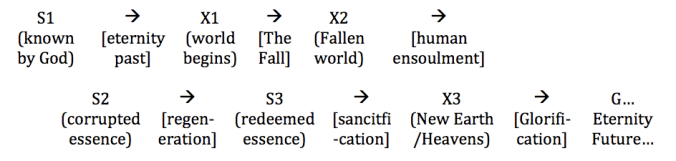
Secondly, a big discussion in Existentialism the relationship between our “existence” and our “essence”.  I pointed out in the previous post that when god was asked by Moses “what’s your essence?” God answered “I exist”. This is the way it is with God. His nature and being are equated with His existence. He simply “is”. The big question concerning these two things in Existentialism is “which comes first?”. Classic Existentialism holds that our existence comes first and our essence is formed and shaped by our existence. This brings up some problems for the Christian. The Bible talks about our essences being known by God before we ever existed, but it also says that there’s something of our essence that is corrupt at its core. When God “knows” us before we exist, does he know our corrupted selves? Does God create us depraved? The Bible seems fairly clear in its representation of the nature of God that He doesn’t create and form our essences as corrupt, so it look likes the question is a bit more complicated than just “which comes first”.

Best I can figure, it looks like both essence and existence have narrative frameworks and are seen as whole things that are shaped through eternity past and future. In short, the story goes like this: God knows and forms our essence-1 (S1), which is pure and good in his sight. He then creates the world of existence-1 (X1) which is made good but then falls and gives way to a different realm of existence, existence-2 (X2).  At the moment this essence-1 enters into existence-1 (X1), it comes into the fallen world and becomes essence-2 (S2) which is corrupt. Christians, then, at conversion are changed at the very level of their essence such that they then become pure in essence (essence-3) living in a corrupt existence (existence-1 still). The rest of the life of the Christian is a slow work by God and others to bring more and more of this Christian’s life and existence in line with their now pure essence-3 (s3), to prepare them for existence-3 (X3). Existence-3 is when this created world/realm within which we exist is restored and glorified and finally our pure essences-3 are able to live in freedom and peace in pure existence-2 in glorified eternity.  Here’s what it looks like graphically:

__________
screen-capture

__________

Lastly, there is a very important service that Existentialism lends to the spirituality of the Christian life. In Existentialism, there is a loss of the objectivity of knowledge. All we know is our existence, and that is a very small sphere of knowledge indeed. What this tenet of the philosophy does is create a very strong sense of angst. Existentialists carry the reputation for being very depressed people, seeing as they can know nothing more than (1) they exist, and (2) they can’t know more than that. We can be sure of no other knowledge. This makes you feel very small in a world of chaos that you can do nothing to change. This sort of worldview should make people very despairing, and it has for people such as Samuel Beckett and Albert Camus. But for others, like Jean-Paul Sarte and Soren Kierkegaard, Existentialism seemed to create a humble sobriety that actually allowed these men to enjoy life in a way many Christians could learn to do.

The Christian life is angst. It’s messy. It’s sloppy. That’s why it’s lived by faith – i.e. “trust”. Reality is such that we will be forced to have to trust our Creator to save us, because there really are no objective grounds (that we can know) upon which His salvation is based. This is because God knows He is the greatest of all things and our tendency is to drift from Him. It’s His love that makes us need to draw near. But, when we do, it shows us even more where we fall short and we cry out to God more. He draws even nearer and we are able to experience that One for whom our soul was made. Faith is not neat. Faith is not tidy. Faith is not naive. Faith is not imbecilic. Faith is having the courage to admit your finitude and inadequacy in order to be joined to and in communion with the Joy of joys, Peace of peaces, King of kings, and Lord of lords.

As one friend put it: “I will not resolve to embody that kind of [naive] faith ever again. So, I will read Scripture, asking God to communicate to me what in me is broken, what is unreconciled, what needs restoration, liberation, salvation. And I will sit at the foot of the cross, in the pain of who I am. And I will ask God for reconciliation, restoration, liberation, salvation. On the other side of it all, I will trust Christ more deeply. This is sanctification. This is working out my salvation in fear and trembling. And then, hopefully I will have caught my breath, and it will all begin again.”

Existentialism helps us recapture the “fear and trembling” part of working out our salvation (hence the title of Kierkegaard’s famous work).

I’ll end with perhaps my favorite set of quotes I have ever read. These have had such a profound impact on me and so reflect how I understand these things to be. These words are from the poet Joe Weil in an interview with Patrol Magazine. I leave you with these words that could have been written by the most quintessential existentialist:

“I once described faith as something I got on my shoe and can’t kick or wash off. I’m stuck with it. My poems are the trespasses and blasphemies of a malpracticing Christian, one who can’t stop ogling an attractive leg, or wanting to be first, who is venial, foolish, seldom at peace, horny and lonely, and so far from the kingdom of God that his whole life becomes the theme of that distance, someone knowing he is in deep shit. It’s the perfect place to be, where you can’t fool yourself into thinking you’re on the right track…The only thing I have to offer God is my sins. I am interested in mercy when it appears in places where you would never expect it. I am interested in love that shovels shit against the tide. I am interested in grace…It is better to be annihilated and crushed by God, if you are in love with God, then it is to have no relationship at all. Better God smite you then merely be absent. God does not ‘tolerate’ me. God loves me.”


Philosophy & Theology {II} | “Christian” Existentialism [1]


In the past few days, the idea of Christian Existentialism has been brought up to me as some sort of viable marriage between philosophy and theology. As I said in my previous post, I think this is a bit misguided.

I think there is a slight danger in the concept of Christian Existentialism. The entire point of Existentialism is that we look inside ourselves for ultimate truth and meaning for existence. Starting at this place causes a lot of problems. I’ll mention three here: sin and Scripture (briefly), and the nature of Christianity itself. “Christian” Existentialism has to define sin in two incorrect ways. First, it would have to say that what makes a sin a sin is the action itself evaluated in light of its consequences. This flies in the face of the Bible which screams that it is in the heart where sin dwells and shows itself, not the actions; and, most sins committed by humans never reach the will anyway, much less have evaluative “consequences”. Second and more Existentially unique, is the idea that sin is anything done that results in the losing of the “true authentic self” of Existentialism (I’ll say the fault in this shortly). And lastly, when it comes to the Bible, Scripture is seen more as something to submit to our experiences rather than to submit our experiences to.

The ultimate fallacy (and what I see to be the most frustrating) in all this is the idea that all things pertaining to God find their meaning, purpose, truth, righteousness, and value in how they relate to us humans. Existentialism would say that we only know anything by seeing where it lies relative to us. I’m sorry, but this whole Christianity thing is not about us. It never has been, nor will it be. It is about Christ and His glory. The more we dive inside of ourselves, all we will see is our depravity and darkness. Any other finding is due to inauthentic searching and subsequent blindness to the true state of one’s soul. Self esteem and self knowledge is not the root of mental health, soul value, and practical empowerment, in spite of what the gurus of our age tell us. It is by looking to Christ, not ourselves, and esteeming and delighting in Him alone that we are made into His likeness at every level, and find meaning, purpose, value, and insight into how this whole thing is supposed to be worked out.

But yet . . .

as I said in my previous post, Philosophies can help provide us with answers to theological dilemmas and categories. Existentialism helps us in questions of sin (in spite of what I said earlier, ironically enough), the relationship between ontology and the Sovereignty of God (our nature vs. God’s providence), and the nature of Christian spirituality.

The most famous “Christian Existentialist” is probably Soren Kierkegaard. But more precisely, though, he probably laid the foundation for what later became full blown Existentialism. Nevertheless, his fingerprints are all over Existentialist though, Christian or otherwise. In his work, “The Sickness Unto Death”, Kierkegaard defines sin as primarily about one’s position in relation to God. This is the difference between “error” and “sin”. Sin is against God and affects our relation to him. He argues against the view of Socrates that sin is merely an act stemming from ignorance. Kierkegaard vehemently denies this because this turns “sin” into a negation – merely a lack. Kierkegaard points out that sin isn’t just negation but it’s a position and posture towards God. How is this still Existentialism? Well, sin is still defined in terms of our position before God – it’s necessarily tied to and defined in terms of our existence before Him. But what makes this Orthodox is that it is not an existence divorced from the backdrop of God Himself. It is intricately linked and fused together as one. Our existence is only existence insofar God Himself is exists. As Paul would say (quoting Greek poets): “in Him we live and move and have our being” (Acts 17:28)

I wrote out the other two points, and they made this article far too long. I really think these next two points are of utmost importance for the Christian to understand, so rather than just putting them at the end of a post and people not really reading it, I’m going to make them their own post tomorrow. In the last two points, I try and use existentialism to help come up with a Christian answer to the age-old question of Existentialism: which comes first: your essence or existence? You’ll see that because of the Fall, these things become quote complicated. Secondly, and perhaps most importantly, Existentialism helps the Christian see that all of life (especially the Christian life) is anything but neat, orderly, nice, and naive. It is full of uncertainty, angst, frustration, and doubt. But, more on those tomorrow.

Derek Webb’s new free song about Fred Phelps


Untitled[EDITOR’S NOTE:  there was apparently a 12- hour window in which to download this song.  That window having passed, I have made the song available on another post on this site.  Continue reading if you want the story behind the song. Click here for the article.]

If you don’t care about background, story, or mystery, and just want free music and lyrics, you can skip down to the asterisks.

Okay, for everyone else, there are two things you should know about that would really help you enjoy this post.  The first thing is who Fred Phelps is.  He’s the “pastor” of Westboro Baptist Church. This is the church that protests dead soldiers’ funerals with the signs reading “God hates fags.” Most of us Christians don’t like Fred Phelps at all.

Including Derek Webb.

Which brings me to the second thing you might want to know about. It is Derek Webb‘s recent “Lost-style” mystery/game/scavenger hunt/fake-controversy thing.  Long story-short: email’s went out to fans from Webb saying “my new album’s controversial, my label doesn’t like it, I’ll figure something out.”  These emails had a code in them which led to the discovery of a website, twitter account, and other strange things (type “kickdrum”, then look right under his left eye, go to the site, type “youneverknow”. This is what use to pop up.). The unofficial hub of speculation has become the comments section of this article on Patrol Magazine.

Anyway, through his site and twitter account, Webb puts out “instructions” (i.e. “scavenger hunt clues”) for various cities in the the country.  People find the clue, email the code to him, and he releases a zip file of small 1 or 2 second sound clips.  No one has any clue what these sound clips are for.  Supposedly you’ll be able to put them together, but with how long they’ve been so far, there won’t be enough audio for even one full song, much less an entire album.  This has been going on for a couple of weeks with people finding these parts and no major updates happening.

***Until today.***

About 45 minutes prior to me writing this post, Derek Webb posted on the Twitter account a couple of messages that when decoded read “redownload stem 2”.  When you do that on this site, inside the zip file is the first song released off of Derek’s new album “Stockholm Syndrome”.  [NOTE: The song can now be found here] It’s called “Freddie, Please” and it is all about Fred Phelps.  It’s a really good song and it makes me really excited about the rest of the album.  It’s not the now-infamous “sh*t” song that will be on the album, but it’s one of the other anticipated songs.  Every one of Webb’s albums has been a completely different style and it looks like he’s taking a more ambient/drum machine/lounge-techno/postal service-style approach to this album.

Anyway, the song pretty much justifiably kicks Fred Phelps in the face.  Best I can tell, it’s from the perspective  of Jesus asking Phelps “How could you tell them you love me when you hate me?”  In the song, Jesus affirms his love for those despised in the world and says that when Phelp’s is picketing these funerals he is in essence “picketing my grave for loving the things you hate.”

Good for you, Derek.  So go download stem 2 at www.ParadiseIsAParkingLot.com and listen to this great song.  [NOTE: the song is no longer there. Instead, go here to download the song] Here are the lyrics:

Freddie, Please

Freddie, please
how could you do this to me?
How could you tell them you love me
when you hate me,
Freddie, please?

You know I’ll love you honey,
and i’ll bleed you dry with money
I’ll talk where I know you can hear.
Cause Freddie can’t you see,
brother, you’re the one who’s queer?

And the stone’s been rolled away
but you’re picketing my grave
for loving the things you hate.

Then why do you seek the living among the dead?

Freddie?

The big news . . .


Nope, not engaged.

Several people here in Philadelphia know this, but I realize hardly anyone in Richmond does, so here I am writing this now.

I won’t be coming back to Westminster next year.

Long story short, my undergraduate loan payments have been steadily increasing and are now getting to a place where my parents can’t handle it alone – nor should they (before you all ask: no, this isn’t the kind of loan that waits until I’m done to require payments; no, my parents can’t consolidate it; yes, we’ve thought through it all).  I’ve decided to take at least a year off from graduate studies to get a full time job somewhere and help pay some things off.I’m focusing in Philadelphia, and trying to stay here, but I’m also looking at jobs in other places (especially Richmond).

Academically, what does this mean?Well, so far I’m still signed up for one counseling class next semester in the evenings, but I’m going to start applying to various Ph.D. programs and seeing what happens.There’s a program at Princeton I’ve fallen in love with in “Psychology and Social Policy”.I’ve realized that I was seeing seminary somewhat as a potential aid in getting into a Ph.D. program, but frankly, it’s seems to only be hurting my chances (on many levels).So, I’ll see if I can get in without it and then go back to Westminster afterwards if I want.

Practically, this means a lot more time and freedom to read what I want, write what I want, minister in different ways, and just generally feel like an actual member of society.I’ve already started writing a little bit more, doing more web stuff (Reform & Revive has been amazing recently!), and (I can’t believe I’m admitting this now), I’ve started a podcast which I’ll write on more later.

Spiritually speaking, what does this mean?Well, the answer to that question deserves a whole post in its self.I’ve been encouraged that as the workload lightens and I seem to be leaving seminary in a sense, I find myself driven more to prayer and the Word of God than while I was in seminary.They don’t tell you that seminary is not a secluded spiritual resort, but rather the darkest front lines of battle.This has been the most intense spiritual year of my life.I’ve had some of my darkest nights and moments this past year.I’ve gone my longest stints ever without drawing near to my Lord in any way.In short, it’s been rough.In short, it’s been painful.In short, I think I came to seminary too soon.I came too young.I wasn’t ready to handle the weight that this institution would hold.I have not developed the maturity and cultivation necessary to have an anchor in my soul beyond my sheer white-knuckled will.

Now, don’t get me wrong, this past year has been amazing.It’s also been the best year of my life, I think.That’s generally how God works.Very Dickensian: the best of times, the worst of times . . ..I wouldn’t give this past year back for anything.My love, affection, and knowledge of my Lord have grown exponentially.If I never go back to seminary I will forever be grateful to the Providence of God for giving me these two semesters.

God has always dealt with me in such a way that I had a very good sense of what the future held for me.This is the first time in my life that he has allowed everything to really fall apart all around me in a matter of weeks.And this is his mercy to me.This is his love for me.It is his commitment to make me need him, because he himself is what I need the most.He is my anchor.He is my certainty.He is my Lord, and my God, and I love him.

So, we’ll see what life holds.God has still been gracious to me in this time. I have great friends and my church (though still going through so much turmoil) has still been healthy and amazing.  I’ve even realized that my life as it was wasn’t very financially sustainable.  I couldn’t continue into my mid- and later-20s still asking my parents for rent money while working 15-hour work weeks at various low hourly rates.  I should have decided to so this regardless of money.

I feel it’s appropriate I’ve written this entire post while I sit in what may be my last seminary class ever, Medieval Church.Which is a appropriate, I suppose.Just like this strange period in history, and more specifically where we are in this last class, I sit here with my Rome having fallen, some dark ages having passed, standing on the cusp of my Reformation, waiting to rediscover the nearness of my Lord.

Feel free to ask any questions you may have.

An Atheist, Africa, and Missions vs. NGOs


In the TimesOnline, a European Online Magazine, prominent Atheist Matthew Parris wrote the following thought provoking article a few days ago. Please read the article and leave your thoughts. Hopefully this will spurn some meaningful conversation. Below are my favorite excerpts.  Here’s the article.

——————————–

As an atheist, I truly believe Africa needs God

Missionaries, not aid money, are the solution to Africa’s biggest problem – the crushing passivity of the people’s mindset

. . . [T]ravelling in Malawi refreshed another belief, too: one I’ve been trying to banish all my life, but an observation I’ve been unable to avoid since my African childhood. It confounds my ideological beliefs, stubbornly refuses to fit my world view, and has embarrassed my growing belief that there is no God.

Now a confirmed atheist, I’ve become convinced of the enormous contribution that Christian evangelism makes in Africa: sharply distinct from the work of secular NGOs, government projects and international aid efforts. These alone will not do. Education and training alone will not do. In Africa Christianity changes people’s hearts. It brings a spiritual transformation. The rebirth is real. The change is good.

I used to avoid this truth by applauding – as you can – the practical work of mission churches in Africa . . . But this doesn’t fit the facts. Faith does more than support the missionary; it is also transferred to his flock. This is the effect that matters so immensely, and which I cannot help observing. . . .

Those who want Africa to walk tall amid 21st-century global competition must not kid themselves that providing the material means or even the knowhow that accompanies what we call development will make the change. A whole belief system must first be supplanted.

And I’m afraid it has to be supplanted by another. Removing Christian evangelism from the African equation may leave the continent at the mercy of a malign fusion of Nike, the witch doctor, the mobile phone and the machete.

——————————–

Enjoy, and let the debates begin!

[By the way, for all those on facebook that are friends with Tim Hoiland, I had a draft of this post done a few days before he posted his, so don’t think I just copy other people’s posts!  But still, read his blog]

Severe Mercy


This song has been my obsession this past couple of weeks as I round out my first semester in seminary.  I hope it stirs you as well.

The Cut by Jason Gray

My heart is laid
Under Your blade
As you carve out Your image in me
You cut to the core
But still you want more
As you carefully, tenderly ravage me

And You peel back the bark
And tear me apart
To get to the heart
Of what matters most
I’m cold and I’m scared
As your love lays me bare
But in the shaping of my soul
They say the cut makes me whole

Mingling here
Your blood and my tears
As You whittle my kingdom away
But I see that you suffer, too
In making me new
For the blade of Love, it cuts both ways

And You peel back the bark
And tear me apart
To get to the heart
Of what matters most
I’m cold and I’m scared
As your love lays me bare
But in the shaping of my soul
They say the cut makes me whole

Hidden inside the grain
Beneath the pride and pain
Is the shape of the man
You meant me to be
Who with every cut now you try to set free

CHORUS…
…With everyday
You strip more away
And You peel back the bark
And tear me apart
To get to the heart
Of what matters most
I’m cold and I’m scared
As your love lays me bare
But in the shaping of my soul
The blade must take it’s toll
So God give me strength to know
That the cut makes me whole

taking it with me


My hero, Matt Chandler, just put up a new blog post.  It so stirred me, that I left this comment on the blog, which you can find here: dwelldeep.net

As a young single man in seminary whose father struggled and miserably failed at fighting the sins of his father and grandfather, I wrestle with this often.  As I grow older, I see more and more in me that which I hate in my father.  From a young age, I began hoping against hope that the Grace of God would be upon me such that this curse would end with me- that I would be the first real man of God my bloodline has seen in generations; that my mother’s sacrifice to stay with my father and endure hell at his hands for the sake of her children would not be in vain; and most importantly, that my God would be seen and shown as worthy, lovely, more beautiful, and more desirable than the curse and sin of passivity, anger, and pain so inflicted upon us.

So yes, this makes sense and resonates in me as I hope to maintain this heart towards my True Father long enough to have the same mind as you with the love of my life and my children to come.  Thank you for this.

–paul

yeah, i want to be kind of a big deal


paul-09-12

I fight with pride a lot.As I was telling a friend today: if you take a guy that is fairly smart, can put disparate concepts together, can talk well, and you make him a Christian, you get something very dangerous.He starts believing the press others say about him and begins to think he is much more mature than he actually is.This is me.My entire life people have set me apart for “something big for God.”Being able to understand and communicate even the deepest truths of God and His Word doesn’t equal maturity one bit.Seminary has certainly been showing me just how independent I try to be from God.

But nevertheless, something does resonate within me when I think about my place on the national/world stage.I feel like I’m being tailored by God for big, visible things out there in the world.I don’t know for sure what this means, and I’m fine with it not coming to pass, but I feel like I’m being prepared for a weight I could not bear apart from prior work by God.

But that’s not the point of this post.Now, like I said, I was grabbing coffee with that friend of mine – a friend who is quite visible on the national and international stage.But he’s been struggling with something recently that really struck me.He pointed out that no person ever used by God for really big things ever did it apart from great levels and displays of suffering.His problem was that he shirks from suffering while seeking comfort – the very thing that is antithetical to what he’s called to.I have a similar problem.

I’m only 22 and I feel like I haven’t suffered much.Some really dark family stuff, spiritual dark months of the soul, and severe emotional pains (loneliness and heartache, mainly), but really no classic forms of real suffering.Yet, in spite of this, God has given me a very developed theology of suffering and God’s Sovereignty within it.This terrifies me.I can not get away from this haunting sense deep in the recesses of my mind that severe trials lie ahead of me.So severe that God needs to prepare me now to survive the pains to come.

In one sense this reaffirms my desire to be well-known, influential, and in front of many people.On the other it sobers me, realizing (perhaps for the first time) what it means to “count the cost.”So perhaps all those that have been praising and building me up for big things in the future have actually been painting a target on my soul for the refining pains and trials of God.

So for those of you out there seeking renown, fame, and exposure.Know that if you really are doing it to God’s Glory, then no servant is greater than his Master, and you should expect nothing less than fulfilling in the body the sufferings of Christ, that His life might be seen through your death for your good and God’s Glory.