[I love this hymn right now]


Thou Lovely Source of True Delight

1. Thou lovely source of true delight
Whom I unseen adore
Unveil Thy beauties to my sight
That I might love Thee more,
Oh that I might love Thee more.

2. Thy glory o’er creation shines
But in Thy sacred Word
I read in fairer, brighter lines
My bleeding, dying Lord,
See my bleeding, dying Lord

3. ’Tis here, whene’er my comforts droop
And sin and sorrow rise
Thy love with cheering beams of hope
My fainting heart supplies,
My fainting heart’s supplied

4. But ah! Too soon the pleasing scene
Is clouded o’er with pain
My gloomy fears rise dark between
And I again complain,
Oh and I again complain

5. Jesus, my Lord, my life, my light
Oh come with blissful ray
Break radiant through the shades of night
And chase my fears away,
Won’t You chase my fears away

6. Then shall my soul with rapture trace
The wonders of Thy love
But the full glories of Thy face
Are only known above,
They are only known above

The Sweet Taste of Sovereign Suffering, III, (Part 5b)


It having been a while since I posted on this, a refresher for some may be in order. About a year and a half ago, I listened to a sermon called “Why Does God Allow Suffering?” by John Slye of Grace Community Church in Arlington, VA. The content of the message shocked me in many ways and I have slowly spent the past year and a half responding point by point to his 7-point message. I do hope to take this content and actually put it into book form some time in the future. Anyway, point 4 was the point of Slye’s that frustrated me the most, so it has been separated in to three parts. Part 5a was about God’s Sovereignty and Present Authority over Sin, this one’s about Satan, the last one will be about God’ Sovereignty in Salvation.

Once more: Slye’s point and his scriptural support:
4. God is not on the throne.

  • “…Satan, the ruler of this world…” –John 12:31(Msg)
  • “Then the devil led Jesus to the top of a very high mountain and showed him all the kingdoms of the world and all their splendor. The devil said, ‘If you will bow down and worship me, I will give you all these things.’” –Matt. 4:8,9(NCV)
  • “The devil who rules this world…” –2 Cor. 4:4(NCV)
  • “…the world around us is under the power and control of the evil one.” –1 John 5:19(NLT)

God’s Sovereignty and Present Authority over Satan

I hope this part doesn’t get too long. The origin of Satan is never explicitly spoken of in the Bible. Most of our understanding’s come from Milton’s Paradise Lost rather than the Bible. Classically, there are two texts used to try and give Satan a story. Ezekiel 28, which is a prophecy against both the “Prince” and the “King” of the country of Tyre. The passage in question is referring to Tyre’s “King,” so the text could be a poetic expression of Satan as the “true King of Tyre” or the real power behind the “Prince.” We don’t know explicitly, but Post-Milton, it’s been generally accepted as talking about Satan. The second passage is in the middle of Isaiah 14. There’s some disagreement among scholarship as to where the passage in question begins and ends, because it is in the middle of a prophecy against Babylon, where the subject is referred to in the plural, so right when you think it’s talking about Satan it refers to “their fathers.” Long story short, it’s ambiguous. The Bible obviously doesn’t think it is a great necessity to give us Satan’s origins. So we aren’t given very much concerning Satan in the Bible, but here is what we do know that reasserts Christ’s rule and reign over all created things including him:

  • Satan is created along with Hell and his demons. Jesus, upon His ascension declares that ALL authority in heaven and earth is His, not Satan’s (Matthew 28:18-20)
  • Satan is merely another angel. The Bible declares that believers will judge over angels. (1 Corinthians 6:3)
  • Jesus came (past-tense) to earth to destroy the works of the devil (Hebrews 2:14).
  • Whenever the BIble talks about any one fighting with the devil (be it verbal or physical), it’s always angels, not God or Jesus that are described as doing so. Including the end of time. God’s ultimate “enemy” is destroyed not by God Himself, but by God’s angels (Jude 1:9; Revelation 20:1-3)
  • Genesis 3:14-16 is what theologians call the “protoevangel.” It is the first preaching of the Gospel found in the Bible. And to whom is the Gospel preached first? Satan!
  • In Job, God orders Satan around and asks questions of him. In fact, putting Job through all those things was God’s idea! He mentioned Job’s name first (Job 1:7-8). In fact after it is explicitly said Satan does specific things to Job, Job turns around and attributes these things to God. The very next verse says: “In all this, Job did not sin or charge God with wrong.” (Job 1:20-22)
  • Satan could not touch Job nor Peter without asking God (and Christ’s) permission first. (Luke 22:31)
  • The Spirit drew Jesus into the desert for temptation, Satan didn’t relentlessly pursue some showdown. Also, this time of tempting was necessary to bring establish Christ as the “Second Adam” who resisted temptation where Adam fell. So that time was preordained, planned, and executed by God, not Satan. (Mark 1:12-13, et al.)

So, this is all good and fine, but how do we resolve the very real sense of authority that the Bible seems to give Satan. I would say that Satan’s legacy is still seen in the fallen state of man and creation. But we see many examples in every day life of someone who has real authority over a given sphere, but is still answerable to one higher than themselves. Revelation 1:4-5 calls Jesus the “ruler of Kings on earth.” Another well-known name for Jesus is “King of kings.” This does not mean that there aren’t very real rulers and authority in the world, it just says that any authority they have is at the will and discretion of Christ to bring about His purposes! So does Satan have power, rule, and authority? Absolutely! But he’s on a very short leash only doing that which God allows him to do.

I’ll end with this: Does this make God responsible for what Satan does? Ehh . . . yes and no. Everything in the universe (God included) acts in accordance to their nature (Matthew 7:16-20; James 3:12). Satan is no different. His nature being corrupt and standing against all that God is and loves, Satan will only act in line with this. Thus God merely allows Satan to do what he is already inclined to do when evil or suffering enters this world. So God doesn’t make Satan be evil, BUT He does allow it for greater, better purposes that will always ultimately lead to the Glory of God and the joy of His elect.
Next, we will explore God’s sovereignty and present authority in the salvation of human souls, then move off of this point of Slye’s message.

The Sweet Taste of Sovereign Suffering, III, (Part 5a)


This post will consist of the first part (of 3) of my theological response to the fourth point of John Slye of Grace Community Church in Arlington’s message called “Why Does God Allow Suffering?” I can’t believe these posts are getting so long. I really could write a book about this.

Once again, for reference, his point and references:

4. God is not on the throne.
-“…Satan, the ruler of this world…” –John 12:31(Msg)
-“Then the devil led Jesus to the top of a very high mountain and showed him all the kingdoms of the world and all their splendor. The devil said, ‘If you will bow down and worship me, I will give you all these things.’” –Matt. 4:8,9(NCV)

-“The devil who rules this world…” –2 Cor. 4:4(NCV)
-“…the world around us is under the power and control of the evil one.” –1 John 5:19(NLT)

I struggled for a while to know how to organize this, but I think I got it. This post will talk about God’s sovereignty and present authority in (1) Sin, (2) Satan, and (3) Salvation.

(1) God’s Sovereignty and Present Authority in Sin
For this I’ll focus on God’s role in (a) the first sin in the world, (b) the greatest sin in the world, and (c) a weird Old Testament passage

(a) The First Sin – Adam’s sin – was absolutely known, ordained, and planned by God. He did not do it or make Adam do it, but it was certainly part of the plan. Let’s go to Genesis 2. The first command God ever gave man, is found in verses 16 and 17: “And the Lord commanded the man, saying ‘You may surely eat eat of every tree in the garden, but of the tree of the knowledge of good and evil you shall not eat, for in the day that you eat of it [alt. translation: ‘when you eat of it’] you shall surely die.” We all know the rest of the story. Adam did, and subsequently ushered in what we now call “The Fall of Man.” What part did God play in this? Notice that God did not say “you shall not eat, for if you eat of it, you shall surely die.” He said “when” you eat of it. In the Hebrew this is a statement of inevitability and foreknowledge. He pretty much says to Adam, “Hey Adam, tomorrow you’re going to eat of that fruit. Don’t do it.” God absolutely knew this was coming, and He ordained it so. Many will say, “yes He knew it was coming but because of His love for man, He let man freely decide to sin while He hoped and wished that man would not do it.” I think this is true – to an extent. Remember my last real post. God had been decreeing the Gospel from eternity past, before the world was created, and this Gospel is about saving sinners from themselves. People had to Fall according to the Will of God, that He might save them and receive Glory for it, all while God maintained His hatred for Sin.

(b) The Greatest Sin – So what was the greatest sin the world has ever known? Killing the Son of God. Surely murdering the Second Person of the Trinity – the Incarnation of all that is perfect, beautiful, and satisfying must be the most despicable act ever done. God brought it about. Isaiah 53:10 literally says of God’s role in the Messiah’s death: “it pleased the Lord to bruise him, he has put him to grief.” Even more explicit is Acts 4:24, 27-28, where the believers all sing to God saying, “Sovereign Lord, who made the heaven and the earth and the sea and everything in them, . . . truly in this city there were gathered together against your holy servant Jesus, whom you anointed, both Herod and Pontius Pilate, along with the Gentiles and the peoples of Israel, to do whatever your hand and your plan had predestined to take place.” His “hand,” symbolizing His exerted influence, did the predestinating here. Do not get foreknowledge and predestination mixed up. God brings about what he predestines, and most surely ordained (“anointed”) Pilate, Herod, Romans, Greeks, and Jews to freely kill the Son of God upon their own free accord, all the while being the Main Actor in the background bringing it to pass. How this works is a profound mystery I will not even pretend I understand.

(c) On a final note, I’d like to bring attention to 1 Samuel 2:25. Eli is rebuking his sons and he tells them to stop sinning against God. But verse 25 says: “But they would not listen to the voice of their father, for it was the will of the Lord to put them to death.” They sinned by disobeying the fifth commandment by not listening to their Father (Deut. 5:16), but the text says they sinned because God was willing to do something else. So, somehow, Hophni and Phineas freely sinned, but it was according to the will of God so that God could bring something about.

Next time (very shortly) we will discuss the relationship between the Sovereignty of God and Sata.

The Sweet Taste of Sovereign Suffering, III (Selah)


“This is not hard to see in the Bible. And it is precious beyond words! I don’t like to get angry at people who call themselves evangelicals; I don’t delight in critiquing people who have major leadership positions [who are] very popular, nice people. This is not fun. It’s heartbreaking! But what can you do when they attack the center with blasphemous cynicism? What can you do?”
— John Piper

John Piper said this concerning N.T. Wright, the British bishop who is now bringing doubt to the orthodox doctrine of Justification. When Piper said this, he was weeping. It has been haunting me these past few days. What you are reading now is my third attempt in writing this post. I keep writing a bit then having to toss it out. Each time my heart still hasn’t been in the right place.

I need to repent. My heart has not been in the right place in these rebuttals. While I feel I’ve done a good job of not letting that effect what I’ve written, sin management is still sin, and it eats you up more than most other sins. My heart has only in the past couple of days been brought to the place that Piper’s quote above comes from. As of a few days ago, I was excited. I, the “great Paul Burkhart,” have been successfully dismantling the argument of a real Pastor. I was defending the faith. I was rebuking lies. I was showing myself better suited for this task than this man. Though I never said these things, I see now this was the state of my heart. Pride. Making my theology an idol, no matter how right it may be, is still sin – and for that I am sorry.

At the end of all these posts, I intend to send them to Pastor Slye and to the person who (with glowing praise) referred me to his sermon. I let unrighteous anger and pride drive me to write, rather than love, and I need to let Slye know that I see this, and I repent. All the Bible says about us young guys is that we are strong, prideful, and foolish. The Bible knows us better than we do, and I thought I could rise above the norm for other twentysomethings. How wrong I was! “O what a wretched man I am! Who will deliver me from this body of death? Thanks be to God through Jesus Christ our Lord!”

Now, I need to do the rest of this tactfully and biblically. The verses right after the verses I just quoted (Romans 7:24-25a) are as follows: “So then, I myself serve the Law of God with my mind, but with my flesh I serve the law of sin.” I think I relate to Paul here. Though with my flesh I have served the law of sin with my pride and arrogance, I still believe I have been serving the Law of God with my mind. I am still certain in the things I have been writing and writing against, I just need to repent for the heart from which I wrote them.

So, I’m going to finish this series, but I hope the tone is different. I no longer look at Slye in contempt as a heretic who needs to be rebuked and shown proper exegetical and theological integrity by the punk VCU student about to go into seminary. I go through this now as a fellow wounded sojourner, seeing why he thinks how he does. I see him as a man who stands week after week in front of God knows how many people who have been burned and hurt by the church, that come to him with their broken suffering hearts needing to know why. Needing to know God has not abandoned them. Needing to know that God is still good and they are still loved. O how calloused I’ve become because of my theology! After Lazarus dies, and Mary doubts Jesus for not being there earlier. Jesus doesn’t say, “Now now, Mary, your theology is all wrong. How dare you doubt me? O you of little faith.” No. He weeps with her, and then lives out those theological truths before her.

Though I am certain that Slye’s view on suffering is unbiblical and ultimately only leads to more cynicism and pain on behalf of the sufferer, I know that as a man who was reluctant to become Pastor in the first place (as their website says), it must have been hard when faced with the weight and realities of real life that I have yet to experience. But experience aside, the Bible is the greatest commentary and authority on true reality, and as such, I believe I have Biblical warrant to honestly and humbly show where Slye has erred in his theology.

This process now for the first time hurts me and breaks my heart. Please pray for me as I continue in this. I no longer want to do this, but the Gospel of Christ compels me, as I have seen that there is only one true comforting view in the midst of the hardest pains. And that is the view of a loving Father who lets nothing touch you that does not first pass through his loving, ordaining hand such that all things that come our way have been ordained and brought to pass ultimately by a God working for our good – building us into the strong, persevering, hope-filled, Glory-loving, broken clay vessels that we need to be to truly enjoy Him and fully worship Him when He finally takes us home.

“For from Him and through Him and to Him are all things. To Him be glory forever. Amen.”

Selah
The Sweet Taste of Sovereign Suffering, III (Part 4 of 7)


This entire post will be dedicated just to the point of Slye’s sermon that made me the most frustrated. Actually, the next two posts will be. This will just cover my problems with his method of Biblical Interpretation. The next post will be my theological reasons. His point is as follows:

4. God is not on the throne.
-“…Satan, the ruler of this world…” –John 12:31(Msg)
-“Then the devil led Jesus to the top of a very high mountain and showed him all the kingdoms of the world and all their splendor. The devil said, ‘If you will bow down and worship me, I will give you all these things.’” –Matt. 4:8,9(NCV)
-“The devil who rules this world…” –2 Cor. 4:4(NCV)
-“…the world around us is under the power and control of the evil one.” –1 John 5:19(NLT)

My problems with this point are three-fold: Exegetical, Theological, and Psychological/Spiritual

I: Exegetical: This word “exegetical” is just a big word for “Bible Interpretation.” That’s my first problem with this point in the sermon – Slye’s methods of Biblical Interpretation. Here are some fatal flaws in his methods to consider.

Translation jumping: First off, one should be wary of an any preacher that jumps around among different translations. On this point alone, 3 out of 4 of the quotations are different translations. In the whole sermon, he jumps among 5 different translations. Many times when translation jumping is done it can be a sign of a pastor that has an opinion first and then tries to find Scripture to support that opinion. He will then try and find the translation that best “fits” his opinion. This is not the sign of a preacher that has submitted himself to Scripture as the authority over his own opinions, but rather a man who sees Scripture as the most widely accepted authority he can appeal to bring validation to what he wants to say. I don’t know if this applies to Slye specifically, I’m simply giving the reader something to look out for. One more little read flag: always be scared of a preacher using a shotgun smattering of Biblical quotes with as many ellipses (the dot dot dots…) as Slye uses. All Scripture should be used with consideration given to its context, not dotting it away.

Ignoring the original language: This is related to translation jumping. I’m not even close to having had any real training in Greek or Hebrew, but with the tools available to anyone on the internet, there is no excuse for pastors blatantly ignoring the original text. Some ways this damages this message:

[“ . . . Satan, the ruler of this world . . .” –John 12:31(Msg); The word “Satan” is not found in the original language, and the word “ruler” in the Greek is actually only “prince.” More on this later]

[“The devil who rules this world . . .” — 2 Cor 4:4(NCV); The original reads “the god of this world has blinded the mind of the unbelievers . . .” The words “devil” and “rules” are not in the Greek. In fact, the word “god” in this passage is the word “Theos.” Out of the 1330 times this word is used in the New Testament, all but 10 of those times it is translated in a way referring exclusively to the true God of the Bible. So while there is some disagreement as to which translation is best in this passage, we can be sure that the seeming “clarity” of Slye’s translation is not the clarity that the passage actually gives us.]

[“ . . . the world around us is under the power and control of the evil one.” –1 John 5:19; The original reads word-for-word “we know that we are from God and the whole world lies in wickedness [or evil, or the evil one].” Based on the translation of the previous verse (5:18), it seems that the translation of “evil one” is right, but there is the chance this could be just “wickedness.” Nevertheless, “lies” is still very different in connotation than “under the power and control of”]

Sorry folks, translation matters.

Ignoring context: I talked some about this in my ellipses comment earlier, but none of the verses he quotes actually means what he’s trying to have them mean. None of them!

[John 12:31 – This is in the middle of a statement by Jesus about his crucifixion saying “now will the prince of this world be cast out.” Hardly a statement of Satan’s authority.]

[Matthew 4:8,9 – Slye argues this would not be a legitimate temptation if all the kingdoms of the world were not Satan’s to give. Except one problem: Jesus. Our Lord’s response to Satan after this temptation is “Be gone, Satan! For it is written, ‘You shall worship the Lord your God and him only you shall serve’” (4:10[ESV];the next verse). Jesus pretty much tells Satan he has not the authority to give what he’s trying to! This is not Slye’s use of the verse.]

[2 Cor 4:4 – verses 3 and 4 say, “even if our gospel is veiled, it is veiled only to those who are perishing. In their case the god or this world has blinded the minds of the unbelievers, to keep them from seeing the light of the gospel of the glory of Christ, who is the image of God” (ESV). In context it seems that the actual power of the “god of this world” only extends to those perishing, not to those who have been redeemed. On a funny side note, the verse before this is describing pastors who are pure in their preaching before God, and he mentions how these preachers refuse “to tamper with God’s word.” I find it interesting that Paul mentions this just two verses before our verse that was taken out of context by a preacher.]

[1 John 5:19 – verse 18 and 19 together say “We know that everyone who has been born of God does not keep sinning, but he who was born of God protects him, and the evil one does not touch him. We know that we are from God, and the whole world lies in the power of the evil one” (ESV). Not only do these verses tell of God’s power over Satan to not let him touch any of His children, but the “whole world” is established as the contrast to the “we.” I don’t think the “we” is talking about the institution of the church. If that were the case, one could argue the “whole world” meant the actual institution of reality we call “the world.” I think the “we” is referring to a group of people that are Christians, which would make the contrast here at the people level, not the institution level. This means the “whole world” probably only refers to people that are unsaved, not the world itself.]

I’ll just give this all to you now to hold you over while I really wrestle through the real meat of this post.

The Sweet Taste of Sovereign Suffering, III (Part 3 of 7)


3. Suffering is not the will of God.

-“Then God looked over all he had made, and he saw that it was excellent in every way.” –Gen. 1:31(NLT) If He wanted it there, He would have put it there in the beginning.


Once again, I see his point, but his logic is off. It makes sense at first, but how disastrous would this be if carried to its logical ends? So much was not here at this “excellent” (or “very good” as most translations say) state, the most important being Jesus. This creates a problem for Slye’s view. This makes Jesus’ death an after thought or plan B. Ephesians 1 tells us that God chose and predestined us for adoption before the foundation of the world. This means God at least knew (if not purposed) that we would be found at some point alienated from his family and in need of adoption. Also, we see in 1 Corinthians 2:7 that the Gospel is “a secret and hidden wisdom of God, which God decreed before the ages for our glory.” God decreed the Gospel before he created all things. The word for “decreed” in the Greek “proorizo” literally means to set limits to beforehand, predestine, determine beforehand, or ordain. God did all this to the “Gospel.” So what is the Gospel? It is not, “God created all things good and that was it.” That was not the plan. Before God created, the secret wisdom he set forth to reveal and get glory from was not a creation that was “excellent” and stayed that way. I would go far enough to say that he never intended on his creation to stay “very good.” He intended the Gospel to be put into action, so he might be glorified in it. So once more, what is the Gospel? It is “the power of God for salvation” (Romans 1:16), the justifying of all peoples through the seed of Abraham (Galatians 3:8), and the repentance of sinners (Matthew 4:17, 23). This plan God intended all along before he created that “very good” world was the wisdom of saving fallen men and women that they might be freed from their bondage to sin and suffering to glorify and enjoy God for all time. The Fall of Man was intended from the beginning, as part of God’s master plan, the Gospel. That glorious Gospel that would have been unnecessary if sin had not entered this “very good” world.

But why would God do this? This is difficult, but I think there are hints in the Bible. In Luke 15:7, Jesus says, “I tell you, there will be more joy in heaven over one sinner who repents than over ninety-nine righteous persons who need no repentance.” In Revelation, God is worshipped for being the lamb that was slain that saved from every tribe, tongue, and nation. Here’s the key to this whole thing, I think: as Luke shows, there is something that brings more glory, joy, and worship to God about something that was good falling and Him redeeming it than if it had never fallen at all. Think about it: if the Fall had never happened, God would never be worshipped as Savior and Redeemer, as He desires to be. I hope this helps some.

I hate leaving this post here. I know it seems all I’ve done is taken the discussion too far to the other side of the spectrum and presented an image of a cold, unfeeling, unloving God who is not worth of our worship. I must tell you now this is not the case! This God is infinitely beautiful, glorious, loving, satisfying, and worth all praise and adoration, you must know that. I just hate I have not the room in this post to show how this all fits together. I intend to do this at the end of these three posts, to wrap up all I’ve said and root it and found it in the beautiful Gospel. If you can’t wait, and still have questions, feel free to drop me a line or read my previous blog posts on this topic (part 1 and part 2) for a full treatment there.

I hope this has been edifying, and expect many more updates, much more frequently. Have a wonderful and glorious day.

The Sweet Taste of Sovereign Suffering, III (Part 2 of 7)


This begins my three part rebuttal to a sermon preached by John Slye called “Why Does God Allow Suffering?” His sermon is comprised of seven points, and I will respond to the first three in this post. Here are his points followed by my response:

1. God is all powerful.

Surprisingly, I actually disagree with Slye here — in a way. I agree with the statement in and of itself, but I disagree with him saying it. This isn’t actually a point in his argument. Rather, this is his “pastoral reasssurance” to his people. He’s pretty much saying, “God has no control or power over people, Satan, or nature that results in suffering. But don’t worry. God is all powerful.”

What?

Is this really the comfort we try and give people going through the inevitable pain and suffering this world will bring our way? That God is either unloving (has the power to stop pain but won’t) or totally impotent (would stop suffering but can’t). Either God is all powerful, or He isn’t. I just don’t see how you can be honest with the people entrusted to you and preface your message with this statement and then deliver to them what the rest of this message does.

2. God uses suffering, he does not cause it. God does not send all things. Scripture never says this.

-“And we know that for those who love God all things work together for good, for those who are called according to his purpose.” –Romans 8:28(ESV)

Slye is saying that God does not send all things. Rather he takes the bad things that happen due to sin and Satan and then “rearranges” and/or “works them out” for the good of all people. Bad things don’t come from a good God, only good things. Many, many pastors and laypeople think this. They preach it, they believe it, and counsel with it. It is an understandable opinion about how God works, I must admit. As I said in my previous post, Slye has a complete “theodicy,” or justification of God for suffering. The problem is, it just isn’t biblical. Let’s start general and get specific.

First, Slye actually says, “God does not send all things.” he quotes the above oft quoted verse to try and show this, but if he had only read Romans for three more chapters, he would have found Romans 11:33-36 which says “Oh, the depth of the riches and wisdom of God! How unsearchable are his judgments and how inscrutable his ways! For who has known the mind of the Lord, or who has been his counselor? Or who has given a gift that he might be repaid? For from him and through him and to him are all things. To him be glory forever. Amen” (emphasis added). This verse not only says all things are from God, but that this is the foundation of praise to Him!

Second, Slye says God does not send acts and deeds of suffering. Job 1:20-22 tells of Job’s response to the acts of suffering he endures. Scripture clearly says that Satan was the orchestrator of all the things that took Job’s most precious things away from him. In response to these deeds of Satan, Job “arose and tore his robe and shaved his head and fell on the ground and worshipped. And he said, ‘Naked I came from my mother’s womb, and naked I shall return. The Lord gave and the Lord has taken away; blessed be the name of the Lord.’ In all this Job did not sin or charge God with wrong” (emphasis added). Once more, Scripture tells us these deeds originated in the will and intention of God Himself, and that this is a foundation and grounds for praise! I will get to a more comprehensive theology of Satan in suffering in the next post.

Thirdly, Slye says that God is not the cause of the evil power that suffering acts stem from. In perhaps one of the most striking verses of Scripture, God says through the prophet Isaiah in Isaiah 45:6b-7, “I am the Lord, and there is no other. I form light and create darkness, I make well-being and create calamity, I am the lord, who does all these things.” The word translated here as “calamity” is the Hebrew word “rah.” The same word is used in the phrase “tree of the knowledge of good and rah.” Over 80% of the time this word is translated “evil.” Of the three verbs presented here (“form,” “make,” and “create”), God chooses “create” to describe what he does to darkness and evil. Of the three verbs, not only is this the strongest and most intimate one, but it is the only one that is only ever applied to God and to no one else. Not people, nature, rulers, or Satan.

I hope these verses show that the whole of Scripture is clear in God’s role is suffering. It is ordained, purposed, used, and willed by our loving Father for our good. I will expand on this in coming posts.

The Sweet Taste of Sovereign Suffering, III (Part 1 of 7)


As said in the previous post, I’m in the process of writing a rebuttal to Pastor John Slye’s sermon on suffering. You can look at that post for more background.

Before this discussion begins, I feel I must give a few background comments giving the context in which this debate takes place. The theological study of evil and suffering in the world and how it relates to God is called Theodicy (pronounced “Thee-ah-di-see”). This word comes from the Greek “Theos” meaning “God,” and “dike” meaning “justice.” So the study of theodicy is very literally a justification of the goodness of God in spite of the evil and suffering in the world. From that perspective, both Slye and I have a comprehensive and good Theodicy – we both have justifications of God that make sense and fully answer the questions raised on this issue by those that raise them.

Thus, the only thing that makes one Theodicy better than another is not how it “makes sense” or “sounds good” or “appeals to our senses,” it must be on how it fits with God’s objective revelation of himself, Scripture. You may say to me, “but . . . Slye has Scripture to support every one of his points!” Yes, he does, which makes my job more difficult, because I can’t just throw more Scripture at him that opposes what he says. A basic tenet in logic and debate is that it is not enough to expose the weaknesses in your opponent’s arguments; you must show your’s to be superior as well, else your’s can be thought to be just as invalid as the argument you just effectively dismantled. So how will I need to do this?

I will have to appeal to the totality of Scripture as God has revealed Himself, not just do as Slye has done and find bits and pieces of Scripture that support notions he already has. My argument must be founded upon the Nature of God as He has revealed Himself in the totality of Scripture, not just here or there. It is from this background of who God is that we will move forth into looking into how he acts, because His actions are preceded by His nature.

I think this is something Slye has missed. Slye has found a system of thought that, with all due respect, will help him and his people sleep well at night, but is disingenuous to God as He has revealed Himself in Scripture as the all-reigning, all-sovereign, all-living God of the universe that we can trust and rest in even through our darkest, most difficult times in life.

Believe me, I’m living it.

Part 1 to come. Anyone that actually wants to gain a comprehensive insight into these things is encouraged to re-read my previous two posts, especially part 1, as I will reference much of the content of those posts in my arguments against this sermon. Here they are: Part 1, Part 2

God bless all, and please know I do this not for argument’s sake, but to defend the name, honor, and Glory of my amazing, beautiful, sovereign Savior Jesus Christ. I truly believe a truer picture of Him is the key to abundant life and the “renewal of your mind.”

I love you all,

–paul

p.s. – these posts will be the strangest birthday gifts I’ve ever given.

The Sweet Taste of Sovereign Suffering, III (Intro)


I really hope I do this in gentleness and truth, though I may get fired up a bit. I recently listened to a sermon by John Slye of Grace Community Church in Arlington, VA. It was entitled “Why Does God Allow Suffering?” You can listen to it yourself here and can download it and the outline here. Here’s the basic outline of the sermon and his Scripture points:

1. God is all powerful.2. God uses suffering, he does not cause it. God does not send all things. Scripture never says this.
-“And we know that for those who love God all things work together for good, for those who are called according to his purpose.” –Romans 8:28(ESV)

3. Suffering is not the will of God.
-“Then God looked over all he had made, and he saw that it was excellent in every way.” –Gen. 1:31(NLT) If He wanted it there, He would have put it there in the beginning.

4. God is not on the throne.
-“…Satan, the ruler of this world…” –John 12:31(Msg)
-“Then the devil led Jesus to the top of a very high mountain and showed him all the kingdoms of the world and all their splendor. The devil said, ‘If you will bow down and worship me, I will give you all these things.’” –Matt. 4:8,9(NCV)
-“The devil who rules this world…” –2 Cor. 4:4(NCV)
-“…the world around us is under the power and control of the evil one.” –1 John 5:19(NLT)

5. God’s will is not always done on earth as it is in heaven.
-“…your kingdom come, your will be done on earth as it is in heaven.” –Matt. 6:10(NIV)

6. Suffering breaks the heart of God.
-“When Jesus saw her weeping, and the Jews who had come along with her also weeping, he was deeply moved in spirit and troubled. ‘Where have you laid him?’ he asked. ‘Come and see, Lord,’ they replied. Jesus wept.” –John 11:33-35(NIV)

7. Fight back.
– “This is for keeps, a life-or-death fight to the finish against the Devil and all his angels.” –Eph. 6:12(Msg)

Anyone who’s read my previous comments on suffering (Part 1, Part 2) knows that this sermon goes against pretty much every basic tenet of my theology on this topic. I wish to engage and oppose the notions expressed in this sermon to the best of my ability, because I see Pastor Slye’s theology as being so rampant and so dangerous to all of Christendom, as I feel it cheapens our very view God.

Seeing as I wish to challenge this comprehensively, but at the same time keep every reader sane and not feeling like they are reading a novel, my responses to these seven points will be over 6 more posts. Part 2 will cover points 1 and 2 in the sermon; Part 3 will cover just point 3, Parts 4 and 5 will be all about point 4 because I am most fired up by that one; Part 6 will cover point 6; and lastly, Part 7 will cover the remaining points. The next post will be an introduction to this topic at hand.

The Sweet Taste of Sovereign Suffering, Pt. II


I’m in the process of writing why Christians take joy in suffering. In this post I hope to explain the second reason why suffering, tribulation, and even evil are the joy and delight of the Christian. The first reason was that all evil, suffering and calamity reveal the Glory of God, which is the delight of the Christian; and must be, for a Christian to be a Christian (See my last post, Part I)

This second reason is a little more difficult to explain. In my life, God revealed these truths to me in a very peculiar way that led to these truths becoming some of the most precious that my mind has ever grasped. It was a night of confusion and not comprehending the words of a great sister, only to finally understand it all the next morning as the Holy Spirit fell in my shower. This post is the fruits of that night I am so indebted to. I pray the Holy Spirit communicates through me these truths, and that they may lead you to a deeper joy for God.

After the aforementioned shower, I went to Starbucks to do my Bible study for the morning and ran across John 9:39, which reads: “Jesus said, ‘For judgment I came into this world, that those who do not see may see, and those who see may become blind.'” If you click the link, you can get more context from Scripture, but Jesus goes on to tell the Pharisees that sight is metaphorical for salvation, obviously. Why is this verse, so profound?

Jesus is pretty much saying that his “judgment” is the greatest benefit of all to some, because it brings them nearer to God; for others, it is to cast them as far from his presence as can be done. His judgment is the greatest gift to those who believe in Him, but is the greatest curse for those who don’t. It’s a foreign concept in the church to worship God for his judgment. Who wants to rejoice in the sending of sinners to Hell? Romans 9:22-24 tells us that God’s Glory is revealed to those saved by the sending of sinners to Hell. His judgment reveals the Glory of God and opens our eyes to see it. Praise God!

[DISCLAIMERS: We can take comfort in the knowledge that this condemnation of sinners is just and righteous. Also, we can have no absolute knowledge as to who those people are that are condemned eternally, thus our preaching is not in vain, it brings about the expansion of the kingdom of God. So, PREACH, but take comfort that it is not based on you, your words, or even your motives whether someone is converted or not, and, remember that even if they are not, you can still praise God.]

In Romans 8:28-39, this principle is carried further. For sake of space, I won’t provide the text, just the exegesis, but please click the link and read it all. The main points are this: v.28 is the most precious and famous of all Bible promises. “We know that in all things God works for the good of those who love him, who have been called according to his purpose.” That’s great, but what is the foundation of this? Why and how can we possibly believe this when we live in this world of suffering and pain? Verse 29 says that our assurance of this promise comes from our assurance of our election and salvation, but Paul doesn’t stop there. He knows this simple trust in God’s choosing and keeping of us doesn’t fully explain the foundation of v.28. I think that’s why he says next: “What, then, shall we say in response to this?” He answers with some of the most glorious truths in the Bible.

He tells us, because God is on our side, the usual system of fear and worry in suffering is destroyed in Christ. He says in verse 32 (this is the key verse for our purposes): “He who did not spare his own Son, but gave him up for us all—how will he not also, along with him, graciously give us all things?” His grace will also give us all things. What did this grace first give us? It gave us a death, a suffering, a tribulation. The first and foundational gift of God’s Grace was a pain. Paul continues speaking of the foundation of this great promise by appealing to (of all things) the judgment of Christ – He is the one who condemns, which secures the power by which he can bring about that promise in our lives. The application of Romans 8:28 which is foremost in Paul’s mind as he is writing is then found in vv.35-39, and it is persecution, death, and tribulation! When Paul says that God will “give us all things,” he means all things – including suffering, tribulation, persecution, and even death. Not only that, that is what He gives “graciously.”

You see, just like we saw in John, all things that normally cause fear and heartache for all, for the Christian, are actually their greatest joy. This is because, just as in Christ’s judgment, all things good and bad are now merely our servants to bring us closer to God – even death. Whereas death is the greatest fear of man, after conversion, it is the things that propels him the deepest into the bosom of God he will ever be. Praise God!

So, in summary, all suffering, tribulation, pain, heartache, loss, judgment, and death we go through in this life is for the purposes of (1) revealing God’s Glory in this world, which believers so delight in, it is their joy, no matter the earthly cost; and (2) bringing us closer to Him, now that He has destroyed the system of fear and heartache in tribulation by making those “fearful” things our servants now to bring us to our Father.

I’ll end with this Psalm of Praise I found. I’ll just put selections up (the link has the whole thing), but pay attention to why it is all of Creation is rejoicing so much. I think you’ll find it “glorious.”

Psalm 96
Sing to the LORD a new song;
sing to the LORD, all the earth.
Sing to the LORD, praise his name;
proclaim his salvation day after day.
Declare his glory among the nations,
his marvelous deeds among all peoples.
Ascribe to the LORD the glory due his name;
bring an offering and come into his courts.
Worship the LORD in the splendor of his holiness;
tremble before him, all the earth.
Let the heavens rejoice, let the earth be glad;
let the sea resound, and all that is in it;
let the fields be jubilant, and everything in them.
Then all the trees of the forest will sing for joy;
they will sing before the LORD, for he comes,
he comes to judge the earth.
He will judge the world in righteousness
and the peoples in his truth.

ahh, Selah

–paul<

The Sweet Taste of Sovereign Suffering


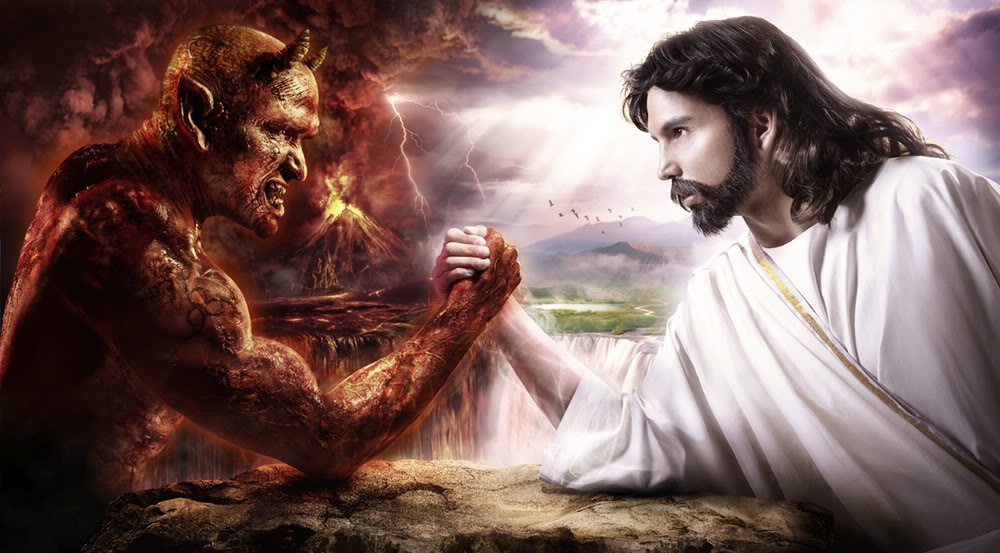
devil-jesus-arm-wrestle

I absolutely REFUSE to believe the following:

  1. I worship and believe in a God that spends half his time saying “Oh crap, did that just happen?” (Romans 8:28)
  2. Satan is just the evil version of God that pretty much has the same power and authority as Him. (Job 1:7-12; Zechariah 3:2; Matthew 16:23)
  3. God merely REACTS to the suffering Satan causes, thus making Satan pre-eminent and initiator of all bad things. (Isaiah 45:7)
  4. Every creature and being in all of the universe has a free will of self-determination EXCEPT God. (Isaiah 55:8-11)

Something that has been on my mind a lot lately, is this topic of God’s presence in a world full of suffering. Let’s face it: life is pain. You’re either coming out it, going through it, or about to enter into it. So . . . where is God in all of this?

We don’t worship a God that looks at the suffering of the world and says “Wow, that’s bad, someone should do something about that.” Rather, we worship a God that enters into this suffering and undergoes it Himself in order that His Will may be accomplished of saving His people and ushering them into His Glory.

My decision to finally get these thoughts down on the blog was because of an interesting message I read in my personal study of Micah. You can find some more context in Micah 2:1-5, here I give the verses of significance.

they oppress a man and his house,
a man and his inheritance.
Therefore thus says the LORD:
behold, against this family I am devising disaster,
from which you cannot remove your necks,
and you shall not walk haughtily,
for it will be a time of disaster.

The Hebrew word for “devising” can also mean “create,” “weave,” “fabricate.” The Hebrew word for “disaster” used here can also mean “evil.” So, this verse can reasonably read:

“Therefore thus says the LORD:
behold, against this family I am weaving together evil.”

If you want a more direct verse, look at Isaiah 45:6-7:

that people may know, from the rising of the sun
and from the west, that there is none besides me;
I am the LORD, and there is no other.
I form light and create darkness,
I make well-being and create calamity,
I am the LORD, who does all these things.

In both these passages, why is God directly weaving together and creating calamity and disaster? In the first passage we see that the intended result of this time of “disaster” is that the Israelites would no longer “walk haughtily” – or in other words: Discipline and Sanctification of God’s people. In the second passage, we see that the LORD is doing these things so that everyone may know that there is no other God but Him, and that He is in control – or in other words: Revelation and Communication of God’s eternal Attributes and Being. How does it do that? Suffering and evil cause something deep inside of us to want to cry out “No!” because something inside of us just knows that it isn’t the way it is supposed to be. Suffering shows us how fallen the world is and how unlike it was originally created to be. So, from these passages we can conclude three primary reasons for suffering, as it is caused by God Himself:

  1. God’s Glory
  2. Our Holiness (God’s Glory in us)
  3. Further His Redemptive Plan (God’s Glory in History)

Where did I get that last one? The context of Isaiah 45 is that this is the passage where Isaiah is prophesying about (and to) the ruler that would free the Israelites from the Babylonian captivity 500 years (I think) later! He calls him by name and country: Cyrus, king of Persia. The opening lines of Chapter 45 are “Thus says the LORD to his anointed, to Cyrus.” He refers to a pagan king who never believed in God (as far as we know) and calls him “his anointed”! Cyrus is anointed because he was chosen by God to free the people and so God says in this passage that he is opening every door and using everything to bring Cyrus to this point to display His Glory in the world, because God will use whatever it takes to bring about the redemption of His Creation, a pagan unbelieving King, light, darkness, or calamity.

Also take note that in all those purposes, God’s Glory is the key to it all. God’s Glory is at the center through every pain, every atrocity, and every evil perpetrated in the world. How does this help us? Well, it can’t – naturally. It really only helps some of us. Those whose very nature has been changed so that it delights in the Glory of God more than the glory of themselves. The natural man cares more about himself than the Glory of God. That is what conversion is. Heaven is an eternal revelation of the infinite Glory of God, being poured into the finite beings. Heaven is not eternal just because that’s how long it is – no, Heaven is eternal because it will take that long to exhaust the storehouses of God’s Glory for us to experience. The problem is thus: when people are born, they care about and enjoy every OTHER thing but the Glory of God. So, conversion is (and must be) the process of changing someone’s very nature so that they now delight in the Glory of God! It is to prepare us for Heaven. What does this have to do with suffering?

Well, two things:

First and foremost, the complete canon of Scripture testifies to the fact that (a) God does ALL things with His Glory foremost in His mind (even love us), (b) He is the one who actively causes suffering, tribulation, and pain in the world, therefore (c) He does it all for His Glory, which the converted soul now delights in, thus the Christian can delight in suffering, trusting that it is revealing God’s Glory in Him/Herself, the World, and History.

[UPDATE TO THIS POST: I should probably give an operational definition to the phrase “Glory of God.” It’s a nice concept, but what does it mean? The best way I have found to define it is thus: The “Glory of God” is the external manifestations of the manifold perfections of God. If that is your passion in this world, then you are converted.]

The second reason this helps the Christian I will discuss at length in my next post, but I assure you, it is Glorious (no pun intended).

I know this is very rough and hard to follow and my case isn’t made very fully. I just knew this was going to be long enough, so I had to try and compact somethings. Really, if anyone wants more Scripture on this, just ask. There is PLENTY to go around. Also feel free to leave a question if you see some philosophical, logical, or exegetical holes in my thinking. I’m sure there is a lot. Please let me know.

I appreciate everyone that reads this blog, and love you so dearly. Until next time.

Mem’ries from beside the Water-bed


Crumpled bed sheets, crumpled life
Crumpled woman upon the floor
Another night, another fight
Her son standing at her door
Numb and tingling all at the same moment.

Sobs and sucks of a snot stuffed nose
Invites the child inside . . .
To hold her, to love her, when no one else does.
He can’t even look at her when she cries.

The tears of mama are salt in the wound
of his seven or so years of life.
The smell of her Revlon-colored hair
Recalls the essence of the source of her pain:

Quote “marriage” to this weak quote “man”
Takes happiness from her grasp
The half-cocked smile of this half-cocked man
Turns the knife . . .
ever so slightly. . .

What comes to mind upon first entrance
of his face into my thoughts?

A reed swaying in the breeze
Dead chaff moving with the forces around it
Weakness, passivity, and pissed-off pessimism
Define that which I call “daddy” and what she calls “pain.”

Sometimes God Doesn’t Just Manifest Himself as a White-Bearded Guy in a Robe Bowling During Thunderstorms


Church Hill – no where else, God only above;
His warm arms hold me, His right hand leads me –
into peace and security and satisfaction and joy.
The personification and perfection of what is meant by
Home, what is meant by security, meant by hope, sustenance.
I feel His hands on my heart, my life, my strife,
Everything.
His warm arms surround every part of me.

But does the child have that?

In the Big Easy now the Big Difficult,
Can the arms of mama make the world a better place?
Will the waters recede at her touch? Only that
Which flows from his eyes can, will she brush away
With gentle tender arms, to
Soothe her sobbing son’s visage: blood-
Shot eyes peering from the black around.
Hunger pains. Hunger for Home, Security, Hope, Food.

Where are the arms of God there
that hold me so close and dear on my Church Hill of Calvary?

The arms of God are there in fact,

with dark, bruised skin,
a single shirt,
mud-caked legs,
tear-stained eyes,
and pain-shod memories.

He is there.

In fact, in a more real way than on that Hill of Church;
He is in every kiss of nappy head and ashy skin.
Indeed, both on Church Hill and in those waters,

there are truly just one set of footprints this day . . .

“On Fuel & Family, and the Costs Thereof” (a poem)


The cell burns from within the pocket
As the needle caresses the crimson “E.”
Justice questioned of the Almighty God
Over inevitability.

Car slows down, it’s time again
To press the speed dial “8;”
Re-bridging two worlds, renewing the scab-
Mom thinks all too late.

The red of the nylon vivid in hue
Tied to the basement rafter;
The blue of the note written on the washer
Heralding the hereafter;

The white of the face of dear old dad
Before kicking the chair from under him;
The brown of the sheriff ,came just in time,
To ring the bell and blunder him.

The images haunt the every thought
As gas necessitates the call
$2, $2.07, $2.75, $3
Causes this one to fall

Back to memories of screams and fights,
Of baseball bats and tears.
OPEC forces one still a child
To confront his darkest years

First once a month, then once a week,
Now once every couple of days.
Mileage doesn’t mean so much
anymore. . . .

Crude incites cruel making distance hit home

The sins of the father.
Justification.
All he’s good at – selfish ways.
Never really seeking the God of this earth
The only thing to save him.

Laying down a family at the altar of his god:
His excuse, his past, his illness, his, his his
Never hers
When she’s deserved it all.

One desires not to talk about it, one never does. Living away, detached from the reality, still hurting.

Pain. Pain. Pain. Tears of pain, fulfilling a role one never meant to fulfill:
surrogate husband to a broken mother.

Making a man of the child but still hurting her in the process.
Just . . . don’t . . . know . . .

Satisfaction and faith in Almighty God
Restores order to it all.
My only real Daddy in this entire world,
No matter “what” I have to call.

One strange paradox defining my world:
Joy, satisfaction, abundant life!!
Amidst all the pain of family hurt –
The constant signs of strife.

Provision not the source of belief,
Rather a recent application.
The value I hold, for my Lord, my God;
Mirrors the gas price of this nation. . .

Copyright© 2005

Proverbs 28 musings . . .


this was the quick word from Proverbs 28 I wanted to give at Paedeia, but was not able to:

“When the righteous triumph, there is great glory, but when the wicked rise, people hide themselves.”
— Proverbs 28:12

This is what has happened to our country, our culture, and our campus. The last couple of generations of Christians, as a reaction to the “Great ‘Intellectual’ Awakening” of humans, withdrew themselves from the influential spots of society and culture. Used to, the brilliant thinkers, scientists, philosophers, politicians, and influencers of society were all God-fearing men. Brilliance is what faith is meant to evoke in us. We as a church withdrew from culture and allowed the wicked to rise as we hid ourselves in the woodwork, afraid of defending that which we are meant to defend. The Holy Spirit has been paving the road for this school year though. All last year and summer he has shown himself strong and true and prepared to work on this campus in a mighty way. God’s desire and plan for this year has been made clear. This is found later in Proverbs 28:28. he says:

“When the wicked arise, people hide themselves, but when they persih, the righteous increase.”
— Proverbs 28:28

He wants the righteous to increase and the wickedness to perish. Hoe must we as Christians go about doing this? The answer is in verse 1 of Proverbs 28:

“The wicked flee when no one pursues, but the righteous are bold as a lion.”
–Proverbs 28:1

This one verse hold many many impications:
– The wicked do NOT flee as a result from any pursuit, be it an intellectual one, spiritual one, moral one, or political one.
– The righteous, to make the wicked flee, need not DO anything, but rather BE something: that which God has called them to be. (One hearkens back to Ephesians where Paul says just to stand with the armor of God, not go fight.)
– What makes the wicked flee? Our boldness.
– Lastly, notice that it says “bold as a lion”. “A” lion, singular. not “bold as lions.” We are called to be unified in our purpose, demeanor, attitude, and boldness in this world.

In short, wickedness has taken this campus over, God has said that this is to end this year. How? Wickedness is directly related to how much the people of God are unified in being who God purposes them to be. We haven’t been. Wickedness will decreases, as unification and righteousness increase. So the campus ministries at VCU (namely Every Nation Campus Ministries) serve the singular purpose of creating new Christians and equipping Christians new and old to be the people God desires them to be. It is only when an entire culture of Chirstians have been established as being who they are meant to be in God as one new man bodl as a lion, that the wickedness will decrease.