Sometimes God’s Heart breaks mine | Mark 4:10-12


When he was alone, those who were around him along with the twelve asked him about the parables. And he said to them, “To you has been given the secret of the kingdom of God, but for those outside, everything comes in parables in order that

‘they may indeed look, but not perceive,
    and may indeed listen, but not understand;
so that they may not turn again and be forgiven.’”

Mark 4.10-12

I simply don’t understand what this says about the heart of God. It seems at odds with everything else Jesus does. Is this just a temporary thing in order for the Gentiles to join in the mystery of redemption? Or is it truly as cold and calloused as this seems? Any help here would be appreciated.

See other Marginalia here. Read more about the series here.

Job, God, & Satan (Can I get some help from the scholar’s out there?)| Job 1.6-7


One day the heavenly beings came to present themselves before the Lord, and Satan also came among them. The Lord said to Satan, “Where have you come from?” Satan answered the Lord, “From going to and fro on the earth, and from walking up and down on it.”
Job 1:6-7

Anyone out there know how the ancient Israelites would have received these words? I see no other parallel in the OT to something similar to this (maybe the Psalms about God’s combat with the other gods?). I find it so confusing.

The one thing I am confident of, though, is that the conflating that Christians often do with this stuff is out of line. The way that (especially Evangelicals) use these verses to set up a systematic theology of “Satan” is absurd and does damage to the texts. Also, there is no indication that this is the same entity that is the serpent in the garden, nor the “Morning Light”, nor the NT Beelzebul, nor the beast of Revelation. Heck, there’s no clear connection between this particular “Satan” and the NT “Satan”.

See other Marginalia here. Read more about the series here.

Here’s absolutely everything the Gospels say was happening on Holy Saturday


The next day, that is, after the day of Preparation, the chief priests and the Pharisees gathered before Pilate and said, “Sir, we remember what that impostor said while he was still alive, ‘After three days I will rise again.’ Therefore command the tomb to be made secure until the third day; otherwise his disciples may go and steal him away, and tell the people, ‘He has been raised from the dead,’ and the last deception would be worse than the first.” Pilate said to them, “You have a guard of soldiers; go, make it as secure as you can.” So they went with the guard and made the tomb secure by sealing the stone.
–Matthew 27.62-66

On the sabbath they rested according to the commandment.
–Luke 23:56b

Yep. That’s it.

See other Marginalia here. Read more about the series here.

#Marginalia Weekly Round-Up #5 [3/24-30/14]


Marginalia is a section of this blog dedicated to (mostly) short reflections, meditations, questions, and difficulties I have while going through my Bible reading plan. I’m still trying to figure out the best pace at which to post these, so be patient with me. To aid in helping people engage with these posts, every weekend I post a round-up of all of Marginalia posts that appeared during that week. This list is in biblical canonical order.

Genesis

History, Theology, & Wrestling with God | Genesis 32.24-32

When morning came, it was Leah | Genesis 33.10

How Christians can read Old Testament horror  | Genesis 34.25-31

Exodus

God’s Sovereignty, Moses’ Will | Exodus 3.4

Our infinitely compassionate (and delegating) God | Exodus 3.7-8

The Proof that God’s Right? When He Is.  | Exodus 3.11-12

Who God is When We’ve Forgotten Who He is | Exodus 3.13-15

Continue reading

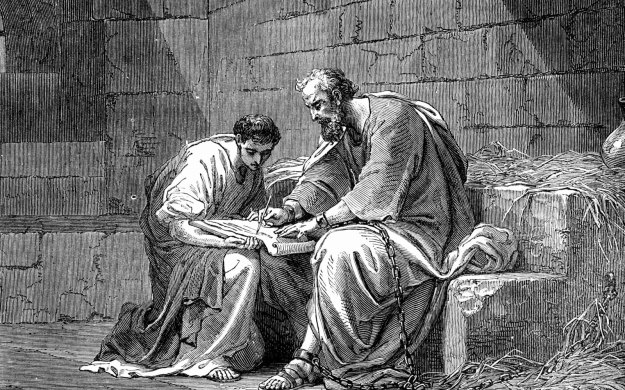
Timothy’s Tears: A Holy Week Pre-Game | 2 Tim 1, Acts 16 & 20


paul-and-timothy

This is part of our Lent series, “The Weeping Word“, where we look at different moments of crying, lament, and tears in the Scriptures.

To Timothy, my beloved child…

I am grateful to God—whom I worship with a clear conscience, as my ancestors did—when I remember you constantly in my prayers night and day. Recalling your tears, I long to see you so that I may be filled with joy.
2 Timothy 1.2-4

Next week is Holy Week, the high (or low?) point of Lent, leading to the crescendo of Easter. It will be a time of darkness, reflection, lament, and meditation. But we’re not there yet. Before the seriousness of Holy Week arrives, I thought I’d share with you a funny memory that’s connected to our Lent series on tears in the Bible.

I was sitting in the little campus ministry Bible Study my junior year of college. Our style of Bible Study was simply sitting down with an eloquent, wise, and gifted pastor, and then walking verse-by-verse through a given book of the Christian Scriptures.

Having just finished nearly a year in the book of Romans, we were just starting our next book: 2 Timothy. Many scholars believe it was Paul’s last letter he wrote before he died. And he wrote it to the man he mentored more than any other we know about: Timothy, a young elder at the church in Ephesus who was still struggling to get this little church plant off the ground.
Continue reading

On alcohol, abstinence, & the “weak in faith” | Romans 14:1-4


philly-beer-resurrection-ale-houseWelcome those who are weak in faith, but not for the purpose of quarreling over opinions. Some believe in eating anything, while the weak eat only vegetables. Those who eat must not despise those who abstain, and those who abstain must not pass judgment on those who eat; for God has welcomed them. Who are you to pass judgment on servants of another? It is before their own lord that they stand or fall. And they will be upheld, for the Lord is able to make them stand.
Romans 14:1-4

Look at that first line. What an interesting way to open this discussion. How might this apply today? Mainly, I think it shows that this goes a whole lot deeper than just “don’t drink around people that have a problem with alcohol”, or some such usual application. Growing up, this was the main way these verses were used in my life. People would say “you shouldn’t drink alcohol, because some people might have alcohol abuse problems and, seeing you drink, it might lead them into their alcoholism.” This introductory line shows us this is a lot deeper than mere behaviors or doctrinal superiority.

As for the rest of these verses, there a few other big takeaways (other than the hilarious swipe at vegetarians, haha).

First, it does not say that because some hypothetical believers out there might not feel comfortable with some things that others who otherwise feel free to do those things should abstain all together, always, in all places. The burden here is on the person who is “weak”, or who is bothered. They bear the weight to communicate this to the community. They are to let it be made known, and the body is to respond accordingly.

This is Paul teaching us how to respond to the realities and messiness of actual, particular members in the community, not to act generally in anticipation of possibilities.

Continue reading

Responding to Prophets: The Holy Spirit Changes Everything | Acts 11:27-30


At that time prophets came down from Jerusalem to Antioch. One of them named Agabus stood up and predicted by the Spirit that there would be a severe famine over all the world; and this took place during the reign of Claudius. The disciples determined that according to their ability, each would send relief to the believers living in Judea; this they did, sending it to the elders by Barnabas and Saul.
Acts 11:27-30

Sounds pretty Old Testament to me. But notice how the people of God respond. In the OT, when prophets spoke all of this, the people either barely responded, or responded in overdramatic wailing and (temporary) repenting. This group of God’s people, however, indwelt with the Holy Spirit, proceed to act in light of the prophecy to seek human flourishing and societal good. This is the response that the prophets of old were looking for and never got.

See other Marginalia here. Read more about the series here.

Where on Earth is Jesus’ Bethlehem? | Luke 2.1-5


In those days a decree went out from Emperor Augustus that all the world should be registered. This was the first registration and was taken while Quirinius was governor of Syria. All went to their own towns to be registered. Joseph also went from the town of Nazareth in Galilee to Judea, to the city of David called Bethlehem, because he was descended from the house and family of David. He went to be registered with Mary, to whom he was engaged and who was expecting a child. While they were there, the time came for her to deliver her child. And she gave birth to her firstborn son and wrapped him in bands of cloth, and laid him in a manger, because there was no place for them in the inn.
Luke 2.1-5

Recent archaeological evidence suggests that this Bethlehem is not the traditional site, but “Bethlehem of the Galilee” (which would make sense). The traditional site is 150km from Jerusalem, whereas this other, newer proposed site is only 7km. A lot easier for Mary. Although some dispute this, pointing out that Justin Martyr in the 2nd-century identified the traditional site as the correct site. Who knows?

See other Marginalia here. Read more about the series here.

Who God is When We’ve Forgotten Who He is | Exodus 3.13-15


But Moses said to God, “If I come to the Israelites and say to them, ‘The God of your ancestors has sent me to you,’ and they ask me, ‘What is his name?’ what shall I say to them?” God said to Moses, “I am who I am.” He said further, “Thus you shall say to the Israelites, ‘I am has sent me to you.’” God also said to Moses, “Thus you shall say to the Israelites, ‘The Lord, the God of your ancestors, the God of Abraham, the God of Isaac, and the God of Jacob, has sent me to you’:

This is my name forever,
and this my title for all generations.

Exodus 3.13-15

Oh this could be for us. The people had been so far from there God, that they may have even the forgotten his name. I feel like this is a similar time to where we are now, with people needing to be told the name of God and reminded who he is and what he does.

God says that this is his name for every generation. Even now? Could this somehow be a model for how Christians today are to live in this world where people have forgotten the name and identity of God? What if we lived as if God is not “The One Who Must be Defended”, “The One Who Judges & Condemns”, “The One Whose Way of Living Must Be Forced Upon Societies”, “The One Who Must Be Pleased”, “The One Who Accepts All”, or even “The One Who Saves Us”.

How would our lives look if we read this Exodus passage, saw this name, title, and covenantal nature and lived embracing this name and identity: The One Who Simply Is, and Is Ours.

See other Marginalia here. Read more about the series here.

The Useless Details of Mark | selections from Mark


Again he began to teach beside the sea. Such a very large crowd gathered around him that he got into a boat on the sea and sat there, while the whole crowd was beside the sea on the land. —Mark 4.1

Mark is famous for useless details like this. He “sat there”? Seems to imply an eyewitness dimension.

And leaving the crowd behind, they took him with them in the boat, just as he was. Other boats were with him. —Mark 4.36

Another useless detail implying eyewitness sources here. Peter?

[After raising a little girl from the dead,] He strictly ordered them that no one should know this, and told them to give her something to eat. Mark 5.43

Haha. another useless, funny detail hinting at this coming from an eyewitness. That is so funny. Reminds me of the statement early on in Mark about how after fasting for 40 days, Jesus was hungry.

Then he ordered them to get all the people to sit down in groups on the green grass. —Mark.6.39

“Green grass”?

A certain young man was following him, wearing nothing but a linen cloth. They caught hold of him, 52 but he left the linen cloth and ran off naked.Mark 14.51-52

Forget the Nephilim, this is the oddest thing in the Bible.

See other Marginalia here. Read more about the series here.

Our infinitely compassionate (and delegating) God | Exodus 3.7-8


Then the Lord said, “I have observed the misery of my people who are in Egypt; I have heard their cry on account of their taskmasters. Indeed, I know their sufferings, and I have come down to deliver them from the Egyptians, and to bring them up out of that land to a good and broad land, a land flowing with milk and honey….
Exodus 3.7-8

Notice the verbs hear that God uses to describe how he relates to his people. He observes, hears, knows, and comes down. How intimate, tender, and powerful. Also, it’s a little funny that he says that he has come down to save if his people right as he’s commissioning Moses to do it for him.

See other Marginalia here. Read more about the series here.

Let’s just finish Esther already (On Purim & History) | Esther 9 & 10


Haman son of Hammedatha the Agagite, the enemy of all the Jews, had plotted against the Jews to destroy them, and had cast Pur—that is “the lot”—to crush and destroy them; but when Esther came before the king, he gave orders in writing that the wicked plot that he had devised against the Jews should come upon his own head, and that he and his sons should be hanged on the gallows. Therefore these days are called Purim, from the word Pur. Thus because of all that was written in this letter, and of what they had faced in this matter, and of what had happened to them, the Jews established and accepted as a custom for themselves and their descendants and all who joined them, that without fail they would continue to observe these two days every year, as it was written and at the time appointed. These days should be remembered and kept throughout every generation, in every family, province, and city; and these days of Purim should never fall into disuse among the Jews, nor should the commemoration of these days cease among their descendants.
Esther 9.24-28

Historically, I wonder: Is this it? Is this the reason for this story? As I said before, it genuinely doesn’t look like this story is historical, so it must have served some other purpose in the community. I wonder if the Jews were coming back from exile and had this random festival named after the plural of “lots”, and so they needed to write a story about how it came about. But if so, how do you go from the word “lots” to all of this story? Quite the stretch. So…what’s the historical core? This one’s tough.

King Ahasuerus laid tribute on the land and on the islands of the sea. All the acts of his power and might, and the full account of the high honor of Mordecai, to which the king advanced him, are they not written in the annals of the kings of Media and Persia? For Mordecai the Jew was next in rank to King Ahasuerus, and he was powerful among the Jews and popular with his many kindred, for he sought the good of his people and interceded for the welfare of all his descendants.
Esther 10

So… Mordechai is the hero here? I guess it could make sense, but he plays such a bit part in the story. He’s consequential, sure; he’s just not around that much, is all. This seems more like the mythologizing of a popular leader in the Jewish diaspora.

And lastly, one last “Christian” reading of this story. If we can analogize this a little, Mordechai “intercedes” for God’s people, for their good and for their descendants. And they’re enemies (like death and sin for us) are comprehensively and almost over-the-top-ly destroyed. And God is faithful to accomplish all of this, even when he seems absent. With this book, that’s the best I can do. I genuinely don’t like this story.

See other Marginalia here. Read more about the series here.

Ancient Miracles, Skepticism, & Historicity | Mark 2.12


And he stood up, and immediately took the mat and went out before all of them; so that they were all amazed and glorified God, saying, “We have never seen anything like this!”
Mark 2.12

Even ancient people knew magic tricks. This was utterly different than anything else they’d ever seen or even thought was possible. This point is especially interesting considering the things they believe God had done in history in the past. Even though they “believed” the things happened, it wasn’t until they were face to face with the New Creation that they really saw the things this God could do.

Similarly to today, I wonder if there’s a subtle, unconscious “wink-wink” about how seriously we take some of these things. In their case, I actually think it was right, however, as those miraculous things in their stories were to be seen more as symbols and shadows that would point forward to an “actual” manifestation in Christ–not as historically-essential events. And yet, when that Christ was there, it still blew there minds.

See other Marginalia here. Read more about the series here.

Matthew & Judas’ Repentance?! | Matthew 27.3-5


When Judas, his betrayer, saw that Jesus was condemned, he repented and brought back the thirty pieces of silver to the chief priests and the elders. He said, “I have sinned by betraying innocent blood.” But they said, “What is that to us? See to it yourself.” Throwing down the pieces of silver in the temple, he departed; and he went and hanged himself.
Matthew 27.3-5

I can’t figure out what Matthew’s characterization of Judas is. He did all the things that a true disciple would in light of his sin. He repents, confesses, and tries to make right. Maybe this is meant to contrast Judas and Peter, perhaps? Both reject Jesus, both face conviction for their actions. Judas, though, runs away from God in shame, but Peter runs to Jesus. Conspicuously, though, there’s no “restoration” passage for Peter here like there is in John.

And yet, this word “repent” is still used here! I should check this another time, unless anyone out there knows: is that term “repent” ever used in a negative sense in the book of Matthew? What is repentance to Matthew?

See other Marginalia here. Read more about the series here.

Our Exile is for the world’s salvation | Acts 7.6-7


And God spoke in these terms, that his descendants would be resident aliens in a country belonging to others, who would enslave them and mistreat them during four hundred years. “But I will judge the nation that they serve,” said God, “and after that they shall come out and worship me in this place.”
Acts 7.6-7

Our exile/ambassadorship/pilgrim-nature as well as God’s judgment are all for the sake of the ultimate worshipnot condemnation–of the nations and the world!

See other Marginalia here. Read more about the series here.