Esther is no Sunday School role-model | Esther 2.8-9


So when the king’s order and his edict were proclaimed, and when many young women were gathered in the citadel of Susa in custody of Hegai, Esther also was taken into the king’s palace and put in custody of Hegai, who had charge of the women. The girl pleased him and won his favor, and he quickly provided her with her cosmetic treatments and her portion of food, and with seven chosen maids from the king’s palace, and advanced her and her maids to the best place in the harem.

Esther 2.8-9

She “pleased him.”  You know what that means, right?

Here and throughout the book are instances where Esther shows herself time and time again to not be faithful to her people or her God in any way. She is selfish, power-hungry, narcissistic, unmerciful, and only helps her people once she is scared she will get killed with the rest of them. She’s kind of a terrible human being. No wonder this book wasn’t accepted as canonical by huge communities of Jews.

See other Marginalia here. Read more about the series here.

The Holy Spirit exorcizes, no matter who you are | Matthew 12:24-28


But when the Pharisees heard it, they said, “It is only by Beelzebul, the ruler of the demons, that this fellow casts out the demons.” He knew what they were thinking and said to them, “Every kingdom divided against itself is laid waste, and no city or house divided against itself will stand. If Satan casts out Satan, he is divided against himself; how then will his kingdom stand? If I cast out demons by Beelzebul, by whom do your own exorcists cast them out? Therefore they will be your judges. But if it is by the Spirit of God that I cast out demons, then the kingdom of God has come to you.

Matthew 12.24-28

Even those that are not the people of God exorcise by the Holy Spirit. Don’t be so quick to discount the healing just because you disagree with the person or even if they’re not Christian! God is the Gospel of healing. However shalom happens, it is the Spirit that brings it.

See other Marginalia here. Read more about the series here.

Lent begins tomorrow. (Will you just give it a try?)


Jesus & The Cross

I grew up in a church tradition that did not take seriously the Christian Church Calendar. Even as I went to college and moved into communities that took some level of tradition more seriously (which was usually limited to quoting Puritans and Reformers in sermons), the Church Calendar wasn’t that big of a deal. It was seen as something sort-of cool that could be incorporated into the already established life of the Church; a buffet from which leaders could pick and choose some aspects that might be helpful in organizing some sermon series or songs. But it certainly wasn’t seen as something that a church should actually incorporate itself into, or build it’s own rhythm around.

I’ve had the privilege of having this paradigm rocked the past several years at my church, and have fallen in love with the Church calendar. It influences much of the rhythm and timbre of my everyday life–both ecclesial and otherwise. I find such life in living within a stream of thought that was not simply created within the past generation by baptizing modern Western American cultural ideas.

I love finding myself as embedded within the cloud of witnesses that have gone before me as possible–even those I may disagree with passionately and fundamentally. Because, at the end of the day, they are my family, and families have traditions. Sure, you can be “that guy” that does his own thing and doesn’t participate in the family rhythms, but where’s the life in that?

Continue reading

Preaching the Gospel to Christians | Romans 1:14-16


I am a debtor both to Greeks and to barbarians, both to the wise and to the foolish—hence my eagerness to proclaim the gospel to you also who are in Rome.

For I am not ashamed of the gospel; it is the power of God for salvation to everyone who has faith, to the Jew first and also to the Greek.

Romans 1:14-16

Notice here that Paul wants to proclaim the gospel to those who are already believers! This Gospel is the whole of the Christian life, not simply our starting place. It not the ABC’s, after which we need theology, doctrine, good works, etc. It is the A-to-Z of the Christian life. When we think our churches, our preaching, and our lives essentially need something more than that, we begin to stray from the Gospel altogether.

See other Marginalia here. Read more about the series here.

Why go to church? Well, why get married? [QUOTE]


If someone asks me what is the use of going to church, what good does it do me, what do I get out of it, how do I answer these questions?

It is as though someone asks me what the use is of getting married, what good does it do me. If I answered such questions by saying, “Well, it is very useful to get married! You have someone to do the housework, the shopping, cook the meals, etc.,” it would clearly be a false view of marriage. No woman wants to be merely a housekeeper, kept because of her utility!

There is only one supreme reason for getting married—for love’s sake, for the other’s sake, for mutual love, self- giving, a longing for intimate communion, and sharing of everything.

So in Christian worship, we worship God for God’s sake; we come to Christ for Christ’s sake, motivated by love. An awareness of God’s holy love for us, revealed in Jesus Christ, awakens in us a longing for intimate communion—to know the love of the Father and to participate in the life and ministry of Christ.

Worship in the Bible is always presented to us as flowing from an awareness of who God is and what he has done: “I am the God of Abraham, Isaac and Jacob . . . I have loved you and redeemed you . . . I will be your God and you will be my people. Therefore, this is how you will worship me.”

As we have seen, worship in the Bible is an ordinance of grace, a covenantal form of response to the God of grace, prescribed by God himself. This is supremely true of the New Testament understanding of worship, as the gift of participating through the Spirit in the incarnate Son’s communion with the Father and his mission from the Father to the world, in a life of wonderful communion.

— from James B. Torrance’s beautiful book Worship, Communion, and the Triune God of Grace (paragraph breaks added for clarity)
You marry a family | Genesis 29.13-14


When Laban heard the news about his sister’s son Jacob, he ran to meet him; he embraced him and kissed him, and brought him to his house. Jacob told Laban all these things, and Laban said to him, “Surely you are my bone and my flesh!” And he stayed with him a month.

Genesis 29.13-14

Well isn’t this interesting? Rachel’s father says the same the marital vows to Jacob that Adam said to Eve. It just goes to show you that marrying one person is, quite literally, marrying their family. This is what covenant is. Think of the implications for church life as well. When someone joins the church they’re joining the entire family. This is why it is so deeply flawed to see Baptism as one’s individual “public declaration”. It is the marital vows of God and his family toward us that bring us into the family.

See other Marginalia here. Read more about the series here.

#Marginalia Weekly Round-Up #1 [2/24-28/14]


Marginalia is a section of this blog dedicated to (mostly) short reflections, meditations, questions, and difficulties I have while going through my Bible reading plan. I generally post between 1 to 3 of these per day, which can be difficult to keep up with. To aid in helping people engage with these posts, every weekend I post a round-up of all of Marginalia posts that appeared during that week. This list is in biblical canonical order.

Death & Life; Names & Vows | Genesis 3.20-21

Adam names Eve only after the Fall. Why?

Noah, Prophecy, & the Comfort of the Earth | Genesis 5.28-29

Noah’s name is interestingly prophetic…

Abraham’s son Ishmael was part of Covenant! | Genesis 17.23-27

This blew my mind. I’m still trying to work through the implications.

Abraham almost loses his son & he worships?! | Genesis 22.13-14

This is why Abraham was the Father of our faith. I couldn’t do it.

Insecurity Leads to Fasting? | Ezra 8:21-23

On sin and spiritual discipline.

Male Headship & Societal Injustice | Esther 1:17-22

A longer one (also part of our Women in the Church series). Some lessons for our Complementarian friends from the book of Esther.

Universal Intimacy: The Beautiful Transition | Matthew 11:25-39

This is what Christian Universalism looks like.

What Draws Out Jesus’ Compassion? | Matthew 15.32

It might not be what you think.

Women at the Cross | Matthew 27:55-54

The Gospels really make an effort to highlight the women. Why?

Who Sent Whom? | Acts 13.2-4

Beautiful words about God’s work through us.

The Good News changes, the Good News gifts | Acts 20.32

The proclamation has got a lot to it.

_________________

See other Marginalia here. Read more about the series here.

Noah, Prophecy, & the Comfort of the Earth | Genesis 5.28-29


When Lamech had lived one hundred eighty-two years, he became the father of a son; he named him Noah, saying, “Out of the ground that the Lord has cursed this one shall bring us relief from our work and from the toil of our hands.”
Genesis 5.28-29

Noah’s name means “comfort” or “rest”. This is an interesting prophetic statement concerning Noah. Hebrew irony at its best. The same Hebrew word for “earth” is used here as “ground”. Same word as in “God created the heavens and the earth”. So, how Noah will bring “relief” from the toil is by playing a part in the undoing of God’s creation of “the heavens and the ground”. In other words, he comes out of the ground to bring comfort to that ground by undoing the ground. Oh, Hebrew.

See other Marginalia here. Read more about the series here.

Universal Intimacy: The Beautiful Transition | Matthew 11:25-39


At that time Jesus said, “I thank you, Father, Lord of heaven and earth, because you have hidden these things from the wise and the intelligent and have revealed them to infants; yes, Father, for such was your gracious will. All things have been handed over to me by my Father; and no one knows the Son except the Father, and no one knows the Father except the Son and anyone to whom the Son chooses to reveal him.

“Come to me, all you that are weary and are carrying heavy burdens, and I will give you rest. Take my yoke upon you, and learn from me; for I am gentle and humble in heart, and you will find rest for your souls. For my yoke is easy, and my burden is light.”
Matthew 11:25-39

What a beautiful transition; from words of exclusivity to words of rest and invitation. It is precisely into the intensely exclusive intimacy between the Son and the Father into which we are invited to come and find rest. This is true Christian “Universalism”: the whole cosmos is brought into the exclusive, fiery love of the Trinity.

See other Marginalia here. Read more about the series here.

Male Headship & Societal Injustice | Esther 1:17-22


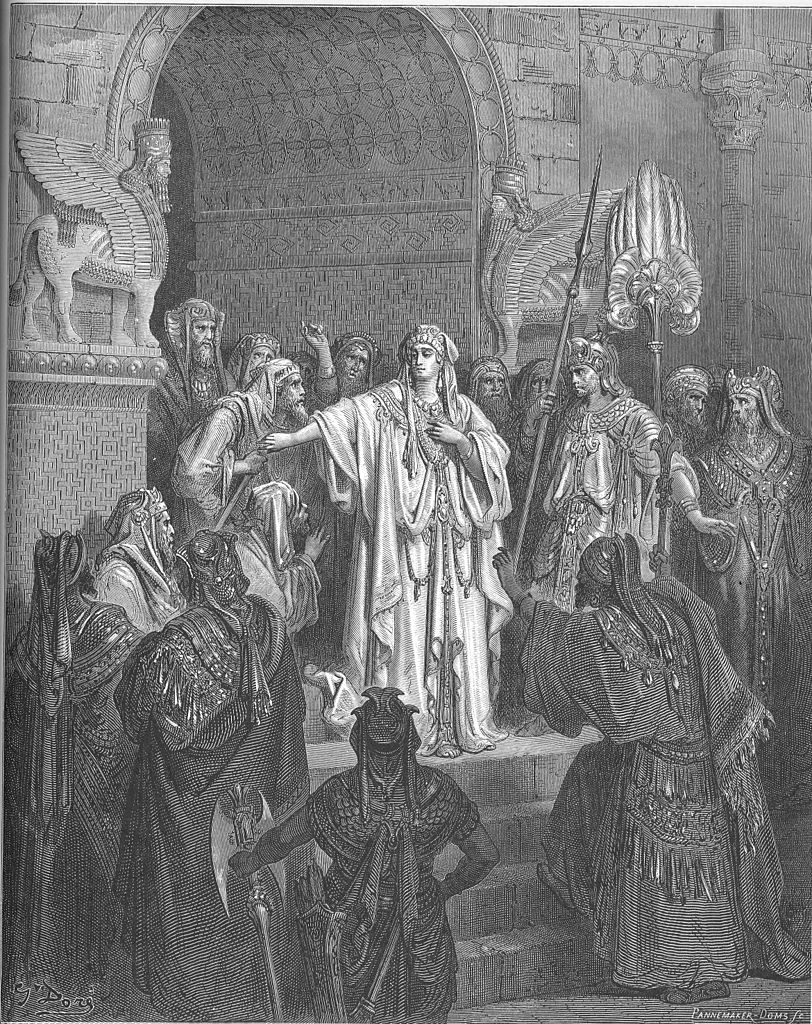
Queen_Vashti_Refuses_to_Obey_Ahasuerus_CommandToday’s post falls into both our new section of the site called Marginalia and our on-going series on Women in the Church.

For this deed of the queen will be made known to all women, causing them to look with contempt on their husbands, since they will say, ‘King Ahasuerus commanded Queen Vashti to be brought before him, and she did not come.’ This very day the noble ladies of Persia and Media who have heard of the queen’s behavior will rebel against the king’s officials, and there will be no end of contempt and wrath! If it pleases the king, let a royal order go out from him, and let it be written among the laws of the Persians and the Medes so that it may not be altered, that Vashti is never again to come before King Ahasuerus; and let the king give her royal position to another who is better than she. So when the decree made by the king is proclaimed throughout all his kingdom, vast as it is, all women will give honor to their husbands, high and low alike.”

This advice pleased the king and the officials, and the king did as Memucan proposed; he sent letters to all the royal provinces, to every province in its own script and to every people in its own language, declaring that every man should be master in his own house.
Esther 1.17–22

I can imagine a conservative evangelical looking at this and saying to themselves, “Now, the king’s court is recognizing a natural order in the way God has made a marital relationship to work, even though they go about reinforcing this biblically-supported picture in the wrong way–through force and not love”. I hope that’s a fair representation.

But either way, (1) they would not want us to pull from this text any lessons about how male headship itself is wrong, just how it’s done badly here, and (2) they would still think the concern of these males is justified (and perhaps even right), as we’ve seen similar dynamics play out in our culture in the aftermath of feminism.

Continue reading

Insecurity Leads to Fasting? | Ezra 8:21-23


Then I proclaimed a fast there, at the river Ahava, that we might deny ourselves before our God, to seek from him a safe journey for ourselves, our children, and all our possessions. For I was ashamed to ask the king for a band of soldiers and cavalry to protect us against the enemy on our way, since we had told the king that the hand of our God is gracious to all who seek him, but his power and his wrath are against all who forsake him. So we fasted and petitioned our God for this, and he listened to our entreaty.
Ezra 8:21-23

What an odd and beautifully honest aside. At first I was put off by the logic here. “I proclaimed a fast…For I was ashamed.” I thought “that’s a terrible reason to have a fast!” But the more I thought about it the more I realized that, of course!, that’s the right time to fast! When you are most unsure, most in need, most insecure. This is when “we might deny ourselves before our God.”

See other Marginalia here. Read more about the series here.

Experiencing God in this Holy Present


flickr-sculpture-worship-kissAt my work, we recently had a training on mindfulness. Now, before you roll your eyes, it was maybe my favorite work training I’ve ever done. It was engaging, practical, and participatory like few trainings are.

Anyway, “mindfulness” is the fancy word used to describe a “non-judgmental awareness of the present”. It’s heightening your senses and calming yourself in order to fully inhabit the present without analyzing it, mulling it, or needing to evaluate it. For those of us with anxiety issues, it really is an amazing way of centering and calming oneself, as well as separating oneself from the internal busyness–at least for a moment.

Another way of putting it is that it is radical present-ness. It is letting this very moment not be merely something you’re passing through as a bridge from the moment that has passed and into the moment that is not yet here. It is to fully inhabit the moment you find yourself in, and let the future come to you rather than anxiously trying to run towards it.

Not gonna lie. It was very spiritual to me. I felt more in tune to God and it got me thinking about how we mystically experience Him in our everyday lives.

When an Atheist talks about this hard-wired human sense to feel the “Numinous”, it often carries with it the sense that it rises from within us. When a lot of Christians talk about meeting the Divine, it often sounds like a presence that comes pointedly at us from outside of us. I’m starting to think that neither of these is right.

Continue reading

The Good News changes, the Good News gifts | Acts 20.32


“And now I commend you to God and to the message of his grace, a message that is able to build you up and to give you the inheritance among all who are sanctified.”
Acts 20.32

Nice. The message of grace itself is enough to sanctify and grow them. Just the message. Further, this message–again, the message itself–gives us the inheritance of the Holy.

See other Marginalia here. Read more about the series here.

Women at the Cross | Matthew 27:55-56


Now when the centurion and those with him, who were keeping watch over Jesus, saw the earthquake and what took place, they were terrified and said, “Truly this man was God’s Son!”

Many women were also there, looking on from a distance; they had followed Jesus from Galilee and had provided for him. Among them were Mary Magdalene, and Mary the mother of James and Joseph, and the mother of the sons of Zebedee.
Matthew 27:55-54

It’s really interesting to me that Matthew adds this little addendum to the end of the account. Why point out the women that were there? Is the assumption that all the men have scattered, and so Matthew had to show his sources for this story?

See other Marginalia here. Read more about the series here.

Introducing Marginalia: a new part of this blog


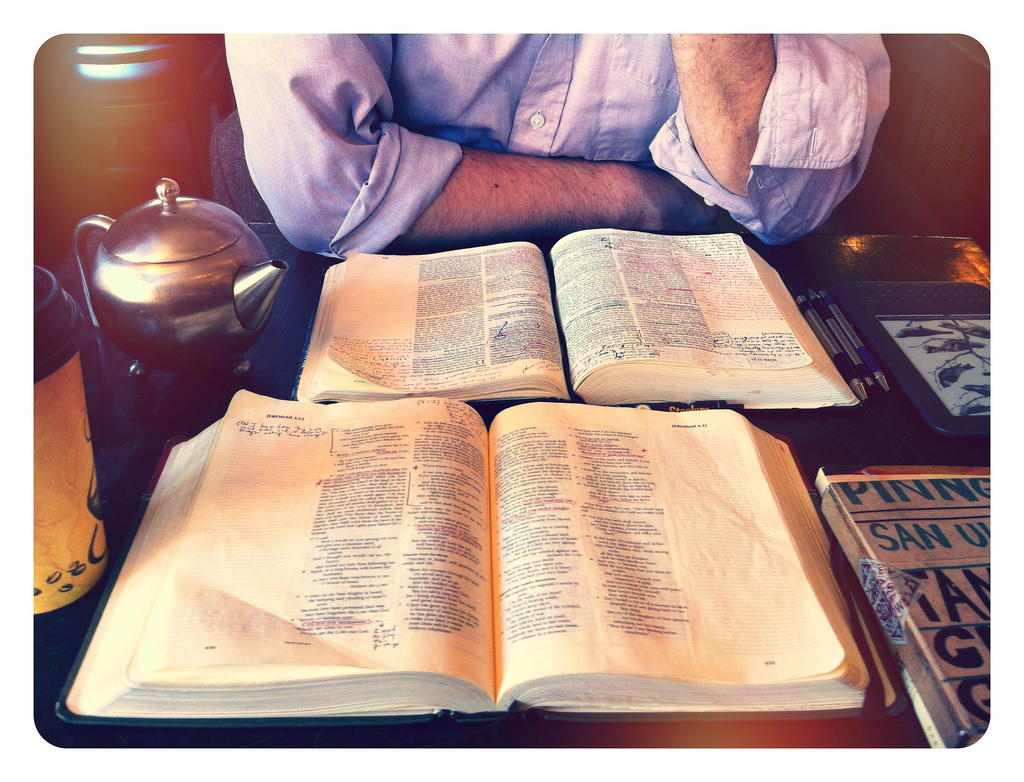
schrott-bibles-paul-coffee

I’ll be honest. It’s been years since I’ve been able to find a way to regularly read the Bible that sticks and works for me. To be frank, readings plans usually don’t work for me because I get bored. Depending on the plan, you’re either stuck in the same book for long stretches of time or you’re jumping around so much that you lose the sense of the whole.
This year, I think I’ve started a regimen that is clicking: the M’Cheyne Bible reading plan. At any given time, I’m going through four completely different part of Scripture and for me, this is keeping me really engaged. As I’ve gone on through the plan these past couple of months, I started highlighting and writing up little notes on random verses here and there. Lots of themAnd I’d like to share them with you.

So today, I’m introducing a new little part of this blog called Marginalia, where I’ll be posting these short little meditations on Scripture as I go through this plan.
Continue reading