“WTFWJD? | (on Christian cursing)”-Reform & Revive


"Andrew Murray" by Amy Roberts

"Andrew Murray" by Amy Roberts

Just wanted to drop a quick plug for a new article I posted yesterday in the online magazine I run, Reform & Revive.  The article is on the topic of Christians that curse and explores the issues that surround it.  It’s received some really good, really helpful feedback and comments, so I wanted to post something here as well letting people know about it so they can join in on the conversation.

Remember to leave comments and retweet.

Here’s the link:

http://reformandrevive.com/2009/07/28/wtfwjd-on-christian-cursing/

Also, if you want to write for Reform & Revive, you can either get in touch with me here or use this form.  We are always looking for more content and new ideas for the site.

You can find more art from Amy Roberts here.

From the iMonk: Mary Consoles Eve


I found this at the site of Michael Spencer (a.k.a. The Internet Monk).  This guy is having an increasing amount of influence and inspiration on my thinking as a Christian in this world.  You find him at The Internet Monk. Anyway, I love this piece of art and the poem.

Crayon & pencil drawing by Sr. Grace Remington, OCSO. Copyright 2005, Sisters of the Mississippi Abbey

_______________

O Eve!

My mother, my daughter, life-giving Eve,

Do not be ashamed, do not grieve.

The former things have passed away,

Our God has brought us to a New Day.

See, I am with Child,

Through whom all will be reconciled.

O Eve! My sister, my friend,

We will rejoice together

Forever

Life without end.

Sr. Columba Guare copyright© 2005 Sisters of the Mississippi Abbey

_______________

This was found by Michael Spencer at Inside Catholic.

“For your life – Flee!” by Sean Brendan Stewart – Reform & Revive | a Plugfest


sorry, no y-axis this time

sorry, no y-axis this time

[Thank you to spectacular photographer and friend David Schrott for inspiring this post]

Okay, due to a few recent articles I’ve written, the number of people visiting my blog has increased by over 4000% in the past week.  It’s pretty nuts.  That’s why everything has seemed to be about Derek Webb and his new album, Stockholm Syndrome.  So, I just wanted to take this chance to put in a few plugs for some of my other projects.

I have web magazine called Reform & Revive.  It looks at the intersection between faith and culture, politics, art, the church, and just life in general.  These Derek Webb posts would perhaps have been more appropriate on that site, but the readership here jumped up so fast (I’m actually on the first page of most Google searches having to do with the album).

Anyway, friend, brother, and fellow impassioned writer, Sean Brendan Stewart, just put up a special article that seems to have a similar message as the new Webb album.  It’s some commentary from him, then a very brief manuscript of some audio from a Carter Conlon message.  After that, feel free to look at our more regular full articles from our Contributors.

Lastly, I have my own personal site, Prodigal Paul, that acts as a hub for organizing other blogs, Bible studies, sermons, and such that I have produced over the years.

That is all.

Derek Webb’s “Stockholm Syndrome”| a preliminary album review


[NOTE: this is not a review of the whole album, just an impression from the songs released so far]

He has said it is his most important album to date.  But no matter what, Derek Webb’s Stockholm Syndrome will not be just an album. Regardless of the music, production, or vocals, this album will first and foremost be a manifesto, an indictment, a message. The lyrics will define this album. This album – this artist, even – has become a voice for an entire group of disgruntled twenty-something Christians that have surveyed the rolling hills of American evangelicalism and have found it lacking. They have called out for a prophet to say the words and use the language that will draw the line in the sand and separate the “Biblical” sheep from the “fundamentalist” goats. A man to come out in sackcloth and ashes and save real grace-driven Christianity from the clutches of the legalistic drones that would rob us of our freedom in Christ.

So, the question I have struggled with ever since the first songs on this album came out is: is this the right message spoken in the right way to the right people at the right time?

I hate saying it, but (from what we’ve seen so far) I don’t think so. There is a time and a place for the message this album seems to carry, don’t get me wrong. I don’t write off a song done by a Christian just because it has a curse word or says things sharply. The Old Testament prophets spoke just as harshly (if not more so) to the “church” at that time. They would call women cows (Amos 4:1), say that the people “lusted” after other gods like some dream of fornicating with others with penises the size of donkeys and ejaculations like that of horses (Ezekiel 23:20), and declare that the best things we ever did were nothing more than rags dipped in a woman’s menstruation tossed before the face of God (Isaiah 64:6).

I fancy Derek Webb sees himself as such a prophet, just as I know many of his fans do. Now, I think this harsh tone is absolutely appropriate and the balance is struck with all of Webb’s previous albums. But the vehemence of the songs released so far from Stockholm is off-putting and seems a bit out of place. It’s not just a declaration that the church is off on a few points and how they’ve gone about some things – all the songs are a mockery and sarcastic rant against her. As a friend well put it: this album probably will not accomplish the goal for which Derek set off writing this record. Rather than shock the church into reform, this album is far more likely to galvanize the opposition force against the church and those that think the Church has become so out of touch and impotent it has become unimportant all together.

I know that’s not Webb’s heart. Anyone that’s heard the album 2003’s She Must and Shall Go Free knows this. The songs from Stockholm Syndrome seem to form an epistle from a wounded lover. A man who loves the Bride of Christ so much he hates how she has gone a stray and has been personally affected and hurt by it. But I wish he would take a page out of Hosea and try to play a part in wooing the church back rather than trying to beat her back.

I just want to say it again: this criticism is not about language or tone. I am really not bothered by the “bad words” used or the forceful tone. Perhaps my favorite song ever recorded by any artist, “Wedding Dress“, has both of these elements, and yet it is geared more towards Webb’s own depravity rather than the Church’s flaws. Look, I have the same criticisms as him. Raised as a Dallas, Texas Southern Baptist, my family has been destroyed by the effects of fundamentalism and “easy believism”. But Jesus said He is building His church, so we must try and find the balance between working with Christ in building it or mocking what He’s done so far, and thereby working against the work Christ would have us do. I fear this album is the latter.

Much has changed on the landscape of American Christianity since Webb’s 2007 album The Ringing Bell. The Church has effectively lost its grip on pop culture, politics, and the prevailing worldview of the nation. This being the case, these songs from Stockholm Syndrome come on the scene too late and kick the church while she’s down, as it were.

But, at some point today, Derek is supposed to begin pre-orders for the album accompanied by immediate digital downloads. So when that happens, I’ll be sure to put up a more comprehensive review as soon as possible.

I pray he surprises us.  Thoughts, anyone?

It is done: Derek Webb’s “Stockholm Syndrome” album release + new free song


Untitled

[WARNING: there’s a “bad” word mentioned a few times in this post]

[Also, for those reading this on Facebook, click here to read this on my actual blog, so you can watch the videos, stream the music, and download the audio more easily.]

Well, it’s done.  After all the drama, Derek Webb’s new album “Stockholm Syndrome” is set for release this Tuesday.  Apparently, if you pre-order the album off his website on Tuesday, you will be able to get a free download of the entire album immediately.

But –

this revelation did not come before another song – the song of the album perhaps – was released.  Anyone who has been following this situation knows that Derek has been releasing “stems” (or pieces of the song) for a while.  This is the song with the cursing that started this whole thing.  It is a song that has been titled “What Matters More” and it has to do with the Church’s treatment of homosexuals.  So without further ado, here are all the songs that have been released off of Derek Webb’s newest album “Stockholm Syndrome”.  Enjoy and be sure to download them all on Tuesday.

Thanks again to Shane for the update.  The name above each streaming song is a link to the actual file for you to download.  Right-click or whatever you do to download these things.

“What Matters More?”

“Freddie, Please”

“Heaven”

“The Spirit vs. the Kick-Drum”

It sounds like the new song is what inspired (or vice versa) Webb’s recent purchase of the domain GiveAShit.org, which he plans on using as a fundraising site.  The site’s had no content on it for a while, but just now as I saw that it has a black screen on it, apparently holding the spot for new content coming soon (Tuesday, perhaps?).  We’ll see.

Lastly, I heard from musical artist and friend Joel Rakes (so if it’s not true, blame him – or the people he follows on Twitter) that there was also a documentary done about this whole thing, so keep an eye out for that.  And check out Joel’s stuff while you’re at it.

Here are other sites concerning Webb and the album. Please visit these as well to support the artist and his craft.

For those that don’t even know about Derek Webb and his music, here are a few of my favorite songs by him. Yeah, he’s pretty stinking good. [Once again, if you’re on facebook, these videos may not show up, so click here to watch them]

“Wedding Dress” off of “She Must and Shall Go Free”
Vodpod videos no longer available.

“Medication” off of “I See things Upside Down”
Vodpod videos no longer available.

“My Enemies Are Men Like Me” off of “Mockingbird”
Vodpod videos no longer available.

“Independence Day?” by B.Rayshawn Graves – Reform & Revive


B.Rayshawn Graves, a Guest Contributor his way to becoming a regular on Reform & Revive just posted a new article.  He originally called it “Decision Day” but I renamed it “Independence Day?” for obvious American calendrical reasons.

The article contains a quote and some of Graves’ thoughts on the balance between God’s Sovereignty and our free will.  Here’s the article:

http://reformandrevive.com/2009/07/02/independence-day/

“Realizing Seminary’s Not For You” – GoingToSeminary.com


paul-dano-12-03

UPDATE: I am now back in seminary. I’ve written the reasons why here.

After a long hiatus from writing for the site (for obvious reasons), I have written a new article on the site GoingToSeminary.com.  I’m really proud of this one and it has generated a LOT of conversation so far.  Some supportive, some . . . otherwise.

Join the conversation here:

Realizing Seminary’s Not For You

Check out the rest of my Going To Seminary posts.

A Twitter Gospel: the contest


Scott Thomas, director of Acts29 Church Planing Network, held a contest on the Acts29 Twitter account for the best statement of the Gospel in 140 characters or less.  The winner gets a free copy of Mark Driscoll’s new book “Religion Saves”.

If you go to this site, you can find all 95 entries.  Mine is number 54 on the list:

a holy God w/ holy demands you don’t meet has both fulfilled these demands & taken the wrath due you. repent & believe he’s done it

My other favorite was this one (number 37):

we suck, Jesus doesn’t & never did, was slaughtered, defeated death & desires to exchange your crap for His perfection

They are asking that you vote for your top 3 favorite tweets by commenting on the bottom of the blog with the entries, messaging Scott on his facebook, or by going to the Acts29 Twitter page and “tweeting the numbers in order of preference followed by hashtag #gospeltweet. For instance: ‘@acts29 101, 98, 107 #gospeltweet'”

So go vote, and if you like mine, remember it’s number 37.

You can follow the votes  so far here.

Have some fun with it.

Wittgenstein, Edwards, & the Substance of Things | Philsophy & Theology {III}


I’ve been slowly working my way through Ludwig Wittgenstein’s “Tractatus Logicus-Philosophicus” and I ran across some ideas that seemed to connect with some of the ideas of Jonathan Edwards I had read in George Marsden’s “Jonathan Edwards: A Life.” This is not a comprehensive look at Wittgenstein’s thought, just how one facet of it can help illuminate Theological metaphysics. I will do my best to put this into normal, down-to-earth language, but metaphysics, by definition, talks about some really heady things. This really is not me just trying to sound smarter. My hope is to give anyone that reads this a bigger grander idea of just beautiful the Reality God has formed actually is, and therefore, a bigger grander idea of how beautiful this God is.

In Wittgenstein’s Tractatus he talks about the nature of possibility, things, being, language, and philosophy. He writes that people are objects of infinite possible properties. Before you’re born, there is an infinite number of various properties you may hold, but none of these properties are inherent to yourself. You have to borrow properties from the substance of this existing world, this realm of existence. So, the substance of the world decides your properties. If this were a world where people flew, one of those infinite possibilities would be that you could maybe fly. This isn’t the case. So, Reality (which Wittgenstein defines as just “the present”) decides your properties.

But (and this is where it gets fun) these properties that you have, in turn, help determine the substance of this world. There being no people in the world that fly helps determine that this world is one where no one flies. This allows for a certain dance between the world and us where each side helps influence the other. This is most readily seen in evolution.

Now, this is where Edwards’ ideas begin to enter in. This whole situation can also work on a bigger level. Before, we were talking about how the substance of the world help determine our properties that help determine the substance of this world. But, how where does the world itself get its substance? Christians would say that the world gets its substance from its relation to God – the Maker and Sustainer of all things. So, now lets start the thinking process over again. The substance of the world has infinite possible properties that are determined by God who upholds all things.

(I know this will sound heretical, but I promise it’s not) God has a a freedom of possibility but not an infinitude of possibility. He has one nature and one set of properties defined by His Own Substance, which is Triune Deity. His substance is the substance that determines the set of properties of the world that in turn help determine the properties of people that in turn helps determine the substance of the world. But, the world doesn’t in turn help determine God. This is where the Creator/creature distinction comes into play. There is a mysterious connection between God and His Creation, but not such that they are the same. Unlike God (as creation and creature), we have infinitude of possibility, but not freedom of possibility. We can be anything (within this world) but we don’t have the freedom to be anything.

Now this next point is important. We see through this process that there a reasonable hierarchy and system of determinants (things that determine the substance of other things). This hierarchy begins with God. Nothing determines His Substance, but he determines the substance of all other things. Therefore, our very being ultimately rests in God Himself. Further, the expressions of our properties ultimately show themselves in our willful choices and actions. When we act, we are expressing our properties. So, our willful actions are actually based on our relation to the substance of this world (remember the connection between these two things from earlier?).

So, in conclusion, who God is in His nature determines the substance of the world that determines our properties that determine our wills. So, when we freely act, we are actually, acting in accordance with our relation to the nature of God. We either love God or hate God. We either act in line with the substance of the world that caused our properties, or we act in line with and are joined to the Substance of the substance of the world, God. This God who, as I said earlier, is the only Being with a true freedom of possibility (but not infinitude of possibility). This means that we can both know who this God actually is while also having full faith He is able to do and accomplish all He sets out to do in us and for us.

We truly serve an awe-some God.

What is Faith? (a call to Atheism)


art by Amy Roberts

art by Amy Roberts (see bottom for link)

My good friend Monica sent me an email with a link to this New York Times blog that had a little weekend competition:

define “Faith”

The post gave the Bible’s definition of faith, a few quotes from others on what faith is and then told other “co-vocabularists” to offer their definitions (the pithier the better).

In a display ad absurdem and ad nauseam of the make-up of NYTimes readers, the vast majority of “definitions” are atheistic rants about how faith is just believing things that are so plainly and clearly not true.  It’s the opiate of the masses.  It’s the crutch that helps weak-minded people get through life.  So on and so forth.

I understand the sentiment.  I do.  And I also see why they think that.  It was just comical seeing post after post after post of people that were so clearly speaking from such bitterness, hurt, and pain that went well beyond “calm, collected reason”.  Even the atheist puts some level of faith in things, even though they feel like this faith is justified by their logical deductions.  Faith isn’t a bad word.  It doesn’t have to be religious at all.  My mac dictionary’s first definition for it is “complete trust or confidence in someone or something.”  The second definition is the religious one!  But in spite of this, that word, for some reason, touches such a deep nerve within those hostile to Christianity that they must do more than simply display a disagreement with a prevailing notion.  It’s not good enough being a-theistic, they must be anti-theistic.

And that, I find, is very interesting.  It implies that atheism is more than a lack of belief.  It can’t stay at that merely reasoned philosophical place.  It is at its core a most outward expression of the rebellion of the heart, and the antagonism of that rebellion must and will come out.

Don’t get me wrong, I love atheists! I do!  But it looks like Atheism is becoming the new radical fundamentalism of the urban United States.  Now I know how absurd all us Christians probably looked for the past 50+ years with all of our political activism, ad hominem attacks on dissenters, made-up “culture wars” to agitate our base, over-excessive vitriol against “opponents” of our system, a circling of the wagons to maintain a false sense of security for “us” and ease of insult towards “them”, and a childish fanatical assent to a few tired (fundamental) tenets with a few tired (apologetic) defenses made by a few tired (hyperbolic, caricatured) leaders that are already irrelevant.

I guess its Atheism’s turn to take the wheel.  Try not to mess up the country in the same ways we did.  Neither you guys nor us have history on our side when it comes to our particular systems reigning supreme.  Things just don’t seem to go well.  Have fun.

As far as my contribution to the discussion?  Here was the little definition I gave:

FAITH: trusting that another has accomplished on your behalf what you ought to have done but can’t.

Grace and peace.

and Faith.

[more artwork by Amy Roberts can be found here]

“Let’s Get it On” – Song of Solomon blog


READ THIS FIRST:

I have a new post up on my Song of Solomon Bible Study blog.

It was written a few days ago and since then it has been brought to my attention how weird it might be that I concern myself even somewhat with the sexuality of married couples.  The thought process is: you’re single.  Therefore, you have no business telling couples how the Bible says to have good sex.  It’s inappropriate and “shameful”.

My favorite metaphor for my relationship with Christ is the Bride/Bridegroom metaphor and the subsequent parallels between the sexuality and spirituality.  I love it.  But is it weird for me to think this way before I’m married?  I’ve thought and talked like this for several years now and no one has ever told me it’s awkward or inappropriate, but now a couple of people have, so I’m wondering:

Is it inappropriate, awkward, or weird for me to write the kind of post I just did on the Song of Solomon Bible Study site?

I’d really like feedback from everyone.  WARNING: the post is potentially sort of sexually graphic.  No more than Song of Solomon itself, but still – Jewish boys weren’t allowed to read the book until they were twelve for a reason.  So if you are drawn into temptation particularly through text and words, you probably shouldn’t read.

But for everyone else, please read and let me know.  I really am ready to change my perspective on this if I need to, I just need some feedback from my brothers and sisters.  So, here it is.  Read and let me know what you’re thinking.

http://solomonssong.wordpress.com/2009/06/16/41-51-lets-get-it-on/

I hope everyone has a good weekend.  I’ll be back on Monday with some posts I’m pretty excited about including posts on Christian cursing and the Southern Baptist Convention.

Philosophy & Theology {II} | “Christian” Existentialism [2]


A couple of days ago, I laid out some reasons why “Christian” Existentialism was not the end-all-be-all philosophical orientation for the Christian. But, as I explained in my first post in this series, Philosophy is not the enemy of theology. Rather, it can help us understand other finer points of theology by giving us new categories to think in. So, I proceeded to give three ways that Existentialism can inform our theology. The first way was that it helps us see sin in regard to our personal orientation to God. This post continues with two more ways:

Secondly, a big discussion in Existentialism the relationship between our “existence” and our “essence”.  I pointed out in the previous post that when god was asked by Moses “what’s your essence?” God answered “I exist”. This is the way it is with God. His nature and being are equated with His existence. He simply “is”. The big question concerning these two things in Existentialism is “which comes first?”. Classic Existentialism holds that our existence comes first and our essence is formed and shaped by our existence. This brings up some problems for the Christian. The Bible talks about our essences being known by God before we ever existed, but it also says that there’s something of our essence that is corrupt at its core. When God “knows” us before we exist, does he know our corrupted selves? Does God create us depraved? The Bible seems fairly clear in its representation of the nature of God that He doesn’t create and form our essences as corrupt, so it look likes the question is a bit more complicated than just “which comes first”.

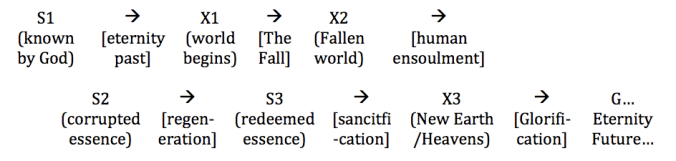
Best I can figure, it looks like both essence and existence have narrative frameworks and are seen as whole things that are shaped through eternity past and future. In short, the story goes like this: God knows and forms our essence-1 (S1), which is pure and good in his sight. He then creates the world of existence-1 (X1) which is made good but then falls and gives way to a different realm of existence, existence-2 (X2).  At the moment this essence-1 enters into existence-1 (X1), it comes into the fallen world and becomes essence-2 (S2) which is corrupt. Christians, then, at conversion are changed at the very level of their essence such that they then become pure in essence (essence-3) living in a corrupt existence (existence-1 still). The rest of the life of the Christian is a slow work by God and others to bring more and more of this Christian’s life and existence in line with their now pure essence-3 (s3), to prepare them for existence-3 (X3). Existence-3 is when this created world/realm within which we exist is restored and glorified and finally our pure essences-3 are able to live in freedom and peace in pure existence-2 in glorified eternity.  Here’s what it looks like graphically:

__________
screen-capture

__________

Lastly, there is a very important service that Existentialism lends to the spirituality of the Christian life. In Existentialism, there is a loss of the objectivity of knowledge. All we know is our existence, and that is a very small sphere of knowledge indeed. What this tenet of the philosophy does is create a very strong sense of angst. Existentialists carry the reputation for being very depressed people, seeing as they can know nothing more than (1) they exist, and (2) they can’t know more than that. We can be sure of no other knowledge. This makes you feel very small in a world of chaos that you can do nothing to change. This sort of worldview should make people very despairing, and it has for people such as Samuel Beckett and Albert Camus. But for others, like Jean-Paul Sarte and Soren Kierkegaard, Existentialism seemed to create a humble sobriety that actually allowed these men to enjoy life in a way many Christians could learn to do.

The Christian life is angst. It’s messy. It’s sloppy. That’s why it’s lived by faith – i.e. “trust”. Reality is such that we will be forced to have to trust our Creator to save us, because there really are no objective grounds (that we can know) upon which His salvation is based. This is because God knows He is the greatest of all things and our tendency is to drift from Him. It’s His love that makes us need to draw near. But, when we do, it shows us even more where we fall short and we cry out to God more. He draws even nearer and we are able to experience that One for whom our soul was made. Faith is not neat. Faith is not tidy. Faith is not naive. Faith is not imbecilic. Faith is having the courage to admit your finitude and inadequacy in order to be joined to and in communion with the Joy of joys, Peace of peaces, King of kings, and Lord of lords.

As one friend put it: “I will not resolve to embody that kind of [naive] faith ever again. So, I will read Scripture, asking God to communicate to me what in me is broken, what is unreconciled, what needs restoration, liberation, salvation. And I will sit at the foot of the cross, in the pain of who I am. And I will ask God for reconciliation, restoration, liberation, salvation. On the other side of it all, I will trust Christ more deeply. This is sanctification. This is working out my salvation in fear and trembling. And then, hopefully I will have caught my breath, and it will all begin again.”

Existentialism helps us recapture the “fear and trembling” part of working out our salvation (hence the title of Kierkegaard’s famous work).

I’ll end with perhaps my favorite set of quotes I have ever read. These have had such a profound impact on me and so reflect how I understand these things to be. These words are from the poet Joe Weil in an interview with Patrol Magazine. I leave you with these words that could have been written by the most quintessential existentialist:

“I once described faith as something I got on my shoe and can’t kick or wash off. I’m stuck with it. My poems are the trespasses and blasphemies of a malpracticing Christian, one who can’t stop ogling an attractive leg, or wanting to be first, who is venial, foolish, seldom at peace, horny and lonely, and so far from the kingdom of God that his whole life becomes the theme of that distance, someone knowing he is in deep shit. It’s the perfect place to be, where you can’t fool yourself into thinking you’re on the right track…The only thing I have to offer God is my sins. I am interested in mercy when it appears in places where you would never expect it. I am interested in love that shovels shit against the tide. I am interested in grace…It is better to be annihilated and crushed by God, if you are in love with God, then it is to have no relationship at all. Better God smite you then merely be absent. God does not ‘tolerate’ me. God loves me.”
Philosophy & Theology {II} | “Christian” Existentialism [1]


In the past few days, the idea of Christian Existentialism has been brought up to me as some sort of viable marriage between philosophy and theology. As I said in my previous post, I think this is a bit misguided.

I think there is a slight danger in the concept of Christian Existentialism. The entire point of Existentialism is that we look inside ourselves for ultimate truth and meaning for existence. Starting at this place causes a lot of problems. I’ll mention three here: sin and Scripture (briefly), and the nature of Christianity itself. “Christian” Existentialism has to define sin in two incorrect ways. First, it would have to say that what makes a sin a sin is the action itself evaluated in light of its consequences. This flies in the face of the Bible which screams that it is in the heart where sin dwells and shows itself, not the actions; and, most sins committed by humans never reach the will anyway, much less have evaluative “consequences”. Second and more Existentially unique, is the idea that sin is anything done that results in the losing of the “true authentic self” of Existentialism (I’ll say the fault in this shortly). And lastly, when it comes to the Bible, Scripture is seen more as something to submit to our experiences rather than to submit our experiences to.

The ultimate fallacy (and what I see to be the most frustrating) in all this is the idea that all things pertaining to God find their meaning, purpose, truth, righteousness, and value in how they relate to us humans. Existentialism would say that we only know anything by seeing where it lies relative to us. I’m sorry, but this whole Christianity thing is not about us. It never has been, nor will it be. It is about Christ and His glory. The more we dive inside of ourselves, all we will see is our depravity and darkness. Any other finding is due to inauthentic searching and subsequent blindness to the true state of one’s soul. Self esteem and self knowledge is not the root of mental health, soul value, and practical empowerment, in spite of what the gurus of our age tell us. It is by looking to Christ, not ourselves, and esteeming and delighting in Him alone that we are made into His likeness at every level, and find meaning, purpose, value, and insight into how this whole thing is supposed to be worked out.

But yet . . .

as I said in my previous post, Philosophies can help provide us with answers to theological dilemmas and categories. Existentialism helps us in questions of sin (in spite of what I said earlier, ironically enough), the relationship between ontology and the Sovereignty of God (our nature vs. God’s providence), and the nature of Christian spirituality.

The most famous “Christian Existentialist” is probably Soren Kierkegaard. But more precisely, though, he probably laid the foundation for what later became full blown Existentialism. Nevertheless, his fingerprints are all over Existentialist though, Christian or otherwise. In his work, “The Sickness Unto Death”, Kierkegaard defines sin as primarily about one’s position in relation to God. This is the difference between “error” and “sin”. Sin is against God and affects our relation to him. He argues against the view of Socrates that sin is merely an act stemming from ignorance. Kierkegaard vehemently denies this because this turns “sin” into a negation – merely a lack. Kierkegaard points out that sin isn’t just negation but it’s a position and posture towards God. How is this still Existentialism? Well, sin is still defined in terms of our position before God – it’s necessarily tied to and defined in terms of our existence before Him. But what makes this Orthodox is that it is not an existence divorced from the backdrop of God Himself. It is intricately linked and fused together as one. Our existence is only existence insofar God Himself is exists. As Paul would say (quoting Greek poets): “in Him we live and move and have our being” (Acts 17:28)

I wrote out the other two points, and they made this article far too long. I really think these next two points are of utmost importance for the Christian to understand, so rather than just putting them at the end of a post and people not really reading it, I’m going to make them their own post tomorrow. In the last two points, I try and use existentialism to help come up with a Christian answer to the age-old question of Existentialism: which comes first: your essence or existence? You’ll see that because of the Fall, these things become quote complicated. Secondly, and perhaps most importantly, Existentialism helps the Christian see that all of life (especially the Christian life) is anything but neat, orderly, nice, and naive. It is full of uncertainty, angst, frustration, and doubt. But, more on those tomorrow.

Philosophy & Theology {1} | The Basics


Photo 56bOver the next few posts, I want to share some brief elementary thoughts and philosophy and theology. In this post, I just want to flesh out a basic worldview I have concerning philosophies and how they fit into a Christian perspective. All posts in this series will then be various applications of these ideas. Looking at things this way has certainly helped me wade through the waters of philosophies that all seem to be right in some respect and the confusion that follows. I hope this helps others out there.

My basic thought is this: as humans made in the image of God, the true parts of any “worldview” or “philosophy” will resonate with us. We are made to resonate with the truth of the Gospel, therefore any worldview we construct tat is appealing to us in any way must touch on some thing we know to be true and long for. I just don’t think that humans are able to come up with a worldview that in some point isn’t actually true. We can only work with what there actually is in the world. Sure we can pervert and distort true things, but they will still be based on true things.

Anyway, what this means is that any particular philosophy can help us recast the Gospel and talk of it in different terms that may increase our worship. For example, with existentialism (where the big question is what comes first, essence or existence?), when Moses is talking to God at the burning bush, Moses pretty much asks Him “what’s your essence?” God answers “I exist” (“I AM”). Existentialism can give us new categories to plum even more depths within this one encounter and ultimately lead to more worship of God. The Bible helps answer the questions of philosophy and philosophy can help us see greater truths in Scripture.

[More on existentialism in an upcoming post . . .]

Orthodox Christianity does not hold (and never has) that the Bible is the sole source of knowledge about God. It says that the Bible is the ultimate and authoritative source of knowledge about God under which all other sources are submitted. The brief example above (hopefully) showed a benefit of bringing existentialism under the authority and clarity of the Bible in order to help us answer (or better understand) questions that the Bible is silent about. Problems in this area arise when people try to submit the Bible to existentialism. It just doesn’t work. The Bible just isn’t the Bible apart from it being the authority and rule of faith in all theology.

I have found the study of secular philosophy very helpful to birthing in me greater worship of our God. But (going back to my first point), though that is the case, I don’t think any one philosophy has the market cornered on theology. All philosophies (from Platonism to Aristotelianism to Humanism to Atheism) have some bit of truth in them. Lower things really are corrupt versions of purer forms; we really do understand history by looking at its final purpose; God really does love humans such that he acts for their benefit; and there really is a freedom and autonomy that man enjoys when they give way fully to their innate rebellion and deny the very existence of God. That’s why I don’t find it helpful (or biblical) to say that “I’m a Christian _________” (fill in the blank with whatever philosophy or worldview you like). To me it’s like saying “I’m a Christian chocolate cake eater”. Uh, okay. I just don’t think that says much and it forces me to ask “Really? That’s how you ultimately define your worldview?” Don’t get me wrong, a good chocolate cake can make me worship God (in all seriousness), but that’s not a useful designation.

In summary: Philosophy is the study of all that is most fundamental about us. Therefore, those that have been thought to have great wisdom in this area should be studied and read because they may in fact be whispering insights to us from within the mind of God that is in seed form within His image in us. C.S. Lewis once said that it is impossible to contemplate and enjoy at the same time. We go first the the Bible to get the material for our contemplation. But then we must look up from the text to the world and reality around us and enjoy the God that has revealed Himself in those Scriptures. A fruitful place I have experienced this is in my brief, elementary study of Philosophy. Hopefully you can see it as well. Enjoy the ride.

Some thoughts on our “Christian” Nation


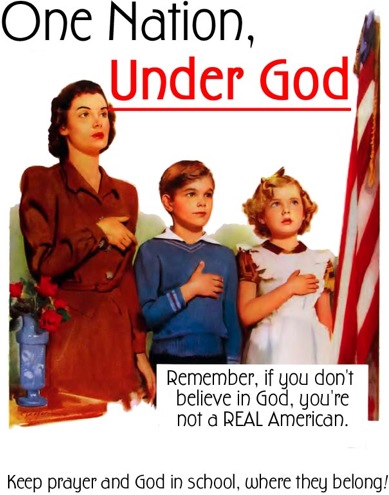
I recently received a facebook request to join the cause: “Tell Obama America is a Christian Nation”.  Coming from the Bible-belt, this was certainly a worldview that I am very familiar with and one that I’ve thought through extensively ever since I was old enough to vote.   I think I have come to a few conclusions concerning the matter.  Please leave feedback.

America isn’t a christian nation.

First, “Christian” is never used as an adjective in the Bible.  There’s no such thing as a “Christian” anything, except for a person.  Sure, for most of its history most people living in America have been Christians, but if you have mostly Christians living in a certain apartment complex, would it suddenly be called a “Christian” apartment complex?  Most all of America’s founders were Universalists (John Adams), Unitarians (Thomas Jefferson), Masons (Ben Franklin), and Deists (pretty much all the rest).  Hardly any were Orthodox Christians in any recognizable sense of the word other than the fact that they used the words “God” and “Creator”, but so do a lot of other groups that clearly aren’t Christians.

Second, there’s a big difference between checking off “Christian” on a poll and actually being a Christian.  Sure most people still check that off, but I would say that the percentage of people that are actually saved, born-again, living-the-life, actually loving Jesus Christians out there is less than half.  It certainly feels that way living in the city, at least.

Thirdly, at the very least, even if America was “founded on Christian ideals”, the nature of a democracy/republic is that it changes with the public beliefs.  Even if it used to be a Christian nation, the basic worldview of the citizenry has changed, so “what” the nation “is” has changed.  The “public” define the nature of a democracy/republic, not its past.

Lastly, every time in history that Christianity has been used to describe a country, it’s never gone well (see: Constantine, the Inquisition, the Crusades, etc.).  I pray America becomes a nation of Christians, but for the vast majority of its history, Christianity has done a lot better when it was in the minority (China, anyone?).  We don’t fight for numbers of people or a percentage of a population or an office in politics.

We fight for the Glory of Christ.

Any thoughts?

Here’s a very balanced and helpful article from Patrol Mag, and here are some lyrics from a favorite Derek Webb Song of mine, “In God we Trust”:

In God we trust
and the government is on His shoulders
in God we trust
through democracy and tyranny alike
in God we trust
He uses both good and evil men

in God we trust
so we fight for peace and He fights for us
in God we trust
even when He fights us for someone else
in God we trust
even when He looks like the enemy

in God we trust
even though our hearts are bankrupt
in God we trust
for more than just the value of our dollar bills
in God we trust
but there’s no gold behind these notes of reserve

in God we trust
even through our great presumption
in God we trust
even though He favors no nation-state
in God we trust
even when the blessing is a curse