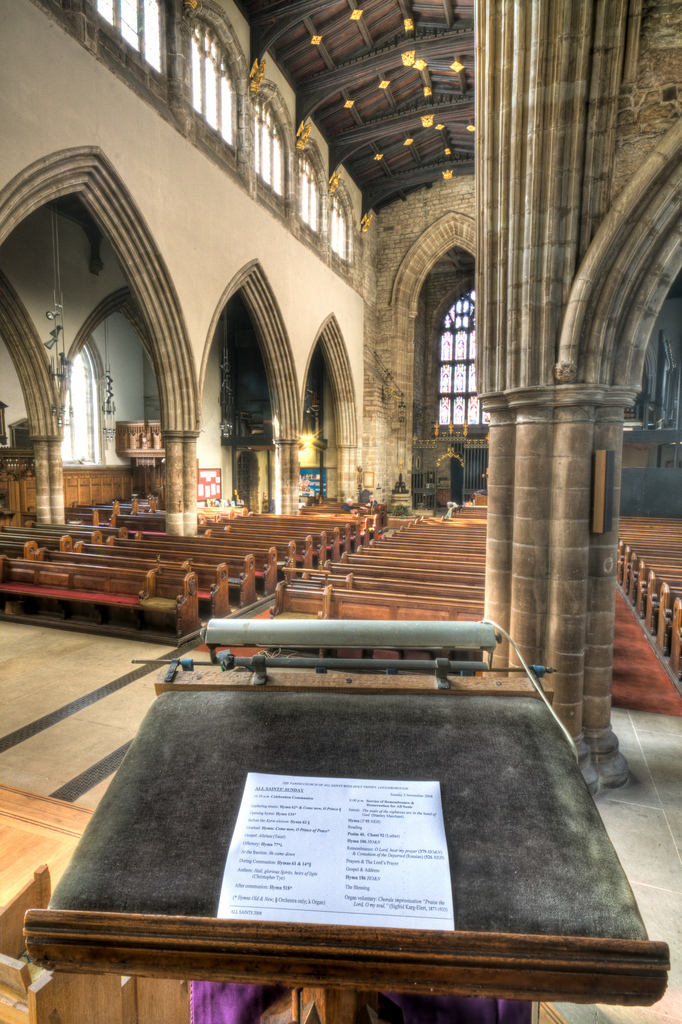
Palm Sunday: “The Emperor Has No Clothes” [POEM]


I feel far, Lord.
But I know you’re here.  I know it.
(Do I?)

(Can I?)

It’s the nature of the matter; a matter of nature, I suppose.
Perhaps only now I feel at the deepest existential depths:
“I believe! Help my unbelief!”

Or in a word: Hosanna

That cry.  That plea.

The certainty of uncertainty.
The pregnancy of a pause.
The pondering of a moment.

That moment.  The moment.  

The moment that dressed my doubt in assurance.
But that emperor has no clothes
(or so everything says).

So where does my assurance lie?
Where do my feet stand?

My body pelted with rain, snow, and hail;
I pray my heart rests beside a fire,
drinking tea,
rocking in a chair,
my shoulders draped in that most costly of quilts –
my Rest.

Clothe me–
with the coat I lay on your path–
for this emperor is naked

and needs his King.

[read my other Holy Day poetry here]
all writings licensed: Creative Commons License

#Marginalia Weekly Round-Up #5 [3/24-30/14]


Marginalia is a section of this blog dedicated to (mostly) short reflections, meditations, questions, and difficulties I have while going through my Bible reading plan. I’m still trying to figure out the best pace at which to post these, so be patient with me. To aid in helping people engage with these posts, every weekend I post a round-up of all of Marginalia posts that appeared during that week. This list is in biblical canonical order.

Genesis

History, Theology, & Wrestling with God | Genesis 32.24-32

When morning came, it was Leah | Genesis 33.10

How Christians can read Old Testament horror  | Genesis 34.25-31

Exodus

God’s Sovereignty, Moses’ Will | Exodus 3.4

Our infinitely compassionate (and delegating) God | Exodus 3.7-8

The Proof that God’s Right? When He Is.  | Exodus 3.11-12

Who God is When We’ve Forgotten Who He is | Exodus 3.13-15

Continue reading

The Tears of John: the Turning-Point of History


job-silohetteToday we continue our Lent series, “The Weeping Word“, looking at different moments of crying, lament, and tears in the Scriptures.

The Bible has 66 books. After 39 of those Old Testament books, God’s people are left with these words:

Lo, I will send you the prophet Elijah before the great and terrible day of the Lord comes. He will turn the hearts of parents to their children and the hearts of children to their parents, so that I will not come and strike the land with a curse.

And the Hebrew Scriptures end. God’s people sit wondering what the heck is happening to God’s promises, all while God just gives them another promise: “I will send Elijah, and I will not curse the land”. That’s it.
Continue reading

Who God is When We’ve Forgotten Who He is | Exodus 3.13-15


But Moses said to God, “If I come to the Israelites and say to them, ‘The God of your ancestors has sent me to you,’ and they ask me, ‘What is his name?’ what shall I say to them?” God said to Moses, “I am who I am.” He said further, “Thus you shall say to the Israelites, ‘I am has sent me to you.’” God also said to Moses, “Thus you shall say to the Israelites, ‘The Lord, the God of your ancestors, the God of Abraham, the God of Isaac, and the God of Jacob, has sent me to you’:

This is my name forever,
and this my title for all generations.

Exodus 3.13-15

Oh this could be for us. The people had been so far from there God, that they may have even the forgotten his name. I feel like this is a similar time to where we are now, with people needing to be told the name of God and reminded who he is and what he does.

God says that this is his name for every generation. Even now? Could this somehow be a model for how Christians today are to live in this world where people have forgotten the name and identity of God? What if we lived as if God is not “The One Who Must be Defended”, “The One Who Judges & Condemns”, “The One Whose Way of Living Must Be Forced Upon Societies”, “The One Who Must Be Pleased”, “The One Who Accepts All”, or even “The One Who Saves Us”.

How would our lives look if we read this Exodus passage, saw this name, title, and covenantal nature and lived embracing this name and identity: The One Who Simply Is, and Is Ours.

See other Marginalia here. Read more about the series here.

Let’s just finish Esther already (On Purim & History) | Esther 9 & 10


Haman son of Hammedatha the Agagite, the enemy of all the Jews, had plotted against the Jews to destroy them, and had cast Pur—that is “the lot”—to crush and destroy them; but when Esther came before the king, he gave orders in writing that the wicked plot that he had devised against the Jews should come upon his own head, and that he and his sons should be hanged on the gallows. Therefore these days are called Purim, from the word Pur. Thus because of all that was written in this letter, and of what they had faced in this matter, and of what had happened to them, the Jews established and accepted as a custom for themselves and their descendants and all who joined them, that without fail they would continue to observe these two days every year, as it was written and at the time appointed. These days should be remembered and kept throughout every generation, in every family, province, and city; and these days of Purim should never fall into disuse among the Jews, nor should the commemoration of these days cease among their descendants.
Esther 9.24-28

Historically, I wonder: Is this it? Is this the reason for this story? As I said before, it genuinely doesn’t look like this story is historical, so it must have served some other purpose in the community. I wonder if the Jews were coming back from exile and had this random festival named after the plural of “lots”, and so they needed to write a story about how it came about. But if so, how do you go from the word “lots” to all of this story? Quite the stretch. So…what’s the historical core? This one’s tough.

King Ahasuerus laid tribute on the land and on the islands of the sea. All the acts of his power and might, and the full account of the high honor of Mordecai, to which the king advanced him, are they not written in the annals of the kings of Media and Persia? For Mordecai the Jew was next in rank to King Ahasuerus, and he was powerful among the Jews and popular with his many kindred, for he sought the good of his people and interceded for the welfare of all his descendants.
Esther 10

So… Mordechai is the hero here? I guess it could make sense, but he plays such a bit part in the story. He’s consequential, sure; he’s just not around that much, is all. This seems more like the mythologizing of a popular leader in the Jewish diaspora.

And lastly, one last “Christian” reading of this story. If we can analogize this a little, Mordechai “intercedes” for God’s people, for their good and for their descendants. And they’re enemies (like death and sin for us) are comprehensively and almost over-the-top-ly destroyed. And God is faithful to accomplish all of this, even when he seems absent. With this book, that’s the best I can do. I genuinely don’t like this story.

See other Marginalia here. Read more about the series here.

Ancient Miracles, Skepticism, & Historicity | Mark 2.12


And he stood up, and immediately took the mat and went out before all of them; so that they were all amazed and glorified God, saying, “We have never seen anything like this!”
Mark 2.12

Even ancient people knew magic tricks. This was utterly different than anything else they’d ever seen or even thought was possible. This point is especially interesting considering the things they believe God had done in history in the past. Even though they “believed” the things happened, it wasn’t until they were face to face with the New Creation that they really saw the things this God could do.

Similarly to today, I wonder if there’s a subtle, unconscious “wink-wink” about how seriously we take some of these things. In their case, I actually think it was right, however, as those miraculous things in their stories were to be seen more as symbols and shadows that would point forward to an “actual” manifestation in Christ–not as historically-essential events. And yet, when that Christ was there, it still blew there minds.

See other Marginalia here. Read more about the series here.

Random Thoughts on Preaching: The Trinity


pulpit-church-hdr-bible

First: Our worship is a participation, mediated by the Spirit, in Christ’s Communion with the Father.

In this Trinitarian picture of worship, where does preaching fit in? Well, there is an eternal “conversation” happening among all the members of the Trinity. The divine words of Creation are presented as an “overflow” of this divine conversation. So to me, preaching is a Spirit-“infused” (and humanly articulated) mediation of the words between the Father, the Son, and the Holy Spirit.

Because the Spirit enables our union with Jesus, and because Jesus is joined to the Father, we find ourselves mystically and intimately in union with the whole Trinitarian God Himself. And so, preaching is–in a sense and at its best–an articulation and “listening in” on this eternal “trialogue” within the Godhead.

The world having been created through and for the Son means that the Father’s words to the Son are now his words to and for us. And this Word that is spoken to the Son by the Father is the Gospel. When it is offered to humans, this eternal, mysterious articulation of the Gospel in the Godhead is always mediated and contextualized in order to be received and perceived by the hearer. This is why the Bible is the way it is.
Continue reading

God & Job | Job 2.11-13


Now when Job’s three friends heard of all these troubles that had come upon him, each of them set out from his home—Eliphaz the Temanite, Bildad the Shuhite, and Zophar the Naamathite. They met together to go and console and comfort him. When they saw him from a distance, they did not recognize him, and they raised their voices and wept aloud; they tore their robes and threw dust in the air upon their heads. They sat with him on the ground seven days and seven nights, and no one spoke a word to him, for they saw that his suffering was very great.
Job 2.11-13

We speak so harshly and sarcastically about these friends. But they really are amazing. And though their view is flawed, they represent the views on suffering that are still most common today. And they are sincerely felt and sincerely held. They are genuinely offering Job what they genuinely feel is the issue. They are being human. But right here, this is amazing. Who of us would do the same thing? As I’ve continued through the book, I’m seeing that we’ve greatly oversimplified and wrongly characterized the “advice” they give Job. Hopefully, in the days to come, we can explore this more through #Marginalia.

See other Marginalia here. Read more about the series here.

I’m terrified of becoming a Pastor


paul-art-wingThis seminary semester, I’m taking classes on both Preaching and the Emotional/Spiritual/Psychological Identity of Pastors. So yeah, get used to seeing more posts like this on the blog. This week, in my “Pastor class” we did readings and had a lecture on “vocational hazards” and discerning one’s “call” to ministry. We were asked about what challenges and encourages us most about this possibility of being “called” to serve the Church in pastoring. Here were my thoughts. 

The biggest fear going into this course–and reinforced in the lecture–is the whole question of whether it is my “False Self” that is called, rather than my True Self. I have spent much of my life following Spurgeon’s (I think) advice that if you feel called to ministry at all, try to do everything else in your life you possibly could do. If you still end up in ministry, then congratulations, you were called.

Continue reading

For the times you want to be strong, but aren’t | 1 Corinthians 1.27-31


But God chose what is foolish in the world to shame the wise; God chose what is weak in the world to shame the strong; God chose what is low and despised in the world, things that are not, to reduce to nothing things that are, so that no one might boast in the presence of God. He is the source of your life in Christ Jesus, who became for us wisdom from God, and righteousness and sanctification and redemption, in order that, as it is written, “Let the one who boasts, boast in the Lord.”
1 Corinthians 1.27-31

Oh how encouraging this is in those moments that I feel most inadequate intellectually and spiritually.

See other Marginalia here. Read more about the series here.

The Joy of Mark & the Looming Cross | Mark 2.1-2


When he returned to Capernaum after some days, it was reported that he was at home. So many gathered around that there was no longer room for them, not even in front of the door; and he was speaking the word to them.
Mark 2.1-2

Who would have guessed where this story was ultimately heading? Who could see at this point the shadow of the Cross? There’s such joy and excitement at this point in the story. To know where it ends, gives these verses an odd weightiness to them.

See other Marginalia here. Read more about the series here.

Hagar: Tears, Empowerment, & the Faithfulness of God


Corot_Hagar_in_the_WildernessToday we continue our Lent series, “The Weeping Word“, looking at different moments of crying, lament, and tears in the Scriptures.

In the early chapters of the Bible, there is perhaps no greater symbol of injustice than Hagar, the Egyptian servant of Abraham and Sarah. She is under forced labor, and is made by her master’s wife to bear a child by an old man. She is, in essence, a sex slave. After Hagar has her son, Sarah deals very harshly with her, causing Hagar to run away. God chases her down:

The angel of the Lord found her by a spring of water in the wilderness, the spring on the way to Shur. And he said, “Hagar, slave-girl of Sarai, where have you come from and where are you going?”

Continue reading

#Marginalia Weekly Round-Up #4 [3/17-23/14]


Marginalia is a section of this blog dedicated to (mostly) short reflections, meditations, questions, and difficulties I have while going through my Bible reading plan. I’m still trying to figure out the best pace at which to post these, so be patient with me. To aid in helping people engage with these posts, every weekend I post a round-up of all of Marginalia posts that appeared during that week. This list is in biblical canonical order.

Genesis

Responding to the Covenant | Genesis 17:10

God & Sarah: one of the most beautiful verses in the Bible | Genesis 21.1

The Echoes of History &  Abraham| Genesis 24.22-23

And the story moves from Abraham to Isaac… | selections from Genesis 26

God’s Camp is Our Camp | Genesis 32:1

Wrestling with God: History & Theology | Genesis 32.24-32

Responding to the Covenant | Genesis 35.9-13

Exodus

Moses the Levite? | Exodus 2:12

Moses the Shepherd | Exodus 3.1

A quick note on why everything you think about angels might be wrong | Exodus 3.2

Continue reading

Mark Driscoll: Now just another fundie, but it still hurts


TT_May_Driscoll

Let not those who hope in you be put to
shame through me, O lord God of Hosts;
let not those who seek you be brought to
dishonor through me, O God of Israel.
Psalm 51

I have written before how much I enjoy my own ignorance of the Christian blogosphere. Things happen in evangelical corners of the world, that I have no idea about. I am happy to know more about the Ukrainian crisis than whatever crisis some mega church or celebrity pastor is going through.

And yet, somehow (usually Facebook), I always seem to keep up with whatever is going on with Mark Driscoll. He has lots of critics, and I am certainly one of them, and many of them seem to be grasping at whatever they can to “bring him down”. There seem to be so many Driscoll obsessions out there, be it plagiarism, making fun of “effeminate” church leaders, extreme church discipline, messy staff turnovers, un-credited ghost writing, or buying his way onto best seller lists. (If you care about those “scandals”, just Google them.)

I have big problems with how a lot of folks criticize Driscoll and the glee they seem to feel in each new thing we all find out. Lore Ferguson has the best and most beautiful articulation I’ve read of the unhelpful ways people levy these criticisms his way.

Continue reading

God & Job | Job 1.8


The Lord said to Satan, “Have you considered my servant Job? There is no one like him on the earth, a blameless and upright man who fears God and turns away from evil.”
Job 1.8

We so often forget that this whole thing was God’s idea, and he initiated it. He is the first one to drop Job’s name and suggest this scheme to Satan.

See other Marginalia here. Read more about the series here.