Wrestling with God: History & Theology | Genesis 32.24-32


Jacob was left alone; and a man wrestled with him until daybreak. When the man saw that he did not prevail against Jacob, he struck him on the hip socket; and Jacob’s hip was put out of joint as he wrestled with him. Then he said, “Let me go, for the day is breaking.” But Jacob said, “I will not let you go, unless you bless me.” So he said to him, “What is your name?” And he said, “Jacob.” Then the man said, “You shall no longer be called Jacob, but Israel, for you have striven with God and with humans, and have prevailed.” Then Jacob asked him, “Please tell me your name.” But he said, “Why is it that you ask my name?” And there he blessed him. So Jacob called the place Peniel, saying, “For I have seen God face to face, and yet my life is preserved.” The sun rose upon him as he passed Penuel, limping because of his hip. Therefore to this day the Israelites do not eat the thigh muscle that is on the hip socket, because he struck Jacob on the hip socket at the thigh muscle.
Genesis 32:24-32

Two strands of thinking here:

Critical-Historical: Where the heck did this story come from?  It’s got to be a later interpolation (it has no connection whatsoever to the surrounding verses and is never mentioned again in the OT), but from what?  That last verse implies that the story came about simply to explain the dietary habits of Israelites. But really, why appeal to such an odd, powerful and incredibly profound story for such a simple message?

Biblical-Theological: Holy crap, what a concentrated text of such meaning. He “wrestles” with God, but it’s in the midst of his greatest stress and travail. It testifies to us how our greatest struggles in life are often wrestlings with God himself. We get a new name, we bear life-long scars, and it affects our ancestors for years to come.

See other Marginalia here. Read more about the series here.

The Worship of Job; the Blame of God | Job 1.20-22


Then Job arose, tore his robe, shaved his head, and fell on the ground and worshiped. He said, “Naked I came from my mother’s womb, and naked shall I return there; the Lord gave, and theLord has taken away; blessed be the name of the Lord.”

In all this Job did not sin or charge God with wrongdoing.
Job 1.20-22

I mentioned this verse earlier in my post on a theology of angels. It’s one of the most concentrated, powerful, packed lines of Scripture in the Bible. Job suffers and he worships. He ascribes to God the actions of Satan and the text explicitly says he does not sin in doing so. He fully inhabits his mourning and it is sincere and it is real. And yet, just as sincere as is his mourning, his worship is as well.

See other Marginalia here. Read more about the series here.

How to read Esther Christianly | Esther 7:4–10


For we have been sold, I and my people, to be destroyed, to be killed, and to be annihilated. If we had been sold merely as slaves, men and women, I would have held my peace; but no enemy can compensate for this damage to the king.” Then King Ahasuerus said to Queen Esther, “Who is he, and where is he, who has presumed to do this?” Esther said, “A foe and enemy, this wicked Haman!” Then Haman was terrified before the king and the queen. The king rose from the feast in wrath and went into the palace garden, but Haman stayed to beg his life from Queen Esther, for he saw that the king had determined to destroy him. When the king returned from the palace garden to the banquet hall, Haman had thrown himself on the couch where Esther was reclining; and the king said, “Will he even assault the queen in my presence, in my own house?” As the words left the mouth of the king, they covered Haman’s face. Then Harbona, one of the eunuchs in attendance on the king, said, “Look, the very gallows that Haman has prepared for Mordecai, whose word saved the king, stands at Haman’s house, fifty cubits high.” And the king said, “Hang him on that.” So they hanged Haman on the gallows that he had prepared for Mordecai. Then the anger of the king abated.
Esther 7.4-10

This book is so weird. Again, Esther is no paragon of virtue or model woman. She sleeps with the King to get ahead, is completely self-interested (has to be convinced to say her people because she might get caught up in the slaughter!), and she refuses to give mercy. This particular story of Haman’s condemnation, in both structure and language, seems to mirror David’s condemnation by Nathan. And yet, David gets mercy. Haman does not.

So what are some Christian take-aways from the book? A couple of things off the top of my head: life for God’s people only comes through a substitute, putting Death to Death, and something becoming a curse. Further, it’s the King who deals the death blow, even as the Enemy assaults us. Lastly, Salvation for God’s people is found when the King’s anger abates.

See other Marginalia here. Read more about the series here.

The Mission of Confession: the World needs the Church to Confess


yoder-farm-bw-snow-instagram

And the Lord said, “What have you done? Listen; your brother’s blood is crying out to me from the ground!
Genesis 4.10

I was taking another look at the verses I wrote about earlier this week, and was struck by a few more thoughts I wanted to share. As I said then, the passage is structured liturgically. The story of Cain and Abel follows the flow of liturgy that God’s people have used for the duration of their existence. (It’s usually something like this: Call to Worship–>Call to Confession–>Passing the Peace–>Word–>Sacrament–>Benediction)

I pointed out that the blood-soaked soil “crying out” was the first instance of lament in the Bible, and it appears in the “Call to Confession” section of this odd liturgy-story, and it shows us how the world bears the weight of our own sin. Looking at it again, though, I see it means much more than just that.

Continue reading

A quick note on why everything you think about angels might be wrong | Exodus 3.2


There the angel of the Lord appeared to him in a flame of fire out of a bush; he looked, and the bush was blazing, yet it was not consumed.
Exodus 3.2

It seems that in other parts of Scripture–both Old and New Testaments–the writers seem to think that this is God himself showing up in the bush. Heck, this account itself makes that claim. So, I’m wonder if angels aren’t so much heavenly beings with their own individual personalities, but rather incarnations (pun intended) of “parts” of God. Maybe certain attributes, perhaps? And so, maybe it is the case that all the stories about angels and heavenly hosts and battles really are more symbolic of general spiritual forces rather than individual beings with their own personalities and such. Maybe they are not “representatives” of God, but are just God in certain forms. Perhaps they are like pre-incarnations? I think we need a new vocabulary to talk about this. Either way, this text clearly says “the angel of the Lord appeared” and then the rest of the story says it’s YHWH himself.

If you want an even more provocative thought. Recall Job, when the “angel Satan” does a bunch of stuff to Job? Well, Job goes on to say that the Lord has done those things to him, and both times he does this, the text clearly says, “Job did not sin with his lips or ascribe wrong to God.” “Satan” does something, Job says God did it. The Bible says Job is right.

Lastly, as a disclaimer on these Marginalia posts. These are my stream of conscious thoughts as I read Scripture. They are not fully-formed doctrinal positions. I think it beneficial not to shield people from even the craziest left-field questions that pop up in one’s mind, but to invite them into the thinking process.

See other Marginalia here. Read more about the series here.

God sometimes might send His people to Hell | Romans 2.1-8


Therefore you have no excuse, whoever you are, when you judge others; for in passing judgment on another you condemn yourself, because you, the judge, are doing the very same things. You say, “We know that God’s judgment on those who do such things is in accordance with truth.” Do you imagine, whoever you are, that when you judge those who do such things and yet do them yourself, you will escape the judgment of God? Or do you despise the riches of his kindness and forbearance and patience? Do you not realize that God’s kindness is meant to lead you to repentance? But by your hard and impenitent heart you are storing up wrath for yourself on the day of wrath, when God’s righteous judgment will be revealed. For he will repay according to each one’s deeds: to those who by patiently doing good seek for glory and honor and immortality, he will give eternal life; while for those who are self-seeking and who obey not the truth but wickedness, there will be wrath and fury.
Romans 2.1-8

Fundamentalists always read stuff like this and think it’s talking about “those people” outside of the Church. But this passage is talking to Jewish Christians! It’s talking to the very people who would presume their security and election (*cough* like many fundamentalists *cough*) . But you know what? Paul never says they’re wrong in their security and election! And yet he still says there will be wrath and fury. Might those things not be mutually-exclusive? An important theme here is that God’s people bear the brunt of God’s judgment, not the rest of the world. These verses are speaking to Christians, not “those people”. God’s people will face the possibility of God’s fire (but might it be refining fire?). This is very much what Lesslie Newbigin wrote about when he talked about election.

See other Marginalia here. Read more about the series here.

The Storied Propaganda of Acts | Acts 6.7,15


The word of God continued to spread; the number of the disciples increased greatly in Jerusalem, and a great many of the priests became obedient to the faith.
Acts 6.7

That’s odd phrasing. This is telling a certain version of history. Surely this fact would be denied by the Jews at the time. And yet, Luke is trying to paint a picture of the Gospel spreading, to the Jews first (in this section, the focus is on Jerusalem and Peter) and then to the ends of the earth (the big Paul section).

And all who sat in the council looked intently at him [Stephen], and they saw that his face was like the face of an angel.
–Acts 6:15

Here we see one of the inklings and beginning of the long Christian tradition of saint veneration and myth-making (St. George and the Dragon, anyone?)

See other Marginalia here. Read more about the series here.

St. Stephen & the History of Israel | Acts 7.48-53


Yet the Most High does not dwell in houses made with human hands; as the prophet says,

‘Heaven is my throne,
and the earth is my footstool.
What kind of house will you build for me, says the Lord,
or what is the place of my rest?
Did not my hand make all these things?’

“You stiff-necked people, uncircumcised in heart and ears, you are forever opposing the Holy Spirit, just as your ancestors used to do. Which of the prophets did your ancestors not persecute? They killed those who foretold the coming of the Righteous One, and now you have become his betrayers and murderers. You are the ones that received the law as ordained by angels, and yet you have not kept it.”
Acts 7.48-53

1. He skips the history of Israel that includes the Divided Monarchy, Exile, Return, Intertestamental Victories and and Sorrows, and the establishment of the Jewish state under Roman Rule.

2. He jumps straight from the temple to their Rejection of Jesus. This could be Jesus’ connection as a New Temple among us, it could highlight Israel’s inordinate obsession with the temple, even unto the rejection of their Messiah, or it could be a reference to the charges they brought against Jesus to get him crucified: blasphemy against the temple.

See other Marginalia here. Read more about the series here.

Some random Beatitude snippets | Matthew 5.6,11-12


“Blessed are those who hunger and thirst for righteousness, for they will be filled.”
Matthew 5:6

So encouraging. This gives me hope.

“Blessed are you when people revile you and persecute you and utter all kinds of evil against you falsely on my account. Rejoice and be glad, for your reward is great in heaven, for in the same way they persecuted the prophets who were before you.”
Matthew 5:6

That’s interesting. He hasn’t mentioned any other Jewish or biblical things. Why root this encouragement in a random reference to the prophets?

See other Marginalia here. Read more about the series here.

In Acts, Paul = Jesus | Acts 27.35-36


After he had said this, he took bread; and giving thanks to God in the presence of all, he broke it and began to eat. Then all of them were encouraged and took food for themselves.
Acts 27.35-36

Here is an obvious parallel between Jesus and Paul. I don’t know if these features are meant to hearken to the feeding of the 5,000, or the Last Supper. Actually, it’s probably not a parallel of the 5,000, because there is no multiplication or anything miraculous about this meal. But, Paul does the same thing with the bread that Jesus does elsewhere, and others are similarly encouraged by what he does. If I had to vote, I would say that this is a parallel of the Last Supper. Or, it is like the road to Emmaus passage, where Jesus is seen in the breaking of the bread.

See other Marginalia here.Read more about the series here.

The Liturgy of Cain & the Tears of the Earth


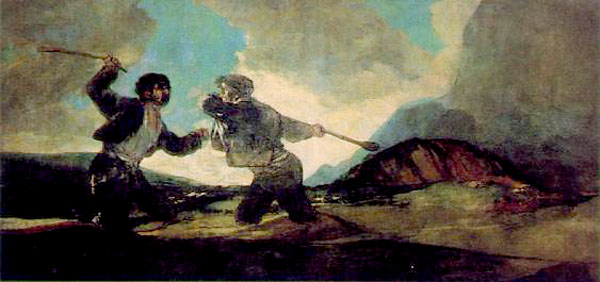
de Goya-fight with cudgels"Our Lent series this year is “The Weeping Word“, where we’re meditating on key places in the Scriptures where Lament, crying, tears, and weeping happen. Today, we look at the first instance of this in the Bible.

There is a particular rhythm that God’s people have always used in their liturgy. If you pay attention, you’ll see this rhythm pop up in lots of different places throughout the Christian Scriptures. My favorite unexpected place where this shows up is in the story of Cain and Abel.

Worship

The story opens with these two brothers coming to worship, answering an implied Call to Worship that issues from God. This is where the liturgical rhythm begins. God calls us to worship him, and we respond by offering him this worship to him.

But everyone comes to worship from different places, and not everyone’s heart and offering is pure.

And the Lord had regard for Abel and his offering, but for Cain and his offering he had no regard. So Cain was very angry, and his countenance fell. The Lord said to Cain, “Why are you angry, and why has your countenance fallen? If you do well, will you not be accepted? And if you do not do well, sin is lurking at the door; its desire is for you, but you must master it.”

Our worship gets twisted and directed towards the wrong things, and this is what we call sin. Offering worship wrongly and to the wrong things. Wrong worship produces wickedness within us.

“Cain said to his brother Abel, “Let us go out to the field.” And when they were in the field, Cain rose up against his brother Abel, and killed him.

Continue reading

#Marginalia Weekly Round-Up #3 [3/8-16/14]


Marginalia is a section of this blog dedicated to (mostly) short reflections, meditations, questions, and difficulties I have while going through my Bible reading plan. I generally post between 1 to 3 of these per day, which can be difficult to keep up with. To aid in helping people engage with these posts, every weekend I post a round-up of all of Marginalia posts that appeared during that week. This list is in biblical canonical order.

Pastors, Purification, & Their People | Nehemiah 12:30

There is an order to pastoring. We’d do well to heed it.

Covenantal Confusion (on my part) | Genesis 6:18

Noah Covenant “versus” Abraham Covenant. Go!

The Saving Call of Christ: you’re already saved | Matthew 9.13

Be who you are.

The God of Chance & Randomness | Genesis 13.14-18

God gave his people some glorious sloppy seconds.

Continue reading

Yep. The gospels depict Jesus as God. | Matthew 28.1-10


After the sabbath, as the first day of the week was dawning, Mary Magdalene and the other Mary went to see the tomb. And suddenly there was a great earthquake; for an angel of the Lord, descending from heaven, came and rolled back the stone and sat on it. His appearance was like lightning, and his clothing white as snow. For fear of him the guards shook and became like dead men. But the angel said to the women, “Do not be afraid; I know that you are looking for Jesus who was crucified. He is not here; for he has been raised, as he said. Come, see the place where he lay. Then go quickly and tell his disciples, ‘He has been raised from the dead, and indeed he is going ahead of you to Galilee; there you will see him.’ This is my message for you.” So they left the tomb quickly with fear and great joy, and ran to tell his disciples. Suddenly Jesus met them and said, “Greetings!” And they came to him, took hold of his feet, and worshiped him. Then Jesus said to them, “Do not be afraid; go and tell my brothers to go to Galilee; there they will see me.”
Matthew 28.1-10

Wow.  This here clearly says that they worshiped Jesus. And he does not at all correct them or steer them to worship elsewhere. This is in stark contrast to the angel in Revelation.

See other Marginalia here. Read more about the series here.

Jesus came from some weird stock | Genesis 19.30-38


Now Lot went up out of Zoar and settled in the hills with his two daughters, for he was afraid to stay in Zoar; so he lived in a cave with his two daughters. And the firstborn said to the younger, “Our father is old, and there is not a man on earth to come in to us after the manner of all the world. Come, let us make our father drink wine, and we will lie with him, so that we may preserve offspring through our father.” So they made their father drink wine that night; and the firstborn went in, and lay with her father; he did not know when she lay down or when she rose. On the next day, the firstborn said to the younger, “Look, I lay last night with my father; let us make him drink wine tonight also; then you go in and lie with him, so that we may preserve offspring through our father.” So they made their father drink wine that night also; and the younger rose, and lay with him; and he did not know when she lay down or when she rose. Thus both the daughters of Lot became pregnant by their father. The firstborn bore a son, and named him Moab; he is the ancestor of the Moabites to this day. The younger also bore a son and named him Ben-ammi; he is the ancestor of the Ammonites to this day.
Genesis 19.30.38

Wow, the ancestral origins of Christ are incredibly odd.

See other Marginalia here. Read more about the series here.