Welcome to Ash Wednesday. Lent begins.


ash-wednesday-pew-lentToday is Ash Wednesday. In just under two months from today we’ll come to the highest point in the Christian Church calendar, Easter. That is where we’ll celebrate Christ’s Resurrection and how God’s perfect world broke into the present and our greatest enemies–sin and death–were conquered and shown to have no more dominion over us and the rest of the world. It’s meant to be the most effusive, overflowing, even ridiculous time of joy.

And yet, when we look at Jesus’ Resurrection, we see that before it ever took place, there was Death. And before that, there was an entire lifetime of loneliness, pain, suffering weakness, and isolation. We see that it was a life surrounded by evil forces and whispers that haunt and hurt Jesus and the people he loved.

And so, our early Church Mothers and Father thought it would be wise to have this time before Easter to prepare, so we might end up celebrating during Easter all the more.

Resurrection was itself a statement against our two greatest enemies: Sin and Death. And so to participate in Resurrection, we take the time of Lent to meditate and press into those things to which Resurrection was the response. We do this not out of morbidity, but out of anticipation.

Continue reading

Lent begins tomorrow. (Will you just give it a try?)


Jesus & The Cross

I grew up in a church tradition that did not take seriously the Christian Church Calendar. Even as I went to college and moved into communities that took some level of tradition more seriously (which was usually limited to quoting Puritans and Reformers in sermons), the Church Calendar wasn’t that big of a deal. It was seen as something sort-of cool that could be incorporated into the already established life of the Church; a buffet from which leaders could pick and choose some aspects that might be helpful in organizing some sermon series or songs. But it certainly wasn’t seen as something that a church should actually incorporate itself into, or build it’s own rhythm around.

I’ve had the privilege of having this paradigm rocked the past several years at my church, and have fallen in love with the Church calendar. It influences much of the rhythm and timbre of my everyday life–both ecclesial and otherwise. I find such life in living within a stream of thought that was not simply created within the past generation by baptizing modern Western American cultural ideas.

I love finding myself as embedded within the cloud of witnesses that have gone before me as possible–even those I may disagree with passionately and fundamentally. Because, at the end of the day, they are my family, and families have traditions. Sure, you can be “that guy” that does his own thing and doesn’t participate in the family rhythms, but where’s the life in that?

Continue reading

Why go to church? Well, why get married? [QUOTE]


If someone asks me what is the use of going to church, what good does it do me, what do I get out of it, how do I answer these questions?

It is as though someone asks me what the use is of getting married, what good does it do me. If I answered such questions by saying, “Well, it is very useful to get married! You have someone to do the housework, the shopping, cook the meals, etc.,” it would clearly be a false view of marriage. No woman wants to be merely a housekeeper, kept because of her utility!

There is only one supreme reason for getting married—for love’s sake, for the other’s sake, for mutual love, self- giving, a longing for intimate communion, and sharing of everything.

So in Christian worship, we worship God for God’s sake; we come to Christ for Christ’s sake, motivated by love. An awareness of God’s holy love for us, revealed in Jesus Christ, awakens in us a longing for intimate communion—to know the love of the Father and to participate in the life and ministry of Christ.

Worship in the Bible is always presented to us as flowing from an awareness of who God is and what he has done: “I am the God of Abraham, Isaac and Jacob . . . I have loved you and redeemed you . . . I will be your God and you will be my people. Therefore, this is how you will worship me.”

As we have seen, worship in the Bible is an ordinance of grace, a covenantal form of response to the God of grace, prescribed by God himself. This is supremely true of the New Testament understanding of worship, as the gift of participating through the Spirit in the incarnate Son’s communion with the Father and his mission from the Father to the world, in a life of wonderful communion.

— from James B. Torrance’s beautiful book Worship, Communion, and the Triune God of Grace (paragraph breaks added for clarity)

#Marginalia Weekly Round-Up #1 [2/24-28/14]


Marginalia is a section of this blog dedicated to (mostly) short reflections, meditations, questions, and difficulties I have while going through my Bible reading plan. I generally post between 1 to 3 of these per day, which can be difficult to keep up with. To aid in helping people engage with these posts, every weekend I post a round-up of all of Marginalia posts that appeared during that week. This list is in biblical canonical order.

Death & Life; Names & Vows | Genesis 3.20-21

Adam names Eve only after the Fall. Why?

Noah, Prophecy, & the Comfort of the Earth | Genesis 5.28-29

Noah’s name is interestingly prophetic…

Abraham’s son Ishmael was part of Covenant! | Genesis 17.23-27

This blew my mind. I’m still trying to work through the implications.

Abraham almost loses his son & he worships?! | Genesis 22.13-14

This is why Abraham was the Father of our faith. I couldn’t do it.

Insecurity Leads to Fasting? | Ezra 8:21-23

On sin and spiritual discipline.

Male Headship & Societal Injustice | Esther 1:17-22

A longer one (also part of our Women in the Church series). Some lessons for our Complementarian friends from the book of Esther.

Universal Intimacy: The Beautiful Transition | Matthew 11:25-39

This is what Christian Universalism looks like.

What Draws Out Jesus’ Compassion? | Matthew 15.32

It might not be what you think.

Women at the Cross | Matthew 27:55-54

The Gospels really make an effort to highlight the women. Why?

Who Sent Whom? | Acts 13.2-4

Beautiful words about God’s work through us.

The Good News changes, the Good News gifts | Acts 20.32

The proclamation has got a lot to it.

_________________

See other Marginalia here. Read more about the series here.

Insecurity Leads to Fasting? | Ezra 8:21-23


Then I proclaimed a fast there, at the river Ahava, that we might deny ourselves before our God, to seek from him a safe journey for ourselves, our children, and all our possessions. For I was ashamed to ask the king for a band of soldiers and cavalry to protect us against the enemy on our way, since we had told the king that the hand of our God is gracious to all who seek him, but his power and his wrath are against all who forsake him. So we fasted and petitioned our God for this, and he listened to our entreaty.
Ezra 8:21-23

What an odd and beautifully honest aside. At first I was put off by the logic here. “I proclaimed a fast…For I was ashamed.” I thought “that’s a terrible reason to have a fast!” But the more I thought about it the more I realized that, of course!, that’s the right time to fast! When you are most unsure, most in need, most insecure. This is when “we might deny ourselves before our God.”

See other Marginalia here. Read more about the series here.

Experiencing God in this Holy Present


flickr-sculpture-worship-kissAt my work, we recently had a training on mindfulness. Now, before you roll your eyes, it was maybe my favorite work training I’ve ever done. It was engaging, practical, and participatory like few trainings are.

Anyway, “mindfulness” is the fancy word used to describe a “non-judgmental awareness of the present”. It’s heightening your senses and calming yourself in order to fully inhabit the present without analyzing it, mulling it, or needing to evaluate it. For those of us with anxiety issues, it really is an amazing way of centering and calming oneself, as well as separating oneself from the internal busyness–at least for a moment.

Another way of putting it is that it is radical present-ness. It is letting this very moment not be merely something you’re passing through as a bridge from the moment that has passed and into the moment that is not yet here. It is to fully inhabit the moment you find yourself in, and let the future come to you rather than anxiously trying to run towards it.

Not gonna lie. It was very spiritual to me. I felt more in tune to God and it got me thinking about how we mystically experience Him in our everyday lives.

When an Atheist talks about this hard-wired human sense to feel the “Numinous”, it often carries with it the sense that it rises from within us. When a lot of Christians talk about meeting the Divine, it often sounds like a presence that comes pointedly at us from outside of us. I’m starting to think that neither of these is right.

Continue reading

Women at the Cross | Matthew 27:55-56


Now when the centurion and those with him, who were keeping watch over Jesus, saw the earthquake and what took place, they were terrified and said, “Truly this man was God’s Son!”

Many women were also there, looking on from a distance; they had followed Jesus from Galilee and had provided for him. Among them were Mary Magdalene, and Mary the mother of James and Joseph, and the mother of the sons of Zebedee.
Matthew 27:55-54

It’s really interesting to me that Matthew adds this little addendum to the end of the account. Why point out the women that were there? Is the assumption that all the men have scattered, and so Matthew had to show his sources for this story?

See other Marginalia here. Read more about the series here.

Introducing Marginalia: a new part of this blog


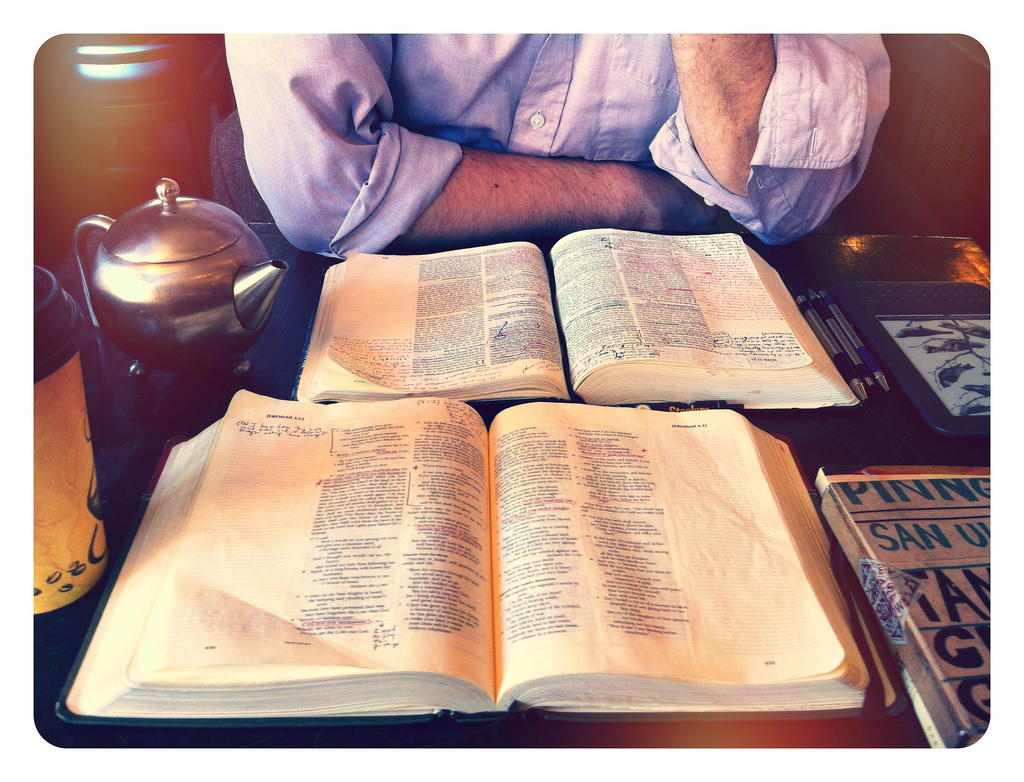
schrott-bibles-paul-coffee

I’ll be honest. It’s been years since I’ve been able to find a way to regularly read the Bible that sticks and works for me. To be frank, readings plans usually don’t work for me because I get bored. Depending on the plan, you’re either stuck in the same book for long stretches of time or you’re jumping around so much that you lose the sense of the whole.
This year, I think I’ve started a regimen that is clicking: the M’Cheyne Bible reading plan. At any given time, I’m going through four completely different part of Scripture and for me, this is keeping me really engaged. As I’ve gone on through the plan these past couple of months, I started highlighting and writing up little notes on random verses here and there. Lots of themAnd I’d like to share them with you.

So today, I’m introducing a new little part of this blog called Marginalia, where I’ll be posting these short little meditations on Scripture as I go through this plan.
Continue reading

Abraham’s son Ishmael was part of Covenant! | Genesis 17.23-27


This is my covenant, which you shall keep, between me and you and your offspring after you: Every male among you shall be circumcised… and it shall be a sign of the covenant between me and you…. Both the slave born in your house and the one bought with your money must be circumcised. So shall my covenant be in your flesh an everlasting covenant. Any uncircumcised male who is not circumcised in the flesh of his foreskin shall be cut off from his people; he has broken my covenant.”… As for Ishmael, I have heard you; I will bless him and make him fruitful and exceedingly numerous; he shall be the father of twelve princes, and I will make him a great nation. But my covenant I will establish with Isaac, whom Sarah shall bear to you at this season next year.”…. Then Abraham took his son Ishmael and all the slaves born in his house or bought with his money, every male among the men of Abraham’s house, and he circumcised the flesh of their foreskins that very day, as God had said to him…. And his son Ishmael was thirteen years old when he was circumcised in the flesh of his foreskin. That very day Abraham and his son Ishmael were circumcised; and all the men of his house, slaves born in the house and those bought with money from a foreigner, were circumcised with him.
Genesis 17.23-27

Yes, God said that Ishmael would not be the primary bearer and “administrator” of the covenant, but he still bears its marks. Reminds me of a reading from Lesslie Newbigin where he talks about how through our election and Covenantal relationship with God, Salvation is extended to all the nations. “Election” isn’t about blessing; it’s about responsibility to extend the Blessing to others.

Other peoples (even those not in the elect people of God) participate in and receive the full benefits of being part of the Covenant. To be elect is to extend these Covenantal blessings to all nations (as we see here with Abraham). To be marked as God’s is to be placed on mission.

Ishmael was still joined to the covenant! Praise God for his gratuitous grace!

See other Marginalia here. Read more about the series here.

Death & Life; Names & Vows | Genesis 3.20-21


The man named his wife Eve, because she was the mother of all living. And the Lord God made garments of skins for the man and for his wife, and clothed them.
Genesis 3.20-21

I don’t know why I’ve never noticed this before. Why does Adam only name Eve after they sin? Further, of all the things to do after receiving the curse from God, he does this covenantal, marital act: he gives her a name.

I know this isn’t in this text, nor was it on the mind of the original writer, but it reminds me of the odd line in Revelation where God promises to give each person a new name that only He and they will know.

It seems that in the whole sweep of redemptive history, the Bride of the first Adam received a new name when he brought death, just as the Bride of the second Adam receives a new name when he brings life.

See other Marginalia here. Read more about the series here.

Abraham almost loses his son & he worships?! | Genesis 22.13-14


 And Abraham looked up and saw a ram, caught in a thicket by its horns. Abraham went and took the ram and offered it up as a burnt offering instead of his son. So Abraham called that place “The LORD will provide”; as it is said to this day, “On the mount of the LORD it shall be provided.”
Genesis 22.13-14

This is right after the whole “sacrifice Isaac” thing. To me, this such an odd response. Not only does Abraham worship God after this, which is crazy enough as it is, but he also sets up a memorial to remember this by! If I were him, I’d need some space from this God for a bit and I’d want to forget this incident as soon as possible.

I’ve always thought it odd that the book of Hebrews puts such an emphasis on Abraham and calling him the “father of faith” and extols his faith so much. Whenever I read that I think about how he had Ishmael with Hagar, due to a lack faith, and (twice) gave his wife up to be the wife of someone else because he was scared they’d kill him–another example of a lack of faith!

But then I read things like this and I think to myself, “Oh yeah, now I get it.”

See other Marginalia here. Read more about the series here.

A Sacrament Primer (and some questions I still have)


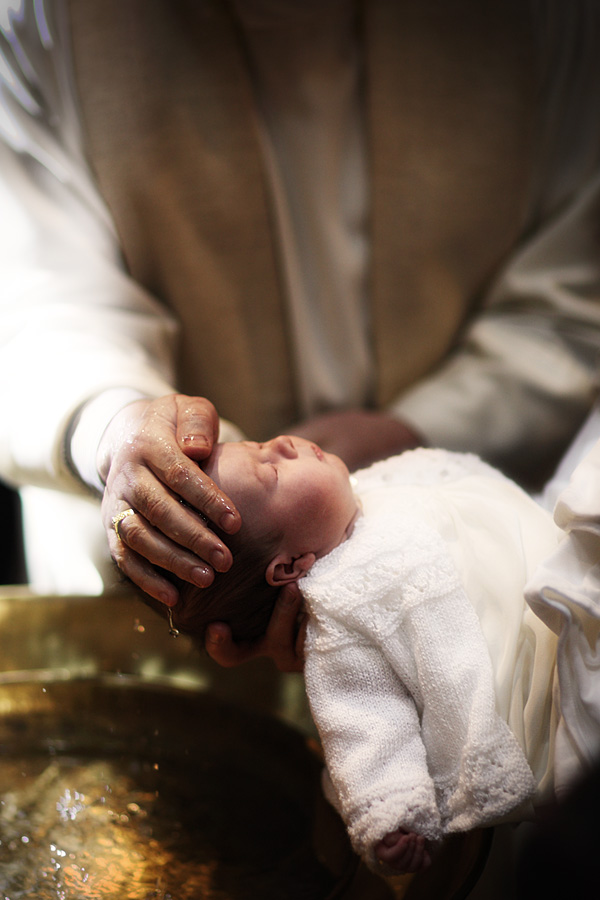
infant-baptism-water-7

For my worship and liturgy class, we had to write up a little thing explaining how we would explain the Sacraments to an everyday person. We were also supposed to throw up some questions that we might still have about them. Here are is mine.

In the beginning of the Bible, we see God create what amounts to a “temple-world”. He wants to dwell in this temple, with his people, and make it his home. He ordains priests to care for it but they fail. So God puts in motion a plan and story to rebuild this world and re-prepare it for his dwelling.

The focal point of this story and our entire faith is Jesus Christ. He is God among us having come dressed in humanity. The Gospel of John says he literally “templed” among us, using our created humanity as something he was pleased to dwell in.

This is the Gospel; it is our life and strength as Christians.
Continue reading

That elusive Rest of all rests…


oldrich-kulhanek-untitled2At my job, I have this client (nowadays they’re called “participants”) who’s unlike any other I’ve known. He’s got some sort of complicated cocktail of mental health issues going on. Whatever they are, they’ve come together to create the most agitated, anxious, hyper, manic, rapid-thinking individual I’ve ever seen.

He’s the kind of guy whose own thoughts race a million miles an hour in addition to the other voices in his head doing so as well. He craves attention and simply has to be the center of it at all times; the more people around, the more dramatic and performative he becomes. He acts out like a child in any way to get the attention he craves, all while his inside hums and buzzes with a constant anxiety.

He can easily talk non-stop for hours with random things setting off new associations and new lines of thought and one topic flowing into another topic that seems unrelated, save for a color, a location, or even a word in common with the prior one. The first time I met him, his thoughts became so fast and so loud, he started screaming and clawing at his head just to get them to quiet down.

He evokes little sympathy from those around him, including myself. He seems to thrive on the fact that he can so affect people–even if it’s in a negative, irritating way.

Continue reading

Crazy thought of the day: God Died. [QUOTE]


“The task of witnessing to the gospel is to vitalize the astonishing fact of the gospel. The message “the Son of God has died” is indeed most astonishing…. God has died! If this does not startle us, what will? The church must keep this astonishment alive. The church ceases to exist when she loses this astonishment. Theology, the precise understanding of the gospel, must be seized by this astonishment more than anyone else. It is said that philosophy begins with wonder; so theology begins with wonder. The wonder of philosophy pales before the wonder of theology. The person astonished by the tidings “God has died” can no longer be astonished at anything else.”

Kazoh Kitamori, Theology of the Pain of God

What Draws Out Jesus’ Compassion? | Matthew 15.32


Then Jesus called his disciples to him and said, “I have compassion for the crowd, because they have been with me now for three days and have nothing to eat; and I do not want to send them away hungry, for they might faint on the way.”

Matthew 15.32

What evokes Jesus’ compassionate response and provision? Faithfulness, neediness, and weakness. That’s it. Not performance, not even belief. Just walking with him while being needy.

Further, we can be confident that he knows our need and knows we will “faint on the way” without him responding. And respond he will.

See other Marginalia here. Read more about the series here.