The Scandal of Holy Week {iv}: the restoration of disciples


[Update: this series has been completed. Part 1: the forsaking of GodPart 2: the Grace of JesusPart 3: the limits of Grace?Part 4: the restoration of disciplesPart 5: conclusion & benediction]

In Part 1 of this series, we saw that we will all forsake Jesus many times in our lives, just as the disciples did on the Thursday night of Holy Week. In Part 2, we saw that in light of this abandonment, Jesus responds to those that forsake him by being unconditionally and unlimitedly gracious towards them in their forsaking of him. In Part 3, we looked at just how scandalous and beautiful this grace is and how and why we often try and limit it. Today, we give practical ways that we can prepare ourselves to come back to our Lord, even after we have forsaken him in our own “Thursday” seasons.

As we saw in Part 1, Holy Week was a week-long process in which everything–creation, creatures, and God Himself–all forsook Jesus, turning their back on him. We’ve said several times now that true disciples of Jesus are not those that never forsake Jesus, but they are those that after forsaking him, turn back. And so, to help us see how we do this, let’s look at the first person in this story to turn back.

Continue reading

The Scandal of Holy Week {iii}: the limits of Grace?


[Update: this series has been completed. Part 1: the forsaking of GodPart 2: the Grace of JesusPart 3: the limits of Grace?Part 4: the restoration of disciplesPart 5: conclusion & benediction]

In part 1 of this series, we looked at the original Holy Week and saw how everything and everyone has and will forsake Jesus. We said that “Thursday”–the day when the disciples forsook Jesus–will come for every disciple. In part 2, we saw that Jesus, as he relates to those that have forsaken him and those that will do so, responds and relates to them on the basis of pure, unfettered grace. Today we look at why this matters and what it looks like in our lives.

We’ve seen that every disciple will forsake Jesus, but the true disciples of God are the ones that come back after they have left him. And further, it is my contention that what brings people back is not fear, not Law, but the unbounded and free Grace of Jesus.

But let’s be honest–this process can be a long one. It can be months, years, or even decades before these true disciples of God return to Him. People can go very far down the path of sin’s temptations, and still be Christians. In fact, any of us can go very far down the path of sin’s temptations and still absolutely be beloved, regenerated, Christian children of God.
Continue reading

The Scandal of Holy Week {ii}: the Grace of Jesus


[Update: this series has been completed. Part 1: the forsaking of GodPart 2: the Grace of JesusPart 3: the limits of Grace?Part 4: the restoration of disciplesPart 5: conclusion & benediction]

Last week, we saw how Holy Week, kicked off by Jesus’ “Triumphal Entry” into Jerusalem, was merely the beginning of a series of events that led to everything around Jesus forsaking him. We went on to ask how disciples of Christ might avoid their own version of “Thursday”–the night the disciples betrayed and forsook Jesus. The reality is, though, that every disciple of Christ has, does, and will forsake Jesus many times over. And so, the proper question to bring to Holy Week is not “how might I keep myself from forsaking Jesus”, but rather “how does Jesus respond to those–including myself–that will end up forsaking him?” I went on to say

“The answer I want to fight for? Jesus responds to all of our forsaking him with pure, unadulterated, offensive, and scandalous Grace. My main point in this message is this: A disciple is not someone who never forsakes Jesus; it’s someone who, after forsaking him, comes back.

Today we will look back at Holy Week to see the ways that Jesus demonstrates this scandalous Grace to those that have and will turn their backs and abandon him.
Continue reading


Prayer and an N.T. Wright Quote on Easter Sunday


Easter ought to be an eight-day festival, with champagne served after morning prayer or even before, with lots of alleluias and extra hymns and spectacular anthems. It is any wonder people find hard to believe in the resurrection of Jesus if we don’t throw our hats in the air? Is it any wonder we find it hard to live the resurrection if we don’t do it exuberantly in our liturgies? It is any wonder the world doesn’t take much notice if Easter is celebrated as simply the one-day happy ending tacked on to forty days of fasting and gloom? It’s long over due that we took a hard look at how we keep Easter in church, at home, in our personal lives, right through the system.

Bishop N.T. Wright (thanks to Dano for the quote)

O God, who hath made this most holy night to shine with the glory of the Lord’s resurrection: Stir up in thy Church that Spirit of adoption which is given to us in Baptism, that we, being renewed both in body and mind, may worship thee in security and truth; through Jesus Christ our Lord, who liveth and reigneth with thee, in the unity of the Holy Spirit, one God, now and for ever.  Amen.

— from the Book of Common Prayer

you can also participate in Holy Week by joining Christians all over the world each day in morning prayer and evening prayer.

On Holy Saturday: “Better Your Arms Around Me (Penelope’s Window)” (a poem)


_____________________________________________________

Better Your Arms Around Me (Penelope’s Window)

You know why I’m standing here.
You know what I’m going to say.
The look behind your eyes betrays you.
Your sleeping head goes away.

Dreams lie as you do;
Dreams lie all night;
like you do.

Pacing back and forth on Friday,
Before you lay these words in my head.
Hoping my closed mouth mined gold
to give you, to give you.
Continue reading

On Good Friday: “Scotchful Thoughts on Treason & War” (a poem)


_____________________________________________________

Scotchful Thoughts on Treason & War

You’re stronger than Scotch, though that’s not what my throat urgently screams at the moment. Ah, the struggles of an artist, a mystic, one whose deep cries out for yours – to express the inexpressible.  To package in words that which can’t be contained.  You’ve caringly — lovingly, even — taken me, torn open my chest, pulled out my heart, and have affectionately run my broken body into your knee such that I am torn in two
_____– one spirit, one flesh:

All of reality stands at this heralding moment:
_____Wide-eyed, eager – youthful
_____anticipation abounds.
Hands on knees looking forward, rocking back
_____so on and so forth they watch:
_____smiles ear to ear.
Continue reading

The Scandal of Holy Week {i}: the forsaking of God


[Update: this series has been completed. Part 1: the forsaking of GodPart 2: the Grace of JesusPart 3: the limits of Grace?Part 4: the restoration of disciplesPart 5: conclusion & benediction]

This Palm Sunday I had the honor to preach at the prison ministry that my church does. It was amazing. I love those guys so much. My message was scrawled in my journal in outline form, so this will be only a rough and condensed manuscript of what was said. I hope you find it beneficial as you navigate these murky waters of life and spirituality.

“As they approached Jerusalem and came to Bethphage and Bethany at the Mount of Olives, Jesus sent two of his disciples… When they brought the donkey to Jesus and threw their cloaks over it, he sat on it. Many people spread their cloaks on the road, while others spread branches they had cut in the fields. Those who went ahead and those who followed shouted, ‘Hosanna! Blessed is he who comes in the name of the Lord! Blessed is the coming kingdom of our father David! Hosanna in the highest heaven!’” —Mark 11:1,7-9

This event is traditionally called the “Triumphal Entry”. It is when Jesus enters into the city of his people in such a way that confirms the suspicions of those around him: he is Messiah; he is King; he is Lord. But we also see that this Palm Sunday begins a week-long process of everything around Jesus forsaking and turning their backs on him, making this a very strange “triumphal” entry.

Continue reading

Why do we hate our bodies so much?


Originally, I was going to entitle this post, Worship, Bodies, and the Economics of Self-Loathing. But, in the interest of readability and trying to seem less intense (and douche-baggy), I’ve changed this to the above title. But still, as that original title implies, there’s a lot here on this topic that I have to say–and may, at some point. But for now, I just wanted to give some musings and thoughts I’ve been having.

I went to a conference a couple of weeks ago put on by a group of artists called Bifrost Arts, and it was on “Liturgy, Music, and Space”. While there, I attended a workshop on the use of our bodies in worship. I was struck at the immense beauty that the Bible offers as it pertains to our embodiment. Our bodies are essential instruments in the worship and life of God. Heck, it’s essential to our very redemption as God Himself took on a body to save us.

And yet, very few of us engage our bodies in those most meaningful of spheres of life, especially when it comes to our spiritual existence. That blasted dualism of our world that elevates the “spiritual” above the “physical” pervades even those most passionate and dedicated of believers in Jesus. We often see our worship merely as a process of dropping immaterial ideas into our immaterial selves to help stir up immaterial emotional responses. And then we wonder why our embodied actions and obedience don’t follow. Could it be that we need to preach the Gospel to our bodies as well?

As I was thinking about this, I was forced to ask: Why do we hate our bodies so much?
Continue reading

sin, joy, desire, & maturity (encouragement from a friend)


I think the sense of our wants, when withal we have a restlessness and a sort of spiritual impatience under them, and can make a din, because we want Him whom our soul loveth, is that which maketh an open door to Christ: and when we think we are going backward, because we feel deadness, we are going forward; for the more sense the more life, and no sense argueth no life.

–Samuel Rutherford, The Loveliness of Christ

I was sent this quote by a dear friend who’s probably starting to get to know me better than I would like.  It really spoke to me.
Continue reading

The Hope of Gethsemane (of Lent, Mortality, & Ashes)


I always have high and lofty hopes for Lent. Each year I have visions in my head of those amazing “spiritual” things I will do over these 40 days that will result in life-long and generational sins merely falling away from my life; my heart finally unburdened of the weights and yokes it has borne for so long.

And alas, God consistently and assuredly meets me in this season, but the time is rather marked by a sharp sense and sting of failure in these things I have dreamt of doing.

And so, I find myself here, five days into Lent, having already felt this weight of my own shortcomings and self-deception: dearest brothers confronting me in the facades I present to the world out of my own fears and insecurities, telling me how hard it is to love me; finding my heart wander to those old idolatries that I thought only marked my youth and immaturity; my social anxieties paralyzing me in my greatest opportunities of worship; falling short of the fast I have offered to God in this season; etc., etc., etc., etc….

And it’s right then in these moments that my greatest love–my Bridegroom, my Lover, my Hope, and my Healer: the Lord–meets me. Continue reading

The Gospel: The Limitation of God


The question came from a friend of a friend; a fellow pilgrim, sojourner, doubter, skeptic, thinker, brother:

If God is omnipotent [all-powerful] can he use this attribute to limit his omniscience [all-knowing] or omnipresence [all- er…present]?

It’s an interesting question, similar to the whole can God create a rock that’s too heavy for him to lift? or (my favorite) can he make a burrito too spicy for him to eat? I think part of the issue here is how we view the idea of attributes.  In our Western, scientific, and post-Enlightenment mindset, we often think of people as fully assembled “systems” of interconnected attributes.  And so, like the chemical compounds that create our physical bodies, we assume that these attributes are separate things that have come together to make us who we are.

Continue reading

i am not my own


…fast falls the eventide; the darkness deepens; Lord with me abide…

Both viruses and people get themselves into us, infect us, surprise us, and change us–both for good and ill. And when they depart we are left with that most complex simplicities of emotions, asking simply: what was that? The story, the episode, that previously seemed to exist with such continuity now seems so disjointed from all others that “the purpose” seems our only thought.

…When other helpers fail, and comforts flee, Help of the helpless, abide with me…

We wonder, we wander, seeking our Home, our Rest, our Selves. We recast our history in the eyes of this present trial, this present pain, this present darkness, and feel the twitch and fear that comes whenever we seriously consider all we’ve done before and all it represents within us–all the trials caused, the pains committed, and the darknesses within us.

Continue reading

My February: Resolutions, Justice, Health, & Lent


This year has been an interesting year for my personal convictions.  Over winter break I read the amazingly helpful book Everyday Justice: The Global Impact of Our Daily Choices by Julie Clawson.  It goes through seven major and “mundane” parts of our lives and shows how there are major global inequities, amoralities, and injustices being perpetrated behind the scenes of all these spheres of living.  She explains, with both nuance and care, these issues and then offers super-practical, nitty-gritty suggestions for living life more justly in light of these things.

My New Year’s Resolution was to take one of her seven issues each month and try to incorporate a more just way of living into that.  The issues (in chapter order): Coffee, Chocolate, Cars/Oil consumption, Food, Clothing, Waste/Pollution, Global Debt.

January for me was officially Just Coffee Month.  Other than an Irish coffee I picked up at an Irish pub (which I couldn’t confirm its trade method),  I have not spent one cent on coffee that has not been ethically traded and certified as such.  Special thanks to my friends at Elixr Coffee (on Yelp), the new best coffee-shop in Philly, for offering amazing Direct Trade coffee choices (which is far more ethical than “Fair” Trade Coffee). Continue reading

Pain, Suffering, & the Story of God


[Update: this post inspired a comment (below), that I ended up responding to. The commenter responded to that, then I gave my final response, and then he gave his. Lastly, a friend posted her thoughts on the discussion as well. Follow the links to get in on the discussion.]

You know that proverbial flu bug that is perpetually in existence all over the country all at once on snowy days?  Yeah, well I’ve got it.  Starting yesterday, the back of my head and the top of my neck were struck by a throbbing pain, pulsating with every heartbeat; my body temperature playing the role of ping-pong ball between the paddles of heat and cold; my body aching with every move.

I went to sleep last night, tossing and turning for a long while hoping for the pain to subside by the time I woke.  I woke and felt great.  That is, while I was laying in my bed.  The moment I stood up and the blood rushed throughout my body, the pain, dizziness, and energy-sapping delirium of flu raged against me.  And then I went to work. Continue reading

My Grandfather’s Passing (Hope in Death?)


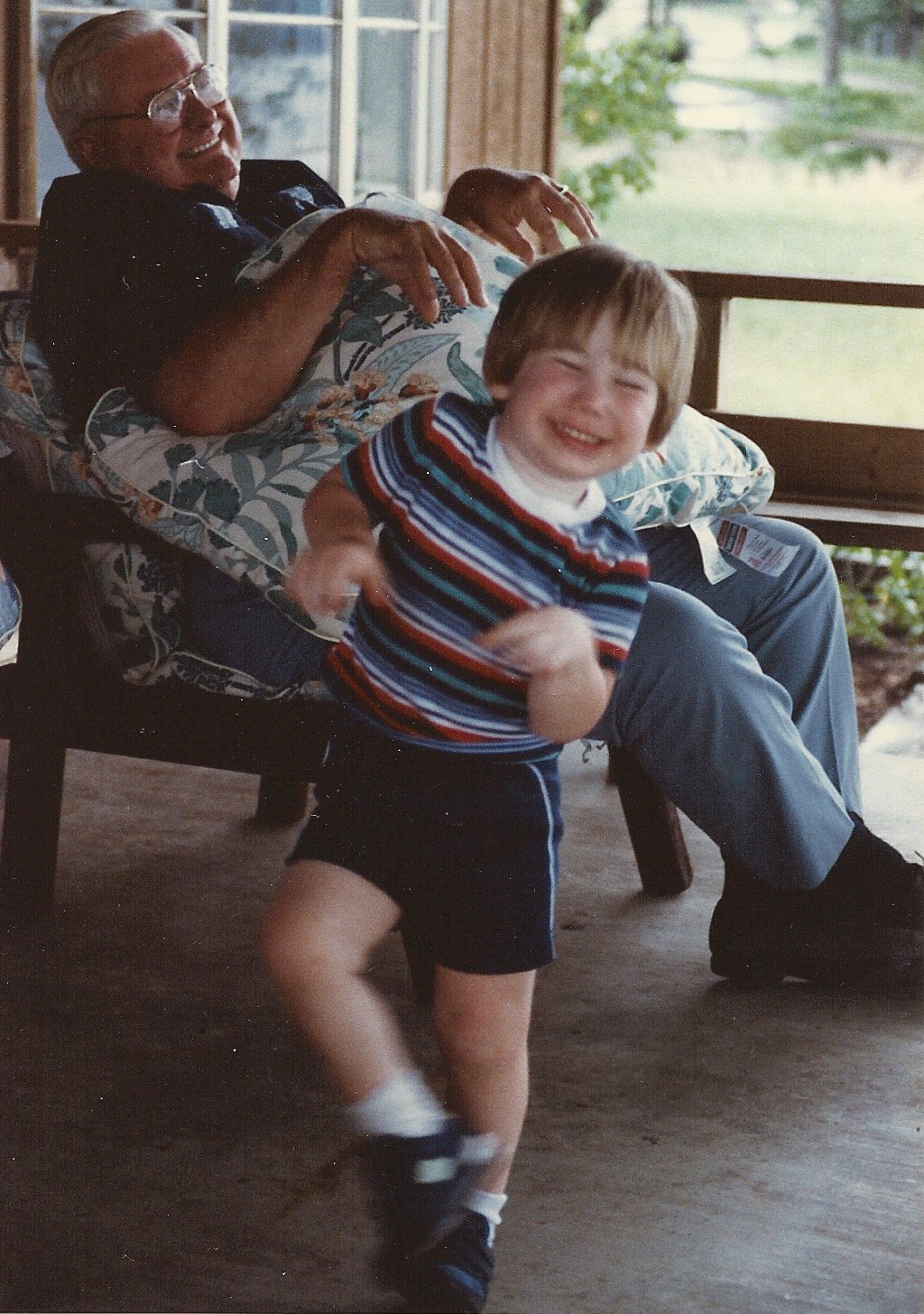
This past Sunday, the day after Christmas, I more or less watched my grandfather die (he managed to go at the one moment when no one was actually looking, just like he had hoped). This is the first death I’ve ever experienced of someone very close to me. Sure, I’ve known regular customers at jobs of mine who had passed, several old high school friends who were in car accidents, and a few people I briefly became close to in college who later died. But this was the first person that had walked with me (and I with them) for my entire life; on whose knee I had sat, been tickled by, heard legends about, and around whom I walked in a general sense of awe and disbelief.

His name was (is?) Lester Travis Williamson, or as I knew him for most my life: Peep (the result of a mispronunciation of the original attempted nickname by the first grandchild of the family). He represented for me a tenacity and determinedness of love that great stories of tragedy and triumph are built upon. As their old pastor said today during the funeral, he was a man that if you asked for a crumb would give you the entire loaf. Further, he would chase you out the door to give you another loaf on your way out. But this is not to be confused with the contemporary pictures of the gratuitously giving man we have today–cheerful, talkative, jocular, and always-optimistic. To be sure, he was the quintessential man of his generation–a “real man”–quiet, determined, and strong. He spoke with passion and intentionality in every syllable, meaning what he said and saying what he meant; he wasted no words for trivial things (except for maybe sports).
Continue reading