AMAZING Interview and Q&A about Women in the Church


haddad-mimi-rhe-egalitarian-womenWell, I think it’s time to restart our on-going series on Women in Ministry, don’t you?

While researching a particular argument for limiting Womens’ role in the Church, I stumbled on this interview and Q&A on Rachel Held Evans’ blog. It is a conversation with Mimi Haddad, President of Christians for Biblical Equality. And it is wonderful.

This whole disagreement about Women in the Church can produce a lot of noise that’s difficult to sift through. Too often, people on both sides end up retreating back to their respective sides and both fulfilling a lot of stereotypes while lobbing that accusation at the other side. This ends up entrenching the conversation even more deeply and intractably. The conservatives end up speaking sort of demeaningly about women (even unintentionally) and accusing egalitarians of not believing the Bible, all while egalitarians end up resorting to radical and simplistic feminist-sounding rants and calling all conservatives misogynists.

Haddad’s interview is wonderful because it moves against this. She is gracious, though firm in her convictions, and maintains the big picture of the discussion rather than getting lost in the rabbit-hole of interpreting individual proof-texts. She speaks in such a conversational, disarming, and winsome way. She brings up common-sense and clear-headed perspectives that are such a breath of fresh air for someone who sits for too long trying to pick apart individual texts. You can tell she loves the Church and the Bible and wants to honor them both well.

It also reinvigorated me to continue this discussion. There is still much more to be said, and as I have the privilege of being part of a church that will be ordaining its first female elder next month (the first church of this kind I’ve been a part of!), these issues are especially pertinent to those around me and the discussions we’re having.

And so, in the weeks to come, see this space fill back up with this discussion. Many of the things I want to write about will be building upon many of the ideas found in this interview and Q&A. So, if you want a big picture preview of what’s come, check it out. Really, I can’t recommend it enough.


Heidelberg (Hyper-)Calvinism? | (a celebration)


morlock-hands-cradling-stone-head

Q. What is your only comfort in life and in death?
A. That I am not my own, but belong—body and soul, in life and in death—to my faithful Savior, Jesus Christ. He has fully paid for all my sins with his precious blood, and has set me free from the tyranny of the devil. He also watches over me in such a way that not a hair can fall from my head without the will of my Father in heaven; in fact, all things must work together for my salvation. Because I belong to him, Christ, by his Holy Spirit, assures me of eternal life and makes me wholeheartedly willing and ready from now on to live for him.

So begins the Heidelberg Catechism, a 16th-century document written under extraordinary circumstances. Long story short, after the counter Reformation, different “princes” over different regions were allowed to declare what “denomination” their region would be. The problem for Frederick III? His region was split pretty evenly between Lutherans and Calvinists. And so, he brought together some people from different traditions, and had them write a document they all agreed upon. The Heidelberg was born.

This document is one of the main doctrinal statements of my denomination, the Reformed Church in America (RCA), and my church. I’ve read little bits and pieces of it in the past, but I recently sat down and read the whole thing. And I was pretty surprised.
Continue reading

On a Theology of “Non-Place” & Being the Suburb of God


suburbs-flickr

Yesterday’s post on how I’m wrestling through a Theology of the City really seemed to have struck a chord. Here on the blog, there was an interesting discussion about how to theologically view the suburbs. We asked many questions, but landed at few answers. And so, I thought I’d continue the discussion by posting the essence of these conversations on the blog and seeing if we can’t keep the conversation going.

To further offer context, I’ve also added a video I had to record as an introduction to my “Urban Christian” seminary class. In it, I offer a little background on where I’m coming from in this discussion and how I came to question my own subtle sense of urban elitism. The angle also makes my hands look massive, so you can enjoy that as well. Feel free to read these exchanges, and jump in, offering your own comments to move this discussion along!

_______________________________

Jacob Haynes wrote:
Continue reading

I’m starting to wonder about this whole Urban Christianity thing…


rooftop-philly-2

Let’s file this one under: Things I Never Thought I’d Say.

First, some realities.

America, almost since its founding, has had an Agrarian ideal spliced into its DNA that has thought more highly of the vision of the independent rural farmer–building himself up from nothing and sustaining his family by the work of his brow–over and above the idea of the dirty urban manufacturer, competing with others for the few jobs that are there.

Further, it’s pretty clear that during White Flight in the mid-1900s, whites took the association of “good, religious folk” with them to the suburbs (along with the support and attention of governments), leaving the cities to be seen as the cesspools of sin that deserved to rot away.

Along with this, the American Church (especially so, but this is definitely global) has tended to neglect cities, enjoying the safe numbers and comfort of the suburbs. In my opinion, this has helped ravage American faith, causing it to take on the aspects of the surrounding suburban culture, making it often isolating, consumerist, capitalistic, intellectual, based on convenience, behavior-driven, and not rooted to any sort of historical tradition or depth. (This does not extend to individuals per se, and it is a broad generalization, but it’s one that I think statistics would show is generally true.)

Continue reading

What is Discipleship? A Definition.


discipleship-silhouette

For one of my spiritual formation classes, I had the privilege of reading Deitrich Bonhoeffer’s Life Together and Henri Nouwen’s In the Name of Jesustwo incredible books. Last night, after having read these books, we were then asked to offer our own one sentence definition of Discipleship, and then spend some time expounding on the definition. Here was my contribution. Feel free to add your own definitions below.

______________________________

Discipleship: The cultivation of an inner and outer life–with both ourselves and others–that is marked by a humble reliance on the work, words, life, and leading of Christ and His Spirit.

The thing that struck me most about these readings as it pertains to discipleship was the weird paradox of one’s inner- and outer-lives. In both Nouwen and Bonhoeffer, there is such an emphasis that our hearts’ goal should be nothing less than the heart of Christ Himself and our reliance upon it. And yet, the primary access point to this Heart is found in the simple, mundane bodily actions we take upon ourselves with regularity.

The way in is from without, I suppose.

Especially for those of us in seminary and who minister in a Church context, isolation in these endeavors can be such an easy temptation. I don’t even pastor a church, and yet as a deacon leading a home group or class or the Sunday liturgy, I feel that damnable desire just to be liked, and not be seen for who I really am.
Continue reading

Are Cities too broken for Christians to fix them?


philly-city-hall-1As I go through these seminary discussions and readings concerning the relationship between Christians and cities, two things are pretty certain for me. First, God loves cities and had/has great intentions for them. Second, things went horribly, completely, and utterly awry.

I have the privilege of taking these courses along with incredibly thoughtful people. They haven’t just taken wholesale this newly “rediscovered” urban emphasis of Christian faith. They get the reality that God and the Bible have an urban-centric feel to them, but they really want to fight for a conception of God’s work in the world that comes to bear upon every person in every type of place in the world–not just city-dwellers.

And so I’ve been wondering: is this “urban call” to Christians a general one, or does it only go out to a very specific type of person? Are the difficulties in cities so big, so intractable, and so unique that only certain types of Christians with certain types of giftings could find a place for Kingdom work?
Continue reading

Discipleship: Making Good Little Pharisees?


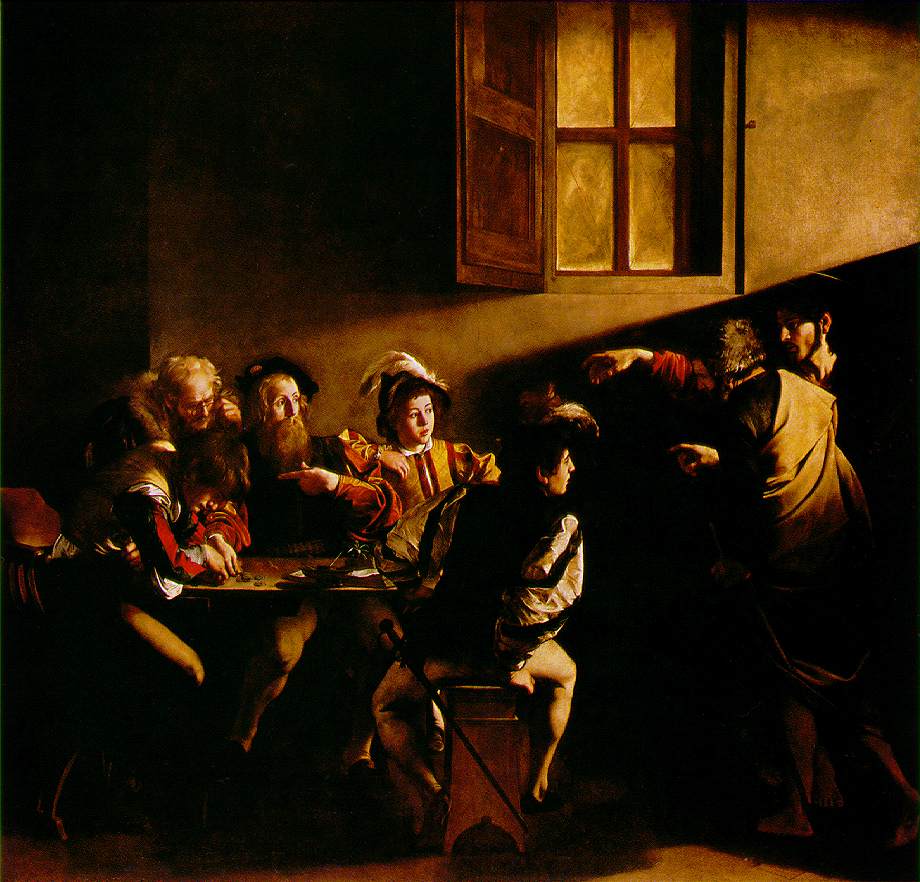
Caravaggio-The Calling of Saint Matthew{summary: the way we disciple others in the church is far too often a results-based process, and not a grace-driven one. Here, I explore Jesus’ example in Matthew as a guide for us. And, once again, we see Jesus’ radical application of grace to his Disciples’ lives.}

I’m taking a class on “The Practice of Discipleship”. Some discussions on our online message boards inspired these thoughts. Discipleship, as many people could tell you is all about “following Jesus”. After all, that’s how Jesus himself invited his disciples into it. But as I was thinking about this, I realized something: Pharisees had disciples too.

Now, with “Pharisee Discipleship” the point was to let that Pharisee get all up in your business so that you could become a good, well-behaved Pharisee someday. Christian Discipleship, as we are often told, is not about following Christians per se, but following Christians who are following Christ. The ultimate goal is to follow Christ and to help one another do that.

This is how it works in theory. I can’t speak for everyone, but at least in my experience, a lot of Christian Discipleship subtly looks more like the type that creates well-behaved Pharisees than the one that truly follows Christ.
Continue reading

Injustice & The Human Jesus (and some more Syria thoughts)


oldrich-kulhanek-untitled2For one of my seminary classes (which started this week) I’ve had to read the Gospel of Matthew. When you read a large chunk of a Bible book in one sitting, you really do get to make connections and get perspective you didn’t have before. I had many moments like that when reading Matthew yesterday, but I had one particularly poignant moment that relates to all of the Syria talk that’s going on in our country right now, and adds to my own comments a couple of days ago.

In Matthew’s Gospel, Jesus begins preaching on his own, gathers some disciples around him and continues teaching while they watch. Eventually, in Chapter 10, he sends this community of people, encouragement, and support off to do ministry in various towns in the wider area and to do what he has been doing among them.

Which means he is alone again.
Continue reading

Postscript: J. I. Packer’s Helpful Evaluation of Praying in Tongues [QUOTE]


ji-packerI just have one more thing to post in this little series on my charismatic sensibilities. Yesterday, when writing about praying in tongues, I quoted from this long piece that J. I. Packer (the spry man to the left) wrote evaluating the charismatic movement as a whole. It’s a heavy article, but if you get to his conclusions, they are very interesting.

Packer is a Reformed Anglican, and believes that the “sign” gifts (the “extra-crazy” works of the Holy Spirit) have now ceased and were only used for a time to “get the church going” as it were. (If it weren’t clear, I think this designation of “sign gifts” is incredibly arbitrary and I think you have to twist the Bible backwards to prove that these things simply stopped at some point in time. I think they are still very much with us, however neglected they may be.)

But still, he is incredibly gracious to the charismatic movement and sees it as a legitimate expression of God’s people seeking a greater communion with him, and even believes that they need to teach the old Reformed fuddy-duddies (is that how you spell that?) a thing or two. I found his comments particularly on tongues especially delightful, and I thought it would be a fitting post-script to these posts I’ve been writing on my own charismatic side. The paragraph breaks in this quote are my own, for ease of reading. Continue reading

Charismatic Confessions, pt. 3: Praying in Tongues for Everyone!


flickr-sculpture-worship-kiss

{abstract: “Praying in tongues” is not really a “gift”, but rather a way in which God makes Himself known, and we commune with Him. Therefore, I believe it’s open to all of us, not just those with a “gift”. It is a sacramental, physical participation in the “real presence” of God praying within you. It may very well be random and not a “real heavenly language”, but nevertheless, God is sacramentally mediated to us in it. I conclude by offering some brief practical encouragements.}

Last week, I started writing some posts in response to a New York Times piece about research concerning the practice of talking in tongues. I wrote about how this piece reminded me of my own charismatic side and how I’ve been neglecting it. I then talked about my views concerning the use of tongues in a corporate Sunday church context. Today, I want to give people a realistic and (hopefully) sensible framework for understanding the private use of praying in tongues.

Continue reading

Charismatic Confessions, pt. 2: Tongues Don’t Have to be Weird


peter-preaching-statue{abstract: The Bible talks about two types of tongues that take place among the Church: speaking in human languages that get translated, and speaking a “heavenly language” that sounds like non-sense and an interpretation is given. The apostle Paul encouraged people to prefer speaking in regular human words rather than tongues, and this practice turned into the later historical practice of rooting authoritative Church speaking in Bible-based sermon preaching. Paul then encourages, and I have embraced, that we move speaking in tongues away from a corporate church usage and a private, prayer one. The next post will talk about praying in tongues.}

UPDATE: Part 3 is up, where I talk about the what, why, and how of individual praying in tongues.

Yesterday, I got thinking about my charismatic past. I mentioned an Op-Ed piece in the New York Times about recent research on the phenomenon of speaking in tongues. This got me thinking about my own charismatic past and experience of these sort of things, and reflecting on how little a part of my life those things are now. Except, that is, for personal praying in tongues.

A couple of nights ago, I raided my bookshelf and pulled down every theologian that may have said anything about this phenomenon and looked through all of them. Every person said something different. There are so many different opinions about tongues. I don’t write this post to sort out this issue or give a definitive account or defense of where I land. I just want to introduce some people to this idea who might otherwise be weirded out, strongly against it, or don’t really know what to think about it.

Continue reading

Confessions of a Lapsed Charismatic, pt. 1


Grace-words-mouth-poetry-psalms

{summary: Though rooted in a Reformed tradition that usually spurns this, I am very much a theological charismatic. I believe in the full, contemporary exercise of the Holy Spirit through his Church, including all of the manifestations this has had throughout Church History. And yet, though I “believe” these things, over the past few years, they’ve played a smaller and smaller part in my life. In this piece, I reflect on that.}

UPDATES: Part 2 is up, where I go through a brief history of tongues in a corporate church context. I’ve also posted Part 3, where I focus in on the why and how of individual praying in tongues.

Several days ago, the New York Times had a wonderful Op-Ed piece called “Why We Talk in Tongues“, by a researcher who is exploring this phenomenon. (It was also appropriate, as it is still sort-of, but not really, still Pentecost.) The piece seems to have been pretty popular. Playing around with Google Trends a bit, it seems that this article made the topic of talking in tongues more popular than it has been since “Speaking in Tongues” by Justin Bieber popped up on YouTube a few years ago. This article made the topic more popular than even Megan Fox’s revelation that she speaks in tongues (and is still a practicing Pentecostal).

It got some play all over my Facebook feed, and a couple of friends asked for some of my thoughts. That they asked for my opinion was both flattering and dismaying; it reminded me of how little I talk about this part of my spirituality among my church community.

I remember years ago, when I first found my church in Richmond, Virginia, right at the end of my first semester in college. I walked into this special evening service and I immediately knew this was where God wanted me. I joined the church and was exposed to a beautiful display of charismatic theology.

Continue reading

Some random, contradictory thoughts on Hell. Discuss.


Rothko-untitled-2Below, you’ll find a random assortment of 30 completely disjointed musings on Hell. Each paragraph is its own statement, in no particular order. This is not meant to be a discussion of where I currently land on this issue. I’d love to just get your thoughts. Respond as you like, below.

(1) In the past 10 to 15 years, the American Church saw a new emphasis on Idolatry as the foundation of sinfulness, rather than “Law-breaking”. I’m starting to see a new re-emphasis on Law-Breaking and Hell as punishment for this. And yet, the “Law” is always connected to God’s Image and Character, and so Law-Breaking is living by a wrong law, or image, and therefore is idolatry. We have an analogy for how a Judge responds to breaking the law, and this leads to the popular view of Hell since Medieval times. But what is the analogy for the response to transgressing an image?

(2) Can any Universalist tell me what the point of missions or Evangelism is in this life, if their perspective is true?
Continue reading

“Simplistic Atheism: a final response” by Daniel Bastian [GUEST POST]


de Goya-fight with cudgels"

(Note: These exchanges are now complete. There is a Table of Contents to the discussion now available.)

Well, it seems that we were not in fact done with this little series. After my final post, Daniel chose to take me up on my offer to have the final word (as I normally try to do in exchanges like this). He has chosen to respond, point-by-point, to my list of what things would lead me to embrace Atheism. If you feel like any of the points still demand a reply from me, or if you have any questions about what Daniel says, feel free to to comment here, on Facebook, or get in touch with me privately. For my part, though, I consider this particular set of exchanges finished. Once again, I thank Daniel for this exchange. I hope you enjoyed it as well.

Paul,

When I initially decided to compile a list of criteria that would convince me my conclusion on the question of theism was wrong, I had sincere hope that a Christian, Muslim or other person of faith would tally up a corresponding register. I am glad to see you rose to the challenge and enrolled in this dialogue. It has been a wonderfully enlightening experience for me, and I do hope that sentiment is mutual.

I read your piece the day it was posted and while at first I found much of it persuasive, the more I reflected the more I realized it was probably the list I would have drafted two years ago, before I renounced my faith. Much of your criteria seems to rest firmly on the aesthetic appeal of the Christian narrative. And this would seem to slot right in line with your epistemological moorings-a concern for the communal connection, compelling force and overall mesmerism of a worldview over against its underlying facticity.

Yet it seems this only holds true up to a certain threshold, given a few of the items on your list. You seem to be OK with affirming the faith given its impact on your life, the power of influence you’ve seen it have on history, and the way it has shaped others with which you’ve crossed paths. But if you were to discover beyond reasonable doubt that this narrative was based on so much myth, that this loosely corroborated Yeshua the gospels are based on was a mere mortal (item #1), you would relinquish the faith forthwith.

Thus it seems to me that our epistemic divergence is one of degree, not of type. With that in mind, I’ll attach some brief notes beside the items in your list. Continue reading

Ross Douthat on Reza Aslan & the “Historical Jesus” [QUOTE]


jesus-suffering-pmaHappy Lord’s Day!

Speaking of the Lord, I wanted to point you all to Ross Douthat’s new column in the Sunday edition of the New York Times. I really like Douthat, and this piece is a good example of why. He is responding to Reza Aslan’s new #1 New York Times Bestseller, Zealot: The Life & Times of Jesus of Nazareth.

As Douthat points out, Aslan’s books is just the newest shot in the two-century long war for the “Historical Jesus“, a series of “quests” in which the assumption is that the Jesus of history is entirely different than the Jesus represented of the Bible. (I’ve recently defended some of my own thoughts on this here and here).

Now some have effectively critiqued much of Aslan’s scholarship, and even his academic credentials to write such a book (it doesn’t seem he’s ever written a peer-reviewed piece on anything in the New Testament!). But Douthat, in usual style, zooms out to the 50,000-foot level and speaks to the bigger context in which these sorts of books seem to always be written. It’s fantastic, and you should read it. Here are the money quotes: Continue reading