Please help me go to seminary! (a request, a plea)


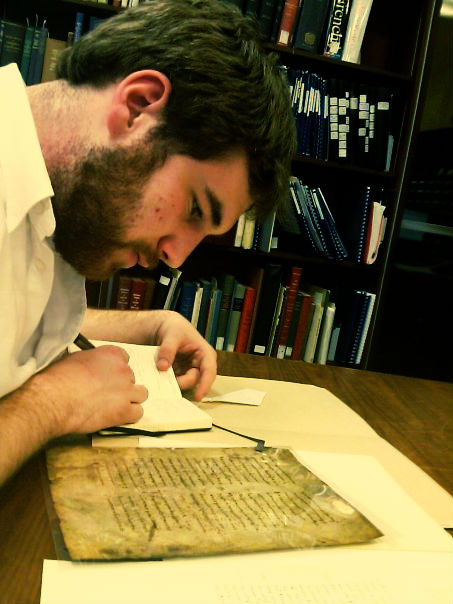
paul-greek-manuscriptIn 2008, I graduated from college and moved to Philadelphia to head to seminary. I ended up not returning to that seminary program when the year was out, primarily for money issues (and some others). Four years later, I’m now going back (to a different seminary). And again, I’m trying to be conscious of money.

I know this is weird, and maybe a little presumptive, but I’m asking blog readers for some help with my seminary textbooks. I have made an Amazon Wishlist with my Fall textbooks, and I’m just throwing it out there to see if anyone could help buy me some of these. They are mainly just “normal” books that are being used as textbooks for classes (nothing over $20), but put altogether, they can add up. I have specifically chosen the Kindle version for some books, and the physical for others, so whatever is on the list is what I need.

I’ve been running this blog for over 8 years, and have written over 800 posts so far. It has been named one of the Top 50 Divinity blogs, has sent me to Guatemala, given me the opportunity to write for several other sites, and has twice been featured on the WordPress homepage. My hope is that if I may have (accidentally, of course) said a thing or two that was helpful, challenging, or enjoyable to you, you might consider coming alongside me to help support and further the work for which this blog has been my primary outlet.

If money is more your preferred way of supporting those in need, you can also make donations through PayPal. And of course, if you can help in neither of those ways, I would appreciate all the prayer you can spare me. So if you read this post, and know you won’t be able to support monetarily, would you take a few moments and offer a brief prayer for me?

I know this is all weird. I’m not expecting much (if anything), but I’m interested to see what happens. So, I would appreciate if you can give as you are able, to show your support for what I do and what I want seminary to help equip me for. Thank you so much for any way you can help. Once more:

P.S. I’ve never used an Amazon Wishlist before, so if there are any problems, please let me know. Thanks again.

A Christian & An Atheist: A Discussion [a table of contents]


Schrott-Cigarettes-Bible-Jeremiah

I had the privilege over the past couple of weeks of engaging in a spirited back-and-forth with a good friend of mine, Daniel Bastian. Unfortunately, in the speed with which this exchange occurred, I know it was hard for people to keep track of the writings, the arguments, and the comments. And so, I’m writing this post in hopes of making it easier for people to follow. Here you will find a “Table of Contents” of sorts for the entire exchange, as it appeared on this blog.

Sadly, much was said over Facebook comments (and even blog comments) that cannot be sorted out and highlighted in their proper place. Comments on each post were scattered among different places and sites and posts, and so to try and consolidate them and make any sense of them for the reader would be nearly impossible. These long-form pieces will have to do, though I’ve provided the link to the Facebook comments when able, in case the interested reader wants to wade in.

____________________
Continue reading

Simplistic Atheism {4}: What could make me an Atheist?


paul-schrott-painting-11-11

(Note: These exchanges are now complete. There is a Table of Contents to the discussion now available.)

In this series of exchanges with my friend Daniel, I’ve tried to argue that his Facebook post on why he is an Atheist expressed an overall view of the world that is too small and too simplistic. I think this is because of his empiricist method and materialist conclusion about reality–that all there is is what we can see, touch, feel, etc.

Some concluding remarks

My whole point has not simply been that Daniel’s facts or even his method is wrong. But rather, it finds its proper place, meaning, fullness, and possibility within the Christian view of reality. I have argued in each of my posts that Christianity does not “refute” reason, science, history, skepticism, textual messiness, historical difficulty, or even doubt. Instead, the Gospel encompasses it all, and each of those things find a greater fulfillment in their use, cohesion in the whole of the world, and reality within that place.

Continue reading

New Testament & History: Christians can be confident [a retort]


bible-schrott-coffee-paul

(Note: These exchanges are now complete. There is a Table of Contents to the discussion now available.)

Update: Daniel has posted a reply below.

When I have these kinds of exchanges on the blog, I really try to let the other person have the last word. After all, I have home field advantage here. I was absolutely ready to move on to my last part of this ongoing exchange with my friend Daniel Bastian in response to his Facebook post about his Atheism.

Last week, I wrote a post trying to give a cursory response to some of his claims about the Bible and miracles. Daniel wrote a response, posted a couple of days ago. I offered a brief response to his critique of my view of miracles. I was really eager to get back to writing about other things.

But it seems I can’t. Not yet.

I’m starting seminary back up this Fall, not simply because I’m interested in all the “knowledge” about the Bible, but because I feel I actually have a (pastoral?) concern for the spiritual well-being of people. I care a lot about what people might see on this blog, and I care that they are able to receive these things in ways that will be ultimately helpful to them.

And I fear that his post, at least for Christians not well-read in these issues, will cloud the waters more than clear them. Don’t get me wrong. Christians should wrestle with what Daniel has written in earlier posts, especially when it comes to the more abstract philosophical concerns of God’s existence and work in this world. These are things that don’t have easy or even clear responses by Christians. I’m not worried about Christians having restless nights or days as they wrestle with legitimate difficulties in the seeming difference between what they believe about God and the way the world seems to be.

But, when it comes to the Bible and the Resurrection, I don’t think we are on as shaky ground as Daniel makes it seem. Let’s discuss.

Continue reading

“New Testament Historicity: A Response” by Daniel Bastian [GUEST POST]


run-down-Bible

(Note: These exchanges are now complete. There is a Table of Contents to the discussion now available.)

Today continues an on-going exchange between myself and a friend of mine, Daniel Bastian. These were inspired by a Facebook post he wrote about why he is Atheist (in this current post, whenever he says “OP”, he means “original post” and is referencing that). Last week, I wrote a post about the trustworthiness of the Scriptures and miracles. Here is his response.

Update: I have some responses posted for his section on miracles in this post. And, honestly, I feel he gets so many things wrong int his post, I’ll have to write another response to this tomorrow. 

More important update: I have a full response to this article now posted.

Paul,

Thank you for the thoughtful post. I think this is your most cohesive piece yet and, better yet, even dives below the surface of a few of my arguments. And allow me to just say up front that it is truly a breath of fresh air to commune with a non-fundamentalist on matters of faith. Rarely do I find a Christian with a sophisticated understanding of the faith’s foundational texts and the underlying nuance operative in these discussions. It is truly refreshing.

In my response I’d like to first address the broader themes of your post and then drill into a few of the more specific items you have noted. Along the way, I will correct some errors, highlight some omitted details, and point out some oversights and oversimplifications that obscure the analysis of New Testament historicity.

At the first, it seems that you still resist recognizing the non-Christian-centric applications of my arguments. Yes, some of my arguments did single out Christianity, as that is the religion I retired from at age 25 and is thus the one in which I am most conversant. However, if you were to step outside the hermetically sealed Christian bubble for just a moment, their broader implications should become apparent. Let’s try again.
Continue reading

Simplistic Atheism {3}: The Bible, Miracles, & History


schrott-bibles-paul-coffee

(Note: These exchanges are now complete. There is a Table of Contents to the discussion now available.)

We continue our response to Daniel Bastian’s blistering critique of religious belief. Part 1 tried to respond to what seems to be Daniel’s basic understanding of the world, reason, and spirituality. Part 2 focused entirely on his use of scientific claims and findings to discredit (at least the need for) religiosity. Yesterday, Daniel responded to Part 2 (here was my response). Today, we narrow in on his views of the Bible, miracles, and history.

A Simplistic Bible

(Disclosure: a lot of this is cut-and-paste from various comments here and on Facebook. Also, I’ve taught a few classes that have a more detailed discussion of a theology of Scripture. Those can be found here, here, and here.)

The points about the Bible in Daniel’s post were especially difficult to read. In fact, they were my inspiration for my post last week talking about how Christianity can shape the types of Atheistic beliefs people come to. My frustration came from the fact that, since Daniel originally wrote this (a while ago), I’ve watched him engage with and express respect for others that offer substantive critiques to what he ended up re-posting last week.

In his points, he expresses a view of the Bible that is mechanical, wooden, systematic, simplistic, and puts expectations on the text that it doesn’t even place on itself. It seems like he is only responding to the modernist, fundamentalist view of the Bible (what I called a “Straw Bible”), and I know his thinking is far more nuanced than that–I couldn’t understand why he still perpetuated this. But nevertheless, he did, so I’ll address it as it’s posted.
Continue reading

Simplistic Christianity leads to Simplistic Atheism: it’s our fault


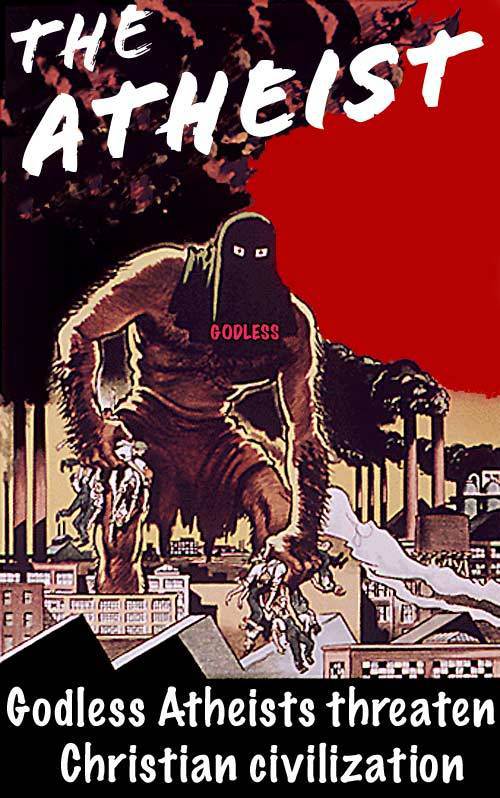
Atheist-monster-poster(Note: These exchanges are now complete. There is a Table of Contents to the discussion now available.)

“I walk outside my house, I look around, and it doesn’t seem apparent to me that there is a God. I just don’t feel it. It doesn’t seem to be the natural conclusion of reality when I live life and look around. I see the world, and the existence of God doesn’t feel like a natural conclusion one could draw.”

I stare down into my coffee, catching the corner of my pastor’s glasses in the dark reflection.

“Well”, he says, “I know it doesn’t fix how you feel, but in the grand scope of human history, and even the global humanity living today, that opinion you just expressed is in the extreme, extreme minority. Most people living in the past and now have found looked at the world and have not been able to come to any conclusion other than their being a God.”

Crap. He was right. What I thought was such an objective engagement with the world around me, was (of course) still the product of the cultural forces from which I drink deeply. History and developmental psychology have shown us that religiousness is the default mode of the human heart.

We are by nature religious. It takes other, external forces to push back against that and move us away from it. And this fact is no apologetic for religion. It’s neither a point “for” or “against” religion. We are also by nature selfish and willing to do whatever it takes to be the fittest and survive. We try not to give into this natural drive and through education and conditioning try to move away from it.

Continue reading

When easy & simplistic proof-texting trumps the nuance & complexity of wrestling pastorally with the text


On Tumblr, a very, very dear friend posted this earlier, in support of the Doctrine of Double Predestination, which says that in eternity past, God predestined not only who would be saved (apart from their own works), but also those who would not be saved (apart from their own works):

“They stumble because they disobey the word, as they were destined to do.” 1 Peter 2:8

Double predestination

#it’s biblical

In one of the most widely used Bible commentaries in existence, I found these words written about this verse, starting with commenting on the word “also” (which isn’t found in my friend’s translation of the verse). I’ve changed some formatting and some grammar to make it easier to understand. Enjoy:

“also” [as in “as they were also destined to do”;  this is in the Greek, though Revelation 19’s translation doesn’t have this]—[this is] an additional thought; God’s ordination; not that God ordains or appoints them to sin, but they are given up to “the fruit of their own ways” according to the eternal counsel of God. The moral ordering of the world is altogether of God. God appoints the ungodly to be given up unto sin, and a reprobate mind, and its necessary penalty.

The phrase “Were appointed,” (Greek, “set,”) is an answer to the “I lay,” (Greek, “set,”) found in 1Pe 2:6.

God, in the active, is said to appoint Christ and the elect (directly). Unbelievers, in the passive, are said to be appointed (God acting less directly in the appointment of the sinner’s awful course) [Bengel]. God ordains the wicked to punishment, not to crime [J. Cappel].

“Appointed” or “set” (not here “FORE-ordained”) refers, not to the eternal counsel so directly, as to the penal justice of God. Through the same Christ whom sinners rejected, they shall be rejected; unlike believers, they are by God appointed unto wrath as fitted for it.

***The lost shall lay all the blame of their ruin on their own sinful perversity, not on God’s decree; the saved shall ascribe all the merit of their salvation to God’s electing love and grace.***

(from the “Commentary Critical and Explanatory on the Whole Bible)

What are your thoughts on this issue? How important do you think it is in the grand scheme of the Gospel?

a brief Prodigal Paul doctrinal statement


paul-phoenix-1

As I am currently registering for my seminary classes, I thought I’d post this “theological statement” I had to write as part of my application materials. Some friends of mine had thought it would be interesting to read what I wrote, so here it is.

Seeing as I was writing to a seminary staff audience, there might be some references that aren’t commonly understood. I’ll link to times I’ve written about some items, but otherwise, any terminology or ideas that aren’t explained are a simple Wikipedia (or Theopedia–yes, it’s a real thing) search away. Continue reading

Well, it seems I’m going to back to seminary.


western-newbigin

Yesterday, I received my acceptance letter into the Newbigin House of Studies, a distance Masters of Divinity program in partnership with Western Theological Seminary in Holland, Michigan.

The seminary belongs to the RCA family of churches (including my own) and is in the Dutch Reformed tradition (here’s a good article on some of the differences between Dutch Reformed thought and other “flavors” of Reformed thinking).

In a couple of months, I will be having my five-year anniversary of living in Philadelphia. What brought me here from college in Richmond, Virginia was my decision to attend Westminster Theological Seminary. Eventually, for several reasons, I left the seminary (reasons that a lot of people didn’t like).
Continue reading

Trusting in our theology vs. Trusting in Jesus {guest post}


bosch-christ-carrying-the-crossToday’s post is by one of my oldest and best friends, Whit Wilson. He is currently in his first year in a master’s in counseling program at Biblical Seminary, just outside Philadelphia. I hope you get to hear more from him as he continues his education.

In the first year of my current program, three classes are required relating to the use of the Scriptures in counseling. Class 1 focuses on an overall interpretational approach to Scripture, class 2 is on the Old Testament, and class 3 is on the New Testament.

This semester my cohort and I are in the New Testament class with an eccentric and somewhat unorthodox professor who enjoys challenging various long-held theological assumptions and beliefs with the goal of helping us freshly think through these issues (everything from gender roles to homosexuality to the afterlife). I can’t say that I agree with him on everything (or most things for that matter), but I have enjoyed his fresh approach and the way he encourages us to think critically about how we use and interpret the Bible.
Continue reading

Women & Church History: The Bad Reformation & the Good News {pt.3}


Silencing-Women-duct-tapeThis is a post in an on-going series on Women in the Church.

The past couple of days, we’ve been talking about the historical development of this whole “Women in Church Leadership” idea. in the first post, we talked about why this is so important, and in the second post, we discussed where this change in ideas concerning ordained female leadership happened. Today, let’s talk Reformation and concluding thoughts.

Continue reading

Women & Church History: the century we’re still recovering from {pt.2}


Dubay-lizglass-eyeThis is a post in an on-going series on Women in the Church.

Yesterday, I began talking about the history of Women in the early Church. Up front, I gave my primary source for information, this issue of Christian History Institute Magazine on “Women in the Early Church”, which I will quote from in this post. If you need more information, you can go there.

I also gave a brief sketch of my view: women were quite active in leadership in the first two-centuries of the Church, but come the 200s, some radical things began to change in the Church–things that still effect us today, especially as it pertains to women in ministry.

(Most of this material is comes from the excellent article “The Early Controversies Over Female Leadership” by Dr. Karen J. Torjesen.)
Continue reading

Let the Female Pastor Reformation begin!


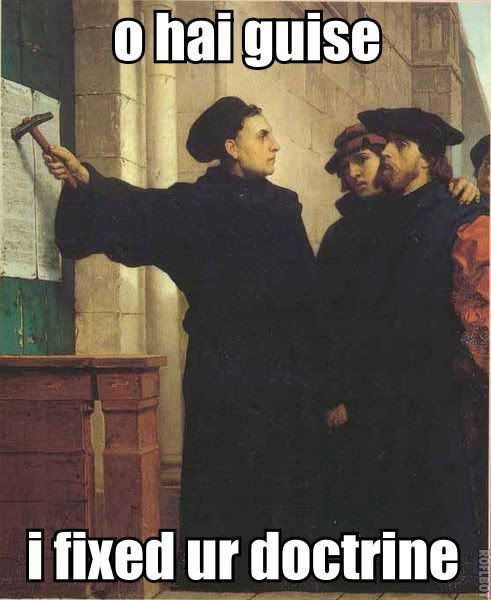
luther-95theses-humor-memeOn this blog, I currently have two running series I’m doing: “Reflections on Repentance” and “Women & the Church“. For these series, I’ve been doing a lot of reading and research on those topics.

For the Women in Ministry series, I’ve been researching what, for me, is the biggest thing that gives me pause in my own egalitarian view in support of female pastors: the complete dearth of women leaders throughout the history of the whole Christian church. With a couple thousand years now of godly men (and women) looking at the same Scriptures I am, why have the vast majority of them come to the same view limiting women’s role?

Well, that’s another post for another time, but rest assured, as I’ve been researching this, I feel I’ve satisfied my concerns in this area. But that’s not what this (mostly tongue-in-cheek) post is about.

For my research for the repentance series, I keep ending up at the Reformation and its leaders. This got me thinking, and doing some math…

Continue reading

Male-Only Church Leadership: Blessing or Curse?


michaelangelo-adam-eve-eden-fall

In these discussions on women’s roles in church leadership, a favorite little one-off argument by Egalitarians (and a pretty darn good sound bite) is that the very idea of exclusive male headship is part of the curse laid upon humans in the Genesis Eden story. In Genesis 3, this is what God speaks over the woman as a curse in response to her sin:

“I will greatly increase your pangs in childbearing; in pain you shall bring forth children, yet your desire shall be for your husband, and he shall rule over you.”

I’ll be honest with you. I haven’t done the research on the Hebrew or scholarship on those lines to know exactly what these lines really might mean.

Honestly, both sides could use them. Conservatives could say that the curse is that women will desire the authority that God rightfully gave men. Egalitarians would say that man’s “rule” over women is the curse.
Continue reading