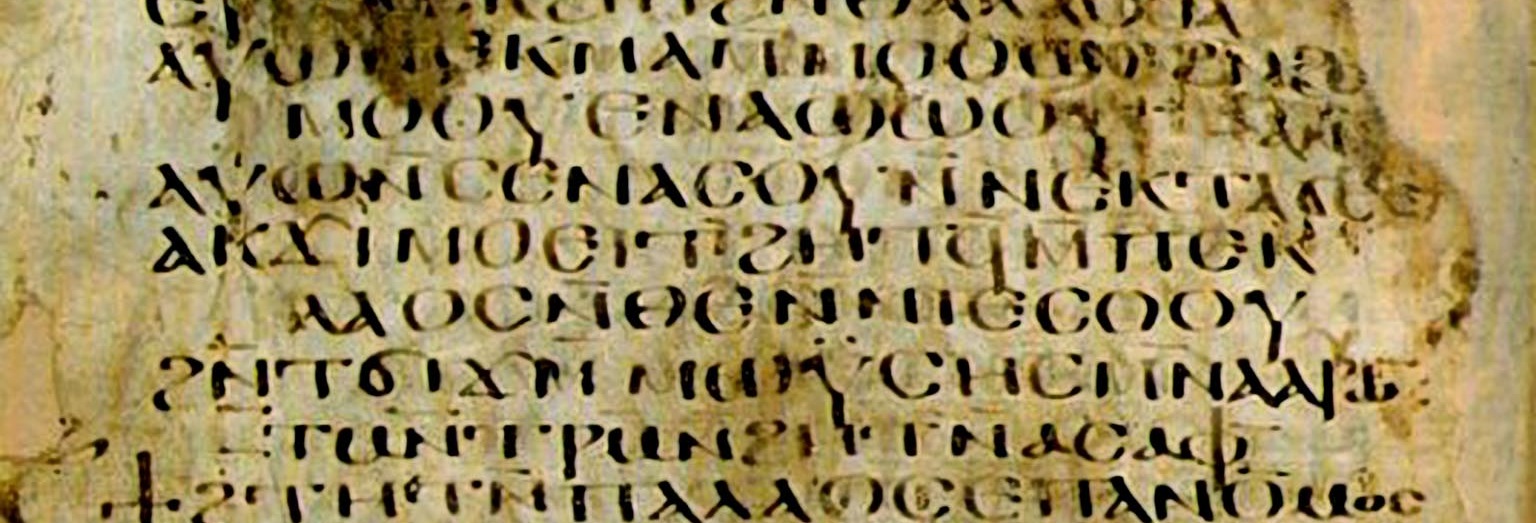
Textual Criticism & the Glory of God


Here is the summary of my final paper for the Textual Criticism portion of my New Testament Intro class.  Enjoy:

My ultimate goal in all these classes is doxological.  That’s how I’m judging my success; not by grades, but whether not I have a greater affection for Christ at the end of each course.  I can say I have that at the end of this course, but it’s not without a price, I feel.

What do I do with, say, the ending of Mark?  How do I preach that text?  Though I absolutely disagree with the Textus Receptus-only arguments, I must say there’s something romantic and (dare I say) “Reformed-sounding” in their arguments.  The idea that God is Sovereign and Providential enough to bring about a final text, even with all its textual errors is enticing (probably because it removes all further critical thought from the process).

It’s ultimately more difficult to reject these notions, though, because you’re forced to face a few realities.

Mainly, what do we do with these texts, then?  If we keep them, then we’re Catholic because we’re placing tradition over the Word as it originally was.  If we get rid of them we seem liberal because we’re subjecting and changing the Bible based on an authority outside of itself.

What about the hypothetical stay-at-home mom that comes to me with the ending of Mark, wanting to know what it means?  Do I unpack textual criticism on her and tell her it wasn’t original so don’t worry about it?

In that case, what if Jesus’ words in John 8:1-11 have been such a comfort to her through the darkest of times?  Is that the Word of God, while the ending of Mark (snakes and all) is not?  How much doubt will it give her to know that there are words in her Bible that John Mark didn’t actually write?  In short, what are the pastoral implications of textual criticism? I don’t know.

Personally, I’m fine with things as they are—keeping very unlikely readings out of the text and just footnoting much.  I’m facing no faith-crises because of this.  I see how far God would go to condescend Himself and thereby draw me to Him, even amidst the messiness of scribal error and change.

I’m just in that very good spot of wrestling through things to see how they fit in a context of proclamation and ministry.  I’m sure they do—they must.

I’m finding that seminary accomplishes its very interesting call of answering many of your questions all while giving you many more, bigger, and deeper questions to grapple with along the way.  This is good.  This will certainly give me more nuance in my ministry of God’s word and His people—a greater understanding of the depth and complexity of God’s Word.

I see now things aren’t so black and white, and that’s by design.  If it weren’t, then we would trust God and His Word on a basis other than Himself.  He will force us to live this life by faith and by no other thing will we be able to fully rest upon—not even the individual black and white text on the page of the Bible, but rather on the Sovereign, Supreme, all-Beautiful, all-Righteous, all-Knowing, all-Just, and all-Gracious God of the Bible.

Get yourself some Ancient Scribery


As ancient scribes copied manuscripts of Scripture, they sometimes wrote little notes to the reader in the margins or at the end of the document. Just read some of these “colophons” as they’re called. Some point out the difficulties of being a scribe:

“As travellers rejoice to see their home country, so also is the end of a book to those who toil [in writing].”

“The end of the book; thanks be to God!”‘

There wasn’t any talking allowed in the “Scriptorium” where the Scribes sat in groups to copy Scripture, so at times they would jot some notes to their neighbor in their own native tongue.  At Princeton Theological Seminary there is a 9th century manuscript of a commentary on Psalms (from a Latin Scriptorium which apparently hired people from many regions) where we see written in the margins, in Irish, the following:

“It is cold today.”

“That is natural, it is winter”

“The lamp gives bad light”

“I feel quite dull today; I don’t know what’s wrong with me”

“It is time for us to begin to do some work”

Some things don’t change, I guess.  But nevertheless, many scribes saw themselves doing God’s work and making it possible to have the Bible we have today.  Thus, their work became worship.

“What happy application, what praiseworthy industry, to preach unto people by means of the hand, to untie the tongue by means of the fingers, to bring quiet salvation to mortals, and to fight the Devil’s insidious wiles with pen and ink! For every word of the Lord written by the Scribe is a wound inflicted on Satan. . . . Man multiplies the heavenly words, and in a certain metaphorical sense, if I may dare so to speak, three fingers are made to express the utterances of the Holy Trinity. O sight glorious to those who contemplate it carefully! The fast-travelling reed-pen writes down the holy words and thus avenges the malice of the Wicked One, who caused a reed to be used to smite the head of the Lord during his Passion.”
— Cassiodorus, 6th century

“O reader, in spiritual love forgive me, and pardon the daring of him who wrote, and turn his errors into some mystic good. . . . There is no scribe who will not pass away, but what his hands have written will remain for ever. Write nothing with your hand but that which you will be pleased to see at the resurrection. . . . May the Lord God Jesus Christ cause this holy copy to avail for the saving of the soul of the wretched man who wrote it.”
— anonymous, possible 2nd century

I hope you enjoyed this little lesson in textual criticism of the New Testament.

–p

curse you μαθητευσατε!


I hate Christian cliches. With a passion. I really do. Few people have seen me more frustrated than when I talk about “pop Christianity”. I mean, potpourri at a Christian book store? “Testa-mints?” Really? Ugh.

Anyway, one of my big soapboxes is the misappropriation of the language Evangelicals use in relation to how the Bible describes things. The Bible never says “accept Jesus into your heart”, Jesus never gives an altar call, and Jesus never “knocks on the door of your heart” (that passage in Revelation is referring to Jesus knocking on the door of a church, not a heart).

One of my biggest frustrations was pounded into me by a good friend and minster. It was the use of “disciple” as a verb. As in “I am discipling him” or “I am being discipled by her”. I and my friends have often responded in an outcry of the Bible never uses disciple as a verb! You don’t ‘disciple’ anyone, you make disciples of Jesus!

Enter, Greek. In Greek class a couple of days ago we were studying the imperative mood of verbs. Well, sure enough, as is often the case, God took this moment to show me my pride and assumptions. In the famous Matthew 28:19 phrase “make disciples of all nations” that verb for “make disciples” is the 2 plural aorist imperative verb μαθητευσατε (matheteusate). This is the verb form of the noun μαθητης (mathetes) meaning “disciple”. The “make” is added by translators to stress the imperative/command sense. It literally means “to disciple”. It’s not two separate words for “make” and “disciple”.

So, I need to repent to all those I’ve been frustrated with for using the phrase. I also need to repent for talking bad about Jesus’ Bride and not trusting the Spirit of God to sanctify God’s Church, even in their pop culture and language.

until God’s next Sovereign moment of humbling,

Get yourself some Metzger


I was reading this in an article by Bruce Metzger on the formation of the Biblical Canon:

“In short, the status of canonicity is not an objectively demonstrable claim, but is a statement of Christian belief.  It is not affected by features that are open to adjudication, such as matters of authorship and genuineness, for a pseudepigraphon [a letter written under a different author’s name, as some claim some of the letters of Paul to be] is not necessarily to be excluded from the canon…To some scholars the seemingly haphazard manner in which the canon was delimited is an offence.  It is sometimes asked how the canon can be regarded as a special gift from God to the Church when its development from a ‘soft’ to ‘hard’ canon progressed in what appears to be such a random and, indeed, haphazard manner…[But, as] William Barclay [said]: ‘it is the simple truth to say that New Testament books became canonical because no one could stop them from doing so.’…If this fact is obscured, one comes into serious conflict not with dogma but with history….

The word and the Scripture are united in such a way that they constitute an organic unity; they are related to each other as the soul to the body [and] that relation is unique; its closest parallel is the relation of the divine and human natures in the person of Jesus Christ, who is the Word incarnate.”

I love our messy, sloppy, confusing, and authoritative Bible.

Get ’em, Bruce.

Seminary: Year 1, Semester 1


These are the just the books I actually bought for my first semester of seminary.  There were many more that were “required” texts that I didn’t buy.  Seminary is a time for reading.  Lots and lots of reading.  I put this up to let all you up and coming seminarians what’s in store.  Also, I want this to be a preview for an upcoming blog post I’m working on that will be up in the next couple of days.  So, for all the nerds out there who are interested . . .

Here are the book listings for each course:

Here are all the books:

and the Scotch is just because it’s a Presbyterian Seminary . . . and it’s good.

The Mind of David Powlison


This is a picture I shot during my class last night.  This man is one of the most brilliant minds in Biblical Counseling, and this picture sort of captures the way his amazing mind works.  For all you CCEF or Redmption Hill folks, you can sort of make out a sun at the top center (Heat), a dead tree on the right (Thorns), the cross at the bottom, and then a living tree on the left (Fruit).  Yes, this is the mind that came up with that model we all learned so well.  Enjoy!

dpowlison