How Preaching Saved Me from Evangelicalism’s Bible


bible-pulpit-sepia

If I’ve learned anything the past few years, it’s that Evangelical Fundamentalism is absolutely right: as I’ve embraced more and more what conservatives often label a “liberal” view of the Bible, it really has negatively affected my spiritual and devotional life.

When you think the Bible is itself the “infallible, inerrant, Word of God”–when you think that the precise words themselves hold a magical power–you do approach the Bible with a greater amount of awe, respect, and mysticism. I’ve written before how it wasn’t until college that I read any of the Gospels on my own, because I had this fear of reading the “literal, unfiltered” words of Jesus. They seemed so big and other-worldly to me.

I’ve loved the Bible my whole life. I still have the first Bible I was ever given as a child. I still vividly remember the evening on my parent’s bed after they had read a Psalm that had been stuck in the middle of the stories about David that it finally clicked for me that the Bible wasn’t just narratives, but also poems and other kinds of writing.

My Southern Baptist upbringing has got it engrained in me that my entire spiritual and devotional life should revolve around this book. No matter how much I tell myself otherwise, something in me always has (and always will) “evaluate” my spiritual health by how I engage the Scriptures, in both quantity and quality.
Continue reading

Paul: The Second Coming of Jonah?


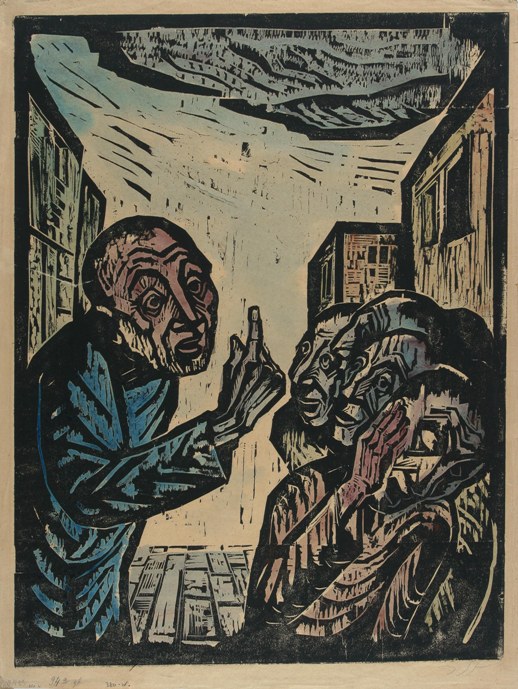
Jonah-Preaching-in-Nineveh-1923sIt’s always odd when you see something in a text that seems incredibly out of place. I took a lot of Latin in high school and college. I remember the first time I was doing some translation and ran across the word Britannia. I looked up the word in the Latin dictionary to see that it was the Roman word for Great Britain.

I don’t know about you, but when I think of ancient Rome, I somehow don’t think of Great Britain having been a thing. Or maybe I thought they would have been familiar with the region, but that it would have had a different name or something. I don’t know. It was just a really unexpected thing to come across.

A similar experience happened when I was going through the book of Galatians for the first time. In the opening chapter, Paul is telling the story of his conversion, and he randomly says that after he became a Christian, he went down to “Arabia” for three years to, in a sense, figure out what this Gospel was that he would bring to the Gentiles. This is a very odd gap in the understanding of Paul’s life, and no scholar has any idea what he was doing in this time. But, more oddly, Arabia? Again, another regional name I wasn’t expecting to see casually thrown into a Mediterranean-based ancient biblical text.

Continue reading

Logos Bible Software & Evangelical Insecurity


devil-jesus-arm-wrestle

I use and love Logos Bible Software for my Bible study and seminary work. It really is an amazing piece of software. You can amass such a huge library of books and resources that all connect and sync up to one another.

The one problem is that they can only put the time and resources into putting out books that people will actually buy. This means that their library selection has long been skewed towards a certain demographic: American Conservative Evangelicals, usually of the “Neo-Reformed” variety.

I don’t tend to like the books that are geared for this market. Their theological assumptions seem to come first, and the text seems to often come second. I love reading robust, scholarly commentaries and books that help grow and stretch me; books that focus on the messiness of Scripture and how it is historically and culturally conditioned. Yes, this means I end up preferring writings from “liberal” (God, I hate that term) perspectives and institutions, even if my actual theological conclusions are fairly conservative.

So it’s been frustrating to me that Logos was lacking in this scholarship and thinking for some time. But in the past year, I’ve noticed this changing. More and more commentary series and scholarship book bundles are coming out by Logos that I am loving (though my bank account hasn’t). Maybe I just never noticed them before, I don’t know. But either way, I’m noticing it now, and I’m really happy.

Or rather, I was.
Continue reading

Seminary & Ministry in the Post-Everything World


Grace-words-mouth-poetry-psalms

All last week I was in Holland, MI attending another one of our in-person sessions for my seminary program. It was another week with amazing people, at an amazing place, learning and discussing amazing things.

One of that classes I had was my preaching class. Over the course of five days, every one of us in the class got up and preached a 15-20 minute sermon. Every person–again, every. single. person.–did amazingly well. There were many surprises. People delivered messages that we could not have anticipated, in both skill and content.

Imagine listening to 14 full-on sermons in the course of a few days. It’s emotionally draining; it’s intense; it’s life-giving. It’s trying to drink from a fire hose of God’s Word and Spirit.

One benefit of this is that I got to get a glimpse into the future of the Church’s preaching ministry, and I am happy to say that I am really encouraged.

Continue reading

Wolterstorff: the liturgy & worship of lament [quote]


job-silohetteLast week, I was in Michigan again for my seminary program. Tomorrow I will post some reflections on my time there. Today, I want to offer you this amazing post-length excerpt by Nicholas Wolterstorff from an amazing piece of his called, “Trumpets, Ashes, & Tears” (pdf):

I suggest that there is yet one more thing which the believer experiences in his life of dispersion and which he brings with him to the liturgy….

As we human beings travel through life we experience pain and suffering–in part our own, in part that of others. Some of this pain and suffering is non-innocent suffering; it is punishment for, or the consequence of, moral evil. But not all of it is that.

The suffering of the Israelites in the brickyards of Egypt was not the consequence of their sin, nor was the suffering of the Jews in the camps of Auschwitz. Some of the suffering of our world even resists our seeing it as the counterpart of anyone’s sin–the accidental death of a child, for example.

Continue reading

Relentless Mercy (I’m never looking at Jonah the same way again) [QUOTE]


The forceful rejection of the doctrine of mercy is voiced by a man who was willing to die rather than cause others to die, and who was willing to leave his native land and pay with his life rather than serve the compassionate God. His vigorous and sincere opposition to divine mercy is striking evidence that it is desperately needed. Just as the flight is unqualified, so is the pursuit relentless…

Jonah must bow his head before the absolute sovereignty of the divine will…before he can hear and understand the explanation given by God, who forgives without being lenient. The gates of escape are shut in the prophet’s face; precisely this provides the opening of the gates of repentance to the transgressors with its full significance, since both are direct outcomes of the Lord’s love for His creatures.

The paradoxical tension between the Lord’s inordinate severity with Jonah and His extraordinary leniency with Nineveh teaches us about the absolute sovereignty of the divine will; it is resolved only when Jonah comes to realize that the will of the Lord is not arbitrary, but compassionate, for those who are near and for those who are far from Him. 

–from the JPS Bible Commentary on Jonah, by Dr. Uriel Simon

Jonah: a Children’s Story of Verbs


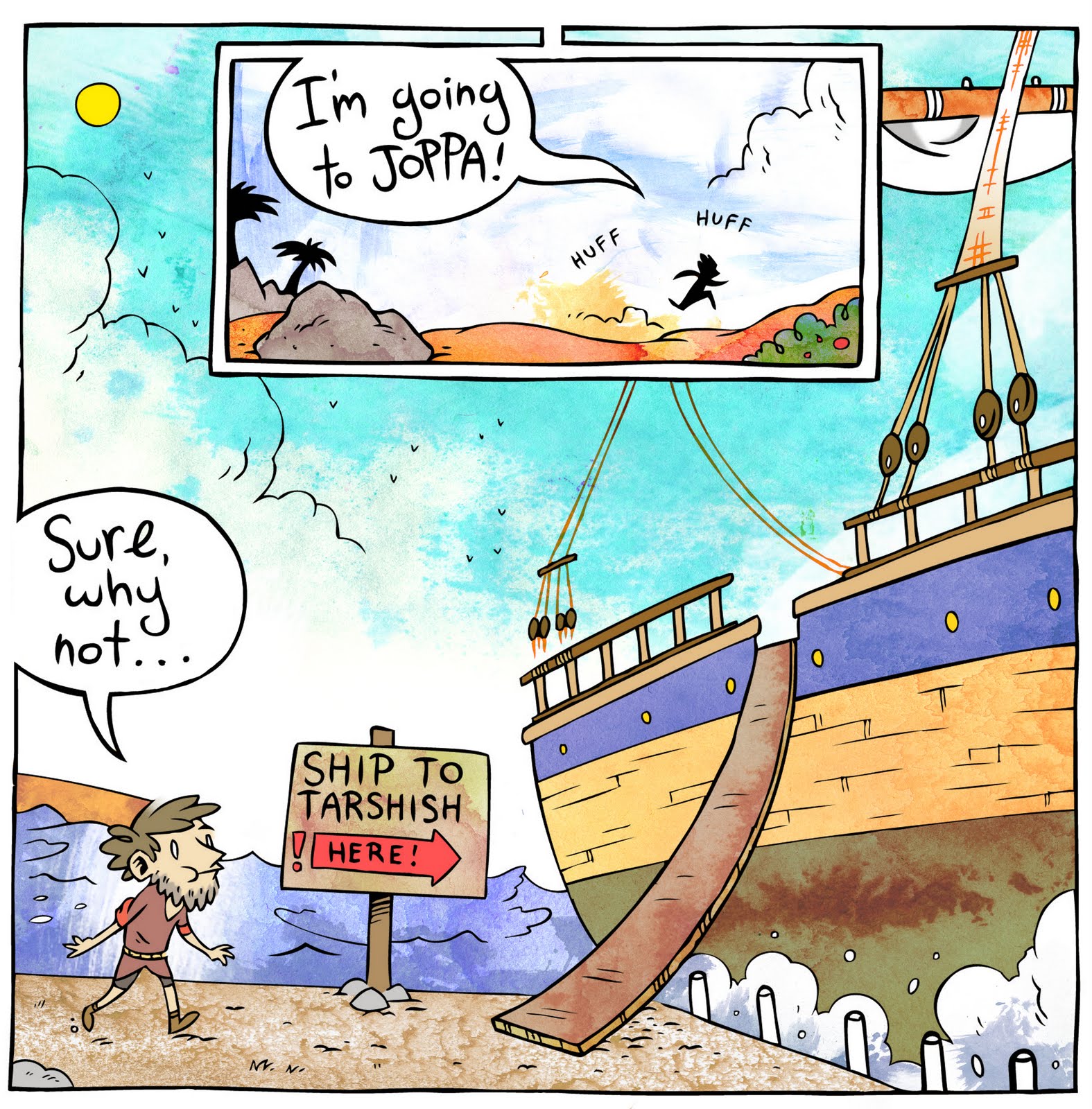
Jonah-boat-comicMy Hebrew class has moved from learning grammar to the actual process of translation and interpretation. To do this, we’re going through the book of Jonah. Our first interpretive assignment was to look at all the Jonah-related verbs in the first six verses and draw some theological conclusions. Here was my contribution.

But first, my incredibly literal and somewhat stilted translation of the opening verses [Jonah 1.1-6], including all the odd word order and idioms of Hebrew:

(1) And the word of the LORD was to Jonah son of Amittai, in order to say, (2) “Rise, go to Ninevah, the large city, and cry out against her because their evil arose to my face.” (3)And Jonah rose in order to flee in the direction of Tarshish from the toward-facing faces [Hebrew idiom for “Presence”] of the LORD and went down to Joppa and he reached a ship going to Tarshish and he gave its fare and went down in it in order to enter with them to Tarshish away from the toward-facing faces of the Lord. (4) And the LORD hurled a large wind upon the sea and it manifested as a large storm among the sea and the ship thought to shatter towards itself. (5) And the sailors were afraid and they cried out, man to his God, and they were made to throw the receptacles which were in the ship into the sea away from them towards making themselves small and Jonah had gone down into the rear of the vessel and had laid down and slept heavily. (6) And the chief sailor came to him and said to him, “Why are you sleeping? Arise! Cry out towards your gods! Perhaps the god of you will bear us in mind and we will not perish.”

And now for some lessons we can draw…
Continue reading

A method for humility, according to St. Paul | 1 Corinthians 3:18-19


Do not deceive yourselves. If you think that you are wise in this age, you should become fools so that you may become wise. For the wisdom of this world is foolishness to God. For it is written: “He catches the wise in their craftiness”
1 Corinthians 3.18-19

What a method for humility. Whenever we feel wise or smart, the best thing we can do is put ourselves in a situation where this is not valued. We must be “simplified” and lose the wisdom, else lose Christ in the process. Here I think of Lesslie Newbigin, who left his lucrative writing and tenured prestige and teaching to work with those who would never know or appreciate his brilliance. This can be a discipline that we do.

For example: Perhaps I should consider ways to stop blogging or cutting it out of my routine in those moments or seasons that I feel it is building me up too much.

See other Marginalia here. Read more about the series here.

My Gospel Terror, Acts, & Letters [photo sermon]


Acts-bible-lomo

Each week, WordPress has a Weekly Photo Challenge, where they give a theme and invite people to highlight photography representing that theme, accompanied by a few meditations on it. OccasionallyI try and write a “photo sermon” or meditation based on those themes, accompanied by a photo of mine . This week’s theme is “Letters“.

* * * * *

I grew up in church and grew up loving the Bible. I did devotionals and sat in Sunday School classes for the vast majority of my life. And yet, it wasn’t until I got to my junior year of college and took a class on the Gospels that I read any of the Gospels all the way through. Sure, I had probably heard most of the Gospels preached on or excerpted in devotionals and books, but I had never read a Gospel from beginning to end.

At the time, I thought it was because they seemed too holy. It felt like too much for my young soul to handle to read the very words of Jesus on my own. It was too weighty for me and scared me. Maybe I just wanted to wait until I could drink whiskey or wine while reading them.
Continue reading

Corinthian Fragments on Church Leadership & Growth | 1 Corinthians 3 & 4


What then is Apollos? What is Paul? Servants through whom you came to believe, as the Lord assigned to each. I planted, Apollos watered, but God gave the growth. So neither the one who plants nor the one who waters is anything, but only God who gives the growth.
1 Corinthians 3.5-7

There is no such thing as “church growth” methods or strategies. Just a “church growing God”. This should correct our hubris and encourage us: when a church “fails”, it need not be because of a failure of method, leadership, vision, strategy, preaching, planning, or obedience. A lot of times, it’s just that God did not give the growth, and we should move on.

For no one can lay any foundation other than the one that has been laid; that foundation is Jesus Christ.
1 Corinthians 3.11

Would that we embraced this as our ultimate Church “growth” philosophy!

So let no one boast about human leaders. For all things are yours, whether Paul or Apollos or Cephas or the world or life or death or the present or the future—all belong to you, and you belong to Christ, and Christ belongs to God.
1 Corinthians 3:21-23

Is it just me or is this an incredibly Protestant view of Church leadership?

Think of us in this way, as servants of Christ and stewards of God’s mysteries.
1 Corinthians 4:1

Oh what a beautiful picture of what Church leadership is! “Stewards of the mysteries of God”. I love that.

I am not writing this to make you ashamed, but to admonish you as my beloved children.
1 Corinthians 4:14

What a model for leader-congregant relationships.

See other Marginalia here. Read more about the series here.

#Marginalia Weekly Round-Up #5 [3/24-30/14]


Marginalia is a section of this blog dedicated to (mostly) short reflections, meditations, questions, and difficulties I have while going through my Bible reading plan. I’m still trying to figure out the best pace at which to post these, so be patient with me. To aid in helping people engage with these posts, every weekend I post a round-up of all of Marginalia posts that appeared during that week. This list is in biblical canonical order.

Genesis

History, Theology, & Wrestling with God | Genesis 32.24-32

When morning came, it was Leah | Genesis 33.10

How Christians can read Old Testament horror  | Genesis 34.25-31

Exodus

God’s Sovereignty, Moses’ Will | Exodus 3.4

Our infinitely compassionate (and delegating) God | Exodus 3.7-8

The Proof that God’s Right? When He Is.  | Exodus 3.11-12

Who God is When We’ve Forgotten Who He is | Exodus 3.13-15

Continue reading

Where on Earth is Jesus’ Bethlehem? | Luke 2.1-5


In those days a decree went out from Emperor Augustus that all the world should be registered. This was the first registration and was taken while Quirinius was governor of Syria. All went to their own towns to be registered. Joseph also went from the town of Nazareth in Galilee to Judea, to the city of David called Bethlehem, because he was descended from the house and family of David. He went to be registered with Mary, to whom he was engaged and who was expecting a child. While they were there, the time came for her to deliver her child. And she gave birth to her firstborn son and wrapped him in bands of cloth, and laid him in a manger, because there was no place for them in the inn.
Luke 2.1-5

Recent archaeological evidence suggests that this Bethlehem is not the traditional site, but “Bethlehem of the Galilee” (which would make sense). The traditional site is 150km from Jerusalem, whereas this other, newer proposed site is only 7km. A lot easier for Mary. Although some dispute this, pointing out that Justin Martyr in the 2nd-century identified the traditional site as the correct site. Who knows?

See other Marginalia here. Read more about the series here.

What the heck is Preaching, even?


peter-preaching-statueFor my preaching class, we’ve been trying to get at what this weird thing called “preaching” really is. It’s not a lecture, it’s a not a conversation, it’s not a debate. So what is it? Here are some of my random thinking on this. But I’d love to hear yours.

As much as I want something far more profound and original, I have not been able to find anything simpler and clearer than Alan of Lille‘s definition: “Preaching is an open and public instruction in faith and behavior, whose purpose is the forming of men [sic].”

Continue reading

Buechner: Fiction as Self-Revelation [QUOTE]


If writers write not just with paper and ink or a word processor but with their own life’s blood, then I think something like [our own words being just as much to us as from us] is perhaps always the case. A book you write out of the depths of who you are, like a dream you dream out of those same depths, is entirely your own creation. All the words your characters speak are words that you alone have put into their mouths, just as every situation they become involved in is one that you alone have concocted for them. But it seems to me nonetheless that a book you write, like a dream you dream, can have more healing and truth and wisdom in it at least for yourself than you feel in any way responsible for.

–Frederick Buechner,Telling Secrets

Let’s just finish Esther already (On Purim & History) | Esther 9 & 10


Haman son of Hammedatha the Agagite, the enemy of all the Jews, had plotted against the Jews to destroy them, and had cast Pur—that is “the lot”—to crush and destroy them; but when Esther came before the king, he gave orders in writing that the wicked plot that he had devised against the Jews should come upon his own head, and that he and his sons should be hanged on the gallows. Therefore these days are called Purim, from the word Pur. Thus because of all that was written in this letter, and of what they had faced in this matter, and of what had happened to them, the Jews established and accepted as a custom for themselves and their descendants and all who joined them, that without fail they would continue to observe these two days every year, as it was written and at the time appointed. These days should be remembered and kept throughout every generation, in every family, province, and city; and these days of Purim should never fall into disuse among the Jews, nor should the commemoration of these days cease among their descendants.
Esther 9.24-28

Historically, I wonder: Is this it? Is this the reason for this story? As I said before, it genuinely doesn’t look like this story is historical, so it must have served some other purpose in the community. I wonder if the Jews were coming back from exile and had this random festival named after the plural of “lots”, and so they needed to write a story about how it came about. But if so, how do you go from the word “lots” to all of this story? Quite the stretch. So…what’s the historical core? This one’s tough.

King Ahasuerus laid tribute on the land and on the islands of the sea. All the acts of his power and might, and the full account of the high honor of Mordecai, to which the king advanced him, are they not written in the annals of the kings of Media and Persia? For Mordecai the Jew was next in rank to King Ahasuerus, and he was powerful among the Jews and popular with his many kindred, for he sought the good of his people and interceded for the welfare of all his descendants.
Esther 10

So… Mordechai is the hero here? I guess it could make sense, but he plays such a bit part in the story. He’s consequential, sure; he’s just not around that much, is all. This seems more like the mythologizing of a popular leader in the Jewish diaspora.

And lastly, one last “Christian” reading of this story. If we can analogize this a little, Mordechai “intercedes” for God’s people, for their good and for their descendants. And they’re enemies (like death and sin for us) are comprehensively and almost over-the-top-ly destroyed. And God is faithful to accomplish all of this, even when he seems absent. With this book, that’s the best I can do. I genuinely don’t like this story.

See other Marginalia here. Read more about the series here.