For All Saints’ Day: Our Son’s Baptism (And Yours)


Today is All Saints’ Day–when Christians remember the saints that came before us. It’s a perfect day to celebrate our son’s entry into visible membership into God’s family through the sacrament of baptism! You can watch it in the video above.

I wasn’t raised witnessing or agreeing with infant baptism. I grew up as a Bible Belt Southern Baptist (and pretty much all my relatives continue in that tradition). As a child, infant baptism was seen as a strange Catholic thing that went against the doctrine of salvation through grace.

But over time, my perspective changed as I found myself drawn into another tradition within Christianity–one that views baptism in a different way that I’ve found incredibly meaningful and beautiful.

Continue reading

Meet Luke, my son and my light…


Allow me to introduce you to my son, Luke Mahnke Burkhart. Tomorrow he is getting baptized, so naturally it got me reflecting on these past three amazing, joy-filled, life-changing months.

Yes, all the cliches hold true: he’s unlocked depths of love I did not know I had; I’ve had all manner of bodily fluids deposited on me with nary a care rising within me; so many things I thought were so important have faded (oh wait–there’s an election going on?).

But there’s more to this new experience than I’ve seen plastered across cards, mugs, baby books, and shirts. He’s embedded himself into my heart in a way that haunts and follows me through my day. He’s re-oriented my affections, intentions, sensitivities, and practices. He’s changed the way I see my wife, our home, and our life together.

Continue reading

In Memoriam: Austin Ricketts (1983-2024)


You can read Austin’s obituary here, and watch his beautiful funeral service here.

Every life is holy; and every life lost is equally a wound and tragedy. And yet, each of us at times encounter a death that feels greater, weightier. A death that makes us want to run out into the unknowing world, almost offended that others do not feel their great poverty now at the loss of this great wealth and beauty taken from their midst.

A couple of weeks ago, this world experienced such a loss: Austin Ricketts–husband, father, theologian, mystic, artist, teacher, pastor, counselor, and friend–was taken from us far, far too soon after a hard fight with a mysterious and aggressive cancer.

(If you have followed this blog over the years, you may also recognize him as an occasional guest contributor here.)

I met Austin in 2008 when we both started seminary Summer Greek, and we became fast friends. I always felt a certain communion with him, even though his restless soul always seemed to be existing in another plane. His was a mind to chase and run alongside, and it was a gift when you were the recipient and object of his inquisitive faculties.

Continue reading

Genesis 3 | The Garden Temptation (a sermon)


I had the chance to offer the sermon this past week at my church. We started a new sermon series called “Bible Mixtape, Volume 2”, where we take otherwise familiar Bible stories and revisit them by putting them in their original culture and context. I kicked us off with Genesis 3, The Garden Temptation, and coupled that with Matthew 4:1-11, Jesus’ Wilderness Temptation. Below you’ll find the video as well as the manuscript. I hope it blesses you. Click here for the podcast audio.

(Click to here to watch the Scripture reading portion.)

Continue reading

Ash Wednesday: Death Becomes Us


Every year seems to play out the same.

Fall begins with a new year’s fervor, and I get some semblance of rhythm and regularity to my life. And I do very well with this. My mental (and marital) health needs structure, schedule, and routine to flourish.

Then–bam–the holidays hit and all those bulwarks against insanity fall away. And I struggle. I eat too much, stay up too late, and my spiritual disciplines become ad hoc and more random. I’m irritable.

And I have this nasty tendency to emotionally hide from others and myself as I hate the chaos that churns within me. (Merry Christmas!)

I stumble from the holiday fog and drift in a malaise for a few months–struggling to find rhythm again, trying to catch up on work I got out of the habit of doing, and straining to be the kind of human I wish to be. Or maybe just feel human at all.

It’s about this time that Ash Wednesday and Lent come around. Right when I need it most.

And it usually ends up serving as the perfect balm and reset for me to get some structure, humanity, and communion into my body once more.

Continue reading

“The Sacred Journey” by Charles Foster [REVIEW]


The Sacred Journey: The Ancient Practices
by Charles Foster


When you imagine a book on Pilgrimage as a Christian practice, many of us would likely anticipate a romantic, beautiful, sweeping celebration of the pilgrimage inherent in all things–how we are all pilgrims and how we might live our lives with pilgrim eyes. The book would be sweet and inspiring, encouraging us to take the stairs, mindfully walk to the bathroom, or carpool as a sort of pilgrim troupe.

This is not that book.

The Sacred Journey by Charles Foster is, as the saying goes, not your mother’s reflection on pilgrimage. It is provocative, rowdy, and challenging; drenched with the sweat, embodiment, and surprise that accompany real, true pilgrimage. It is devoid of sentimentality and sweetness and refuses to be nice. It revels in smashing your theological assumptions and comforts.

And it is astonishingly good.

Continue reading

Roadblocks & Reasons: A Life Update & New Series


In 2017, I had finished my Masters of Divinity and was preaching, teaching, and leading things at my church on a path towards ordination in my denomination. Some personal crises hit and I stepped back from ministry work to heal, grow, and (hopefully) mature on a number of fronts.

After years of therapy and spiritual direction, a global pandemic, and a church merger (and getting married!), I am stepping back into some ministry work, albeit in a way I never expected: youth ministry.

After some discernment and consideration, I’m now the Interim Youth Director at my church.

When I was initially asked, I admit: it was out of left field. I had never seen myself as the “youth pastor” type, or at least the usual stereotype of the adult man-child with lingering frat boy partier energy, or middle-aged men cosplaying as such. (I know that’s incredibly unfair and not characteristic of the vast majority of youth leaders out there, but it is a type.)

More substantively, I am not the kind of person that has any interest in making Christian faith more palatable, less complicated, or easier. I love making its complexity more comprehensible, but not simplified or “easier”, as if that makes youth more likely to maintain their faith. In fact, I’ve seen the opposite. The less complex and flexible your faith, the more brittle, anxious, and fragile it becomes.

(You can probably already see where this is going.)

The longer I took this train of thought, I felt more and more excitement about cultivating this in youth, how important that mindset and ministry could be, and how well suited I actually was for it.

Continue reading

Two Books for the Feast of St. Catherine of Siena


Nearly a decade ago, I wanted to pick a saint for myself whose life I could study and be inspired by. I ended up (accidentally) choosing Catherine of Siena, the 14th-century mystic, theologian, political activist, and (I’d say) preacher of the faith. She was the perfect choice, and today is the day set aside to meditate on her life and works.

Of all the saints I know, I resonate with Catherine’s energy the most. I really connect with the theology of some (Origen, most the Gregories, Augustine), the social and practical emphasis of others (Francis, Clare, Ignatius, Theresa of Calcutta), and the mysticism of still others (Teresa of Avila, John of the Cross, Julian). But only Catherine embodies for me all of these dimensions and the brashness and angst I carry with me regularly.

Catherine says and does some weird things. She overstates, goes too far, and is counter-productive in a lot of what she does. But she comes by it honestly and is clearly doing the best she can with what she knows and believes. She sharply argued with and called out Popes, rejected the leadership of church hierarchy, and followed her theology to its end, even when many called her a heretic (she has since been canonized as a theological Doctor of the Church).

And yet, with the world and people around her, and in her spirituality, she is so tender, sensitive, and romantic. There is a passion and ecstasy to her spirituality that can seem weird from the outside but so beautiful and inviting from within.

I resonate with all this. Bucking against authority to unhelpful (and often wrong) degrees, feeling misunderstood and unseen even while trying my best, phrasing things in ways that make sense to me while others stare at me in confusion, the tenderness and desire to sit with people in their pain, and the deep desire for ecstatic union and communion with God. These are all my vibe, and Catherine’s.

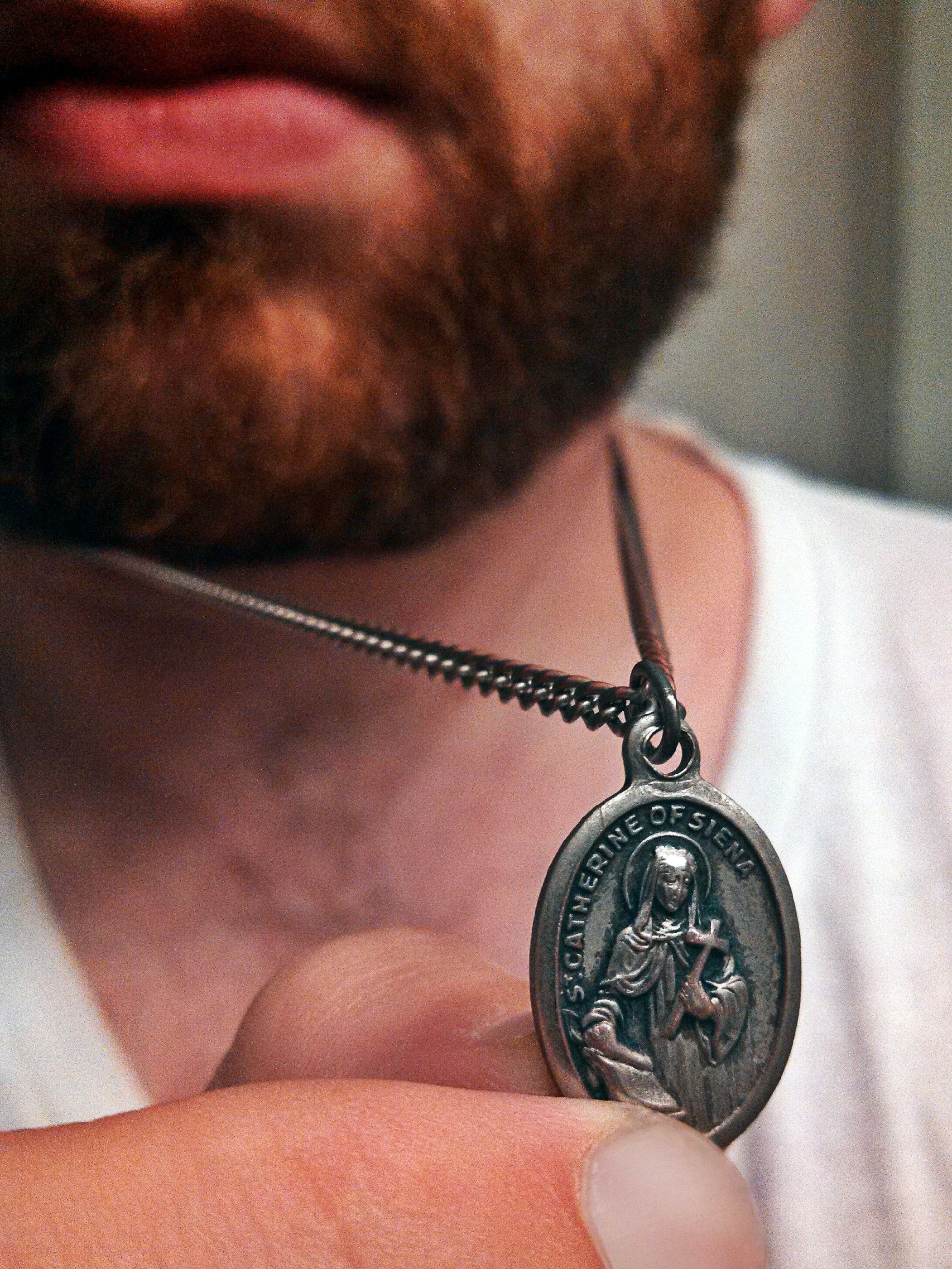
A decade on, I still wear my Catherine pendant daily, in order to carry her with me and keep her close. If you are interested in knowing more about Catherine’s life and spirituality, here were two of the books that helped me get to know and be inspired by her. Continue reading

Cultural Vignettes at the End of a Life


I’m still going through some of the materials from a recent course I took on death and dying, and reflecting on the lessons I learned, especially as I engaged much of this course around my deepest experience with death–the passing of my grandfather in 2010.

I previously spoke about how this shaped me personally and vocationally, and how I often felt I was on the outside looking in, taking in the scene at my grandparent’s house almost as an observer. No doubt this retreat into my mind was protective, for better and worse.

But one thing this granted me was the chance to look at this from a bird’s eye view and observe some of the subtle cultural dynamics here, ancient and modern, and their collision with human tendencies around death and grief.

Death–awaiting it, grieving it, and even approaching it ourselves–is wrapped up in a myriad of cultural forces that shape our inner and outer lives. One could even argue that most (perhaps all) of our cultural rhythms are a response to mortality: a denial of it, a distraction from it, outliving it, or an attempt at delaying it.

My grandfather passed passed away the day after Christmas, so our grief and vigil in that last week happened against the backdrop of the holiday (and my birthday, which was another odd dynamic). It was an unusual paradox, to say the least.

Continue reading

Vigil & Vocation: My Grandfather’s Death & My Life


Two weekends ago was the birthday of my late grandfather, who died a decade ago. I just finished a social work class on end-of-life issues, and that class had me thinking a lot about him, the impact of his death, my own life and legacy, and how that has all changed and morphed over these past ten years.

So I’m going to spend a few posts reflecting on this. Today I wanted to share how the experience of his death shaped my life personally and professionally.

But first, a little about him. Due to a mispronunciation by the first grandchild, we called my grandfather “Peep”; and Peep and Mammaw’s house was where the entire family came for weekly dinners and holidays. He was the quintessential man of his age: the quiet, stoic, Texas man’s man. He was my mother’s father, the patriarch of the family, and exerted a great centrifugal force in the system. His death left a large hole which I don’t know we’ve recovered from, honestly.

Continue reading

Race, Liturgy, & My Great Awokening


My wife will tell you I have a “both sides” problem. I reflexively think through hard things by trying to see them from all sides and treating them equally. But inevitably, while this makes me think I’m acting “enlightened” and “objective”, that’s largely an illusion–and quite often, it does more harm than good.

At least when I employ it, it gives me a false sense that I am hovering above the conflict and that I am not actual mired by my own bias, defensiveness, and not actually being affected by the conflict itself.

But too often, rather than nobly making space and elevating other perspectives and voices, it leads me to prioritize my own voice and simply invalidate that of others.

And that’s precisely what happened in 2012 after the death of Trayvon Martin.

After Martin’s death at the hands of George Zimmerman, I watched the struggle and lament from black America, and felt an odd disconnect. I felt like I could “see both sides” and “understand” why white America was confused why this particular moment was so galvanizing for blacks.

I wrote a blog post about my frustration that me, as a white man, did not feel like I was culturally “allowed” to speak to these issues. The post is bad. I’m still incredibly embarrassed and ashamed of it–but I’ve kept it online (with a note) to document change and repentance.

I had great friends that really laid into me about that post. They took me to task, were patient with me, fully articulated their thoughts, and demonstrated the implications of and ideas behind the things I was saying. It gave me a lot of pause and made me wonder what I was missing–because while I trusted them, I simply couldn’t see what they were seeing.

* * * *

Around that time I watched a special by the comedian Dane Cook at Madison Square Garden. His final joke of the night was about religion. To set it up, he began with “I was raised Catholic…” but was interrupted by cheers in the crowd.

He stops, takes note, and says, “Peace be with you!” and in return tens of thousands of people responded in unison with the ancient liturgical reply: “And also with you”.

Now, huge numbers of those people had probably abandoned their Catholicism long ago, and yet the repetitive week-in, week-out liturgy of their Catholic upbringings had embedded itself in their psyches so they knew how to reflexively respond in that moment to the words of the liturgy–even if they had left the Church decades prior. 

I don’t know how or why this happened, but it was in that moment that everything my friends had been telling me about race and privilege clicked for me.

Continue reading

When Death and I have met


I’m currently in a class on caring for those at the End-of-Life. At the beginning of this course, we were given an assignment (which you can do yourself) to give us a baseline as to our feelings and experiences around death and dying, and begin cultivating an awareness of how we cope with it.

I thought I had a good sense of my relation to death in my life, but this really clarified and confronted me in some profound ways. I saw just how unacquainted I am with death, and struggled to recall times it had entered my life.

The first death I knew of was my great-grandmother, with whom I had an oddly strong connection. But I was 10 or 11 at the time and heard about it from my mom, I think, while we sat in the car in our driveway. I remember numbness and confusion, not really knowing how I was supposed to feel. I felt solace in how religious she was, and I felt a responsibility to carry on her “legacy”.

But still, we did not return from Virginia to Texas for her funeral. This meant that my first funeral for a little boy at my church who had drowned. I was maybe 14 at the time. I did not know him, nor his family, and had no connection with them other than we went to the same large church. I went more out of curiosity and was confused at how detached I felt.

My biggest acquaintance with death was that of my grandfather. It was the first dead body I saw, and I was present for the hospice care and process of dying and grief over the course of a couple of weeks or so. But I will have more to say about this death another time.

Continue reading

Lent, Accompanied by Death


I am back in school. After having received my Masters of Divinity several years ago, I am now completing the other half of training for my desired career path: a Masters of Social Work.

I’ve been working in the social work field for over a decade and have known that I’ve wanted to move towards more clinical therapy-type work. All along, I have imagined this would be your run-of-the-mill outpatient counseling with adults dealing with addiction, marital issues, mental health concerns, etc. I have respected those that work in inpatient settings, with kids, with the elderly, and such–but I have not imagined that would be my route. And I still don’t.

However, here in my second semester, just as the Christian Church is in the season of Lent, I am taking a course on End-of-Life Care, and it’s shaping up to be one of those courses that will profoundly affect me in the long run.

I’m taking the class not only because my desire in clinical work is to try and bring some greater sense of wholeness, health, and dignity to the hardest parts of human existence, but because death is an aspect of human life I’ve not had a lot of experience with. I’ve had some family members, a few acquaintances, and plenty of clients die over the years; and I’ve walked with others in their grief over the loss of others. But still, I’ve had relatively little training and direct experience with it.

Also, while religious faith can provide a structure and a sense of resilience, coping, and meaning in the face of death–that’s certainly been true for me–it can also sometimes serve as a distraction from our mortality. It can be used to minimize death, prevent us from taking it seriously, or keep us from really grappling, internalizing, or accepting it.

Continue reading