Seminary & Ministry in the Post-Everything World


Grace-words-mouth-poetry-psalms

All last week I was in Holland, MI attending another one of our in-person sessions for my seminary program. It was another week with amazing people, at an amazing place, learning and discussing amazing things.

One of that classes I had was my preaching class. Over the course of five days, every one of us in the class got up and preached a 15-20 minute sermon. Every person–again, every. single. person.–did amazingly well. There were many surprises. People delivered messages that we could not have anticipated, in both skill and content.

Imagine listening to 14 full-on sermons in the course of a few days. It’s emotionally draining; it’s intense; it’s life-giving. It’s trying to drink from a fire hose of God’s Word and Spirit.

One benefit of this is that I got to get a glimpse into the future of the Church’s preaching ministry, and I am happy to say that I am really encouraged.

Continue reading

Wolterstorff: the liturgy & worship of lament [quote]


job-silohetteLast week, I was in Michigan again for my seminary program. Tomorrow I will post some reflections on my time there. Today, I want to offer you this amazing post-length excerpt by Nicholas Wolterstorff from an amazing piece of his called, “Trumpets, Ashes, & Tears” (pdf):

I suggest that there is yet one more thing which the believer experiences in his life of dispersion and which he brings with him to the liturgy….

As we human beings travel through life we experience pain and suffering–in part our own, in part that of others. Some of this pain and suffering is non-innocent suffering; it is punishment for, or the consequence of, moral evil. But not all of it is that.

The suffering of the Israelites in the brickyards of Egypt was not the consequence of their sin, nor was the suffering of the Jews in the camps of Auschwitz. Some of the suffering of our world even resists our seeing it as the counterpart of anyone’s sin–the accidental death of a child, for example.

Continue reading

Jonah: a Children’s Story of Verbs


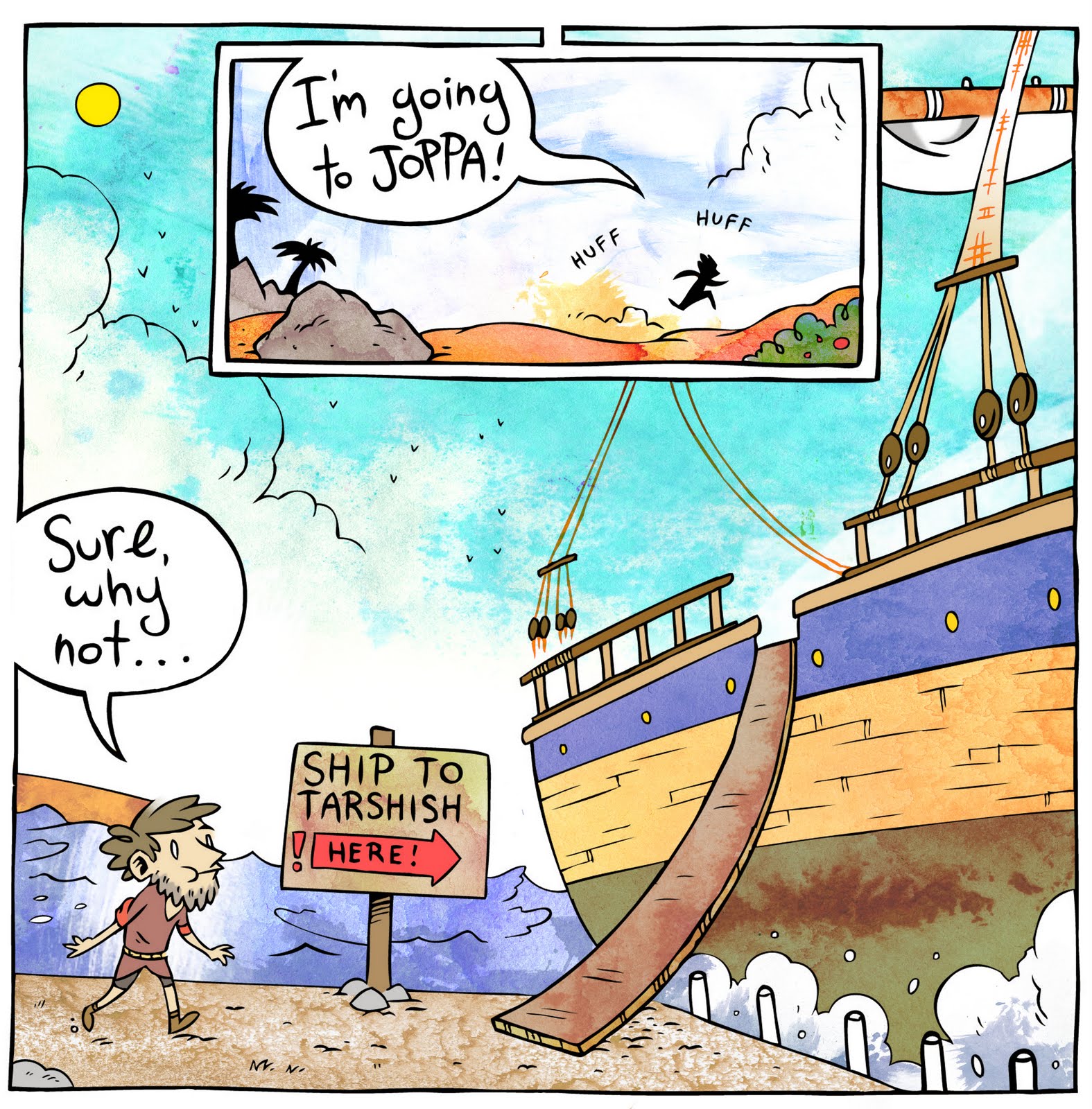
Jonah-boat-comicMy Hebrew class has moved from learning grammar to the actual process of translation and interpretation. To do this, we’re going through the book of Jonah. Our first interpretive assignment was to look at all the Jonah-related verbs in the first six verses and draw some theological conclusions. Here was my contribution.

But first, my incredibly literal and somewhat stilted translation of the opening verses [Jonah 1.1-6], including all the odd word order and idioms of Hebrew:

(1) And the word of the LORD was to Jonah son of Amittai, in order to say, (2) “Rise, go to Ninevah, the large city, and cry out against her because their evil arose to my face.” (3)And Jonah rose in order to flee in the direction of Tarshish from the toward-facing faces [Hebrew idiom for “Presence”] of the LORD and went down to Joppa and he reached a ship going to Tarshish and he gave its fare and went down in it in order to enter with them to Tarshish away from the toward-facing faces of the Lord. (4) And the LORD hurled a large wind upon the sea and it manifested as a large storm among the sea and the ship thought to shatter towards itself. (5) And the sailors were afraid and they cried out, man to his God, and they were made to throw the receptacles which were in the ship into the sea away from them towards making themselves small and Jonah had gone down into the rear of the vessel and had laid down and slept heavily. (6) And the chief sailor came to him and said to him, “Why are you sleeping? Arise! Cry out towards your gods! Perhaps the god of you will bear us in mind and we will not perish.”

And now for some lessons we can draw…
Continue reading

My Gospel Terror, Acts, & Letters [photo sermon]


Acts-bible-lomo

Each week, WordPress has a Weekly Photo Challenge, where they give a theme and invite people to highlight photography representing that theme, accompanied by a few meditations on it. OccasionallyI try and write a “photo sermon” or meditation based on those themes, accompanied by a photo of mine . This week’s theme is “Letters“.

* * * * *

I grew up in church and grew up loving the Bible. I did devotionals and sat in Sunday School classes for the vast majority of my life. And yet, it wasn’t until I got to my junior year of college and took a class on the Gospels that I read any of the Gospels all the way through. Sure, I had probably heard most of the Gospels preached on or excerpted in devotionals and books, but I had never read a Gospel from beginning to end.

At the time, I thought it was because they seemed too holy. It felt like too much for my young soul to handle to read the very words of Jesus on my own. It was too weighty for me and scared me. Maybe I just wanted to wait until I could drink whiskey or wine while reading them.
Continue reading

Fundamentalist vs. Pentecostals vs. the Cross | 1 Corinthians 1.27-31


For the message about the cross is foolishness to those who are perishing, but to us who are being saved it is the power of God. For it is written,

“I will destroy the wisdom of the wise,
    and the discernment of the discerning I will thwart.”

Where is the one who is wise? Where is the scribe? Where is the debater of this age? Has not God made foolish the wisdom of the world? For since, in the wisdom of God, the world did not know God through wisdom, God decided, through the foolishness of our proclamation, to save those who believe. For Jews demand signs and Greeks desire wisdom, but we proclaim Christ crucified, a stumbling block to Jews and foolishness to Gentiles, but to those who are the called, both Jews and Greeks, Christ the power of God and the wisdom of God. For God’s foolishness is wiser than human wisdom, and God’s weakness is stronger than human strength.
1 Corinthians 1.27-31

So good. And also really appropriate for this age. The fundamentalists want knowledge and certainty, and the Pentecostals want experience and signs. But we preach Christ crucified.

See other Marginalia here. Read more about the series here.

A Holy Saturday kind-of Easter (on doubting the Resurrection)


Rothko-blue-and-gray

The culmination of Lent is Holy Weekend, prefaced by Maundy Thursday and consisting of Good Friday, Holy Saturday, and Easter Sunday. I realized that each year that I have been really intentional about my Lenten engagement, one of those four “Holy Days” seems to overshadow the the others and carry over into this Easter season (yes, it’s a season).

There are some years where the foreshadowing and ever-repeating Presence of Jesus in Communion makes Maundy Thursday the highlight (or lowlight?) of Lent. Some years, the utter darkness, weight, and drama of Good Friday overtake me and linger in my mind well into Easter season. And still others, no matter how I try to reflect and meditate on sinfulness and fallenness, I still can’t escape the lighted joy and horizon-cresting dawn of Easter, whose anticipation overshadows (or over-brightens?) my Lenten experience, making all the doom and gloom seem foreign to me.

For me, this year is a Holy Saturday kind-of Easter.
Continue reading

Longing for Liturgy (a Catechumen’s reflection on Holy Week) {by David Schrott}


In recent years, and prior to my Orthodox catechesis, I heard many a Protestant writer or preacher lament that Easter was not of enormous import to most Christians when it was the eminent Christian holiday.  I didn’t share that view. Easter was an after-thought for me – another spring holiday without much real significance. Little did I know that it was the cultural liturgy of the market-place that informed my position towards the holiest of Christian celebrations.

Liturgies form us. Whether they are cultural or religious, we are moved to be formed in the image of something and in the West, the market-place is driven by the most powerful liturgy called Consumerism. Christmas is the most powerful holiday in our culture and not because of what it is or what it means; it is the most powerful because of the 30-something day cultural liturgy from Black Friday til Christmas day that forms our hearts not toward God, but towards pretty much everything else. As James K.A. Smith notes in his book Desiring the Kingdom, the Culture understands liturgical formation better than the modern church does.photo1

The Holy Orthodox Church is not the modern church.  Before I decided that Orthodoxy was the church of the Apostles, the Fathers and Christ himself, I longed for liturgy without knowing what I was longing for. I think this is the basis of the modern Evangelical root of church innovation. The Western Christian wishes to attach himself or herself to something, but doesn’t know how or have the framework for doing so; so innovation in church methods based on market research emerge. A few years ago, I’d fast all of Good Friday (and accidentally get drunk when breaking fast that night with beer and bread; Lord have mercy!) or round up friends for a Maundy Thursday dinner or try to watch the Passion movie. These were my own personal longings for connectedness to Holy Week and the larger Church; these were longings for liturgy. Little did I know that there was already a place where these connections existed and they existed nearly unchanged for most of 2000 years.
Continue reading

Holy Week Music: Mozart’s “Requiem”


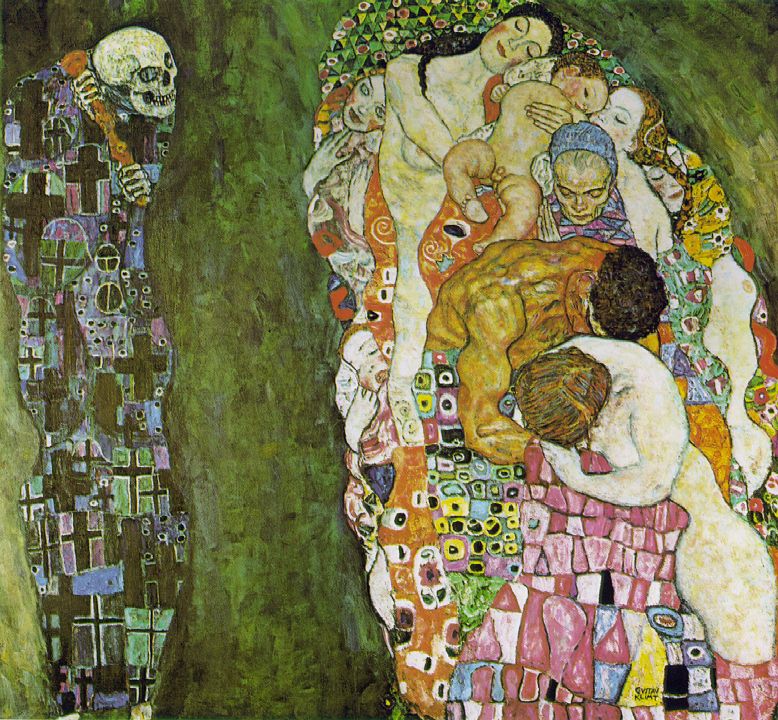
Klimt-Death-LifeOne of the primary ways I relate to the Church Calendar is through music (hence the free Mixtapes I put out each season). Even when I am terrible at engaging at an intellectual or even a practical devotional way, I am really intentional about filling my life with music that will still put my soul in the proper posture for the particular season.

For this Lent, I found myself spending significant time with Mozart’s Requiem, a “Mass for the Dead”. This was his last (and still mysterious) piece–unfinished before he died. Before Holy Week was over, and as we enter into the Holy Weekend, I wanted to offer this to as a way you might be able to engage in these last few days of Lent. Here is the audio, and below that you will find an English translation of the entire Mass. The words are achingly haunting and beautiful and deserve your perusal whether you have time for the music or not. Have a blessed Lent.

W. A. MOZART, REQUIEM
English Translation, from St. Matthew’s choir
Continue reading

Palm Sunday: “The Emperor Has No Clothes” [POEM]


I feel far, Lord.
But I know you’re here.  I know it.
(Do I?)

(Can I?)

It’s the nature of the matter; a matter of nature, I suppose.
Perhaps only now I feel at the deepest existential depths:
“I believe! Help my unbelief!”

Or in a word: Hosanna

That cry.  That plea.

The certainty of uncertainty.
The pregnancy of a pause.
The pondering of a moment.

That moment.  The moment.  

The moment that dressed my doubt in assurance.
But that emperor has no clothes
(or so everything says).

So where does my assurance lie?
Where do my feet stand?

My body pelted with rain, snow, and hail;
I pray my heart rests beside a fire,
drinking tea,
rocking in a chair,
my shoulders draped in that most costly of quilts –
my Rest.

Clothe me–
with the coat I lay on your path–
for this emperor is naked

and needs his King.

[read my other Holy Day poetry here]
all writings licensed: Creative Commons License

Timothy’s Tears: A Holy Week Pre-Game | 2 Tim 1, Acts 16 & 20


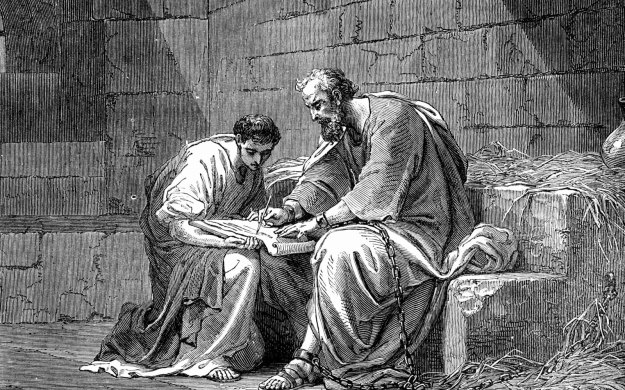
paul-and-timothy

This is part of our Lent series, “The Weeping Word“, where we look at different moments of crying, lament, and tears in the Scriptures.

To Timothy, my beloved child…

I am grateful to God—whom I worship with a clear conscience, as my ancestors did—when I remember you constantly in my prayers night and day. Recalling your tears, I long to see you so that I may be filled with joy.
2 Timothy 1.2-4

Next week is Holy Week, the high (or low?) point of Lent, leading to the crescendo of Easter. It will be a time of darkness, reflection, lament, and meditation. But we’re not there yet. Before the seriousness of Holy Week arrives, I thought I’d share with you a funny memory that’s connected to our Lent series on tears in the Bible.

I was sitting in the little campus ministry Bible Study my junior year of college. Our style of Bible Study was simply sitting down with an eloquent, wise, and gifted pastor, and then walking verse-by-verse through a given book of the Christian Scriptures.

Having just finished nearly a year in the book of Romans, we were just starting our next book: 2 Timothy. Many scholars believe it was Paul’s last letter he wrote before he died. And he wrote it to the man he mentored more than any other we know about: Timothy, a young elder at the church in Ephesus who was still struggling to get this little church plant off the ground.
Continue reading

What the heck is Preaching, even?


peter-preaching-statueFor my preaching class, we’ve been trying to get at what this weird thing called “preaching” really is. It’s not a lecture, it’s a not a conversation, it’s not a debate. So what is it? Here are some of my random thinking on this. But I’d love to hear yours.

As much as I want something far more profound and original, I have not been able to find anything simpler and clearer than Alan of Lille‘s definition: “Preaching is an open and public instruction in faith and behavior, whose purpose is the forming of men [sic].”

Continue reading

Let’s just finish Esther already (On Purim & History) | Esther 9 & 10


Haman son of Hammedatha the Agagite, the enemy of all the Jews, had plotted against the Jews to destroy them, and had cast Pur—that is “the lot”—to crush and destroy them; but when Esther came before the king, he gave orders in writing that the wicked plot that he had devised against the Jews should come upon his own head, and that he and his sons should be hanged on the gallows. Therefore these days are called Purim, from the word Pur. Thus because of all that was written in this letter, and of what they had faced in this matter, and of what had happened to them, the Jews established and accepted as a custom for themselves and their descendants and all who joined them, that without fail they would continue to observe these two days every year, as it was written and at the time appointed. These days should be remembered and kept throughout every generation, in every family, province, and city; and these days of Purim should never fall into disuse among the Jews, nor should the commemoration of these days cease among their descendants.
Esther 9.24-28

Historically, I wonder: Is this it? Is this the reason for this story? As I said before, it genuinely doesn’t look like this story is historical, so it must have served some other purpose in the community. I wonder if the Jews were coming back from exile and had this random festival named after the plural of “lots”, and so they needed to write a story about how it came about. But if so, how do you go from the word “lots” to all of this story? Quite the stretch. So…what’s the historical core? This one’s tough.

King Ahasuerus laid tribute on the land and on the islands of the sea. All the acts of his power and might, and the full account of the high honor of Mordecai, to which the king advanced him, are they not written in the annals of the kings of Media and Persia? For Mordecai the Jew was next in rank to King Ahasuerus, and he was powerful among the Jews and popular with his many kindred, for he sought the good of his people and interceded for the welfare of all his descendants.
Esther 10

So… Mordechai is the hero here? I guess it could make sense, but he plays such a bit part in the story. He’s consequential, sure; he’s just not around that much, is all. This seems more like the mythologizing of a popular leader in the Jewish diaspora.

And lastly, one last “Christian” reading of this story. If we can analogize this a little, Mordechai “intercedes” for God’s people, for their good and for their descendants. And they’re enemies (like death and sin for us) are comprehensively and almost over-the-top-ly destroyed. And God is faithful to accomplish all of this, even when he seems absent. With this book, that’s the best I can do. I genuinely don’t like this story.

See other Marginalia here. Read more about the series here.

Some emotional outbursts at Esther. I don’t like this book. | Esther 9


Now in the twelfth month, which is the month of Adar, on the thirteenth day, when the king’s command and edict were about to be executed, on the very day when the enemies of the Jews hoped to gain power over them, but which had been changed to a day when the Jews would gain power over their foes, the Jews gathered in their cities throughout all the provinces of King Ahasuerus to lay hands on those who had sought their ruin; and no one could withstand them, because the fear of them had fallen upon all peoples. All the officials of the provinces, the satraps and the governors, and the royal officials were supporting the Jews, because the fear of Mordecai had fallen upon them. For Mordecai was powerful in the king’s house, and his fame spread throughout all the provinces as the man Mordecai grew more and more powerful. So the Jews struck down all their enemies with the sword, slaughtering, and destroying them, and did as they pleased to those who hated them. In the citadel of Susa the Jews killed and destroyed five hundred people. They killed Parshandatha, Dalphon, Aspatha, Poratha, Adalia, Aridatha, Parmashta, Arisai, Aridai, Vaizatha, the ten sons of Haman son of Hammedatha, the enemy of the Jews; but they did not touch the plunder.
Esther 9.1-10

What on earth? No gonna lie, this is maybe the first real deep reading I’ve given to Esther. I never internalized that this part was here. This is always skipped in popular retellings of this story. And I can see why. What was the point of this stuff? Save the Jews just to kill an even greater number of people? I can see why this book was so despised by many Jews. Once again, Esther is no model to follow after. I genuinely have no idea why this book is in the Bible. What little research I’ve done has said that there’s no evidence that this meant to be taken historically, so what purpose would this book have played in the community? Anti-imperialist wish fulfillment? A giant cathartic “what if?”

That very day the number of those killed in the citadel of Susa was reported to the king. The king said to Queen Esther, “In the citadel of Susa the Jews have killed five hundred people and also the ten sons of Haman. What have they done in the rest of the king’s provinces? Now what is your petition? It shall be granted you. And what further is your request? It shall be fulfilled.” Esther said, “If it pleases the king, let the Jews who are in Susa be allowed tomorrow also to do according to this day’s edict, and let the ten sons of Haman be hanged on the gallows.” So the king commanded this to be done; a decree was issued in Susa, and the ten sons of Haman were hanged. The Jews who were in Susa gathered also on the fourteenth day of the month of Adar and they killed three hundred persons in Susa; but they did not touch the plunder.

Now the other Jews who were in the king’s provinces also gathered to defend their lives, and gained relief from their enemies, and killed seventy-five thousand of those who hated them; but they laid no hands on the plunder. This was on the thirteenth day of the month of Adar, and on the fourteenth day they rested and made that a day of feasting and gladness.
Esther 9.11-17

What? Oh, and 75,000 people killed? Yeah right. This is a despicable book.

See other Marginalia here. Read more about the series here.

I’m terrified of becoming a Pastor


paul-art-wingThis seminary semester, I’m taking classes on both Preaching and the Emotional/Spiritual/Psychological Identity of Pastors. So yeah, get used to seeing more posts like this on the blog. This week, in my “Pastor class” we did readings and had a lecture on “vocational hazards” and discerning one’s “call” to ministry. We were asked about what challenges and encourages us most about this possibility of being “called” to serve the Church in pastoring. Here were my thoughts. 

The biggest fear going into this course–and reinforced in the lecture–is the whole question of whether it is my “False Self” that is called, rather than my True Self. I have spent much of my life following Spurgeon’s (I think) advice that if you feel called to ministry at all, try to do everything else in your life you possibly could do. If you still end up in ministry, then congratulations, you were called.

Continue reading

For the times you want to be strong, but aren’t | 1 Corinthians 1.27-31


But God chose what is foolish in the world to shame the wise; God chose what is weak in the world to shame the strong; God chose what is low and despised in the world, things that are not, to reduce to nothing things that are, so that no one might boast in the presence of God. He is the source of your life in Christ Jesus, who became for us wisdom from God, and righteousness and sanctification and redemption, in order that, as it is written, “Let the one who boasts, boast in the Lord.”
1 Corinthians 1.27-31

Oh how encouraging this is in those moments that I feel most inadequate intellectually and spiritually.

See other Marginalia here. Read more about the series here.