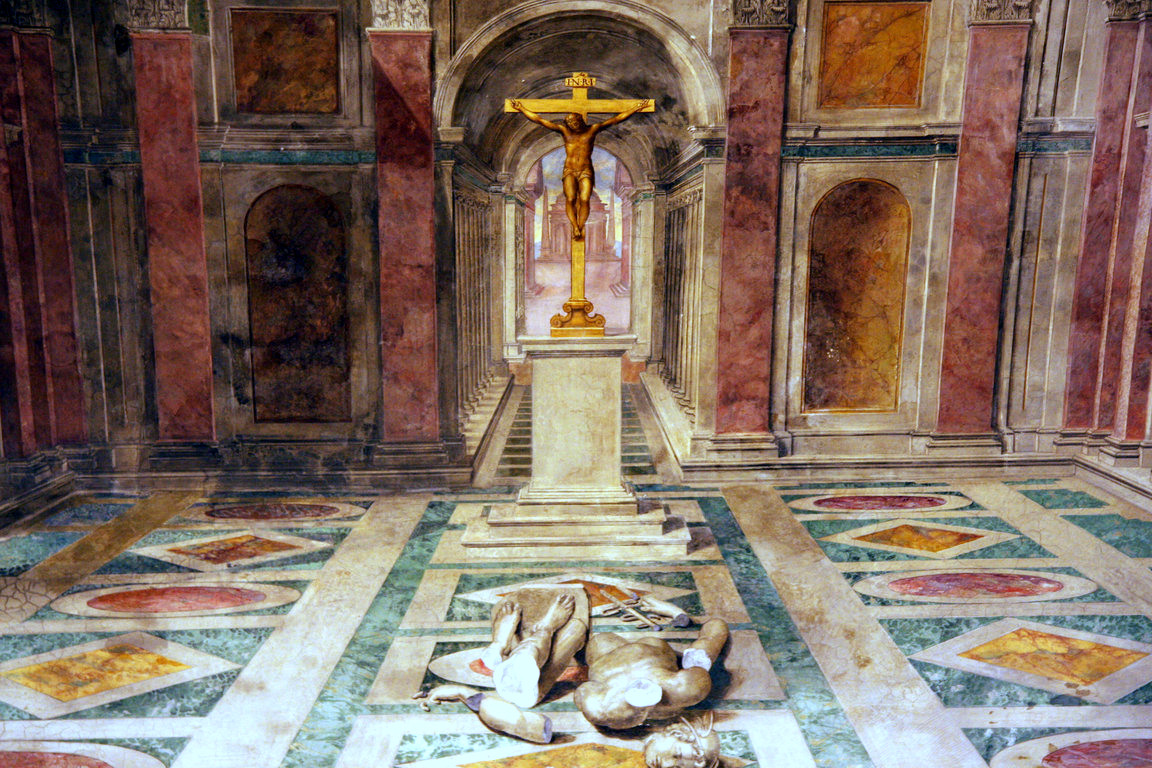
Get yourself some Calvin


They who strive to build up firm faith in Scripture through disputation are doing things backwards . . . Since for unbelieving men religion seems to stand by opinion alone, they, in order not to believe anything foolishly or lightly, both wish and demand rational proof that  Moses and the prophets spoke divinely.  But I reply: the testimony of the Spirit is more excellent than all reason.  Some good folk are annoyed that a clear proof is not ready at hand when the impious, unpunished, murmur against God’s Word.  As if the Spirit were not called both “seal” and “guarantee” for confirming the faith of the godly; because until he illumines their minds, they ever waver among many doubts!

Therefore, Scripture bears its own authentication.  Let this point therefore stand: that those whom the Holy Spirit has inwardly taught truly rest upon Scripture, and that Scripture indeed is self-authenticated [by the Spirit].  Therefore, illumined by his power, we believe neither by our own nor by anyone else’s judgment that Scripture is from God; but above human judgment we affirm with utter certainty that it has flowed to us from the very mouth of God by the ministry of men.

Therefore we seek no proofs, no marks of genuineness upon which our judgment may lean; but we subject our judgment and wit to it as a thing far beyond any guesswork!  If God has willed this treasure of understanding to be hidden from his children [to necessitate revelation for us to know Him], it is no wonder or absurdity that the multitude of men are so ignorant and stupid!  Whenever, then, the fewness of believers disturbs us, let the converse come to mind, that only those whom it is given can comprehend the mysteries of God.

— selections from John Calvin’s Institutes of the Christian Religion, Ch. 7

The Mind of David Powlison


This is a picture I shot during my class last night.  This man is one of the most brilliant minds in Biblical Counseling, and this picture sort of captures the way his amazing mind works.  For all you CCEF or Redmption Hill folks, you can sort of make out a sun at the top center (Heat), a dead tree on the right (Thorns), the cross at the bottom, and then a living tree on the left (Fruit).  Yes, this is the mind that came up with that model we all learned so well.  Enjoy!

dpowlison

[I love this hymn right now]


Thou Lovely Source of True Delight

1. Thou lovely source of true delight
Whom I unseen adore
Unveil Thy beauties to my sight
That I might love Thee more,
Oh that I might love Thee more.

2. Thy glory o’er creation shines
But in Thy sacred Word
I read in fairer, brighter lines
My bleeding, dying Lord,
See my bleeding, dying Lord

3. ’Tis here, whene’er my comforts droop
And sin and sorrow rise
Thy love with cheering beams of hope
My fainting heart supplies,
My fainting heart’s supplied

4. But ah! Too soon the pleasing scene
Is clouded o’er with pain
My gloomy fears rise dark between
And I again complain,
Oh and I again complain

5. Jesus, my Lord, my life, my light
Oh come with blissful ray
Break radiant through the shades of night
And chase my fears away,
Won’t You chase my fears away

6. Then shall my soul with rapture trace
The wonders of Thy love
But the full glories of Thy face
Are only known above,
They are only known above

If it weren’t for God, I’d be an Atheist


Forgive how disconnected my thoughts are. I’m taking a break from all my reading for Grad school to write this and I’m really tired. Anyway, I’m really frustrated right now.

For all those still in Richmond, the United Secular Alliance (U.S.A.) of VCU (the atheist “campus ministry”) is bringing in Christopher Hitchens, one of the “Four Horsemen” of the New Atheism (as many evangelicals lovingly call them; the other three main evangelical atheists Dennett, Dawkins, and Harris), on Tuesday to debate a Christian apologist who I think they had to find after no campus ministry answered their call for a debater.

Several weeks ago, I was inspired by this news to watch some videos with this apologist, Frank Turek, and then watch a bunch of videos from Harris, Dawkins, and Hitchens online (including a fascinating discussion between Richard Dawkins and Alister McGrath at Oxford). Anyway, like I said, I’m really frustrated.

As I hope the leaders I know and love of the U.S.A. read this, I have one main take way from this post. If no one gets anything else out of this, just take this:

Christian conversion is first and fundamentally a spiritual event with intellectual implications, rather than the more outspoken model out there that it is an intellectual event with spiritual implications.

All the tenets of the Christian faith as encapsulated in what the Bible refers to as “the Gospel” are the highest of all Divine wisdom. They are. The Gospel is the highest of all possible “storylines” this world could go through. The Bible over and over again places this Gospel against human wisdom and shows the futility and hopelessness of a non-Christian, non-theistic worldview.But here’s the key: this is only truly seen from the inside.

I look at Hitchens and am reaffirmed in my belief that conversion is and must be a spiritual act initiated and accomplished by God, and not by man. Apart from God, I really would be a rational atheist. For someone not converted by God, Atheism really is the only logically consistent worldview.

“Conversion” is an act by God by which he changes the very nature of the individual so their entire perceptual framework is changed. Many Christians seem to act like every non-Christian out there is just miserable as they perpetually and willfully suppress the faith they secretly know is true; that they can’t have any healthy relationships, raise any good children, and their worldview necessitates a holocaust and wonton anarchy of bloodthirsty violence and debauchery.

This certainly is not the case, because it is not giddy emotionalism, healthy relationships, good kids, or the social benefits of any given worldview that defines its “truth”. Many Christians act like this is the case. This is the “christianity” that is often offered to the Hitchens’ of the world. The nice, perfectly packaged, logically superior worldview that makes everything better.

One need not look long at the world to see the absurdity and repulsion this profession must evoke. Christians often try to appeal to the same standard of rationalism to undergird their faith that Atheists do to form theirs. This can be helpful I suppose to a point, as long as the Christian knows that this is the standard of truth the Bible spends its entire time mocking, so none of our faith can rest in it.

Ultimately, it was not archaeology, philosophy, pragmatism, or logic that drew us to the realities of this “Christianity thing”. It was the effectual and Sovereign work of God that changed us so we then saw the evil of our hearts, the beauty of Christ, and the wisdom of this “storyline” of the Gospel.

What is this highest of all Divine wisdom, so far above human minds that it cannot be comprehended naturally but must be revealed to us? That God, being the source of all life, has a justifiable claim on those that use this gift of life, and He has so desired we use this life to be joined to the source of it and in that find our ultimate rest, joy, and peace. But humanity, seeking to find that rest, joy, and peace in lower things he can manipulate, control, and take responsibility for, left union with this source of life for lower things and in that allowed sin to weaken and corrupt every part of themselves – mind, will, and emotions.

And then, while we were the rightful repositories for the full wrath of God, He rescued us. For humanity committed these acts of treason, so humanity must be the one to pay for them. But weakened and corrupted, humanity has not the ability to do this fully and live.

So God came in the form of a human and lived the life of righteousness we were meant to live, and died the death we were supposed to die, taking the cup of God’s wrath that hung perilously over the heads of those that would be saved and pouring it fully upon Himself, suffering more than any sinner ever will in Hell, that he might bring his people to Him, to be joined once more with that source of life. And all he asks is that we would but trust that what he lived and died was adequate to do for us what we were not able to do for ourselves, and that we cannot add to it, nor take from it.

Does this answer “all the questions”? No. But no Christian becomes a Christian because all their questions are answered or because the flow of the propositional statements lined up. I don’t believe in Christianity because it makes sense; I know I have and will encounter things in life that will challenge that.

In short, I can’t not believe in God, because Christianity ultimately is self-verifying. This is so important. It’s ultimate validity and truth does not lie in history, philosophy, facts, human experience, logic, or reason. It lies in the within the Source of all Truth, God Himself. Can I use all the grounds listed above to show the superiority of the Christian worldview and the beauty of its wisdom? Yes, but that is not what converts people or changes their mind.

To the unconverted mind, this highest of all wisdom is foolishness. But this realization of the necessity of revelation should not be something that brings self-righteousness as if we Christians were able “figure out” and discern this highest of Divine Wisdom while those foolish Atheists just aren’t astute enough. No, this show of our absolute dependence on God to know anything about God should bring us to our knees in humility and praise.

That a God this good would still reveal Himself and change us when it would be absolutely just for Him to let us continue to wallow in our weakness and corruption, forever disconnected from this source of all true life, peace, and deep transcendent joy.

So, even though after my little bit of movie-watching I think Turek is going to embarrass himself and the other Christians in the room by reinforcing every bad stereotype, know that no one’s conversion depends upon Turek or anyone else, but it depends on God who can stop the mouth of Hitchens or Turek at any moment He pleases and change the hearts of anyone in that room to see the wonders and beauty of His Glorious, Wise, and Beautiful Self.

I pray He might.

“Do I?” (a poem)


[Audio for “Do I?” from upcoming book of poetry “Of Clefts and Gardens”]

Just because I’m joined to One above
does this mean I am in want of desire for
one below,
one beneath,
one under?

Do I not dream the same as you?
A joyful consummation at the end of the day
of rising and falling
rising and falling?

Of breaths and sighs
of whimpers and cries
and half taken breaths whispered in my ear
under the weight of knowing

knowing
that which was good before we Fell,
before we fell away from Him-
fell away from one another.

Let me fall back into Him, into you:
fall for you as I rise into Thy love
and thine
and mine.

Restored –
a picture thereof as my soul is known
and I know this union once more.

So can I want?  Can I dream?
Can I read the words of wisdom old
and long for your fingers to drip with myrrh
as I reach into your garden latch

and seek the rose I long to taste?

May I?

Sex (Of Clefts and Gardens)


Yes, that title was mainly to catch your eye and get you reading, though it isn’t completely off topic.  I’ve been criticized recently for this blog becoming too theological and not really very personal as it used to be, so the past few posts have been my attempt at getting back to that.  Don’t worry, there’s more theology to come, I’m just taking a breather.  Anyway, as many people know, I’ve spent the past six months or so writing an album entitled “So Tearful Apologies.”  Recently I “finished” it (as any musician knows, are you ever really “finished” with your music?).  Technically, it’s not completely done, but it’s done enough for me to feel free to work on my next project, which I wanted to write this post about.

So, I’ve been on a concept album kick.  That’s where you write an album with a unified theme or story as opposed to the typical random assortment of songs.  My next project is about sex.  The working title for it is “Of Clefts and Gardens.”  Using Song of Solomon as one of my inspirations, I was wondering if a Christian in 21st century Evangelical America could write and sing art that is explicitly sexual, but both God-glorfying and beautiful.  As I’ve jokingly said, my goal is to write stuff that is completely God-glorifying but that no Christian bookstore would carry.

With this project, I want to try something different.  I’m writing it as a book of poetry and also recording performances of that poetry and writing music to go along with it in a CD.  Some will be songs, some will just have background music for the poems, but I really want to try and publish this.  I have a lot of poetry already.  I might as well start trying to get it out there.  A little bit about the book/album:

I really do want to explore sexuality in all it’s different facets in this project.  It will be broken up into four sections, each dealing with a certain part of sexuality:
(1) Purpose: exploring the symbolism and design of sexuality
(2) Passion: looking into that drive that makes us sexual
(3) Perversion: exploring the sexual brokenness in this fallen world
(4) Purity: a celebration of sex in its purest and most God-glorifying forms.

As a treat to those who made it through this whole post and apparently care, I’ve included the audio to the first track/poem from the album/book.  It’s called “Do I?” and it sets the tone for the project, asking if I, as a Christian, have as much a right to talk about these things as secular minds do (as a contrast, the last track/poem will be called “I Do” and it will be a celebration of marriage).  Feel free to leave comments, criticisms, ideas for poems/songs, or witty insults.  Here’s the poem/track.  Just click on the title for the audio:

“Do I?” from “Of Clefts and Gardens”

Just because I’m joined to One above
does this mean I am in want of desire for
one below,
one beneath,
one under?

Do I not dream the same as you?
A joyful consummation at the end of the day
of rising and falling
rising and falling?

Of breaths and sighs
of whimpers and cries
and half taken breaths whispered in my ear
under the weight of knowing

knowing
that which was good before we Fell,
before we fell away from Him-
fell away from one another.

Let me fall back into Him, into you:
fall for you as I rise into Thy love
and thine
and mine.

Restored –
a picture thereof as my soul is known
and I know this union once more.

So can I want?  Can I dream?
Can I read the words of wisdom old
and long for your fingers to drip with myrrh
as I reach into your garden latch

and seek the rose I long to taste?

May I?

Final Monologue for Acting Class


This is my “final exam” for my acting class I took this past spring.  I performed the death scene of Cyrano DeBergerac in the play by the same name.  He starts hallucinating all the flaws within him as real people and tries to fight them.  These flaws are what have kept him from being happy his entire life, and it is only now, as he’s dying, that he realizes this.  Thanks to film student/future director Dylan Goodwin for filming all our monologues.  Also thank you to my beard for making a cameo shortly before I left it.

For those reading this imported on facebook, you’ll have click on the “view original post” link at the bottom of this note to see the video.

Mark Nicks of Cool Hand Luke


Anyone that knows me well knows that my favorite band is Cool Hand Luke.  They have had this title since about my sophomore year of high school and it seems that their musical stylings have matured along with my musical tastes, leading me to love them all the more through the years.  Anyway, I saw them play a show in Newport News last night and it was absolutely incredible.  Mark Nicks, the lead singer/songwriter of the band stopped before the last song to talk for a bit and ended up preaching this seventeen minute-long sermonette that touches on everything from politics to current church trends.  Usually, bands talking for a while can get annoying, but this was awesome.  He’s so humble in what he says and so right at the same time.  So, I decided to post this up for everyone else to hear as well.

Click here for Mark’s “Sermon”

_

A Theology of Acting


My “final exam” in this acting class I’ve been taking at VCU was on Thursday of this past week. For the class, I had to keep a “journal” to record my experiences through the course. This is one of my “entries.” I hope you all enjoy:

So where is God in acting, anyway? I really do think that all art points to and represents God in some way. So what about acting? I’ve been wrestling through this for a bit now and I’ve come to a couple of ideas:

1 – All parts of the Bible are dramatic representations of the ultimate plan of God – the Gospel. So, Abraham and Isaac, Joseph, Moses, the Exodus, the Exile, the sacraments are all dramas (“shadows” as the Bible calls them) of realities greater than the sum of these parts. SO maybe acting is true art (or more accurately, drama is) because the basic organizational structure of personality, history, and reality itself is a giant dramatic arrow pointing to God and the Gospel.

2 – Acting explores various aspects of the “Imago Dei” – or, Image of God in man. It’s purity, potential, purpose, and perversion. All these aspects of the present reality of that “thing” that makes us human are the substance of good acting. When you touch that part of us, perhaps you touch something divine. The same thing that the incarnation touched in people as Jesus – divinity in humanity – walked among us. The same thing that will be touched for all time when all God’s people adore and behold Jesus for the rest of time. This leads me to my last point.

3 – Acting could be a symbol of the Incarnation. Jesus became that which he was not (human) to such an extent He became that while not leaving the reality of who He was (divine). It is in this process of God taking on the nature of what He was not in order to redeem it, that the greatest “method acting,” if you will, was ever seen. This is a very weak and poorly developed parallel, but hopefully thought provoking nonetheless.

Indeed, these are just possibilities, but they made me think about and love Christ more, so my hope in writing this is that all of you will to.

–paul

Jesus? May I?


Jesus?

I sit here at this laptop, a vision bouncing ‘round my head
to write a prose to you that shows your grace, beauty, and strength.
But I’m tired and I keep typoingt ypos, over and iver again.
And you know what?  I’m not going to correct that above,
because that really was an accident.

I know, I know.  “Nothing’s new” I heard the wise one once said.
No thought, no word, no deed has the sun not shone itself upon.
Looking down, looking down upon my filthy rags, mocking and burning,
mocking and burning.  I just need to get this out!

Oh, Christ! Will thou not enable me to write these words?

He won’t.

Some may say I’m attempting some not so subtle display of irony,
trying to be original, profound, or cute; noting the use of prose to Him
as my medium for my diatribe on not being able to write a prose to Him,
but it’s not.

These words are nothing, they are filth, not fit for the King I serve.
No edits, no plans, no thoughts or “brainstorming” went into this.
Just the feeble cries of a broken man, wallowing, drowning, fighting,
losing.  It seems.

The weight of people not yet known – their souls upon my shoulders.
The sin I bear upon my back, the doubt that grows within.
I’m lost.  I’m depraved.  My futile thinking, my hardened heart,
my ignoble desires, my Glorious King! the One I have! the One I need!

Oh Christ!  Oh Sovereign Lord!  Be the God to me You are!
Oh that my tongue were loosed with the tongues of angels
to say all your Grace could say!

Let my soul take flight! Rise me into Thy Love!
Faster.  Faster!  Make me only Thine!  I need it!
I must! I lust, covet, and gluttonously gorge myself upon
the Grace I so desperately need desperately. . .

desperately.

And even with that, I end this now, not having said
what I wanted to say – what I needed to say.
Your Grace did not come, or at least in the measure I hoped.
This burden thus stays, this wineskin won’t burst,
this angst will continue to grow.

But I know, in the quietest parts of my soul, those deep whispers
and silent voices, echoing within:
my Beloved is mine and i am His, and His Grace is at His whim,
for if it were up to me, I would not need Him,

and it’s in my need I have Him most.

The Sweet Taste of Sovereign Suffering, III (Selah)


“This is not hard to see in the Bible. And it is precious beyond words! I don’t like to get angry at people who call themselves evangelicals; I don’t delight in critiquing people who have major leadership positions [who are] very popular, nice people. This is not fun. It’s heartbreaking! But what can you do when they attack the center with blasphemous cynicism? What can you do?”
— John Piper

John Piper said this concerning N.T. Wright, the British bishop who is now bringing doubt to the orthodox doctrine of Justification. When Piper said this, he was weeping. It has been haunting me these past few days. What you are reading now is my third attempt in writing this post. I keep writing a bit then having to toss it out. Each time my heart still hasn’t been in the right place.

I need to repent. My heart has not been in the right place in these rebuttals. While I feel I’ve done a good job of not letting that effect what I’ve written, sin management is still sin, and it eats you up more than most other sins. My heart has only in the past couple of days been brought to the place that Piper’s quote above comes from. As of a few days ago, I was excited. I, the “great Paul Burkhart,” have been successfully dismantling the argument of a real Pastor. I was defending the faith. I was rebuking lies. I was showing myself better suited for this task than this man. Though I never said these things, I see now this was the state of my heart. Pride. Making my theology an idol, no matter how right it may be, is still sin – and for that I am sorry.

At the end of all these posts, I intend to send them to Pastor Slye and to the person who (with glowing praise) referred me to his sermon. I let unrighteous anger and pride drive me to write, rather than love, and I need to let Slye know that I see this, and I repent. All the Bible says about us young guys is that we are strong, prideful, and foolish. The Bible knows us better than we do, and I thought I could rise above the norm for other twentysomethings. How wrong I was! “O what a wretched man I am! Who will deliver me from this body of death? Thanks be to God through Jesus Christ our Lord!”

Now, I need to do the rest of this tactfully and biblically. The verses right after the verses I just quoted (Romans 7:24-25a) are as follows: “So then, I myself serve the Law of God with my mind, but with my flesh I serve the law of sin.” I think I relate to Paul here. Though with my flesh I have served the law of sin with my pride and arrogance, I still believe I have been serving the Law of God with my mind. I am still certain in the things I have been writing and writing against, I just need to repent for the heart from which I wrote them.

So, I’m going to finish this series, but I hope the tone is different. I no longer look at Slye in contempt as a heretic who needs to be rebuked and shown proper exegetical and theological integrity by the punk VCU student about to go into seminary. I go through this now as a fellow wounded sojourner, seeing why he thinks how he does. I see him as a man who stands week after week in front of God knows how many people who have been burned and hurt by the church, that come to him with their broken suffering hearts needing to know why. Needing to know God has not abandoned them. Needing to know that God is still good and they are still loved. O how calloused I’ve become because of my theology! After Lazarus dies, and Mary doubts Jesus for not being there earlier. Jesus doesn’t say, “Now now, Mary, your theology is all wrong. How dare you doubt me? O you of little faith.” No. He weeps with her, and then lives out those theological truths before her.

Though I am certain that Slye’s view on suffering is unbiblical and ultimately only leads to more cynicism and pain on behalf of the sufferer, I know that as a man who was reluctant to become Pastor in the first place (as their website says), it must have been hard when faced with the weight and realities of real life that I have yet to experience. But experience aside, the Bible is the greatest commentary and authority on true reality, and as such, I believe I have Biblical warrant to honestly and humbly show where Slye has erred in his theology.

This process now for the first time hurts me and breaks my heart. Please pray for me as I continue in this. I no longer want to do this, but the Gospel of Christ compels me, as I have seen that there is only one true comforting view in the midst of the hardest pains. And that is the view of a loving Father who lets nothing touch you that does not first pass through his loving, ordaining hand such that all things that come our way have been ordained and brought to pass ultimately by a God working for our good – building us into the strong, persevering, hope-filled, Glory-loving, broken clay vessels that we need to be to truly enjoy Him and fully worship Him when He finally takes us home.

“For from Him and through Him and to Him are all things. To Him be glory forever. Amen.”

Selah

The Purposeful God of Eternity


Tonight on a midnight ride to Williamsburg, God changed my life yet again. How? With this realization: God does all things in us primarily for an eternal purpose before he ever does them for a temporal one.

The “things” God does “in us” refers to pretty much everything: How we feel in a given situation, what we think, what we desire, our temptations, our struggles, our blessings, our joys, our pains, our purification, everything.

I realized tonight that this means that when anyone asks God, “Why?” about anything, there is a possibility of three responses from God; two for the non-Christian and one for the Christian. To the non-Christian he answers either (1) to draw you closer to me, or (2) to further condemn you so your eventual condemnation is just. To the Christian God’s answer is always (3) “to make you holy.”

(1) is pretty obvious. God will put people through a lot of crap sometimes and cause feelings and desires to both come and fall away in order to bring them to him.

(2) is a little harder to swallow, but true nonetheless. God is determined to be just. He will not condemn those not worthy to be condemned, and he has committed himself to showing those not his elect that their condemnation is just (Romans 1:20 , 1: 26-27, 3:5-8). My primary Biblical support for this is in Genesis 15:16. In the context, God is laying out the conditions of his covenant with Abraham. He will punish so-and-so people and give him so-and-so land, and so on and so forth. But at the very end of these covenant promises, God makes a very interesting statement. He says that the final fulfillment of these promises will be delayed. He says, “And they [Abraham’s descendants] shall come back here in the fourth generation, for the iniquity of the Amorites is not yet complete.” God delayed the destruction of the people occupying the promised land and delayed His people entering it because the Amorite’s iniquity had not reached the level of deserving that wrath, thus he refrained so that their condemnation was just and He was justified in their destruction. So he does with some non-believers in Christ.

Anyway, (3) is what changed my entire perspective on God, me, and sanctification. We are generally presented with a certain situation that has pain and we begin to do what? Worry about the future and how it will resolve itself. God told me tonight that the resolution in the temporal to that situation is not the point. He gives (or allows us to feel [but if he’s all powerful, then “allowing” is just the same as “willing]) emotions both good and bad to us, and their effect in the temporal is not the point. God is preparing all of us for Eternity! No matter where we will end up in eternity, His every act toward us is to prepare us further for that end. I’ll repeat that:

No matter where we will end up in eternity, His every act toward us is to prepare us further for that end, both Christians and non-Christians.

So what does this process look like? I ask God “why do I feel this way?” He says, “to make you holy.” I say, “well, how will it end up?” He says, “It doesn’t matter. This all has eternal ramifications to it before it ever has temporal ones – THAT’S the primary point; don’t worry about the temporal – worry about how this is preparing you and those around you for eternity after these temporal things fall away.”

I don’t know about anyone else, but this gives me the key to entering into God’s rest in this life, no matter what comes your way. Being able to step back and see things from an eternal perspective rather than zooming in a focusing on the temporal creates a peace and a rest from faith that can only come from God.

No more worrying necessary, for the things I go through now are to prepare me and make me worthy for His Coming; to make sure He fulfills His commitment to me to make me His spotless Bride. Whatever temporal things that come about are merely part of the ride.

in Him,

–paul

p.s. – I’m still processing all this and have yet to actually spend a day with this perspective and see how this practically works out. I don’t really know what will happen outwardly if anything. We’ll see. I’ll keep you up to date. Now I’m off to slumber into my said first day with new perspective.

What’s Your Isaac?


I’ll give the thesis to all this first:
When God asks us if we are willing to give something up, it does not NECESSARILY follow that God wants you to actually give that thing up. I know, I know. Let me explain . . .

As is typical of most truths God lays on my heart, this truth in the hand of immature or false believers can be very very dangerous. So I encourage anyone as they pray through this to be very critical of their own applications of this principle as it could be very self-serving. Anyway, we turn to where all things started and must start, the Word of God:

“After these things God tested Abraham and said to him, ‘Abraham!’ And he said, ‘Here am I.’ He said, ‘Take your son, your only son Isaac, whom you love, and go to the land of Moriah, and offer him there as a burnt offering on one of the mountains of which I shall tell you.’ . . . When they came to the place of which God had told him, Abraham built the altar there and laid the wood in order and bound Isaac his son and laid him on the altar, on top of the wood. Then Abraham reached out his hand and took the knife to slaughter his son. But the angel of the LORD called to him from heaven and said, ‘Abraham, Abraham!’ And he said, ‘Here am I.’ He said, ‘Do not lay your hand on the boy or do anything to him, for now I know that you fear God, seeing you have not withheld your son, your only son, from me. . . By myself I have sworn, declares the LORD, because you have done this and have not withheld your son, your only son, I will surely bless you, and I will surely multiply your offspring as the stars of heaven and as the sand that is on the seashore. And your offspring shall possess the gate of his enemies, and in your offspring shall all the nations of the earth be blessed, because you have obeyed my voice.’
Genesis 22:1-2, 9-12, 16-18 (emphasis added)

I really want to make this short and sweet, so here goes. Two interesting things to point out in the story: (1) though God asks Abraham to give up Isaac, he doesn’t ever have to actually “give up” Isaac in the complete temporal sense we think. (2) Though Abraham, in the natural, doesn’t actually complete the “offering” of Isaac, notice that God tells him that he didn’t withhold his son, and that Abraham has done this (in the Hebrew a completed action referring to the original command of God in v. 2). God tells Abraham he fully accomplished what God ordered him to do in the very beginning. God didn’t “change plans” or lie to Abraham. Abe did exactly as God ordered him to do and completed “offered his son there as a burnt offering.” This means in God’s eyes, “giving up” something may mean something much more meaningful than just giving up on it. Just because God asks of you’re willing to give something up, does not mean, it is his desire that we do that in the typical temporal way we usually think.

In American Christianity we suffer so much from Platonic Dualism and Gnosticism. Our first response to things is to cast off the material for the sake of some spiritual ideal. Especially charismatics, who desire so much for the spiritual realm to “break through” into the material world with great signs and wonders, who build this dichotomy between spiritual and material and put such a distance between the two. So when God asks, “will you give this up?” The first inclination people jump to is that God must be telling them to give this thing up for the sake of the spiritual ideal hidden within the question. Perhaps this may not be the case.

Oh Saint. Oh Christian. Oh Beloved. We serve not a God that commands us to not love things in this world. He most certainly calls us to not love things of this world, but those are two very different things. He does not call us to remove ourselves from all things in this world we enjoy that bring us fulfillment, joy, and pleasure; rather he calls us to redeem those things in the world to reflect the spiritual Reality He is and find our joy fully in those things as they reflect Him. This how it can be completely acceptable and worshipful to God for a pastor to enjoy, love, and cherish his people, for a parent to do the same for their child, and for a husband to do that for his wife. It is because those things are designed to reflect the spiritual in their very nature.

My point is this: If God were to ask a husband, “are you willing to give up your wife?” It would not mean in any way, shape, or form, that He were insisting that man actually do so. Many times the point of the question is merely to test where your heart is in the matter, whether you are loving this thing for its own sake, or for how it reflects God. If you have been loving it for its own sake, or have been treating it in some other inappropriate way, God’s answer in this (from what I can see Biblically) is not even most of the time to give that thing up. Rather, His answer is to call you to redeem it so he can be reflected.

So, reader, what is your Isaac? Many of us have relationships, jobs, projects, callings, plans, and dreams God may have whispered in our ear “are you willing to give this up?” Know now that God many times has instilled all these things in your heart not to take them away, but to be glorified in them. What is your thing you have been called to “offer up” but maybe not necessarily give up? If I may encourage anyone out there, let it be in this: What I see in this story with Abraham and Isaac is God’s dedication to purify our love for things he has put in our heart, not necessarily to take them away (key word: necessarily).

So, Beloved, open your eyes and realize that many of the things that God asks if you are willing to give up are the very things that he plans and intends to use to fulfill promises and blessings made since eternity past for your own life and for the blessing and joy of all those around you, after you have responded appropriately to his question, not by taking the easy route of casting off that which God has called forth now for redemption, but by fighting for the reflection of Christ in your Isaac, who was “offered up” not by being “given up”, but by being lifted up for God to show his Son in for your joy and the joy of all peoples.

–paul<

p.s. – also, though God may not be calling you to actually give up in the temporal your “Isaac”, keep your eyes open for any “Rams in the thicket” God may be intending for you to sacrifice in your “Isaac’s” stead. These are things that must be sacrificed so that your “offering” of your “Isaac” can be complete and God’s blessing of it can follow. These “Rams” may be anything from insecurities, desires, lack of desires, current projects, jobs that have nothing to do with the desire God has placed in your heart, classes and majors that have nothing to do with the calling God has for you, certain ministry involvements that prevent the growth God wants in you, certain positions of leadership (or fears of being in those positions), or anything else that may be intended for the temporal altar other than your “Isaac,” which may belong purely on your spiritual altar so it can stay living and active in the temporal to bless you and those around you.

I hope you followed the metaphor enough to make sense of all that.

A Confession


” But you, O my love, for whom I faint with longing that I may be strong, you are not those material objects we can see, in heaven though they are, nor are you the beings which we do not see there, for you have created them and do not even count them as your highest works. How much more distant are you, then, from mere figments of my imagination, fantasy-bodies that have no reality at all! More real are the memory-pictures we form of objects which at least do exist, and more real again than these are the physical beings themselves; yet none of these are you. Better and more certain than the bodies of material creatures if the soul that gives life to their bodies, yet you are not the soul either. You are the life of souls, the life of all lives, the life who are yourself living and unchanging, the life of my own soul.”

— St. Augustine