August Book Club on Christianity & Race: “Divided by Faith” by Emerson & Smith


August’s Book book-divided-by-faith-race width=

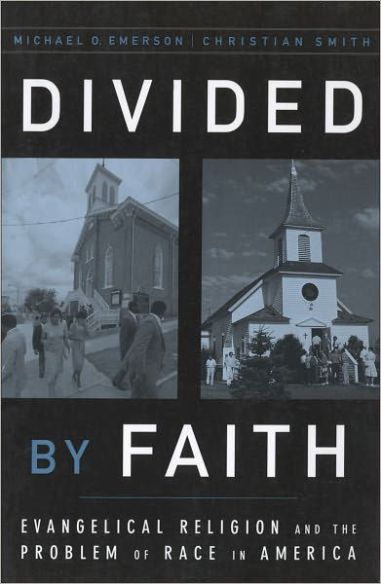
Divided by Faith: Evangelical Religion & the Problem of Race in America
by Michael Emerson & Christian Smith
Last night’s book discussion went really well, and it makes me even more excited for this month’s meeting.

For my church‘s monthly Theology Book Club, I’m excited to have us read an especially timely and important book, Divided by Faith by sociologists Michael Emerson and Christian Smith. The opening lines of the Preface summarize their purpose beautifully:

To learn more about American life, this book examines the role of white evangelicalism in black-white relations. Our argument is that evangelicals desire to end racial division and inequality, and attempt to think and act accordingly. But, in the process, they likely do more to perpetuate the racial divide than they do to tear it down.

In America, we have a problem with race. White Christians, I think, genuinely act in good faith to play a positive role in race relations in America. And yet, they often end up unintentionally exacerbating some of the broader cultural problems that feed into racial injustice.
Continue reading

Join the Liberti Church Theology Book Club!


July’s Book book-jamessmith-hownottobesecular

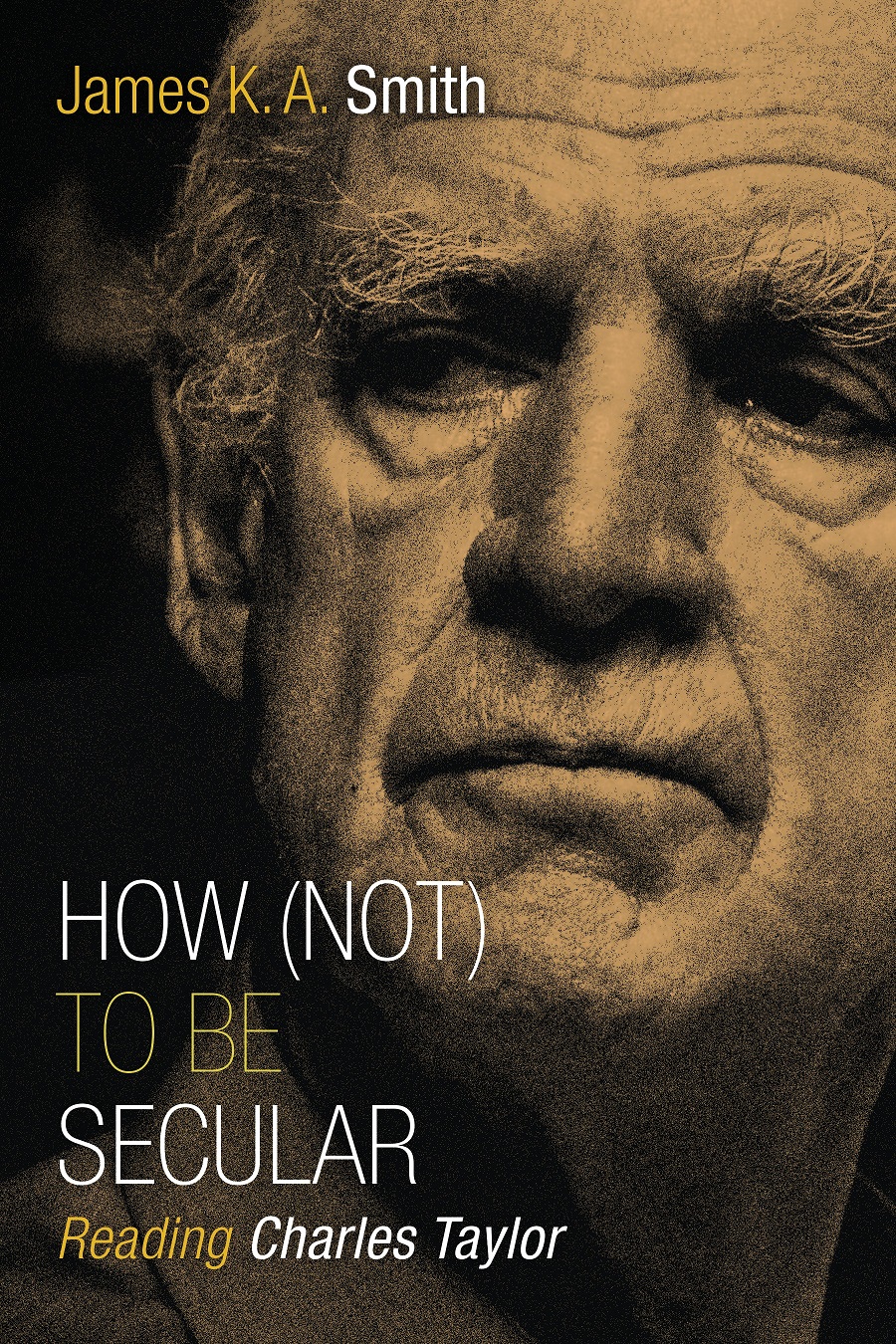
How (Not) To Be Secular
by James K.A. Smith
Amazon


Wtsbooks

For those of us that are Christians, we come to church on Sundays to get re-grounded and re-oriented in the rhythms and truths of the Christian life.

Many of us also try and live life in various small groups and Bible Studies throughout the week in order to press these truths all the more deeply in our hearts and communities.

But still, some of us are wired to wrestle with big ideas in a different way. That’s why at my church we’re starting the Liberti Theology Book Club: a way to walk with others through different perspectives and insights on theology, the Bible, and Christian thought.

It’s been designed to take up as little of your time as needed, while also letting us really work through some deeper and harder parts of faith. Also, because of the decentralized nature of it, anyone across the country can join in!

Continue reading

Book Club Blogging: Intro to a Secular Age


de-Goya-The-GiantFor the Book Club I’m leading at my church, we’re reading James K.A. Smith’s How (Not) To Be Secular (a summary of a much bigger, denser book, A Secular Age by Charles Taylor). To begin, we turn to the opening pages to get our bearings and become acquainted with the general contours of the pages to come.

Introduction

Honestly, if the Preface and Introduction were all there was, this would be worth the price of admission. It is such a helpful 50,000-foot view of the ideas unpacked in the rest of the book.

Smith’s account begins with an attempt to narrate some of what our day and age “feels” like. He speaks of the disconnect between typical American Christianity and the way the rest of the world experiences reality. He points out that nonbelievers in the Christian faith are actually able to find meaning, fullness, and significance without appealing to any divine Being. And yet, even those without belief can’t seem to shake a certain “hauntedness” to our world.

In short, neither adherents to religion nor those that don’t find much usefulness for it can construct a way of experiencing reality that takes into account all of what it means to inhabit humanity today. We’re all sort of stuck in this liminal space, this limbo, seeking distraction of reductionism to break the tension.  We’re all “suspended between the malaise of immanence and the memory of transcendence”.
Continue reading

Bible Nerds: Help Me Choose NICOT/NICNT Commentaries!


My go-to Bible Study software of Logos. They have some amazing sales every once and a while and right now they are having a great sale on the New International Commentary Series (popularly known as NICOT and NICNT). They are selling each volume at $19.99 a pop, which is amazing. I am really picky about commentaries, but I know a good deal when I see it. So, I’m enlisting your help to help me pick out a few of these for my library.

So…for those of you that have had experience with these, which would you say are really good and why? Which would you say are definitely not worth one’s time?

So you know what I’m looking for: I go to commentaries more for biblical critical scholarship, not systematic theology. Even though I am theologically conservative, I really do not enjoy commentaries by conservative Evangelicals that spend most of their time grinding their conservative axe against all those “big bad liberals”. Those commentaries end up being more about conservative theological apologetics than the text. For that reason, I find it far more helpful to engage with commentaries that have an openness and sympathy to critical (“liberal”) scholarship.

In short, if one of the primary selling points for a commentary is that it is “conservative”, then it’s probably not for me. I can think of so many other adjectives I would prefer came to one’s mind first to describe a good commentary. If a commentary writer is conservative, great! But breathlessly defending that dogma at the expense of the text isn’t helpful to me.

Okay sorry, soapbox done. What do you all think?

St Teresa & A Woman’s Longing to Preach


François_Gérard_-_St_Theresa_(detail)Saint Teresa of Avila was a 16th-century mystic and Carmelite nun who traveled around teaching and writing mystical treatises on the interior life of maturing Christian spirituality and contemplative practices. (Here’s a great intro on her life.)

To read her writings and to read about her life is one of the most powerful testimonies to a woman’s place in the Christian church. She constantly rubbed the male power structures the wrong way and in many of her writings one can see how she bends over backwards to accommodate their concerns about a powerful woman, trying to demonstrate how a woman can teach and lead while also living in accordance to the doctrines of the scriptures. And yet, more than any intellectual argument, it is her grace, maturity, and powerful insight into the Bible, the Christian Life, and the human soul that are some of the greatest apologetics for a woman’s full right to teach and preach and lead in the Church. I am currently reading through her magnum opus, The Interior Castle, and it is breathtaking. I ran across this brief passage and lamented along with Teresa… Continue reading

Acorns: The only way I’ve been able to save money


Squirrel-Acorn-3

First off, no, this isn’t some “Sponsored Post”. But yes, I am passing off a link that could get me and you $5 for free. (So is this a sponsored blog post then? I don’t know.)

Anyway, this blog is mainly about big things, deep things, human things. Religion, Culture, Politics, Cities, Justice, Beauty, and others. But it’s also about me–a thing neither big nor deep, but still quite human.

And there are few things that expose our humanity more than money. How we relate to the resources under our care shows so much about who we are and the ways we’re wired. For me personally, I’ve had difficulty saving money. Not because I don’t make enough or because I spend too much–I’m just pretty undisciplined and disorganized.

If statistics are any indication (although research differs), for one reason or another, you might have a similar difficulty with saving money.
Continue reading

Batman:The Animated Series & Mental Health (Podcast Suggestion)


batman-mask-of-the-phantasm

Here’s a little casual Friday post for y’all.

As a child, my favorite show was Batman: The Animated Series. Likely, if you were born in the 80s, this show was part of your youth. Surprisingly, can you believe it was only on for 3 years?! Only 85 episodes were ever made.

But I loved it, and I watched it over and over again. It was dark and gritty (or as much as it could have been), had compelling stories, and (in hindsight) was full of complex characters.  So complex, in fact, you could actually create an entire podcast psychologically analyzing them!
Continue reading

The Unintentional Idolatry of “10,000 Reasons (Bless the Lord)”


flickr-sculpture-worship-kiss

I like to think I listen to really good music–and I do. My most recent listens have been Sufjan’s Carrie & Lowell, Mozart’s Requiem, Miles Davis’ A Kind of Blue, Fugees’ The Score, and Taylor Swift’s 1989. But I also have a secret, closeted (until now) habit of listening to Christian Praise music on my own.

One of my favorite more recent songs is called “10,000 Reasons (Bless the Lord)” by the Australian artist Matt Redman (video below). We sing it at my church, and I listen to it on my own. It’s one of the better contemporary worship songs out there, but there is a grave grammatical error in the song that, for at least me, colors my experience of this song in a distracting way. Here’s the chorus of the song:

Bless the Lord oh my soul, Oh my soul
Worship his holy name
Sing like never before, Oh my soul
I’ll worship your holy name

Do you see it? Yes, there is an odd tense change from present imperative verbs to a future verb in the last line, but that’s not what I’m talking about.

Rather, it’s that the first three lines are speaking to one’s soul about God, and then it says “I’ll worship your holy name”. Who is being spoken to? Throughout the chorus, the singer is speaking to their own soul, telling their soul to worship God, and then it jumps to second person.

I know, I know, the song’s intention is to turn to worshipping God, but grammatically, it is offering this worship to one’s own soul. And I think this matters for several reasons.
Continue reading

“Selma”: A Post-Christian Treatment of Christianity


Martin_Luther_King,_Jr._and_Lyndon_JohnsonI recently re-watched Selma, the movie about the Civil Rights Marches in Selma, Alabama led by Martin Luther King, Jr. I really, really love this movie. Watching it again, I couldn’t help but notice some powerful dynamics in how faith is represented in the film.

It was directed by Ava Duvernay, who, with this movie, became the first black female director to ever be nominated for an Academy Award. I don’t like artist analysis in approaching a work, as I think a piece of art should stand on its own regardless of its creator. But at times, after the fact, it can illuminate some aspects. And indeed, in looking into Duvernay’s background, I found that she is a very helpful symbol for the spiritual place many in our society find themselves.

She grew up in Compton, in the midst of many of the structural, generational, and long-standing effects of political and economic segregation, disempowerment, and white privilege. She went to an all-girls Catholic high school where, no doubt, she received a very robust religious education.

And yet, now, as she made this film about a man whose legacy is built on acts flowing from his religious convictions, when Rolling Stone asked her, “Are you religious yourself?”, she responded with, “No, not religious. But I love God.”

This, I think, captures well the dynamic of a film like Selma in our day-and-age, when it comes to the relationship between faith and culture. Let me be clear: the film is not in the least hostile to faith. This is not some Christian cultural martyrdom post. The film powerfully depicts the religious tenor and foundation of King’s movement.
Continue reading

The best piece I’ve ever read on Mental Health & the Church


Kulhanek-Untitled

“I want to know if you smile when you see me happy again and if a tear runs down your face when you realize that your people are the reason I’ve never quite healed, that chemistry and not Christianity has been my cure.”

~ Lydia Childress,“They’ve Thrown Us Out of the Church Like Lepers”

That’s the opening quote of this amazing piece, “Jesus is not our Zoloft: Reflections on Mental Health and the Church”, by R.L. Stollar, and I think it captures well the heavy heart with which he writes.

I’ll be honest, I don’t know much about Stollar, what he does or what his experiences in this area are, but this blog post is absolutely stunning. It is a response and critique of a recent Gathering on Mental Health and the Church conference, spearheaded by Rick Warren. He sees many things that encourage him, and some others that further dismay him. And he is spot on.

He points out the ways that the Church has wrongly seen mental health issues and mistreated those with them, and he beautifully charts a way forward.

Please read this. Yes, it’s kind of longer than most blog pieces, and doesn’t lend itself to skimming. But if all church leaders and Christians read this and took it to heart, it could change and help so much. The Church needs to hear this.
Continue reading

My Day with Cornel West (or rather, his autobiography)


Cornel-WestIf you know who Cornel West is, I’m pretty confident in saying that what you think you know about him is probably wrong, or at best, dramatically incomplete. If you don’t know who he is, then you should.

For my current class on Leadership, I had to pick an autobiography of a leader whose perspective on faith and life is probably dramatically different than my own. The book I chose was Brother West: Living and Loving Out Loud. 

My own anxiety and compulsivity make it difficult for me to read for long stretches of time. I can usually only read one thing for ten or fifteen minutes before having to bounce my mind to something else or change up what I’m reading. But, due to my own procrastination and inefficiency with time, I came to the day before my paper was due not having opened up the nearly-300-page tome.

And so I did what needed to be done. I left my electronics at home and brought nothing but the book to a nearby Starbucks. I got a cup of coffee, turned on a Jazz radio station on my phone, settled into a couch, and read the entire thing.

Continue reading

Cool Hand Luke’s “Of Man”: a favorite album is now free (and perfect for Lent)


cool-hand-luke-of-man-coverIf you don’t care about the commentary, and just want the amazing music, you can get it at Noisetrade. If you’d like to listen to the album first, just press play:


Someone’s “favorites” are a weird thing to define.  They are prone to fickleness, are tied so closely with whatever else is subjectively happening in one’s life, and usually bear little resemblance to what that person would consider as the technically “best” of any particular thing. So when you have a “favorite” that sustains that title for years–decades, even–it’s a big deal.

Since high school my favorite band has been Cool Hand Luke. Back then they were a little hardcore screamo band. At that time, to get their CD, you had to mail a check to the lead singer’s house. As time when on, their style changed at the very same time and in the very same way as my own. It felt like we were growing together.

Around my senior year of high school, they came out with an album called Wake Up,  O SleeperAnyone who’s heard of CHL probably knows them from this stunningly powerful work of art. It quickly became the most influential and “favorite” album of mine. And it has been ever since.

Towards the end of college, I became pretty good friends with the lead singer. For a while, every few months, we’d talk for a couple of hours on the phone. He was discerning whether to go to seminary and what to do about the financial mess their shady manager had left the band in. I got to see his heart and the heart behind the beautiful music they made.

Eventually, he got married, I started seminary, and he decided it was time to end the band and begin seminary himself. But there was one last project he felt he had to do.

Of Man.

Continue reading

Lent & Ash Wednesday for Kids (….or maybe not)


rabu-abuLast night, my church had their Ash Wednesday service. I had the honor of helping lead the liturgy by offering the greeting and opening introduction/ explanation. Unlike most times we gather, the kids stayed in the service so I was asked to make sure my opening words were at least somewhat comprehensive to children.

This turned out to be one of the most helpful exercises for me. I ended up spending more time thinking through these brief opening words than I normally do and crafting each line as intentionally as possible. And so, for the heck of it, I thought I’d throw this up on the blog for anyone who was struggling with explaining Lent and/or Ash Wednesday to their young ones, and also to get your thoughts on how best to communicate this to kids. Here’s what I said:

(Lent: Two things hold us back)

Tonight kicks off the Church season of Lent. Most all of us live our lives wanting to be better people than we are right now. But if we’re honest, there are two things that can get in the way of that sometimes and make us frustrated as we try and become the people we want to be.
Continue reading

I have found the Holy Grail against women in leadership, and I am ruined


Countering-the-Claims-of-Evangelical-Feminism-Grudem-Wayne-9781590525180This is a post in an on-going series on Women in the Church.

A while ago, I stumbled on a clearance copy of the book Countering the Claims of Evangelical Feminism by Wayne Grudem. Now, for those that don’t know, Grudem is one of those super-influential evangelical theologians that doesn’t get a lot of play in the wider culture. He’s not going to make any headlines like Mark Driscoll, and he’s not going say anything too outside the conservative box, like Rob Bell. He’s a quiet intellectual who writes and influences a lot.

Through college, I had a bunch of friends obsessed with his “Big Blue Book”, Systematic Theology, which is an accessible, clear introduction to what became the “New Calvinism” fad. In short, he’s sort of a Calvinistic Baptist that believes the Holy Spirit is still doing more outlandish sorts of things.

And yet, if you look at all of his publications, the vast majority of them are simply various versions and editions of just these two books (well, admittedly, the book I’m writing about today is an abbreviated version of this book). It’s quite easy to see that Grudem has devoted his life primarily to two things: Systematic Theology and Gender Roles in the Church. A lot of the arguments you’ll hear from complementarians–those that do not think Women should be allowed to exercise authority in Church or Home contexts–come straight from Grudem.

And so, in the interest of being fair in my Women and the Church series, I picked this book up to hear “the other side”. The book goes through 45 of (what Grudem feels are) the absolute best Egalitarian arguments. He lays out the individual argument, usually printing a paragraph-length quote from someone who has expressed that opinion. And then he offers responses (usually about 1 to 4) for each of these points. Each chapter is 2 to 5 pages long.

I went into the book with only minor curiosity, because I was raised with his perspective, was completely inundated with it in college, and pretty much felt I knew most of the arguments he would throw out there.

Well I was wrong.
Continue reading

Weekend Wine Tasting: Cool Ranch Doritos & Pinot Noir [casual fri]


paul-terrain-flowers-wine-12-07The other night, my church small group held our second annual Wine Tasting party. It was such a beautiful evening of great wine and great food (there was even Chardonnay paired with Chicken and Waffles–and it worked really well!).

But, also just like last year, I couldn’t just do a nice, casual, brief tasting. If you’ll remember, I paired Port Wine with Fluffernutter sandwiches (you can see the video here).

Similarly, this year, my inner nerd-dom drove me to come up with a whole presentation around my attempt at another odd pairing. I wrote up some notes to guide me, and I thought I’d post them here to guide you on your own wine experiments this weekend, especially if you want a great pairing on a budget.

_________________________________

This is a different kind of tasting. It’s not so much about bringing out certain flavors as it is experiencing an unexpected reaction between the two items. It’s going to take some focus, so prepare your taste buds. But first, a story.

Continue reading