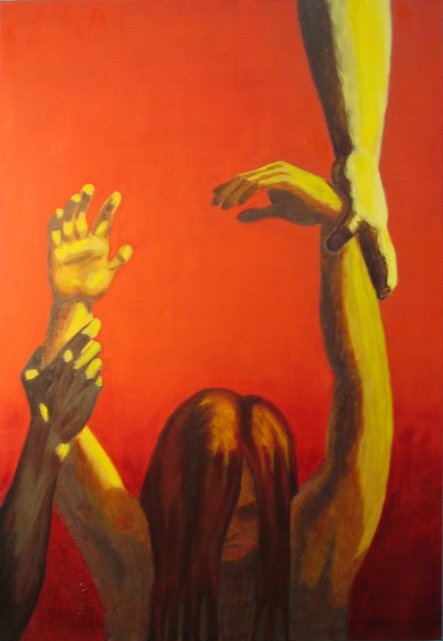
On Good Friday: “Scotchful Thoughts on Treason & War” (a poem)


_____________________________________________________

Scotchful Thoughts on Treason & War

You’re stronger than Scotch, though that’s not what my throat urgently screams at the moment. Ah, the struggles of an artist, a mystic, one whose deep cries out for yours – to express the inexpressible.  To package in words that which can’t be contained.  You’ve caringly — lovingly, even — taken me, torn open my chest, pulled out my heart, and have affectionately run my broken body into your knee such that I am torn in two
_____– one spirit, one flesh:

All of reality stands at this heralding moment:
_____Wide-eyed, eager – youthful
_____anticipation abounds.
Hands on knees looking forward, rocking back
_____so on and so forth they watch:
_____smiles ear to ear.
Continue reading

“On Maundy Thursday, Narrative, & Sacrament” – Patrol Magazine


I’ve got a new article up at Patrol Magazine.  In case you haven’t noticed, I’ve been doing a series on Holy Week all week (you can the relevant links below).  The article is about a few different things.  First, it’s about today being Maundy Thursday, the day of the Church calendar where we celebrate the Last Supper and the institution of the Eucharist.  It’s also about my growth in a more liturgical context for church and love for the sacraments. Lastly, it’s about what bearing this has on our “selfhood” and how we look at the rest of the world.

Maundy Thursday, Narrative, & Sacrament

Continue reading

On Palm Sunday (or, “Oh, the Glory, the Beauty, & the Tragedy of Being Human!”)


This past Sunday was Palm Sunday, the Christian holiday that ushers in Holy Week. It celebrates the “triumphal entry” of Jesus into Jerusalem (Mk 11:1-11). Seen with the insight of hindsight, though, this is one of the oddest “triumphal entries” one could imagine. It is the triumphal kick-off for what will be the death of the Son of God.

Lately, I’ve been thinking about the common “courtroom” analogy for the Gospel. You’ve surely heard it: You are standing before a judge. You are guilty. The punishment is death. It is a right and just penalty for your crimes. But then Jesus comes in and freely offers to take your punishment for you on your behalf so you can be set free. Will you accept this gracious offer?

Many an atheist has pointed out the logical flaws in this analogy, but I think there are even bigger issues I have with it. Really, it only works if the parties involved in this switch are seen as equals. A pure man for a guilty man — seems like an even trade, right? But how does the death of this one man absolve the sins of a multitude? How is this even just?

Continue reading

On Holy Week, Idolatry, & Suicidal Ideations


This week marks the most important week of the entire Christian calendar. It’s Holy Week; the time we meditate upon Christ’s Passion — the last week he spent in Jerusalem during the Passover preparing to be the true and perfect Passover Lamb. This is also the final week of the Lent season. For weeks now we have celebrated the angst, tension, and pain of Lent. This has been a time where we have focused on the fact that we have not yet become who we will be, and we still live in much of that old way of life. This has been a time where we look our idols in the eyes, hear their whispers and discern what they have been promising us and what we have believed they can give. Love. Security. Affirmation. Rest. We seek all these things under the sun, but all these things find their Source beyond.

Continue reading

Absolutism vs. Relativism: Is there Another Way?


Sorry.  I know this is lame.  But, I was organizing some of the files on my computer and I ran across this proposal I wrote last year to the Journal of Religion and Popular Culture for an article.  It didn’t get accepted, so I never wrote the article.  I thought I’d go ahead and put it up though to see if you all have any thoughts on this topic, or if you’d like to see this article written anyway.  Feel free to leave some comments at the bottom of the post.

In the midst of the culture wars, deep philosophical shifts are challenging old ways of thinking. As a culture of post-modernity encroaches upon ground that was previously held by religion, the presuppositions of all faiths are being challenged by new, competing ideas. Religion charges post-modern culture with Relativism — a tenet that religion claims is unsustainable. This critique is not without validity: no philosophy can stand for long that admits its lack of foundation, and does not recognize a need for such epistemological certainty. The relativizing of post-modernity will surely collapse under a generation of those disillusioned by its inability to deliver that which it has no principle nor authority to deliver.

Continue reading

Repentance (for Liberti & my Home Group)


I help lead a home meeting for Liberti Church: Center City. In these home meetings we usually further discuss the sermon from Sunday and try and see what bearing it might have on our everyday life. As most everyone knows, I have started my new job now and had to work last night so I wasn’t able to attend the home group. So, I thought I’d write out my thoughts here.

This post is mainly trying to place this past week’s message in the broader context of our current series “Lent For Everyone”. The first week, we looked at Jesus’ temptations in the desert to show us how we are meant to live life here and now in the “desert” of history — after our freedom from slavery but before the Promised Land (Audio). The second week of Lent Jared preached on how the God of Christianity  is unlike any other god we make, because of his Covenantal character, and how He does not demand that we bound ourselves to Him, but rather He commits Himself to us (Audio). This past week we heard God in Isaiah 55:1-9 invite us toward the gift of repentance, and in that find life (Audio). Next week, he will talk about the celebration this God is actually inviting to take part in (Audio), and in the final week, he will talk about who this King is that has been with us all along (Audio). In our home meeting, we’ve been talking about these ideas and how our sins reveal the true nature of our hearts.

Continue reading

Catholics on Scripture and Inerrancy


Oh, the Bible. It’s the lifeblood of the Church. It’s our backbone. But there’s so much we don’t get, and the culture both within and without the Protestant Church hasn’t helped. In its response to the Enlightenment, Evangelicals adopted the ground rules and assumptions that undergird modernism, namely, that Truth must be something that has a one-to-one correlation to things in created reality (as opposed to Ultimate Reality–God Himself), therefore making science and history the only vehicles for this Truth. This has caused so many problems with the rest of the world when talking about a little doctrine: Inerrancy which means, at its simplest level, that the Bible contains no “errors”. What does that mean?

Catholics can help us answer this.

I fear that Evangelicalism is becoming increasingly irrelevant to the current discussion on nearly every front because of these improper assumptions about Scripture. Catholics, though, were having these discussions in the Middle Ages! They have largely already dealt with the things that we Protestant are only now encountering issues with. This gave them a foundation that let them maintain intellectual and biblical credibility in light of the Enlightenment and now modernism. Here’s what they say about Scripture in the Catholic Catechism:

Continue reading

“Lord have mercy…”


[journal entry dated 2/28/10]

Father? Daddy?

I’m so f—-ed up. That’s just the best phrase for it. It’s Lent. It’s only a week in and I’ve already broken my fast several times. Why? Why can’t I just…stop?

(Okay, I get it.)

The point of giving something up for Lent is not to just “give something up”. At the heart-level it’s supposed to be a sign of devotion to You. That’s what it is at heart. And you know our hearts, Daddy. You know they’re weak. You know they’re willing. I’m willing Father, I’m just so f—-ing weak…

Ha!

I sound like “high-school Paul” all over again with those old Christian flavors of angst and “emo-ness”. I suppose there’s a place for him somewhere in my walk with You. But what is it? I’m not quite sure. But I don’t think he’s supposed to be here right now.

I’m secure. I’m loved. I’m Yours. I’m pleasing to You. I’m approved.

Continue reading

Catholicism on Torture, the State, & the Eucharist


I know, I know — this seems like a weird topic to inaugurate this series. Today, in my ongoing series “Catholics Aren’t Crazy” I wanted to put up a post on a Catholic view of Scripture, inspiration, and inerrancy. They have some amazing things to say on these topics that Evangelicals could do really well to embrace. But alas, current events have changed that plan. Tomorrow I’m posting up a potentially controversial article here on a Christian view of Torture. I’m writing it in light of the recent developments, publications, and interviews concerning the legal and ethical exoneration of the “Torture Memo” authors, John Yoo and Jay Bybee. In my research I stumbled upon the following wonderful article by Andrew Sullivan of The Atlantic, posted on his blog on Ash Wednesday:

“May the Judgment Not Be Too Heavy Upon Us” — The Daily Dish

The article concerns Marc Thiessen, former speech writer for President Bush. Thiessen is on a tour of every news outlet it seems (I’ve seen him on like four different ones just this past week) to promote his brand new book, Courting Disaster, the point of which is pretty much as follows: Our “enhanced interrogation” techniques were moral, effective, and NOT torture; and President Obama has ended them, thereby “inviting the next attack” and putting everyone in America at risk of being slaughtered by Islamic extremists.

Continue reading

Catholics Aren’t Crazy (New Series)


As some of you may have noticed, weekends are pretty quiet here on the blog. In an ideal world, I would post every day during the week and then take weekends off (as I’m not too sure people are surfing much on the weekends. Am I wrong?).  Anyway, I want to try something.  Beginning yesterday, I’m trying to start a little tradition where on Saturdays I’ll post a more personal, meditative post and Sundays I’ll do the series I’m kicking off today.

I was raised in the Bible Belt as a Southern Baptist where there is absolutely no diversity in Christian denominations: there are only Baptists and Catholics — nothing else. This was, at least, my exposure growing up in Dallas, Texas. Throughout my years as a “good ol’ boy” Southern Baptist, I was regularly taught by my Sunday School teachers that Catholics aren’t actually Christians. Let me unpack this briefly.

Continue reading

It’s that time of year again….Lent.


I was just reading the article I wrote last year when I gave up Facebook for Lent. So much has changed. I remember that last year I saw fasting during Lent as some Catholic thing that might be a good idea to do. Also, my reason for giving up Facebook was to help me in the areas of procrastination and discipline.

On the discipline front, it’s funny to have watched how things have played out since then; even more so in light of this year’s Lent. As I finished up that second semester of seminary, my procrastination and discipline issues only worsened.As I dropped out and spent the summer woefully unemployed and poor, my nights got later, I became completely unproductive on nearly every front, and my soul seemed to shrivel because of my lack of discipline and consistent pursuit of God.

In the Fall I moved to a new church community and slowly started to become revived. For the first time I began to understand Calvin’s assertion that theology is only truly theology when it’s lived out. I can no longer divorce orthodoxy from obedience. As time went on, I got swept up in the various means of grace that God has given his church (to be talked of more later), and I was drawn to Him. In the midst of my “dry season” (as we charismatics call them) I feebly reached for a few resources to keep the dwindling flame alive. I eventually got my hands on a sweet copy of the Book of Common Prayer. As of about a month ago, after getting some help, I actually began getting up at a consistent early time and doing some morning devotions. I’ve even been doing some evening devotions as well. I’ve been more consistent in my thinking, writing, and planning. It’s been amazing. I feel my soul revived. After reading that Lent post from last year, I can’t help but wonder if this newfound discipline and productivity are the fruits of the grace obtained in last year’s Lent season.

Continue reading

Open Mic: A Theology of Transgenderism? (pt.iii)


As I said in a previous post in this series (Part 1, Part 2), this problem of how the Church must address Trangenderism will be an increasing problem as time goes on. This is mainly because of how the whole idea of gender identity has changed in the past 100 years.

It is only since Sigmund Freud that we use our sexuality as an “identity”. And it’s only after the Enlightenment that living in light of one’s natural identity is seen as the highest ideal.

Now, Christianity agrees with the Enlightenment on this point, but with a caveat. A very, very important caveat that should shape this entire discussion, especially as it pertains to how we actually counsel and interact with transgendered individuals.

The caveat is this: humanity is the image-bearer of God. We are called to reflect and live in light of that Image. When we don’t do this, we are actually going against how humanity was truly designed to live. We are, in effect, acting less human, not more.

Therefore, as we become Christians and our hearts are (slowly) changed, we live more and more as our fully-human, Resurrection selves. Being joined to Jesus as our representative for true humanity, we find our truest, most truly human identity in him–not in our sexuality, not in our physical sex, not in our gender.

In Christ there is neither slave nor free, Jew nor Gentile, male nor female, gay nor straight. There is only Christ.

Continue reading

Open Mic: A Prolegomena of Transgenderism (pt.ii)


UPDATE: This series is finished. Part 1 can be found here and Part 3 is here.

Yesterday, I started a little miniseries on Transgenderism in response to a question a friend sent me. They were wondering how Christians are supposed to look at this particular issue. I laid out the questions and definitions involved here and asked for feedback (be sure to read all of those comments). Today, I’m talking about a “Prolegomena of Transgenderism”.

Prolegomena” is just a big (but appropriate) word that basically refers to all the things we must keep in mind before trying to answer big questions. For example, in Systematic Theology, Prolegomena is when we lay out the very foundation of our knowledge about the given topics and the presuppositions that will guide us through the rest of the endeavor. That’s what this post is. I want to explore a couple of perspectives that have driven a lot of the answers I’ve seen about this before trying to come to firm conclusions in the next post. So, with all that being said, let’s get started.

Continue reading

Open Mic: The Question of Transgenderism (pt.i)


UPDATE: This series is finished. Part 2 can be found here and Part 3 is here

A couple of days ago, a friend of mine shot me a facebook message asking me for a Christian perspective on, of all things, transgenderism. For many reasons that will be explained later, this will be a topic of increasing pertinence that the Church will have to give a theologically-informed account for at some point. We need to have answers for questions like: “Did God make them that way?”, “Are they just confused?”, “Should we support many people’s desire for surgical alterations?”,”What hope for ‘healing’ can we expect in this life?”,”Is it something that needs to be ‘healed’ in the first place?”, “Is it a sin?”, “What does a Christian with transgender issues look like?”, “Is that even possible?”, among others.

To be honest, I don’t feel like I have a rock solid answer to any of these questions. Every time I feel like I do, I talk to someone and they show me a new dimension I hadn’t seen before. So, I’m very open to ideas, which is why I’m writing this on the blog. I would love everyone’s feedback and opinion as to how one should answer these questions.

Continue reading

John Piper on Porn, Wives, & Marriage


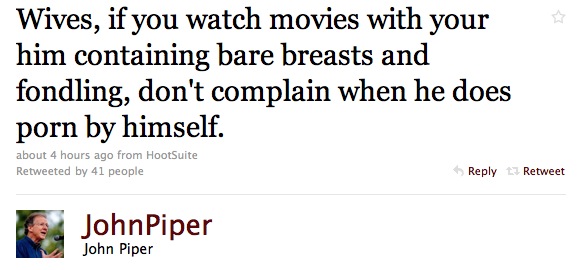
I try not to bash pastors that I know have good intentions.  Those pastors that have demonstrated a desire to be biblically sound and pastorally sensitive, usually get the benefit of the doubt from me, even when I don’t think they are at the moment being biblically sound and pastorally sensitive.  I also know that well-known pastors probably get far more useless and inane criticism from young twenty-somethings that think they know everything (myself included, far more often than I’d like to admit).  But this went a bit too far.  Tonight, John Piper put up the following tweet:

Really?

Continue reading