The Triune God is Beauty{3}


Caravaggio - The Conversion of Saint Paul 3bThis is the third part in what will end up being a fairly long and comprehensive series on Beauty. It’s based on a recent message I gave on the topic. You can find the full audio and full manuscript below. [Bold: things I had time to say // Regular: things I didn’t have time for] So far, we’ve seen why we long for Beauty, we’ve discussed what it is, now let’s apply this definition.

What is beautiful?

First and foremost, the Triune God is beautiful.

He is Three Persons (complexity) existing in One Deity (simplicity). Just think of that word God. That is the human term that he has chosen to be acceptable for us to call him. Those three letters contain the simplest expression of the Sovereign Creator God of the Universe. Most old school systematic theologies are structured the same basic way: the first actual section of theology is reserved for “the Doctrine of God”, and the first thing you learn about God is his “unknowability”. This is the fact that God is infinite, inexhaustible, holy, and completely separate from all things we could ever conceive or understand. We cannot know him. Any pursuit we go on to know him will always be futile. Just the fact that the Infinite God has revealed anything to us in a way that we can actually understand is beauty itself. He is the perfect and complete tapestry within which all things are woven together in the first place. He is peace. He is shalom. He is Beauty. But let’s look at His distinct persons as well.

God the Father is beautiful.

In Exodus 3, Moses is talking to this God who is showing Himself through a burning bush and he asks this God “Who are you?” The huge transcendent God simply says “I am that I am”. So, in the Bible and in the creation, God the Father reveals Himself clearly enough that we can know who we should worship. Think about it. The infinite God who is outside of time and space uses finite things within time and space to communicate himself. This Infinite Head of the Godhead reveals the Infinite strands of who He is in one of the simplest of tapestries: “I AM”. This is beautiful.

God the Holy Spirit is beautiful.

1 Corinthians 2 says, “As it is written, ‘what no eye has seen, nor ear heard, nor the heart of man imagined, what God has prepared for those who love him’” We often stop there. We talk about all those infinite promises God has made that no one has seen and no one can know. But this isn’t the case. Read on. Paul writes that all these things that no one has seen, all these infinite and glorious promises that would blow our minds “God has revealed to us through the Spirit. For the Spirit searches everything, even the depths of God. For who knows a person’s thoughts except the spirit of that person, which is in him? So also no one comprehends the thoughts of God except the Spirit of God. Now we have received not the spirit of the world, but the Spirit who is from God, that we might understand the things freely given us by God.” The Infinite complex Spirit of the Infinite complex God dwells within finite simple believers and what’s more, he communicates the previously unspoken thoughts of God Himself. So through the mediator of the Holy Spirit, God weaves his thoughts into the tapestry of our souls.

God the Son is beautiful.

Of course, we go to John 1 for this: “In the beginning was the Word and the Word was with God and the Word was God. He was in the beginning with God. All things were made through him, and without him was not any thing made that was made. . . And the Word became flesh and dwelt among us, and we have seen his glory, glory as of the only Son from the Father, full of grace and truth. . . For the law was given through Moses; grace and truth came through Jesus Christ. No one has ever seen God; the only God, who is at the Father’s side, he has made him known.” He is the ultimate earthly reflection of beauty. He is the living word of God. He is God of God in the flesh of man. The ultimate, infinite, precious, all-consuming, King of Kings and Lord of Lords takes on the form of a child born in a manger. Oh the humility. Oh the beauty in this act we call the Incarnation, where the infinite God takes on finite humanity.

Though much more could be said (and maybe should be) I feel I’ll stop there. This is an all too-brief picture of why/how God is beautiful, but this is because most people acknowledge that if there is a God, He is in fact what we would think of as beautiful. Otherwise He wouldn’t be worthy to worship. Most would agree with what I’ve written if in fact this was the God that existed. We’ll discuss that more next week. On Wednesday, though, we’ll talk about worship, nature, science and how all those things connect. It’s one of my favorite sections. Here are the links I mentioned earlier:

Click for Manuscript Pdf

Manucscript

Click here for sermon audio

Audio

May I Offer a Definition of | Beauty{2} ?


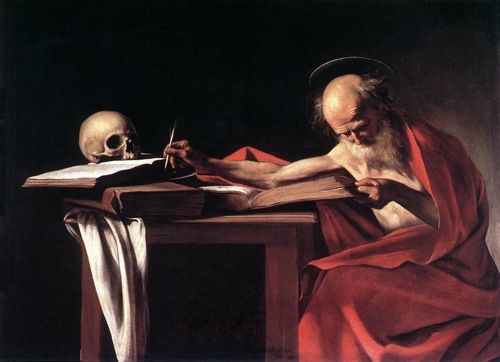
Caravaggio - Saint Jerome2This is Part 2 of an ongoing series based on the paper I wrote on Beauty and the subsequent sermon I gave on it. [Bold: things I had time to say // Regular: things I didn’t have time for]

__________

Whenever you go to study a particular topic in the Bible, the first place you go is the concordance. You go online, or you look in a book, and you search for every time that word is used. If you’re lucky, you’ll find some place in the Bible where the the writer gives you a direct definition for that topic. You look for statements like “This is love” or “Faith is” or “This is the will of God”. The Bible never gives a definition of Beauty. It calls God, creation, and people all beautiful. It says some people are beautiful. It says some people do beautiful things. It calls both good things and evil things beautiful. It calls for us to seek after certain beautiful things. It tells to avoid certain other beautiful things. So, just simply looking at the whenever the Bible uses the word “beautiful” doesn’t help us tremendously, but it’s a start. We can start to see that beauty is a bit more complex than we’re sometimes told. We start to see how a lot of common definitions we hear some times aren’t true Biblically. We see that:

  • it’s not perfection.
  • it’s not just when something reflects God.
  • it’s not just order or symmetry. We all know there can be beauty in chaos sometimes.
  • it’s not just in the eye of the beholder. There is some objective sense of beauty.
  • it’s not just an attribute of things or people.

The next step in studying something topically is to look at the original language to see what the English translation “beauty” meant in the Greek and Hebrew. When you do this, things get nuts. In the ESV alone, there are over 20 very different Hebrew and Greek words all translated as “beauty” or “beautiful”, but we can still learn a few things. First off, we see that the Hebrew mindset is a lot richer than the Greek one. The Hebrew words range in literal meanings such as pleasant, dignified, adorned, sweet, delightful, precious, boastful, arrogant, glorious, vigorous – one word used only once even means “scraped of all impurity”. The Greek words mean simply good and beautiful. But there is some depth here. The most common NT word used for “beautiful”, but most often translated as “good”, originally comes from a verb which means “to call”, speaking to the attractive nature of beauty. The other word used comes from the word for “hour” which describes beauty as being “within one’s hour”. By the way, in the attached manuscript, you can find a full breakdown of every instance these words appear in the Bible, their form, their frequency, and what each of those Greek or Hebrew words most literally mean.

So now we have a fuller idea of beauty, but still no working definition. At this point you just have to pray, read, and think a lot while looking at the broader context of theology. We use the things we clearly know about the nature of God, humankind, and reality to shed light on the ambiguous things and help us get closer to a definition. When you do that, some things come up that we need to keep in mind.

First, our definition needs to make God the most beautiful Person in the universe, it needs to make the cross the most beautiful event in history, it needs to make Jesus the most beautiful man who lived the most beautiful life this world has ever known, and lastly, it needs to make the Gospel (or the message of Christianity) the most beautiful thing anyone could ever hear or believe.

Secondly, we see that there is a tension that has to be held when it comes to talking about Beauty. It seems like Christians throughout history have fallen into one of two errors when thinking about it: either a pantheistic view or deistic view of beauty. The pantheistic view would say that God is beauty so only things that join him in His beauty can be beautiful. Nothing can have beauty in and of itself. It’s only beautiful as much as God shines through it. This definition would say that bad music made by Christians will always be more beautiful than really good music made by non-Christians. Now we all know that’s not true, because we’ve all heard really bad Christian music. This is the over-objective view of of beauty. The other view, the deistic view would say that God is beautiful, so He put beauty on earth that’s completely separate from Him so we can have a beauty that’s all our own, and it doesn’t relate to God in any way. God is beautiful. Humans are beautiful. There’s no connection. We don’t share in God’s beauty. This view would say that there is absolutely nothing more beautiful about one song that talks about the depths of who God is as opposed to another that doesn’t. They’re just songs. This view is an over-subjective view of beauty.

The Biblical view is different from both of these. The Bible teaches that God is separate from His creation, but He’s still present. God is not in created things, but those things can and do preach about who God is. Man is not God, but God has become a man so that He might communicate Himself to us and accomplish for us what we could not do for ourselves. So God is completely other, but He’s near. So, our definition of beauty has to reflect this. It has to be something that is connected to the nature of God but is still something humans can possess, but not in the same way. It has to objective for God, but subjective for us.

After doing all that, are you ready for an actual definition? The best definition that my arrogant, immature, and prideful 23-year old mind has been able to come up with for beauty is this:

Beauty is the attribute of something that expresses complexity, simply.

That’s it. Beauty is what makes infinity, finite; it makes transcendent things seem near. So the more “stuff” that is represented more “simply”, the more beautiful something is. The best image I’ve been able to think of to explain beauty is the Hebrew word shalom. Many people know that this word is usually translated as “peace” but it has a much richer meaning than this. The Old Testament uses this word to describe the ultimate goal and end of history and all that God is doing–peace. Now, when we think of peace, we usually define it negatively- no fighting, no war, no hunger, no pain. But this word in the Hebrew carries with it the connotation of reknitting the very fabric of the universe. It paints a picture of a world that is made up of an infinite number of “strands” of sorts, and shalom is when these strands are re-woven together into a sort of tapestry. Beauty, therefore, is when some or many of these complex strands are woven together into a tapestry that we can perceive with our senses, both physical and spiritual. The more complex strands contained in one simple “tapestry”, the more beautiful that thing is.

This is the objective idea of beauty. But, this definition also has the benefit of having an appropriate subjective component as well. You see, we as individuals over time become more sensitive to certain ones of those strands of the universe and less sensitive to to others. Our culture, experiences, natural make-up, and ultimately our spiritual state all cause us to sense and value various strands differently, making us value different “tapestries” differently.

Next time, we’ll begin applying this definition to other things to (a) better explain it, (b) see if it works, (c) explain why we find somethings beautiful. The first thing we’ll talk about being beautiful? God. Until then . . .

Click for Manuscript Pdf

Manucscript

Click here for sermon audio

Audio


CashTag

Enjoy the Post? Leave a tip with Square Cash!

Why We Long (Setting the Stage) [Eccl.2+3] |Beauty{1}


Scotland-Summer 2006-Edinburgh-Calton Hill-040This is the first part in my series going through the different ideas in the manuscript I wrote for a recent message I gave at Epiphany Fellowship’s monthly ministry “First Friday Fundamentals”. Upcoming topics include what Beauty is, how science reveals Beauty, why we find some things/people unattractive, and the nature of physical beauty. This first part lays out a theological and psychological understanding for why we long for beauty in the first place and how even that longing can get derailed because of our fallenness, finitude, and sinfulness. Also, I made a Web Album of pictures I took from Calton Hill.  They can never do it justice, and they look really anticlimactic, I know, but just trust me, God met me there.  I also linked relevant references in the manuscript to their appropriate pictures.

[Bold: things I had time to say // Regular: things I didn’t have time for]

___________________

In the Summer of 2006 I spent some time studying Creative Writing abroad at the Glasgow School of Art in Glasgow, Scotland. It was amazing in many ways. It was the first time I’d ever been out of the country. I saw things, met people, and went places I only could have dreamt of seeing, meeting, or going. One particularly memorable highlight: I had my first beer ever in a Scottish pub, July 4th, during the World Cup. The third week or so into the program, we had a free weekend so I decided to spend the weekend in Scotland’s capitol, Edinburgh. On Sunday I found a church and attended this amazing service. Afterwards, I just started walking around the city. I ended up following my map to this place called “Calton Hill. I walked in the shade of the tress around the base of the hill and found these little stairs to my right. I followed those stairs and as I reached the top, the trees broke just right, and the light fell so precisely, and I turned at just the right angle that I suddenly found myself standing above the entire city of Edinburgh looking out for miles. As I turned around 360 degrees, I could see the ocean on one side, the city on the other, and the giant hill to my left a mile or so away called Arthur’s seat that they say figures into the King Arthur legend.  [Click Here for the Web Album]

I began to cry almost immediately. One thing you’ll realize about me over time: I’m either the most rational romantic or the most romantic rational. To the charismatics in an old church of mine in Richmond I was the cold, dead theologian. To the seminarians up here I was the feely, emotional charismatic. They’re probably both right. But regardless, I broke down on top of this hill because I was staring at the most beauty I’ve ever seen. I felt small, I felt sinful, I felt worshipful, and I felt the presence of God more tangibly in those few hours I spent on top of that hill than at any other moment of my life. At the very same time I felt the most complexity and simplicity of emotions. I was so at peace, yet I wanted to scream.

So why is it that beauty draws those sorts of things from us? What is it anyway? How do we know what is beautiful and how to respond to it? We live in a world of such paradox. Pain and ugliness are the primary soundtrack of our lives, it seems, and yet most of us don’t live in a constant state of despair. We seem to live off those little oases of beauty in life. So how do we understand what beauty is and how it works in the midst of the seeming vanity of all life? Well, there was another man in history that pondered these things and recorded them in the book of the Bible we know as “Ecclesiastes”. He looked out on his own existence and the nature of life and saw it for what it was: full of useless strivings and the vain repetitions of repeated history as all reality just keeps turning, turning, turning. We know him today by the Hebrew word for “Speaker” or “Preacher” and that is what he does. In the text we’ll be in he tells us about life and beauty and how these things relate.

The Text (Ecclesiastes 2:22-3:15)

Read 2:22-24 | verse 24, as the Hebrew literally says it, and how it can legitimately be translated, reads: Nothing is better unto mankind than that he should eat and drink and see his soul as beautiful in the midst of his toil.

Read 2:25-26 | The “toil and striving of the heart” the writer talks about here is the work that we do in light of our deepest desires. It’s the pursuits to fulfill all we want and all we long for. It is those pursuits that can never be accomplished, those longings that can never be fulfilled. It’s the deepest drives within us that motivate everything we do. The writer says that these desires, these strivings can never be satisfied. We can try all we want, but no matter what, that pain and vanity will always be the constant state of our lives. But why? Why is it so vain to work so hard at this?

Read 3:1-8 | You see, it’s vain because all things already have their proper predetermined season. Everything you work to accomplish will only come in it’s appointed season for you, and everything you work to avoid will always come in its appointed season for you. That is why our toil is all in vain. But yet we strive anyway. So why do we still strive in this life? The Preacher asks this very same question: What gain has the worker from his toil? He then tells us that he thinks that God has given him a special perspective to give us some insight on why we do (and should do) the strivings that we do. He says: I have seen the business that God has given to the children of man to be busy with. He says that he thinks he sees it. He has looked out over history and life and he thinks he sees why it is we strive. Though it’s in vain, God still births something in us to toil. The Preacher has seen the proper striving that God has given humans to do. So what is it? Well, his answer to that is our main text tonight.

Read 3:9-15 | The writer says I have seen the business that God has given to the children of man to be busy with. He has made everything beautiful in its time. Also, he has put eternity into man’s heart, yet so that he cannot find out what God has done from beginning to end. Does anyone else see how weird this sounds? The writer says this is the business of man and then goes on to talk about God doing things and what we can’t do. So what’s going on? This is what I think the writer is saying: God has a picture of what a good and beautiful world looks like and He is forming this world into that picture as he is making all things beautiful. This beautiful world is an Infinite, eternal one. So, He has put eternity into our hearts, or in other words, put a deposit of this eternal beautiful world in our hearts, causing us to long for it. This seems to be so we can recognize the beauty that God is making while not seeing the exact mechanisms that God is using to do it. It forces us to enjoy what God is doing while still having to trust Him rather than trying to predict Him. Apparently the business of man, then, is to see, recognize, and enjoy the beauty God is doing. But, in our sinfulness, we don’t like not being able to find out what God is doing from the beginning to the end, so we like to form our own pictures in our heads of what a good and beautiful world looks like. So every action of every human being is to make the world out there match the world in their head. The task of the Christian, then, is to make the world they want in their head match the world the God has placed a longing for in their heart. The rest of our text describes what this looks like, so we’ll get to that later when we talk about how we respond to beauty. But let’s first get down a definition of Beauty.

And that, my friends, is for next time . . . Here are the audio and manuscript links, as promised:

Click for Manuscript Pdf

Manucscript

Click here for sermon audio

Audio

Eternity in Our Hearts: The God of Beauty, the Beauty of God


Sargent - Madame Errazuriz-smallThis message was seven months in the making, and this past Friday I finally delivered it.  So, as promised, I’m posting both the audio and the manuscript here.  You can also find a general outline on my Sermon site, and you can also find it at my Podcast.

Click here for sermon audio

Click for Audio

Click for Manuscript Pdf

Click for FULL Manuscript

This is the message I gave at Epiphany Fellowship. The topic was Beauty. The attached manuscript is the full manuscript. It is 43 pages long and contains far more information than I was able to give in a 40 minute message. It includes an appendix where every form of every word in the Greek and Hebrew translated as “Beauty” or “Beautiful” in the English Standard Version of the Bible is ordered by frequency and includes the literal meanings and lexical range of each word.

I really cannot stress how much more is in the manuscript than was preached.  Every section has huge amounts of thought and prayer in it that was not able to be included in the final message.  That’s why throughout the next week or more, I’ll be blogging about every section of this manuscript.  Each post will focus and discuss the fuller version of each section.  If it gets to be too much I’ll spread it out as need be, but we’ll see.  This is where your thoughts and insights will be so helpful and needed, but if you have a question now, don’t feel like you have to wait for that blog post to come to ask.  Engage with any and everything now.

I hope this blesses all of you as much as it did me.  The feedback that evening was more than I knew how to handle and perhaps I’m still processing it.  Thank you all for your grace and affirmation.  For those that came out, I thank you. I very much enjoyed both preparing and delivering this message, and I look forward to further chances to do so.  If you’re interested in giving me such a chance, feel free to use the contact email on the sidebar to the right (or just click here).

Enjoy, and feel free to let me know what you think, and please at least look through some of the manuscript.  Until next time . . .

One small final note: on most every site and post I’ve used to discuss this message I’ve used the attached piece of art.  It is a piece called “Madame Erraruriz” and it is by my favorite American painter John Singer Sargent.  I got to see this painting in an exhibit of his at the Virginia Museum of Fine Arts and ever since seeing the brushstrokes in this simple painting and seeing the nuances and the subtleties that don’t quite come across from this digital shot, I have long found it to be one of the most beautiful paintings I’ve ever seen.  It is for that reason I have chosen it as the picture that has constantly been up for all these posts.  A few years back I even wrote a poem based on the piece called “Extended Engagement”.  I ended up writing two versions, one less structured than the other to better mirror the feel of the piece, but on this blog you can read both Version 1 and Version 2.  Let me know which you prefer.

Speak your mind: What is Beauty? (A Survey)


Sargent - Madame Errazuriz-small

For those that might run across this post in the future, the message mentioned in this post was written, given, and walked through part-by-part on this blog.  You can see all these posts by clicking here.

So . . . I’m giving a talk in a few weeks on the topic of Beauty.  The first section of the talk will be a discussion attempting to answer the question “What is Beauty?”  To aid me in this I’d like to extend this question to the world at large.  So, I’m asking all of you out there: what do you think beauty is?

Feel free to take your time or just give me the first thing that pops into your head, or even give me more than one idea if you want. This is totally open.  Leave a comment.  Email me.  Facebook me.  Whatever you want.

Or, leave a joke if you want – but only if it’s a good one.  Here’s the dictionary definition for “Beauty” to get you started thinking:

the quality present in a thing or person that gives intense pleasure or deep satisfaction to the mind, whether arising from sensory manifestations (as shape, color, sound, etc.), a meaningful design or pattern, or something else (as a personality in which high spiritual qualities are manifest).

So, that’s what Dictionary.com thinks.  What do you think Beauty is?

(art: “Madame Errazuriz” by John Singer Sargent)

Philosophy & Theology {II} | “Christian” Existentialism [2]


A couple of days ago, I laid out some reasons why “Christian” Existentialism was not the end-all-be-all philosophical orientation for the Christian. But, as I explained in my first post in this series, Philosophy is not the enemy of theology. Rather, it can help us understand other finer points of theology by giving us new categories to think in. So, I proceeded to give three ways that Existentialism can inform our theology. The first way was that it helps us see sin in regard to our personal orientation to God. This post continues with two more ways:

Secondly, a big discussion in Existentialism the relationship between our “existence” and our “essence”.  I pointed out in the previous post that when god was asked by Moses “what’s your essence?” God answered “I exist”. This is the way it is with God. His nature and being are equated with His existence. He simply “is”. The big question concerning these two things in Existentialism is “which comes first?”. Classic Existentialism holds that our existence comes first and our essence is formed and shaped by our existence. This brings up some problems for the Christian. The Bible talks about our essences being known by God before we ever existed, but it also says that there’s something of our essence that is corrupt at its core. When God “knows” us before we exist, does he know our corrupted selves? Does God create us depraved? The Bible seems fairly clear in its representation of the nature of God that He doesn’t create and form our essences as corrupt, so it look likes the question is a bit more complicated than just “which comes first”.

Best I can figure, it looks like both essence and existence have narrative frameworks and are seen as whole things that are shaped through eternity past and future. In short, the story goes like this: God knows and forms our essence-1 (S1), which is pure and good in his sight. He then creates the world of existence-1 (X1) which is made good but then falls and gives way to a different realm of existence, existence-2 (X2).  At the moment this essence-1 enters into existence-1 (X1), it comes into the fallen world and becomes essence-2 (S2) which is corrupt. Christians, then, at conversion are changed at the very level of their essence such that they then become pure in essence (essence-3) living in a corrupt existence (existence-1 still). The rest of the life of the Christian is a slow work by God and others to bring more and more of this Christian’s life and existence in line with their now pure essence-3 (s3), to prepare them for existence-3 (X3). Existence-3 is when this created world/realm within which we exist is restored and glorified and finally our pure essences-3 are able to live in freedom and peace in pure existence-2 in glorified eternity.  Here’s what it looks like graphically:

__________

screen-capture

__________

Lastly, there is a very important service that Existentialism lends to the spirituality of the Christian life. In Existentialism, there is a loss of the objectivity of knowledge. All we know is our existence, and that is a very small sphere of knowledge indeed. What this tenet of the philosophy does is create a very strong sense of angst. Existentialists carry the reputation for being very depressed people, seeing as they can know nothing more than (1) they exist, and (2) they can’t know more than that. We can be sure of no other knowledge. This makes you feel very small in a world of chaos that you can do nothing to change. This sort of worldview should make people very despairing, and it has for people such as Samuel Beckett and Albert Camus. But for others, like Jean-Paul Sarte and Soren Kierkegaard, Existentialism seemed to create a humble sobriety that actually allowed these men to enjoy life in a way many Christians could learn to do.

The Christian life is angst. It’s messy. It’s sloppy. That’s why it’s lived by faith – i.e. “trust”. Reality is such that we will be forced to have to trust our Creator to save us, because there really are no objective grounds (that we can know) upon which His salvation is based. This is because God knows He is the greatest of all things and our tendency is to drift from Him. It’s His love that makes us need to draw near. But, when we do, it shows us even more where we fall short and we cry out to God more. He draws even nearer and we are able to experience that One for whom our soul was made. Faith is not neat. Faith is not tidy. Faith is not naive. Faith is not imbecilic. Faith is having the courage to admit your finitude and inadequacy in order to be joined to and in communion with the Joy of joys, Peace of peaces, King of kings, and Lord of lords.

As one friend put it: “I will not resolve to embody that kind of [naive] faith ever again. So, I will read Scripture, asking God to communicate to me what in me is broken, what is unreconciled, what needs restoration, liberation, salvation. And I will sit at the foot of the cross, in the pain of who I am. And I will ask God for reconciliation, restoration, liberation, salvation. On the other side of it all, I will trust Christ more deeply. This is sanctification. This is working out my salvation in fear and trembling. And then, hopefully I will have caught my breath, and it will all begin again.”

Existentialism helps us recapture the “fear and trembling” part of working out our salvation (hence the title of Kierkegaard’s famous work).

I’ll end with perhaps my favorite set of quotes I have ever read. These have had such a profound impact on me and so reflect how I understand these things to be. These words are from the poet Joe Weil in an interview with Patrol Magazine. I leave you with these words that could have been written by the most quintessential existentialist:

“I once described faith as something I got on my shoe and can’t kick or wash off. I’m stuck with it. My poems are the trespasses and blasphemies of a malpracticing Christian, one who can’t stop ogling an attractive leg, or wanting to be first, who is venial, foolish, seldom at peace, horny and lonely, and so far from the kingdom of God that his whole life becomes the theme of that distance, someone knowing he is in deep shit. It’s the perfect place to be, where you can’t fool yourself into thinking you’re on the right track…The only thing I have to offer God is my sins. I am interested in mercy when it appears in places where you would never expect it. I am interested in love that shovels shit against the tide. I am interested in grace…It is better to be annihilated and crushed by God, if you are in love with God, then it is to have no relationship at all. Better God smite you then merely be absent. God does not ‘tolerate’ me. God loves me.”

Philosophy & Theology {II} | “Christian” Existentialism [1]


In the past few days, the idea of Christian Existentialism has been brought up to me as some sort of viable marriage between philosophy and theology. As I said in my previous post, I think this is a bit misguided.

I think there is a slight danger in the concept of Christian Existentialism. The entire point of Existentialism is that we look inside ourselves for ultimate truth and meaning for existence. Starting at this place causes a lot of problems. I’ll mention three here: sin and Scripture (briefly), and the nature of Christianity itself. “Christian” Existentialism has to define sin in two incorrect ways. First, it would have to say that what makes a sin a sin is the action itself evaluated in light of its consequences. This flies in the face of the Bible which screams that it is in the heart where sin dwells and shows itself, not the actions; and, most sins committed by humans never reach the will anyway, much less have evaluative “consequences”. Second and more Existentially unique, is the idea that sin is anything done that results in the losing of the “true authentic self” of Existentialism (I’ll say the fault in this shortly). And lastly, when it comes to the Bible, Scripture is seen more as something to submit to our experiences rather than to submit our experiences to.

The ultimate fallacy (and what I see to be the most frustrating) in all this is the idea that all things pertaining to God find their meaning, purpose, truth, righteousness, and value in how they relate to us humans. Existentialism would say that we only know anything by seeing where it lies relative to us. I’m sorry, but this whole Christianity thing is not about us. It never has been, nor will it be. It is about Christ and His glory. The more we dive inside of ourselves, all we will see is our depravity and darkness. Any other finding is due to inauthentic searching and subsequent blindness to the true state of one’s soul. Self esteem and self knowledge is not the root of mental health, soul value, and practical empowerment, in spite of what the gurus of our age tell us. It is by looking to Christ, not ourselves, and esteeming and delighting in Him alone that we are made into His likeness at every level, and find meaning, purpose, value, and insight into how this whole thing is supposed to be worked out.

But yet . . .

as I said in my previous post, Philosophies can help provide us with answers to theological dilemmas and categories. Existentialism helps us in questions of sin (in spite of what I said earlier, ironically enough), the relationship between ontology and the Sovereignty of God (our nature vs. God’s providence), and the nature of Christian spirituality.

The most famous “Christian Existentialist” is probably Soren Kierkegaard. But more precisely, though, he probably laid the foundation for what later became full blown Existentialism. Nevertheless, his fingerprints are all over Existentialist though, Christian or otherwise. In his work, “The Sickness Unto Death”, Kierkegaard defines sin as primarily about one’s position in relation to God. This is the difference between “error” and “sin”. Sin is against God and affects our relation to him. He argues against the view of Socrates that sin is merely an act stemming from ignorance. Kierkegaard vehemently denies this because this turns “sin” into a negation – merely a lack. Kierkegaard points out that sin isn’t just negation but it’s a position and posture towards God. How is this still Existentialism? Well, sin is still defined in terms of our position before God – it’s necessarily tied to and defined in terms of our existence before Him. But what makes this Orthodox is that it is not an existence divorced from the backdrop of God Himself. It is intricately linked and fused together as one. Our existence is only existence insofar God Himself is exists. As Paul would say (quoting Greek poets): “in Him we live and move and have our being” (Acts 17:28)

I wrote out the other two points, and they made this article far too long. I really think these next two points are of utmost importance for the Christian to understand, so rather than just putting them at the end of a post and people not really reading it, I’m going to make them their own post tomorrow. In the last two points, I try and use existentialism to help come up with a Christian answer to the age-old question of Existentialism: which comes first: your essence or existence? You’ll see that because of the Fall, these things become quote complicated. Secondly, and perhaps most importantly, Existentialism helps the Christian see that all of life (especially the Christian life) is anything but neat, orderly, nice, and naive. It is full of uncertainty, angst, frustration, and doubt. But, more on those tomorrow.

Philosophy & Theology {1} | The Basics


Photo 56bOver the next few posts, I want to share some brief elementary thoughts and philosophy and theology. In this post, I just want to flesh out a basic worldview I have concerning philosophies and how they fit into a Christian perspective. All posts in this series will then be various applications of these ideas. Looking at things this way has certainly helped me wade through the waters of philosophies that all seem to be right in some respect and the confusion that follows. I hope this helps others out there.

My basic thought is this: as humans made in the image of God, the true parts of any “worldview” or “philosophy” will resonate with us. We are made to resonate with the truth of the Gospel, therefore any worldview we construct tat is appealing to us in any way must touch on some thing we know to be true and long for. I just don’t think that humans are able to come up with a worldview that in some point isn’t actually true. We can only work with what there actually is in the world. Sure we can pervert and distort true things, but they will still be based on true things.

Anyway, what this means is that any particular philosophy can help us recast the Gospel and talk of it in different terms that may increase our worship. For example, with existentialism (where the big question is what comes first, essence or existence?), when Moses is talking to God at the burning bush, Moses pretty much asks Him “what’s your essence?” God answers “I exist” (“I AM”). Existentialism can give us new categories to plum even more depths within this one encounter and ultimately lead to more worship of God. The Bible helps answer the questions of philosophy and philosophy can help us see greater truths in Scripture.

[More on existentialism in an upcoming post . . .]

Orthodox Christianity does not hold (and never has) that the Bible is the sole source of knowledge about God. It says that the Bible is the ultimate and authoritative source of knowledge about God under which all other sources are submitted. The brief example above (hopefully) showed a benefit of bringing existentialism under the authority and clarity of the Bible in order to help us answer (or better understand) questions that the Bible is silent about. Problems in this area arise when people try to submit the Bible to existentialism. It just doesn’t work. The Bible just isn’t the Bible apart from it being the authority and rule of faith in all theology.

I have found the study of secular philosophy very helpful to birthing in me greater worship of our God. But (going back to my first point), though that is the case, I don’t think any one philosophy has the market cornered on theology. All philosophies (from Platonism to Aristotelianism to Humanism to Atheism) have some bit of truth in them. Lower things really are corrupt versions of purer forms; we really do understand history by looking at its final purpose; God really does love humans such that he acts for their benefit; and there really is a freedom and autonomy that man enjoys when they give way fully to their innate rebellion and deny the very existence of God. That’s why I don’t find it helpful (or biblical) to say that “I’m a Christian _________” (fill in the blank with whatever philosophy or worldview you like). To me it’s like saying “I’m a Christian chocolate cake eater”. Uh, okay. I just don’t think that says much and it forces me to ask “Really? That’s how you ultimately define your worldview?” Don’t get me wrong, a good chocolate cake can make me worship God (in all seriousness), but that’s not a useful designation.

In summary: Philosophy is the study of all that is most fundamental about us. Therefore, those that have been thought to have great wisdom in this area should be studied and read because they may in fact be whispering insights to us from within the mind of God that is in seed form within His image in us. C.S. Lewis once said that it is impossible to contemplate and enjoy at the same time. We go first the the Bible to get the material for our contemplation. But then we must look up from the text to the world and reality around us and enjoy the God that has revealed Himself in those Scriptures. A fruitful place I have experienced this is in my brief, elementary study of Philosophy. Hopefully you can see it as well. Enjoy the ride.

Is it okay to laugh at Church signs?


Slate magazine has a great article and accompanying slideshow featuring their favorite church signs from around the country.  Some make it because of their phraseology, some their ghetto-ness, , and some because of their simple sincerity and devotion to our Lord, even though resources were obviously tight.  Below is my favorite.  You can find the pictures here.

16jpg

Also check out their other Easter and Religio-centric articles.  There’s at least something of interest to everyone.  And don’t worry, there’s even some stuff in there for all you atheists and agnostics out there!  Let me know what you think of any articles you read:

The Good Motivations of the Heart: God-merica, pt. IV


This is the last in a 4-part series. (And here’s Part 1, Part 2, and Part 3)

My exploration of motives for Christian involvement in politics began to shift when I realized that the same Paul and Peter that preached a political worldview of simply obeying the laws (in Romans 13 and 1 Peter 2, respectively) were the same Paul and Peter that when told by authorities not to preach, they refused to obey.

What’s going on? Apparently there’s some other principle at work that creates a depth, complexity, and dynamism within this issue: God and His Nature, Christ and His Glory.  More on this in the next post.

I then started looking not just for Paul’s statements about politics but also how he politically viewed himself in a political world.  Paul was a Roman citizen, the ancient equivalent of being an American citizen.  It came with the same privileges, rights, and disdain we as Americans experience today.  So when did Paul pull the “Roman Citizen” card?  In short, when it furthered his preaching of the Gospel.  He pulled the card a few times in the latter part of Acts, each time to talk to a successively higher authority in the Roman government.  Acts ends with Paul waiting in prison to talk to Caesar himself after using his citizenship to appeal his charges to the emperor.

So, as for conclusions, here’s where I’ve landed (at least for the time being).  God’s concern for the political actions of His People does not ultimately rest upon what is done.  Rather, He is concerned that His Bride act from transformed hearts that effect why they are doing, voting, advocating as they are.  Paul used the rights and privileges offered him by his nation to further enable his continuing work and service of the Gospel.  Not to create external structures that do this work for him.  So, I’m all for advocating and seeking legislation that furthers our freedom to do the work of the Church.  I think there’s an absolute Biblical precedent for seeking the support and freedom for the individual to do the work of a Christian.  Our defiance to the laws of this land begin where this freedom ends.  Where the laws and statutes in place hinder us from doing the work that Christ has called us to, that is when our defiance starts.

Jesus said that his Kingdom was not of this world, and that if it was, then his followers would fight to free Him from Pilate.  His Kingdom is a spiritual, not temporal reality, hence our weapons to usher this Kingdom are spiritual and not temporal.  Laws, states, and politics don’t do it; rather love, service, and preaching do.  This being the case, all our political maneuverings should be to free us to do those things.  We will do them regardless, mind you, but it is (or is meant to be) in the interest of the prosperity and stability of a country to support and free Christians to act like Christians – not push them or even create incentives for them to, but create the welcoming environment in which they can serve, love, preach, and suffer for the benefit of those around them with no hindrances.

So what frees us to do the service of the Gospel?  I think this is where personal leadings, preferences, discussion, and discourse come in.  Perhaps making gay marriage unconstitutional will actually ultimately hinder our work as Christians rather than facilitate it.  So what if it “made a statement”?  At what cost?  Perhaps being in favor of the war would hinder your evangelism to Muslims.  Perhaps being against the war would not free you to take advantage of the new open environment there now is for missions work in Iraq.  Perhaps (and I really stress the “perhaps” on this one) making abortion illegal would hinder our freedom to act like Christians.  I will unpack all this in my last post.  Don’t freak out over that statement.  I just want the conversation opened up and founded upon the biblical basis for our activism: putting the weight on ourselves to be the Church rather than on the country to reflect the ideals of the Church, because Christ’s Kingdom is not of this world.

I know I have overstated my case.  I have repeated myself and rephrased myself in more ways than perhaps necessary.  Some of that stems from all this being fairly fresh in my mind, and it probably comes out in my writing.  The rest of it though comes from my conviction that this worldview is essential for so many reasons.  The American Church is impotent today and has little impact on the culture it finds itself in.  Much of this comes from the recent fanaticism of Fundamentalism in light of post-modernity becoming the reigning philosophy of the day.  Fundamentalism just doesn’t work anymore.  The rest of the watching world has already filed Evangelicals away as completely out of touch and irrelevant in today’s modern world.  Historically, the Church has been a small movement that has toppled nations.  Now it is a massive creature with absolutely no impact whatsoever on the people, communities, and cultures around it.  Remove the Church in America and very little would change.

Bottom line:
Our goal in our legislation should be this: that we would so free ourselves to be and act like Christians that in doing so we serve the people, communities, cities, and nations around us to such an extent that they would suffer without us.  And it is in this that the watching world will see a Gospel that proclaims that there is a God through Whom all things were made and find their sustaining life so that this God has a just and rightful claim on the lives of His creatures.  They will then see that this God has moved upon individuals on the basis of this claim to change them radically to love those around them in a way no one else does.  And it is by seeing this that they will behold our Beautiful Christ and Savior who loves His Bride to love His world so that His world might love Him as was intended and will surely be.

I hope this helps.

The Bad Motivations of the Heart: God-merica, pt. III


This is Part 3 of a series. (And here’s Part 1, Part 2, and, Part 4)

“Damn it . . .”

That’s what I said the other night upon seeing the movie “Amazing Grace” for the first time.  As most of you probably know, the movie is about William Wilberforce’s life-long fight to end the British slave-trade, which he eventually did.

The reason curses fell from my lips after this display of passion, dedication, and commitment to what is right is because something resonated within me saying this was right; this was good; this is how Christ’s intentions were to be displayed in this world.

The only problem was that it went against every trajectory the past couple of posts of mine have set.  I realized that the direction I was going in these posts was close to some sort of moral-anarchistic libertarianism where politics were ultimately not a moral issue and political affiliations were a matter of personal preference and opinion, not moral and ethical worldview.

I now see that this view is equally as narrow-minded and incomplete as the opposing view that it attempts to counter, namely that politics is the chief means by which we assert and change the moral state and opinions of individuals and nations.  I am reminded that I am a fallen man with a fallen mind who is as prone to wander to the extremes of opinion as anyone else.  So, coming from this place of repentance and humility (hopefully), I’d like to briefly explore the heart of this issue as I now see it.

A few things got me shifting my thinking a bit on this whole politics/Christianity thing.  First, Amazing Grace.  Second, a sermon by A.W. Tozer called “The Christian’s Relation to Government,” on a passage in 1 Peter.  Third, a brief, but influential discussion on this topic with my pastor in Richmond.  And lastly, a book I’m currently reading The Victory of Reason by Rodney Stark, that shows “how Christianity led to freedom, capitalism,  and Western success”.

If you look at the world as Evangelical Fundamentalists would like to have it, it suspiciously looks like a world that lives your Christian life for you.

A world where the poor pulled themselves up by their own bootstraps so the Church wouldn’t have to deal with them; where your t-shirt, tracts, and bumper stickers did your preaching so you didn’t have to engage people where they were; where your music was all so blatantly Christian, you didn’t have to look for God’s work in and through everything else in this world; where abortion was illegal and homosexual relationships were unconstitutional so we didn’t have to actually engage so-called “sluts” and “gays”.

In this hypothetical world, we could keep us godly people close together and keep those “sinners” far away from us so we didn’t “catch it”; it’s be a world where our laws would do the preaching and our lips would do the condemning.

I’m not saying this ease of spirituality is the motive in the front of every fundamentalists’ mind.  I think people are doing exactly what they think they are supposed to do as Christians in America, because of this Gospel of comfort and self-determination preached from nearly every pulpit in America that gets significant exposure.  This births a worldview that has two primary flawed presuppositions:

(1) that conversion is fundamentally an act of the human will, so every non-Christian is just flat out refusing to do what they must know is true – love Jesus.  I mean, if it’s so obvious to us, how could they possibly not know?

(2) that the Gospel makes life “easier” in some sort of way, be it financially, cognitively, circumstantially, and/or emotionally.  This leads to the assumption that those who don’t ascribe to it must be absolutely miserable with completely dysfunctional relationships, families, and lives.

These two ideas firmly in place lead to the general idea that if we can create an environment that caters to Christians and encumbers non-Christians, then they’ll see how much better it is on our side and convert.  Then everyone will be happy.

Now, once again, I don’t think this is consciously the idea, just the functional ethos underlying much of what is done. However (to put it gently) this is all unbiblical, destructive, unloving, and tantamount to blasphemy against the nature and intention of God.

I mean every word of that, but (here’s where my recent research and thinking has changed my tone), what is so bad about that prevailing worldview unpacked is the heart behind what is done, not necessarily how that’s actually worked out.

What this means is that if you have two people doing the same sort of advocacy for the same political issue, one could be in sin and the other not.  Where the difference would be is in the motives of the heart.

My contention is that much – most, perhaps – of the motivations underlying the political involvement of American Evangelical Fundamentalists is unbiblical.  It is trying to make the nation we’re in reflect “Christian” ideals so as to ease the burden off Christians to act for those ideals in spite of the government.

“Christian” was never intended to become an adjective.  It was only ever supposed to be a noun to describe people – not music, shirts, bookstores, or nations.

These are the wrong motives underlying much of what is going on. In my next post, I’ll tell you what I think is the underlying Biblical principle for proper political involvement by Christians.  Leave comments freely.

The Matters of the World: God-merica, pt. II


This is Part 2 of a series. (And here’s Part 1, and Part3a, Part3b)

Today I want to give some filters (biblical ones hopefully) by which we look at the issues of our country and world. First, I want to offer two basic foundational principles.

Foundation 1: Worldviews and actions stem from beliefs, and non-Christians don’t believe the same things as Christians.  This seems obvious, but it’s very important. 

This means that we should not expect non-Christians to act like Christians.  I’ll take it further: we shouldn’t try and force them to act like Christians if they’re not. Christianity is a heart business, not a legalistic one. Forcing everybody in this nation to act, teach, speak, spend, and live like Christians does not make them Christians, nor this nation into a “Christian” nation. In fact, it makes us a nation of Pharisees trying to make a natural, temporal  kingdom out of a spiritual, eternal one.

Foundation 2: This nation is now post-Christian, and it’s the best thing to ever happen to the American church. 

For the first time in our history, the basic predominating culture in America is not a Christian one. And this is good news. In American Church history we see the degradation of theology and doctrine happen when politics and religion are fused.

Orthodoxy took a back seat to membership and “conversion” numbers after everyone started assuming we thought the same. And this was primarily expressed through the political rhetoric of the of the day. American Evangelicals became “arminian pre-millennial cecessionist dispensationalists”. If you don’t know what those words mean, don’t worry.  Just know these are all theological views that parallel American political and cultural views in the 18th and 19th centuries.

These ideas include self-rule and autonomy from a higher authority (arminianism), rational anti-supernaturalism (cessesionism), immediate gratification/escapism (rapture theology), encouragement of the creation of short-term earthly “self-kingdoms” (pre-millenialism), and the idea that higher authorities should change and respond to the actions of the people, not vice-versa (dispensationalism).

So what does all this mean? 

America is secular and secularists are not supposed to act like Christians. It means that our fight is not with flesh and blood, letter and law. So so many of the culture war touch-points (everything from abortion to prayer in schools to education) are entirely missing the point. Neither Culture nor politics can be “redeemed” or “Christainized”, and we’re not called to try.  The people within a culture are our goal.

No servant is greater than their master.  We are meant to live here as Christ did.  We are to serve and submit to them, putting aside our rightful authority as heirs to all things while sacrificing ourselves for God’s Glory and their good.

We are called to be ambassadors.  What ambassador goes into the nation he’s called to serve and demand it be changed to look like his?

No, beloved.  We are called to declare the inferiority of the world that is and proclaim the supremacy of a Kingdom to come, while pleading with its inhabitants to swear allegiance and affection for the coming King.  The King who came and willingly submitted and died under the godless laws of the people he was trying to save, more interested in the affections of their heart than the politics of their people.

I’ll end with this famous passage from Romans 13.  Remember, Paul is writing this about Rome, the country that was everything Evangelicals are terrified about this country becoming.  Try to grasp the feel of this as Paul writes it and see if it matches the vehemence and pride with which the Evangelical culture addresses these issues.  I hope you see it doesn’t.

“Let every person be subject to the governing authorities.  For there is no authority except from God, and those that exist have been instituted by God.  Therefore whoever resists the authorities resists what God has appointed, and those who resist will incur judgment.  For rulers are not a terror to good conduct, but to bad. Would you have no fear of the one who is in authority?  Then do what is good, and you will receive his approval, for he is God’s servant for your good.  But if you do wrong, be afraid, for he does not bear the sword in vain.  For he is the servant of God, an avenger who carries out God’s wrath on the wrongdoer.  Therefore one must be in subjection, not only to avoid God’s wrath but also for the sake of conscience.  For the same reason you also pay taxes, for the authorities are ministers of God, attending to this very thing.  Pay to all what is owed to them: taxes to whom taxes are owed, revenue to whom revenue is owed, respect to whom respect is owed, honor to whom honor is owed.  Owe no one anything, except to love each other, for the one who loves another has fulfilled the law.” (Rom. 13:1-8)

Next post: let’s really look at why some American Evangelicals care so much about this stuff.

Blog-post to a Christian Nation: God-merica, pt. I


This is the first in a 4-part series. (And here’s Part 2, Part 3, Part 4)

I’m scared I’m going to make a lot of people mad with these.

Everyone who knows me knows I’ve been in this re-evaluative angst recently concerning the place of Christianity in the public sphere.  It happens every four years.  I go crazy for a bit going to various extremes only to get burnt out on politics in general and put it down for another 42 months or so.  I just recently moved to Philadelphia and of course, it being around the 4th of July, the place is going nuts with uber-patriotism.  Everyone and their dog (all joking aside) are decked out in their reds, whites, and blues.  Skyscrapers are graced with like-colored lights strobing across their faces and re-enactors fill the sidewalks dressed in felt imitations of 18th century garb.

Another strange thing happens every election year: the American Evangelical Religious Right machine awakens from its slumber and begins to mobilize, proselytize, and evangelize the world with God’s politics, scientific theorems, and social views as they see them.  They speak and perpetuate ideas as if they are God’s laws and create a stigma to all those that fall out of those bounds.  They have created a new Orthodoxy based and founded upon ignorance, pragmatics, extremity, and commercialism and are not afraid to brand as heretics (or worse yet, “liberals”) those thoughtful Christians that seek other possible views.

We have the Scots to thank for this by the way.  And the Second Great Awakening.  The ideals of the Scottish Enlightenment (pragmatism and the innate inalienable rights of all men but blacks) so influential on our founding fathers and the motivational power of emotionally-driven decision-based religiosity led to this whole “God-merica” thing, so you then found patriotic documents using religious language and religious documents using patriotic language.  It’s really very strange if you think about it.  Biblically speaking, when God had the chance to declare his own socio-political structure for Israel, He established the Church authority and Civic authority as SEPARATE spheres between which there was little overlap.  The religious leaders were not supposed to be the civic leaders and vice versa.  God was the real founder of the idea of separation of church and state.  Politics were never meant to be a religious issue!  Theological?  Yes.  Bit not religious.  I’ll explain in a later post.  Probably Part 3.

So what does it mean to be Christian in a political world?  Would Paul include “God Bless Rome,” and “My Empire ‘Tis of Thee” in the hymnal of his day?  Would Jesus put a yellow “Support Our Troops” ribbon-magnet-that-ruins-the-paint-job-of-your-car thing on his vehicle? (by the way: really, a ribbon magnet?  why don’t you either wear a ribbon or use a magnet?).

I want to invite people into my wrestlings right now so they can use these thoughts to form their own ideas.  The outline for these posts will be: (1) what Evangelicals want to change/keep the same; (2) why they want these things these ways; and (3) how they go about changing them.  I want to talk about how we see each of these these worked out in both modern America and the Bible.

First off, some introduction: first century Rome was everything that Evangelicals (both conservative and liberal) are so scared of America becoming.  (Starting with the conservative fears,) Entertainment was based on the ready availability of sex in the streets and the gratuitous violence of the coliseum.  Homosexuality was absolutely tolerated and actually encouraged in some philosophical circles as a higher or more beautiful form of sexuality.  The devalued human life to such a degree that various classes or types of people were seen as disposable based on convenience.  (Now to the liberals: ) Rome was a power hungry Empire seemingly unaware of the ramifications of its own actions, or just not caring.  Fear and power were their primary agents of political influence, both domestic and abroad.  The socioeconomic class disparities were large enough to fill the streets with poverty.

Though this was the case, you don’t see ANY New Testament writers bemoan the ills of society and tell Christians to try and change it NOR redeem it!  Really, think about it.  Can you remember any passage saying anything but pay your taxes (giving to Caesar), live peacefully with authorities that are around you, and obey the laws.  Think about what this means for religious political activism in the public sphere.  What does this really mean for us?

Next post: Going through the things that get Evangelicals so mad at politicians and explaining why they shouldn’t.  Things like homosexuality, entertainment, taxes, war, evolution, prayer in public schools, and even abortion.

The Sweet Taste of Sovereign Suffering, III, (Part 5b)


It having been a while since I posted on this, a refresher for some may be in order. About a year and a half ago, I listened to a sermon called “Why Does God Allow Suffering?” by John Slye of Grace Community Church in Arlington, VA. The content of the message shocked me in many ways and I have slowly spent the past year and a half responding point by point to his 7-point message. I do hope to take this content and actually put it into book form some time in the future. Anyway, point 4 was the point of Slye’s that frustrated me the most, so it has been separated in to three parts. Part 5a was about God’s Sovereignty and Present Authority over Sin, this one’s about Satan, the last one will be about God’ Sovereignty in Salvation.

Once more: Slye’s point and his scriptural support:
4. God is not on the throne.

  • “…Satan, the ruler of this world…” –John 12:31(Msg)
  • “Then the devil led Jesus to the top of a very high mountain and showed him all the kingdoms of the world and all their splendor. The devil said, ‘If you will bow down and worship me, I will give you all these things.’” –Matt. 4:8,9(NCV)
  • “The devil who rules this world…” –2 Cor. 4:4(NCV)
  • “…the world around us is under the power and control of the evil one.” –1 John 5:19(NLT)

God’s Sovereignty and Present Authority over Satan

I hope this part doesn’t get too long. The origin of Satan is never explicitly spoken of in the Bible. Most of our understanding’s come from Milton’s Paradise Lost rather than the Bible. Classically, there are two texts used to try and give Satan a story. Ezekiel 28, which is a prophecy against both the “Prince” and the “King” of the country of Tyre. The passage in question is referring to Tyre’s “King,” so the text could be a poetic expression of Satan as the “true King of Tyre” or the real power behind the “Prince.” We don’t know explicitly, but Post-Milton, it’s been generally accepted as talking about Satan. The second passage is in the middle of Isaiah 14. There’s some disagreement among scholarship as to where the passage in question begins and ends, because it is in the middle of a prophecy against Babylon, where the subject is referred to in the plural, so right when you think it’s talking about Satan it refers to “their fathers.” Long story short, it’s ambiguous. The Bible obviously doesn’t think it is a great necessity to give us Satan’s origins. So we aren’t given very much concerning Satan in the Bible, but here is what we do know that reasserts Christ’s rule and reign over all created things including him:

  • Satan is created along with Hell and his demons. Jesus, upon His ascension declares that ALL authority in heaven and earth is His, not Satan’s (Matthew 28:18-20)
  • Satan is merely another angel. The Bible declares that believers will judge over angels. (1 Corinthians 6:3)
  • Jesus came (past-tense) to earth to destroy the works of the devil (Hebrews 2:14).
  • Whenever the BIble talks about any one fighting with the devil (be it verbal or physical), it’s always angels, not God or Jesus that are described as doing so. Including the end of time. God’s ultimate “enemy” is destroyed not by God Himself, but by God’s angels (Jude 1:9; Revelation 20:1-3)
  • Genesis 3:14-16 is what theologians call the “protoevangel.” It is the first preaching of the Gospel found in the Bible. And to whom is the Gospel preached first? Satan!
  • In Job, God orders Satan around and asks questions of him. In fact, putting Job through all those things was God’s idea! He mentioned Job’s name first (Job 1:7-8). In fact after it is explicitly said Satan does specific things to Job, Job turns around and attributes these things to God. The very next verse says: “In all this, Job did not sin or charge God with wrong.” (Job 1:20-22)
  • Satan could not touch Job nor Peter without asking God (and Christ’s) permission first. (Luke 22:31)
  • The Spirit drew Jesus into the desert for temptation, Satan didn’t relentlessly pursue some showdown. Also, this time of tempting was necessary to bring establish Christ as the “Second Adam” who resisted temptation where Adam fell. So that time was preordained, planned, and executed by God, not Satan. (Mark 1:12-13, et al.)

So, this is all good and fine, but how do we resolve the very real sense of authority that the Bible seems to give Satan. I would say that Satan’s legacy is still seen in the fallen state of man and creation. But we see many examples in every day life of someone who has real authority over a given sphere, but is still answerable to one higher than themselves. Revelation 1:4-5 calls Jesus the “ruler of Kings on earth.” Another well-known name for Jesus is “King of kings.” This does not mean that there aren’t very real rulers and authority in the world, it just says that any authority they have is at the will and discretion of Christ to bring about His purposes! So does Satan have power, rule, and authority? Absolutely! But he’s on a very short leash only doing that which God allows him to do.

I’ll end with this: Does this make God responsible for what Satan does? Ehh . . . yes and no. Everything in the universe (God included) acts in accordance to their nature (Matthew 7:16-20; James 3:12). Satan is no different. His nature being corrupt and standing against all that God is and loves, Satan will only act in line with this. Thus God merely allows Satan to do what he is already inclined to do when evil or suffering enters this world. So God doesn’t make Satan be evil, BUT He does allow it for greater, better purposes that will always ultimately lead to the Glory of God and the joy of His elect.
Next, we will explore God’s sovereignty and present authority in the salvation of human souls, then move off of this point of Slye’s message.

The Sweet Taste of Sovereign Suffering, III, (Part 5a)


This post will consist of the first part (of 3) of my theological response to the fourth point of John Slye of Grace Community Church in Arlington’s message called “Why Does God Allow Suffering?” I can’t believe these posts are getting so long. I really could write a book about this.

Once again, for reference, his point and references:

4. God is not on the throne.
-“…Satan, the ruler of this world…” –John 12:31(Msg)
-“Then the devil led Jesus to the top of a very high mountain and showed him all the kingdoms of the world and all their splendor. The devil said, ‘If you will bow down and worship me, I will give you all these things.’” –Matt. 4:8,9(NCV)

-“The devil who rules this world…” –2 Cor. 4:4(NCV)
-“…the world around us is under the power and control of the evil one.” –1 John 5:19(NLT)

I struggled for a while to know how to organize this, but I think I got it. This post will talk about God’s sovereignty and present authority in (1) Sin, (2) Satan, and (3) Salvation.

(1) God’s Sovereignty and Present Authority in Sin
For this I’ll focus on God’s role in (a) the first sin in the world, (b) the greatest sin in the world, and (c) a weird Old Testament passage

(a) The First Sin – Adam’s sin – was absolutely known, ordained, and planned by God. He did not do it or make Adam do it, but it was certainly part of the plan. Let’s go to Genesis 2. The first command God ever gave man, is found in verses 16 and 17: “And the Lord commanded the man, saying ‘You may surely eat eat of every tree in the garden, but of the tree of the knowledge of good and evil you shall not eat, for in the day that you eat of it [alt. translation: ‘when you eat of it’] you shall surely die.” We all know the rest of the story. Adam did, and subsequently ushered in what we now call “The Fall of Man.” What part did God play in this? Notice that God did not say “you shall not eat, for if you eat of it, you shall surely die.” He said “when” you eat of it. In the Hebrew this is a statement of inevitability and foreknowledge. He pretty much says to Adam, “Hey Adam, tomorrow you’re going to eat of that fruit. Don’t do it.” God absolutely knew this was coming, and He ordained it so. Many will say, “yes He knew it was coming but because of His love for man, He let man freely decide to sin while He hoped and wished that man would not do it.” I think this is true – to an extent. Remember my last real post. God had been decreeing the Gospel from eternity past, before the world was created, and this Gospel is about saving sinners from themselves. People had to Fall according to the Will of God, that He might save them and receive Glory for it, all while God maintained His hatred for Sin.

(b) The Greatest Sin – So what was the greatest sin the world has ever known? Killing the Son of God. Surely murdering the Second Person of the Trinity – the Incarnation of all that is perfect, beautiful, and satisfying must be the most despicable act ever done. God brought it about. Isaiah 53:10 literally says of God’s role in the Messiah’s death: “it pleased the Lord to bruise him, he has put him to grief.” Even more explicit is Acts 4:24, 27-28, where the believers all sing to God saying, “Sovereign Lord, who made the heaven and the earth and the sea and everything in them, . . . truly in this city there were gathered together against your holy servant Jesus, whom you anointed, both Herod and Pontius Pilate, along with the Gentiles and the peoples of Israel, to do whatever your hand and your plan had predestined to take place.” His “hand,” symbolizing His exerted influence, did the predestinating here. Do not get foreknowledge and predestination mixed up. God brings about what he predestines, and most surely ordained (“anointed”) Pilate, Herod, Romans, Greeks, and Jews to freely kill the Son of God upon their own free accord, all the while being the Main Actor in the background bringing it to pass. How this works is a profound mystery I will not even pretend I understand.

(c) On a final note, I’d like to bring attention to 1 Samuel 2:25. Eli is rebuking his sons and he tells them to stop sinning against God. But verse 25 says: “But they would not listen to the voice of their father, for it was the will of the Lord to put them to death.” They sinned by disobeying the fifth commandment by not listening to their Father (Deut. 5:16), but the text says they sinned because God was willing to do something else. So, somehow, Hophni and Phineas freely sinned, but it was according to the will of God so that God could bring something about.

Next time (very shortly) we will discuss the relationship between the Sovereignty of God and Sata.