Simplistic Christianity; Simplistic Atheist: a response [GUEST POST]


(Note: These exchanges are now complete. There is a Table of Contents to the discussion now available.)

Earlier today, I posted an introductory post in response to a Facebook note by my friend Daniel. Before I posted it, I had a few friends read the post to see if they thought it would be taken especially personally and shut down, rather than promote, further conversation. They said that it was on the line, but they didn’t think it was too personal. Unfortunately, it seems I (we) were wrong.

Daniel responded in a comment, but I thought it deserved a more prominent place on the blog. I’ve included his response below, and included some brief words of clarification to his points.

__________________________________

Paul,

While I do appreciate your taking the time to respond, I don’t appreciate the flagrant misrepresentation. The religious opinion and intellectual caliber you ascribe to me in this piece in no way reflect my actual disposition and are so off-piste that I quickly lost track of whether you were talking about me or some nondescript internet denizen with which you have passing familiarity.

To set the record straight, you do not know me personally, and you clearly know even less about my views of religion and the serious, contemplative academic respect for and to detail to which I approach the topic. If you have a question about my views on an issue, ask me. Ask me. Don’t implant your own thoughts onto my character and radiate them in a public post. It’s unprofessional and ventures headlong into character intrusion.

To avoid further blatantly misinformed opinion from surfacing, I have tremendous respect for people of any and all religious persuasion, though I may depart from them on the metaphysics of their beliefs. I am under no delusion that theism, and Christian theism, can be dismissively fit into a box rather than a broad spectrum of nuance and theological nicety. Fundamentalism is *not* the truest articulation of Christianity and in fact is the most injurious strain of Christianity in its long history. There *are* legitimate theistic views to be voiced and I can entertain and respect those voices without affirming them for myself. I do so regularly and incorporate many of these voices in both my reading list and my book reviews on various websites.
Continue reading
Simplistic Christianity leads to Simplistic Atheism: it’s our fault


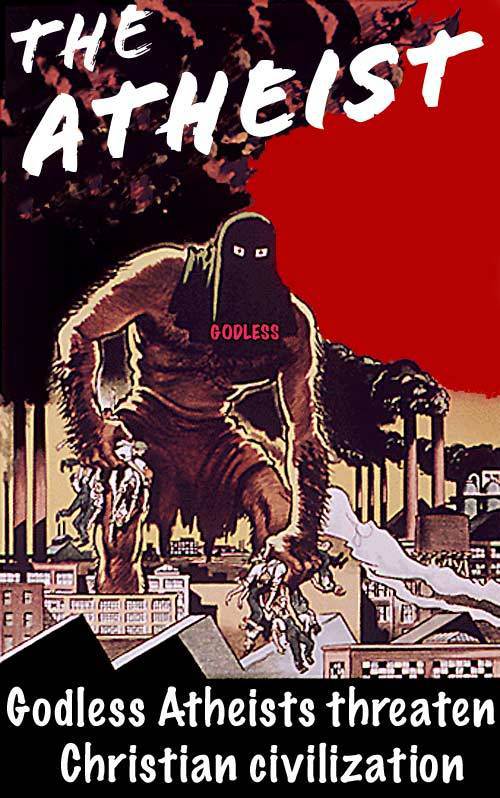
Atheist-monster-poster(Note: These exchanges are now complete. There is a Table of Contents to the discussion now available.)

“I walk outside my house, I look around, and it doesn’t seem apparent to me that there is a God. I just don’t feel it. It doesn’t seem to be the natural conclusion of reality when I live life and look around. I see the world, and the existence of God doesn’t feel like a natural conclusion one could draw.”

I stare down into my coffee, catching the corner of my pastor’s glasses in the dark reflection.

“Well”, he says, “I know it doesn’t fix how you feel, but in the grand scope of human history, and even the global humanity living today, that opinion you just expressed is in the extreme, extreme minority. Most people living in the past and now have found looked at the world and have not been able to come to any conclusion other than their being a God.”

Crap. He was right. What I thought was such an objective engagement with the world around me, was (of course) still the product of the cultural forces from which I drink deeply. History and developmental psychology have shown us that religiousness is the default mode of the human heart.

We are by nature religious. It takes other, external forces to push back against that and move us away from it. And this fact is no apologetic for religion. It’s neither a point “for” or “against” religion. We are also by nature selfish and willing to do whatever it takes to be the fittest and survive. We try not to give into this natural drive and through education and conditioning try to move away from it.

Continue reading

Listen to the Hurting {ii}: how now shall we suffer?


Rothko-untitled-2Yesterday I wrote about how our offense and struggle with evil and suffering in the world is often detached from the feelings and words of those that actually endure much of it. I said that intense Suffering doesn’t seem to produce an extinguishing of faith to those that experience it.

People have often said that the deep suffering and injustice of the world is one thing that led them to Atheism or skepticism, but this seems to be more the case for those that observe and think about the idea of suffering, more than enduring it themselves. Yes, there are stories of those that lose their faith in the midst of their suffering, but they really are so few and far between.

This is one of the main themes of Dostoevsky’s Brothers Karamazov. The most powerful argument for Atheism I’ve ever read is in the famous “Grand Inquisitor” chapter. After reading it, I was so deeply shaken for a few weeks after. And it was written by a Christian.

One of the central themes of the book is that Atheism is an absolutely logical and reasonable system, but not one that can be consistently lived out. When observing the world and its injustice intellectually and from a top-down perspective, Atheism is probably more easily sensible than Christianity. But, as the book goes on to show, no matter the philosophical veracity of Atheism, no one can truly live real, actual human life as a fully-consistent Atheist and flourish as a human, in human relationships, and in human society.

Even if people think about suffering Atheistically, people usually live in the midst of it religiously.
Continue reading

Listen to the Hurting {i}: why Suffering is a silly reason to be an Atheist


Adolph Gottlieb-rolling

Update: Part 2 is up.

In the religious circles I walk in, I hear about injustice and suffering quite a bit. Theology friends constantly muse about how to view these things in light of biblical revelation. Atheist and skeptic friends constantly point to these things as the inherent illogical inconsistencies that undermine religious faith.

And caught in the middle are many, many more friends, who live their lives trying to navigate their jobs, families, and relationships the best they can–all while these questions haunt them in their quieter moments or right before they sleep. Unlike the other two groups above, they don’t feel like they have answers. And this can lead to periods of doubt, insecurity, and frustration.

For every group, though, questions abound in these conversations. Oftentimes, they have a religious flavor. Why does this stuff happen? How does this relate to the goodness of God? What does it mean for the reality of God? How is God just when this stuff is real? Why does God seem absent?

And yet…

These are almost never the questions I hear from the people actually going through the suffering.
Continue reading

Atheist: A Biography | {story#18}


This is an original fiction piece posted for StoryADay September. It’s a long one, so for your convenience, you can also read this story in PDFKindle, or EPUB formats. Read more about StoryADay & follow here.
________________________________

Luke was born into a moderately religious household. His family spent each Sunday morning rushing around the house amid a flurry of curses and arguments trying to get everyone ready for the Sunday School and service at the large Baptist church down the street. When Luke was older, he also went to the Wednesday night youth group this church had. But outside of that, religion wasn’t any great percentage of his day-to-day life. His parents never prayed before meals, there was no religious paraphernalia around the house, and the most frequent invocation of God was in front of the phrase “damn it”.

There was one time, though, that for some reason, Luke remembered his entire life. During one period when he was about 6 or 7, when his parents were fighting a lot, Luke found himself needing his father for something shortly after a particularly loud argument had concluded. His mother was in the washroom, loudly banging the doors to the washer and dryer as she changed loads. Luke walked into his parent’s bedroom and found his father on his knees beside the bed, knuckles clasped as if he would die should he let go, muttering quiet pleas within breaths taken between violent sobs. Luke stood there wordless for about 30 seconds watching this, until his presence was felt by his father. His father looked up and saw Luke staring at him with wide eyes.
Continue reading

Debates with Atheists (And Good News for Them)


Recently, a friend sent me a link inviting me to a debate between a prominent evangelical intellectual and a prominent atheist thinker. It made me remember how I used to eat those sorts of things up when I was in college, and I really appreciated this friend sending it, but at this point in my life, I genuinely had no interest whatsoever.

Eventually, you realize that every debate of this sort goes the exact same way. At some point–without fail– there’s comes a moment when the evangelical says something to which the atheist responds with “well, what proof [or “evidence” or “basis” or “reason”] do you have to make such a claim!”, to which the evangelical responds with something like “well, it’s faith” (or something like that).

And then the debate should end. The fool’s errand of these events has been exposed.

Continue reading

The New Old New Atheism of Simon Critchley & Others


I have noticed, recently, especially with the waning influence (or at least presence) of the “New Atheists” in the public square, that there has been a shift in the tack that Atheists have taken against Christianity in the past year or so.

Philosophical movements generally begin in academia, then find themselves trickling down to the masses as those twenty-something college students that were influenced by these academic discussions now move on into the wider world. Both Atheism and Evangelical Christianity generally find themselves one generation behind in these philosophical developments of the world.

So, for example, when the world was just beginning to move on into “post-modernity” (notwithstanding the functional meaninglessness of such terms at this point), it was the heyday of  Atheistic and Evangelical evidentiary apologetics, representing firm pre-modernist, Enlightenment thought (on both sides). Arguments centered around the very existence of Jesus, fidelity in translation and transmission, Intelligent Design, and the general historical reliability of the Bible.

Continue reading

Going Medieval on my Atheist Self (on art & assurance)


Even back in my hyper-Calvinist days–assured that I was chosen, secure, and Elected unto salvation–I recognized the reality that if I were not a Christian, I’d certainly be an Atheist. If there was some way that I could be convinced that Christianity was a fraud (and here are some ways), I would not face any temptation to be a Buddhist or New Age mystic or anything of the like. No, No. I would be a hardened, militant Atheist.

How do I know this? Well, Christianity has the idea that within each believer is the “Old Self” and the “New Self”. This Old Self is, essentially, who we are apart from God.

That Old Self, though we fight it our entire Christian lives, won’t actually be fully snuffed out until the end of all things. And so, in a sense, if we’re sensitive to it, we can sometimes “feel” that “without-God” version of ourselves rolling around in there somewhere in our hearts.
Continue reading

Chesterton on the Atheism of God on Good Friday [QUOTE] | Lent {10}


When the world shook and the sun was wiped out of heaven, it was not at the crucifixion, but at the cry from the cross: the cry which confessed that God was forsaken of God. And now let the revolutionists choose a creed from all the creeds and a god from all the gods of the world, carefully weighing all the gods of inevitable recurrence and of unalterable power. They will not find another god who has himself been in revolt. Nay (the matter grows too difficult for human speech), but let the atheists themselves choose a god. They will find only one divinity who ever uttered their isolation; only one religion in which God seemed for an instant to be an atheist.

–from Chesterton’s Orthodoxy, as quoted by philosopher  Slavoj Zisek, in this article on “German Idealism & Christianity, from Hegel to Chesterton” (via Micah Towery). Read the rest of this Lent series on “The Lamb Eternally Slain”

Pain, Suffering, & the Story of God


[Update: this post inspired a comment (below), that I ended up responding to. The commenter responded to that, then I gave my final response, and then he gave his. Lastly, a friend posted her thoughts on the discussion as well. Follow the links to get in on the discussion.]

You know that proverbial flu bug that is perpetually in existence all over the country all at once on snowy days?  Yeah, well I’ve got it.  Starting yesterday, the back of my head and the top of my neck were struck by a throbbing pain, pulsating with every heartbeat; my body temperature playing the role of ping-pong ball between the paddles of heat and cold; my body aching with every move.

I went to sleep last night, tossing and turning for a long while hoping for the pain to subside by the time I woke.  I woke and felt great.  That is, while I was laying in my bed.  The moment I stood up and the blood rushed throughout my body, the pain, dizziness, and energy-sapping delirium of flu raged against me.  And then I went to work. Continue reading

On Poetry & Atheism (I’m Writing for Patrol Magazine)


Sorry things have been so slow this week on the blog.  I’m still trying to find my rhythm for writing while I have this new full-time job.

As of late last week, I am the newest writer for the blogs at Patrol Magazine. Patrol is a great site putting forward some of the best writing available on culture, the arts, and spirituality from the perspective of post-everything twenty-somethings. I am the Thursday contributor to “The Scanner” section of the site. The Scanner is the place for “daily culture, media, views, and blather.” Today, my first article went up. Here’s the link:

Poetry is the Only Thing That Can Save Atheists, Says Other Hitchens Brother

I’m really excited and grateful to have the opportunity to contribute to one of my favorite sites. Like I said, you can see my writing every Thursday there on Patrol Magazine. As I continue writing, you can see all of my articles here.

Does anyone have any ideas for future posts?

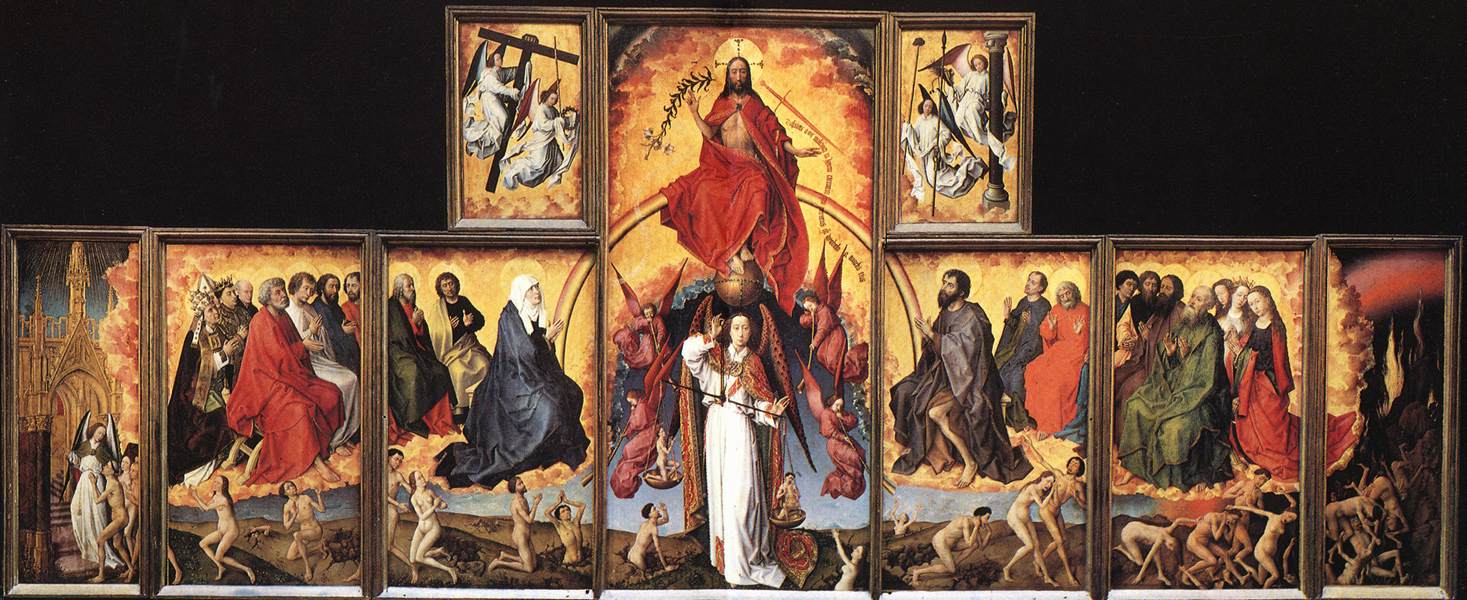
[Art above: “The Last Judgment” by Rogier van der Weyden. Just read the article. It’ll make sense.]

The Bible, Slavery, & Atheists{2b}: Theology & Ethics | Reform & Revive


By the time I finished the next article in the series, it was substantive enough and socially-oriented enough to warrant being posted on my webzine Reform & Revive.  The previous post was on on how secular Philosophy can inform our view of ethics and contribute to the discussion of Slavery, Atheism, and the Bible.  This one is about how Christian theological ethics can uniquely inform our ethics in modern times.  The article covers a LOT of ground and is the longest one I’ve written yet in this series.  Hopefully that’s not a turn off.  This article has more of my thought concerning truth and Biblical interpretation than perhaps any one article I’ve ever written contains.  Here’s the link:

http://reformandrevive.com/2009/12/22/a-theology-of-ethics-contemporary-applications/

It seems in light of my earlier post I’ve decided to pour more of myself into this series, rather than just quickly finishing it off.  Hopefully it’s helpful.

Lastly, I keep getting private emails, texts, and messages from Christians talking about how much they’re enjoying this series, and how helpful it is to them, but hardly any Christians are publicly commenting.  I’m getting tons of comments from my atheist friends, though.  Discrepancy?  I think so.  If you have a thought, please leave it.  It could be really helpful to get more input on this and diversity of thought on this.

Thank you all for your support and encouragement.  It means a lot.

weekend update


I wanted to write a quick note to anyone that’s been confused about the lack of writing on all of my sites.

For one reason or another, I’ve decided to do more research on the Slavery, Bible, and Atheism series.  Here’s why: It’s a six part series and so far each part has required two separate posts.  I am mostly done with the second post of Part 2, and for the whole series so far, I have almost 20 pages of content written.  With the stuff I want to say, and the content I wish to cover, I’ve realized that by the end of the series, if I stay on pace, I could have anywhere between 60 and 75 pages worth of material written.  And this doesn’t even include the pages worth of comments I’ve written on comments on Facebook and here on the blog.  So far, all I’ve written has been very “bloggy” in style and language; in other words — completely unworthy of even considering trying to see published.  It’s been very polemical and directly addresses other people and conversations not directly involved in this blog.

Continue reading

The Bible, Slavery, & Atheists{2a}: Philosophy & Ethics


As I’ve looked at and read the various articulations about this issue put forward by my atheist friends, I’ve noticed a few philosophical assumptions about ethics that are driving many people’s perspective on how the Bible does/should talk about these things. In this post, I’d like to highlight those things and show how they are neither philosophically or theologically correct. By the time I finished writing, it was really long, so, using one of the few benefits of blogging as a medium of discourse, I will put up the second part (concerning the more theological side of this) tomorrow or the next day.

The Philosophy of Ethics

Principles vs. Applications

Even the most cursory look shows that the study of ethics is the study of transcendent principles that govern our morality and behavior. There is an important distinction though made between those transcendent principles and their applications. One can hold to the exact same set of principles, but apply them differently at different times/cultures. It is simplistic and reductionistic to think that anyone’s “ethics” will be applied in the exact same way every time. No ethicist secular or otherwise treats ethics in this fashion. I believe that Scripture is consistent throughout in its transcendent principles, though not in their comprehensive applications (below). To navigate applications takes another pair of things the Bible talks at length about: faith and wisdom (more in the next post). Further, I don’t think this principle/application distinction provides any serious ethical challenge to biblical authority. The Bible itself never claims to treat ethics in this reductionistic manner, so to force it upon Scripture is dishonest.

One of my atheist friends mentioned the converts in isolated African tribes where nudity is prevalent, saying that if Christians were consistent, they must insist that they all cover up in order to be Church members in good standing. Except there’s a problem with that: there is no Christian ethic of “non-nudity”. There is a Christian ethic of “modesty” that says that we have the responsibility to adorn God’s beautiful creation of the human body in such a way that it maintains the respect and dignity it deserves. Now, how respect and dignity is shown changes culture to culture, so it takes wisdom to see where the human form is being abused in that culture — and that is not a compromise of Christian ethics. The consistent biblical principle has still been preached, upheld, and lived. If ethics (secular or Christian) were as naively structured as is necessary for some of these atheist criticisms to make sense, then the entire field of ethics would be unnecessary and non existent, because we could have a computer program that could make all the black-and-white moral decisions for us.

Continue reading

The Bible, Slavery, & Atheism: Part 1b


this is real (I did it myself)

The next post is pretty much done, but I wanted to send out this quick note before moving on. The previous post revealed a lot of things that I neglected to make clear. My fault. Sorry.

First and foremost, the last post was not meant to settle the question on slavery and the Bible. I just wanted to get out what the Bible actually says about it. The most I wanted to accomplish toward addressing the issue was to let people see a clear trajectory within Scripture wherein no part is inherently contradictory to the parts before or after it, no more than a seed is contradictory in nature or form to a fully blossomed flower. I also wanted to give a sense of the complexity of the issue. In every passage that lies out even the most comprehensive sets of morality and ethics for the Israelite people, you never see slavery there. It was never an action that was consistently seen as something moral. It’s not a freedom that the Israelites are free to use whenever they desire; it’s used sporadically, meaning that there must be something else going on beyond some explicit commentary by God on the moral nature of slavery. The New Testament is clear that the crucifixion of Christ was something that was foreordained and ultimately brought about by God, but this neither expunges the moral responsibility of the people that actually did it, nor says that God is all about crucifixion and thinks it is “morally neutral” or “ethically okay”. He clearly thinks it is wrong and evil, and yet He clearly ordained it, allowed it, and used it to bring about his promised redemption to the world.

Continue reading