Lent-erpretative Musings {a theological interlude} {3a}


WARNING: this post gets into some theological discussion that, for most everyone out there, will be neither helpful nor interesting. And it’s way too long (which is why I’ve broken it up into two separate posts). Forgive me and please be gracious.

_____________

Anyone that follows the blog knows that I’m currently thinking through and writing a Lent series on the theological idea that Jesus was slain “before the foundations of the world” (Part 1, Part 2). Even though no one has said anything to this effect, I have felt like somewhat of a hypocrite. As I’ve been doing this, I’ve been haunted by a little voice reminding me that it seems like I’m employing many of the same techniques of interpretation and viewing the Bible that I’ve criticized in others before. This post is my attempt at reconciling this in my own head (in front of all of you).

As J.R.D. Kirk (and others) has often talked about, many of our theological disagreements in the church boil down to a simple question “what is the Bible?”. At the end of the day, we can argue about any number of things appealing to the Bible, but if we believe fundamentally different things about what the Bible is–and how it is that–we will never get anywhere.

And here’s where I’m getting into problems with this series: there are ways of viewing the Bible that, in others, I have criticized as reductionistic, simplistic, and frankly, abusive to the text itself, and I fear that I’m employing many of those same techniques in my thinking through this series. Here are two of those ways (two more later):
Continue reading
A Shout-Out to My Mennonite Pacifists Out There…


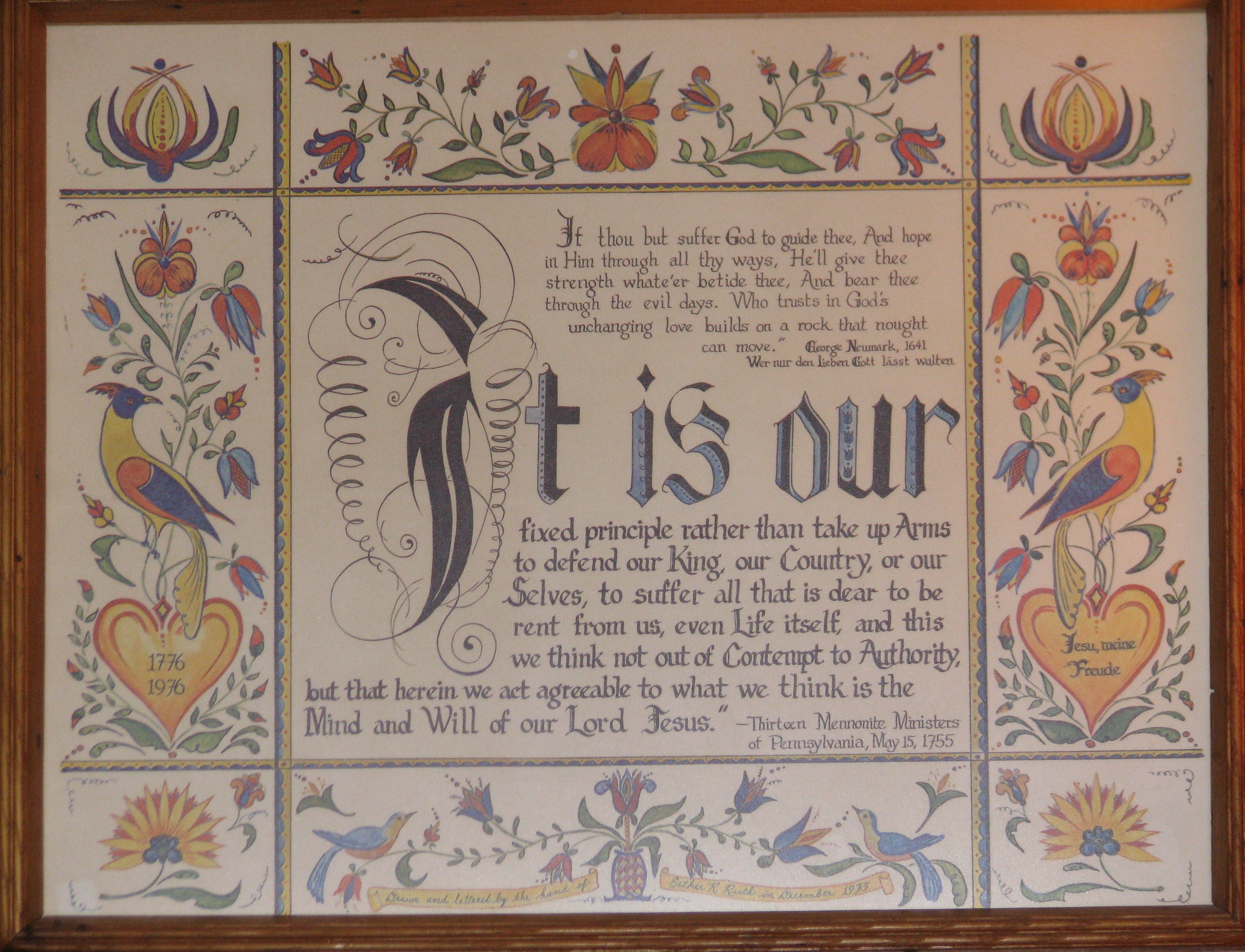
Being in Pennsylvania, I meet lots of people that either consider themselves Mennonite, or at least were raised that way. One of the most well-known aspects of Mennonite belief is their unwavering commitment to pacifism (or, as a commenter corrected me below, the Mennonite “doctrine of nonresistance”). Hanging out with one of my new raised-Mennonite friends the other evening, she showed me (with pride) the above picture that has hung in one of their family’s houses for a long time. It struck me as beautiful as well, especially the second quote. Here it is, nicely typed out for optimal readability and convenience:

“It is our fixed principle rather than take up Arms to defend our King, our Country, or our Selves, to suffer all that is dear to be rent from us, even Life itself, and this we think not out of Contempt to Authority, but that herein we act agreeable to what we think is the Mind and Will of our Lord Jesus.”

–Thirteen Mennonite Ministers of Pennsylvania, May 15, 1755

Continue reading

God loves me. But does he like me? (on being “Christ-like”) | Advent {8a}


UPDATE: Part 2 of this post is now up.

I have a quick confession. I technically ascribe to the “flavor” of Protestantism called “Reformed” that takes the roots of its doctrinal tradition all the way back to the leaders of the Reformation. The first church I really learned much of anything about Christianity and theology is Reformed…ish. The seminary I went to prides itself in being the bastion of orthodoxy for “Reformed” theology. My church is a member of the Reformed Church in America family of churches.

But, I’m not a good Reformed man.
Continue reading

our failed function, God’s full faithfulness | Advent {3}


This week, I’m meditating on a few particular aspects of the Advent event. I’m thinking through and writing about how, in Jesus, God inhabited our creaturely form, care-taking function, comprehensive fallenness, and communal formation.

As I said in the teaching I gave over the summer about the Nature and Narrative of the Bible, the opening chapters of the Bible describe this divine act of creating in very architectural terms; the same words are later used in describing the building of the tabernacle and the temple. In this we see that God’s act of creating was, in essence, building this world as his temple in which he would rest (for more on this see John Walton’s amazing book, The Lost World of Genesis One, or just watch this short video).

In the story, he builds and establishes this Temple-World, and then creates and ordains two priests–Adam and Eve–to be his representatives in this temple to care for it and work in it faithfully. In the ancient world, temples were usually placed in the midst of large and beautiful gardens which acted as extensions of the temple itself; to care for the garden was to care for the temple, and to make the garden larger was to expand the scope and size of the temple.
Continue reading

Advent, Evolution, & Absolution


It’s Advent. A time where we especially orient ourselves towards rejoicing and celebrating the fact that God did not remain far off and merely create a “legal” or “dogmatic” satisfaction for the plight of his creation and creatures. Rather, he broke into it and came into his creation and among his creatures. In this year’s Advent series, we’re exploring how, in this Coming, Jesus took on our creaturely form, care-taking functioncomprehensive fallenness, and communal formation.

First, God took physical, human, creaturely form. In the study I did–and subsequent lecture I gave–on Beauty a couple of years ago, I defined “Beauty” as the attribute of something that expressed complexity simply. Is not this God-in-human-flesh (theologically referred to as the Incarnation) the most beautiful of all miracles to take place? The Infinitely Complex God inhabits the simplest of human forms: a child.
Continue reading

Join Us for a Tour of Biblical History at the Penn Museum this Saturday!


For those those in Philadelphia or nearby, I’ll be leading a tour of The University of Pennsylvania’s Museum of Archaeology of Anthropology focusing on Biblical History (mainly Old Testament). They have a very rich collection of items from the regions in which most all of Biblical History unfolds: Mesopotamia, Canaan, and Egypt. We will be following the unfolding storyline of the Bible as we travel to each section, learning the context and the history that set the stage for the faith many of us now call our own.

If you’re interested, meet us at 12pm on Saturday, November 19th in the courtyard in front of the main entrance (pictured above). The cost is $10 for adults and $6 for students (and well worth the price). The museum is located at 33rd and Spruce (map), right across the South St bridge. (Parking advice: park on the east side of the South St bridge in the Graduate Hospital area and then walk over the bridge). See you there!

Weekend Must-Reads {09.09.11} | church leadership retreat edition


This weekend I find myself with the honor, joy, and privilege of heading to a two-day long leadership retreat for my amazing church, liberti church: center city. In honor of this, I wanted to post articles by myself and others focusing on Church philosophy, community, and such. Some of them are a bit longer than usual, so feel free to grab a cup coffee before digging in. I hope you find these helpful and encouraging no matter where you find yourself in relation to the Christian Church. Have a great weekend. And be sure to stop by next week; I’m pretty excited for the stuff I’ve got planned for the blog then.

And Thus It Begins: liberti home meetings & my heart | the long way home

liberti: center city’s home meetings start next week. I wrote this blog post last year the day before I began leading a brand new group in the Rittenhouse neighborhood of Philadelphia. It’s wonderful to look back over the past year with these people and see that God has answered every prayer I had in this post. I’m still serving these amazing people as their leader, and I can’t wait to see them on Tuesday.

On the State of Contemporary Theology | Fors Clavigera – James K.A. Smith

Here, the author of one of my favorite books I’ve ever read, Desiring the Kingdom, offers his thoughts on the current state of theology, denominations, and theological education. A quick must-read for all.

Continue reading

Mark’s Endings, the Church’s Beginnings, & History’s End


Having recently finished my own personal study on the Gospel of Mark, I just had a few thoughts on the ending of the book, what it meant for the early church, and what it means for us today. So, first, if you’ve never read the last chapter of Mark, let me encourage you to do so here.

You’ll see it’s really weird. There are reasons why most sermons on this part of Jesus’ story don’t often come from this book. It doesn’t have an actual Resurrection account. There seems to be some humor (the ladies ask “who’s gonna roll away the stone when we get there?” They look up and it’s rolled away and Mark adds, “it was very large”). The angels say “tell the disciples and Peter about all this”, but the women are scared and don’t say anything. And then it just ends (assuming the last part isn’t original, as we’re about to talk about). The ending seems to not carry with it the same reverence, awe, gravity, and seriousness of the moment that other Gospels seem to have. It’s almost playful. As far as Gospel accounts go, it’s definitely odd.
Continue reading

Making the Father Real (when you don’t feel it)


Late last night I finished my own personal study through the book of Mark. I wrote about my love for this book a while back in light of some reflections on Ash Wednesday, and having finished it again, it was confirmed once more that this indeed is my favorite Gospel.

As I was ending it, I really wanted to see my Father in these words and be moved by Him. This last stretch I read was from Jesus being handed over to Pilate through the Resurrection–arguably some of the most dramatic and supposedly heart-string-pulling moments for the Christian. I mean, Our Lord is being unjustly mocked! He is being crucified! He’s being raised!

And yet, I felt nothing beyond the scan of my eyes upon the page offering the simple intellectual reminder of these events.
Continue reading

Prayer & the Christian Life [a teaching I did at liberti church] {AUDIO}


Last week, I posted the manuscript and audio from a teaching I did on the Bible from a series of seminars/discussions my church has been doing called “Summer Conversations“. This week I wanted to post the other teaching I did. This one was on the idea of Prayer. This was a really amazing thing to prepare for and the night went really well. Also, unlike last week, the audio turned out really clear.

Audio | download
Notes| download: pdf, Word, Kindle, ebook read: Google DocsScribd
Continue reading

The Nature & Narrative of the Bible [a teaching I did at liberti church] {AUDIO}


This summer, my church has been doing a series of seminars/discussions called “Summer Conversations“. I was asked to teach at two of them. I am providing the manuscript and audio from the first night here. The second one I’ll post next week. This first “seminar” was on The Nature & Narrative of Scripture. The night went really well. The audio, on the other hand, did not. This recording is really tough to listen to. Fortunately, for this particular talk, I wrote everything out in manuscript form and stuck pretty closely to it (especially Part 1). So, feel free to download/preview these in whatever way/format is most convenient for you and may they enhance your understanding of our God and how He has revealed himself.

[Also check out the other talk I gave at liberti on Prayer and the Christian Life (much better audio)]

Audio | download
Manuscript | download: pdf, Word, Kindle, ebook read: Google DocsScribd
Continue reading

science and the evolution of the science of evolution


Over at Scot McKnight’s blog, Jesus Creed, the resident scientist-who’s-a-Christian (I hate that I can’t just write “Christian Scientist”), RJS (I have no idea what his full name is, and I couldn’t find it), recently posted a brief post about the ongoing dilemma of a fossil called Tiktaalik rosea, the dating of which and the evolutionary place in which it exists is still in flux. After recounting some of the changing conclusions about this fossil, RJS asks:

Is this kind of give and take an evidence for weakness in the evolutionary hypothesis?

Is it unexpected waffling or the expected progress of scientific discovery and the refinement of understanding?

Continue reading

The Scandal of Holy Week {v}: conclusion & benediction


As I said in Part 1, this series was originally given as a sermon to a group of prisoners attending my church’s prison ministry. This is the conclusion and benediction I gave them at the end. This post picks up right after the end of Part 4, where we listed out practical ways that Jesus prepares his disciples for them forsaking him and the ways he reveals himself to already-wayward disciples, thereby calling them back to Him. I encourage you to read the other parts of this message: Part 1: the forsaking of GodPart 2: the Grace of JesusPart 3: the limits of Grace?Part 4: the restoration of disciplesPart 5: conclusion & benediction]

Conclusion

These are not guarantees: all these different practical things I’ve mentioned are not the “magic formula” for how to restore your faith if you feel you’ve lost or forsaken it. Sometimes none of these things are necessary; the Centurion did not seem to have any of these things. Sometimes, you’ll do all of these things for years–decades, even–and nothing will change.

All I can tell you is that He is worth it. The God of Holy Week is a God worthy to be wrestled against for years and years and years and years until he finally meets you, even if it is for the briefest of moments before slipping away back into frustration, doubt and sin.
Continue reading

The Scandal of Holy Week {iv}: the restoration of disciples


[Update: this series has been completed. Part 1: the forsaking of GodPart 2: the Grace of JesusPart 3: the limits of Grace?Part 4: the restoration of disciplesPart 5: conclusion & benediction]
In Part 1 of this series, we saw that we will all forsake Jesus many times in our lives, just as the disciples did on the Thursday night of Holy Week. In Part 2, we saw that in light of this abandonment, Jesus responds to those that forsake him by being unconditionally and unlimitedly gracious towards them in their forsaking of him. In Part 3, we looked at just how scandalous and beautiful this grace is and how and why we often try and limit it. Today, we give practical ways that we can prepare ourselves to come back to our Lord, even after we have forsaken him in our own “Thursday” seasons.

As we saw in Part 1, Holy Week was a week-long process in which everything–creation, creatures, and God Himself–all forsook Jesus, turning their back on him. We’ve said several times now that true disciples of Jesus are not those that never forsake Jesus, but they are those that after forsaking him, turn back. And so, to help us see how we do this, let’s look at the first person in this story to turn back.

Continue reading

The Scandal of Holy Week {iii}: the limits of Grace?


[Update: this series has been completed. Part 1: the forsaking of GodPart 2: the Grace of JesusPart 3: the limits of Grace?Part 4: the restoration of disciplesPart 5: conclusion & benediction]

In part 1 of this series, we looked at the original Holy Week and saw how everything and everyone has and will forsake Jesus. We said that “Thursday”–the day when the disciples forsook Jesus–will come for every disciple. In part 2, we saw that Jesus, as he relates to those that have forsaken him and those that will do so, responds and relates to them on the basis of pure, unfettered grace. Today we look at why this matters and what it looks like in our lives.

We’ve seen that every disciple will forsake Jesus, but the true disciples of God are the ones that come back after they have left him. And further, it is my contention that what brings people back is not fear, not Law, but the unbounded and free Grace of Jesus.

But let’s be honest–this process can be a long one. It can be months, years, or even decades before these true disciples of God return to Him. People can go very far down the path of sin’s temptations, and still be Christians. In fact, any of us can go very far down the path of sin’s temptations and still absolutely be beloved, regenerated, Christian children of God.
Continue reading