The Best Wedding Scripture Reading Ever (Marriage Blessings, Andrew & Laura!)


One of my dearest friends got married two weeks ago. He had originally asked me to do this Scripture Reading at the wedding. But unfortunately, the drive from Philly to Newark, Ohio is a long one, and many variables can make for much delay, and indeed, this is what happened. Anyway, to add to the pain of this loss, this particular set of Scriptures that I was going to have the honor of reading just happens to be the best set of Scripture readings I’ve ever encountered for a wedding. No Song of Solomon or 1 Corinthians 13 here; just a proper and exegetically sound exploration of the sweeping story of God’s relationship with his own Bride, the Church. Therefore, I felt compelled to share these verses with you today.

Andrew and Laura, I pray that this feeble attempt at publicly participating in the celebration of your union communicates the love and grace of our Lord to your hearts.  May it bless you.

Continue reading

I Am A Fearful Man (and i need to get over it) {pt3}


[Read Part 1 and Part 2 of this series]

Finally, this is done. This is the last post in a three-part series that’s been walking through my development as a thinker and feeler in this world. The first part, at its core, was about the culture and world around me as I grew up that helped cultivate the arrogance I still war against inside me. The second part was about the things that have humbled me and showed me my finitude. So where does that leave me now; and why does it warrant this little series?

The confluence of all of these forces (of arrogance and humbling) has made a very interesting creature out of me as of late. A recent trip back home to visit my parents found me getting into several vehement fights with them over (of all things) politics. It’s not even that I disagree with them very much! It was mainly a frustration over just how unwavering and (I felt) naively arrogant their commitment to these ideas were. In short, I was getting mad that they seemed to allow no room for disagreement or for them to be wrong. A couple of times my Dad asked me, well what do you think? And I realized I had no answer. All I knew was that no one could know so surely what was right. Why? Because God had showed me in the past several years that I couldn’t. And if I (of all people) couldn’t know with certainty, then surely no one else out there could, right? (P.S.- that was sarcasm) It all culminated in a moment where my dad pretty much said that my writing had been steadily losing it’s quality ever since the “pinnacle of my writing”: a post I wrote called “On Holy Week, Suicidal Ideations, & My Heart“.

Continue reading

Some of my dearest friends got engaged this weekend. And I have a tape.


Two of my favorite people–Jospeh Yasso and Tara Molthen–got engaged this past Friday.  It was amazing.  Joseph had planned this thing for a long time and it went off perfectly.  And, just as is the case with most all of our lives nowadays, it was all caught on tape.  Actually, like 5 or 6 of them.  And I have one.  As I was writing this post, I found Joseph’s “official” tape” on YouTube and thought that it offered some things that my video lacked.  My video gives the “crowd” perspective from outside the restaurant to when we enter.  His is good for the perspective form inside the restaurant from the beginning of the entire thing.  His is posted first after the break and mine is below it, followed by the lyrics of his song he wrote.  Like I said, it’s amazing.  One last note: so sorry for the crazy audio feedback at the end of my video.  It’s pretty unbearable, but worth it, I feel.  Enjoy.

Joseph and Tara: Congratulations.  I love you two, and can’t wait to watch you get married.
Continue reading

{3John11} | Of Translations, Repentance, and Worship


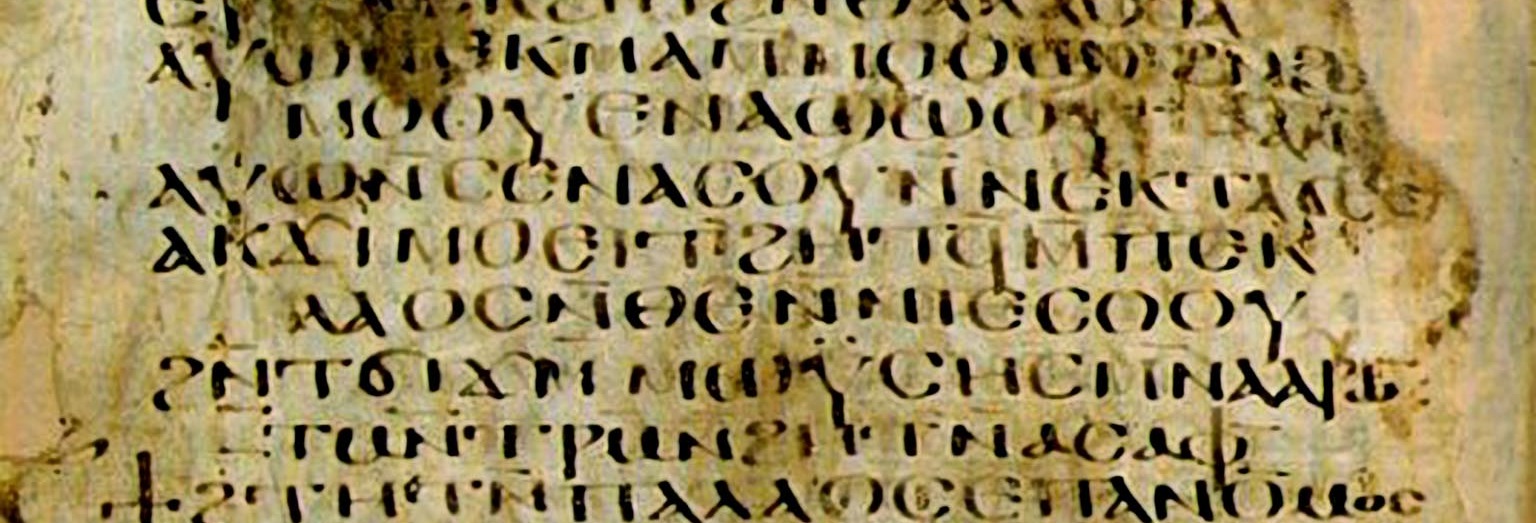
bible-greek-manuscript

ὁἀγαθοποιῶνἐκτοῦθεοῦἐστιν· ὁκακοποιῶνοὐχἑώρακεντὸνθεόν.

[ho agathopoion ek tou theou estin; ho kakopoion ouk heoraken ton theon.]

The one who does good is

[of/from/because of/in the manner of/apart from/part of/controlled by]

God.

The one who does evil has not seen God.

{3John11}

Forgive these fragmented and perhaps poorly-written or elementary thoughts. I write this post not to “show off my Greek” (today was the first I had opened it up in the past couple of months) nor to confuse people by talking very technically. I (hopefully) write this as worship.

I finished translating 3 John today. I’m starting with the shortest New Testament book and just continually trying to translate up to the longest. It’ll probably never be done, but it’s some sort of system, so it works for me. I always know what’s next so that’s helpful.

Anyway, like I said earlier, this was the first day I had gone back to 3 John in a couple of months. I only had a few more verses left so I quickly finished it and then started the first couple of verses of 2 John. I then began to shut my books and move on to the next item on my reading list when I realized something: I couldn’t even remember vaguely what I had translated in 3 John. I had been so concerned with just translating and “getting it done” that I forgot to even meditate or think on it.

I turned to my translation and looked over what I had written and the above verse popped out at me. So, I’m writing this as my act of both repentance for having this gift of the ability to translate and not using it to know God more, and as my act of worship, that I might explore some nuances in this text.

The problem with this verse is a problem common in any language: the preposition. That word εκ [ek] means any of the bracketed things above. Most simply, it’s translated as “of”, but the question always turns to “what does ‘of’ mean here? “Which of the myriad of possible translations does this mean? Well, you look at the context.

What I noticed is that whatever it means, it’s supposed to be a contrast to “The one who does evil has not seen God”. So whatever this “of God” means, it is in contrast with “not seeing God”. It also means that being “of” or “from” God is a matter of seeing him. To see Him is to be joined to Him, to be of Him, or to be from Him. I don’t know enough about Greek to make a definitive call about precisely which translation is correct, but this idea is enough for me: walking obediently so as to please God is a matter of seeing God, and those that continue in disobedience show that they have not.

The way this is phrased let’s us know that whoever is walking obediently can take no credit for this, because their obedience is of/from God. But at the same time, those that are still walking in disobedience bear the full weight of responsibility for their disobedience because they have not seen Him. It is a mystery that leads to God’s greatest Glory and our greatest joy.

So for those saints weary under the weight of their sin and disobedience, be encouraged: obedience and doing good is not a matter of striving and fighting your own will. It is a matter of seeing Him and therefore being joined with Him so that all our being, living, and moving is from/of/in the manner of God. Seeing and therefore being joined to Him through Christ allows us to move according to His nature and will. All disobedience, sin, and evil results from not seeing God. He is our hope. He is our salvation.

Let us therefore fix our eyes on Him, and run.

Textual Criticism & the Glory of God


Here is the summary of my final paper for the Textual Criticism portion of my New Testament Intro class.  Enjoy:

My ultimate goal in all these classes is doxological.  That’s how I’m judging my success; not by grades, but whether not I have a greater affection for Christ at the end of each course.  I can say I have that at the end of this course, but it’s not without a price, I feel.

What do I do with, say, the ending of Mark?  How do I preach that text?  Though I absolutely disagree with the Textus Receptus-only arguments, I must say there’s something romantic and (dare I say) “Reformed-sounding” in their arguments.  The idea that God is Sovereign and Providential enough to bring about a final text, even with all its textual errors is enticing (probably because it removes all further critical thought from the process).

It’s ultimately more difficult to reject these notions, though, because you’re forced to face a few realities.

Mainly, what do we do with these texts, then?  If we keep them, then we’re Catholic because we’re placing tradition over the Word as it originally was.  If we get rid of them we seem liberal because we’re subjecting and changing the Bible based on an authority outside of itself.

What about the hypothetical stay-at-home mom that comes to me with the ending of Mark, wanting to know what it means?  Do I unpack textual criticism on her and tell her it wasn’t original so don’t worry about it?

In that case, what if Jesus’ words in John 8:1-11 have been such a comfort to her through the darkest of times?  Is that the Word of God, while the ending of Mark (snakes and all) is not?  How much doubt will it give her to know that there are words in her Bible that John Mark didn’t actually write?  In short, what are the pastoral implications of textual criticism? I don’t know.

Personally, I’m fine with things as they are—keeping very unlikely readings out of the text and just footnoting much.  I’m facing no faith-crises because of this.  I see how far God would go to condescend Himself and thereby draw me to Him, even amidst the messiness of scribal error and change.

I’m just in that very good spot of wrestling through things to see how they fit in a context of proclamation and ministry.  I’m sure they do—they must.

I’m finding that seminary accomplishes its very interesting call of answering many of your questions all while giving you many more, bigger, and deeper questions to grapple with along the way.  This is good.  This will certainly give me more nuance in my ministry of God’s word and His people—a greater understanding of the depth and complexity of God’s Word.

I see now things aren’t so black and white, and that’s by design.  If it weren’t, then we would trust God and His Word on a basis other than Himself.  He will force us to live this life by faith and by no other thing will we be able to fully rest upon—not even the individual black and white text on the page of the Bible, but rather on the Sovereign, Supreme, all-Beautiful, all-Righteous, all-Knowing, all-Just, and all-Gracious God of the Bible.